Today, we're listening to a record from the most revolutionary jazz musician of
the 20th century. Actually, he's the most revolutionary jazz musician
of all time, none other than the legendary Charlie Parker.
This is Charlie Parker with Strings.
I'm Adam Maness. And I'm Peter Martin.
And you're listening to the You'll Hear It podcast.
Music explored, brought to you today by Open Studio.
Go to openstudiojazz.com for all your jazz lesson
needs. Peter, I'm gonna set the scene.
Okay. Imagine you're a young musician in 1949.
Your favorite style of music is bebop Yes and your
favorite bebop musician is coming out with a new album.
Or is he coming out of a swimming pool with Ethel Merman?
No, he's coming out like this.
Pizzicato.
Ooh, come on
now! Now he's back in the swimming pool, coming up and with Very Hollywood.
Yeah. Very Hollywood, this album. Synchronized, the original synchronized swimming.
For sure. Oh, so great. Harp?
And swing!
Obra. Or is that English horn? Hey. Is it English horn? I
Modulation.
Oh, beautiful.
Man, every phrase Oh, my God the Bird plays
is just this, like, amazing legacy of melody.
Stan Freeman on piano. Killing it! Man, killing
it. Not easy to come in after the Charlie Parker
solo, is it?
Back, double time.
Could you imagine hearing Charlie Parker do double time, and then like, "Ah, here's
my take on it"?
Solid. Holds his own. Yeah.
I'm gonna put it out here right now, just that solo on
Just Friends Which the opening track He plays three solos.
Plays three solos. Which is amazing. Plays three solos through the whole thing.
Three minutes of Charlie Parker solo Yeah which is, you know, incredible.
But just that track, just his, his improvisation, is
the equivalent of going to music conservatory.
Yeah. If you just studied that Ooh for four years Yeah and figured
out what he was doing and how he was doing it and what he was
playing over and... I mean, that would teach you You still wouldn't be him.
You wouldn't be him! But you'd learn a lot.
But you'd learn You'd learn a lot a hell of a lot about
how to improvise, about how melody works, phrasing.
We're talking about one of the great geniuses Blues
in music history, the great Charlie "Yardbird"
Parker, born August 29th, 1920. Kansas City, Missouri, is in
the house today, Peter. That's right. In a lot of different
ways. I'm so stoked we're listening to this album, Charlie
Parker with Strings, one of the greatest bebop
albums, even though it's not a bebop album.
It's not a bebop album, and there's, like, 17 different versions of it that all
look close to this ! Yeah. But not- there's that.
But, I mean, it's kind of a phenomenon, right?
When we talk about Charlie Parker with Strings, this has been repackaged many
times. This is kind of... Well, this is a CD, but this is some
cool, like, Japanese, um, editions I used to buy, where they'd make it look
like the original LP, that was very short, with only six tunes on it.
Well, this is Well, no, it wasn't even an LP. What was that called, like an EP or...
It's not, I mean Yeah, I mean, you know, before the mid-'50s
Yeah albums were very... They weren't really a thing, right?
No, no. So like when we, we, we addressed
this when we did our Louis Armstrong episode,
there weren't any albums back then. Right.
It was just all these singles, right?
All of these And even that, because of the, the
78s that were, were limited in time, three and a
half minutes or something Yeah depending on how dense they were.
Very, very short records that you would have to get, and so this was still in that
era. Yeah. So this was... It started off as, like you said, a collection of six
songs Yeah that were all about two and a half to three and a half minutes long.
Uh, it was released by And that was all, that was all
the 19- what we're calling the 1949 sessions, right?
The first six tracks on what we now know as Charlie Parker with Strings.
What's been released on CD is these 14 tracks. The first six were recorded in 1949.
They were so successful that they recorded eight more in a session the year later.
Yeah. It's on the Mercury record label, produced
by Norman Granz, who I'm sure we'll talk
about. Norman Granz loved to repackage his albums, by the way.
He was, like, the original influencer that would, like, repackage content again and
again. Right, yeah. He would take this album and
do it, like, three more times with three different
kind of titles and everything. Very, very interesting Now, this actually says producer Clef
Records. I wonder if that was one of the repackagings Oh, interesting or if that was the original.
Uh, yeah, no, I have here on my, on my show notes, Mercury, but
maybe that's Yeah I don't know. A, a subsidiary,
LLC of... It's all good. Nobody cares.
So produced by Norman Granz. The rhythm section of this is, is pretty
awesome. Oh, man. Ray Brown on the bass So good Buddy Rich on
the drums. You know, they were also playing a lot at this time
with Bud Powell. Yeah. And so to be on this album. They
were playing a lot with, with Charlie Parker, too.
Uh, and then, like you said, Stan Freeman on piano.
I don't know Stan's work other than this, honestly, if I'm being Well,
you can see him a little, but we'll put a picture up here, too, from the
original album. That's right, him, right in the corner here. See?
Oh, yeah, there he is. Right there on the cover.
I mean, he, he sounds good, man.
Sounds good. He sounds really good. Yeah.
Uh, but Bernie Leighton is playing piano on the, the 1950
sessions. Right. It's still Ray Brown and Buddy Rich on those '50 sessions Right
but a different pianist. So and then there's a whole string section, and then
there's, of course, on these first six tracks, Mitch Miller on the oboe.
Maybe the English horn. I thought it was the oboe, but maybe it's the Uh, he did, but he played both.
That sounded v- I mean Was a little, it was a little catty. The, the tone might have been an E horn.
Cor anglais? Cor Yes, exactly, which can be a
beautiful instrument. Let's just put that out there.
Shout-out to Haley Banamon of the St.
Louis Symphony Orchestra That's right a beautiful That's right cor anglais player.
I just wanna say, 'cause you mentioned Ray Brown, whose name I'm sure is gonna come
up again. First of all, like, how...
He, is he the For- Was he the Forrest Gump of jazz?
Like, always at the right place at the right time, but s- but actually
impacting it, like, right? You know I would never Art Tatum, Oscar
Peterson, and Charlie Parker ever call him the Forrest Gump of anything.
Well, you know But he is a through line in the history
Through line of music Yes from the very beginnings.
Yes. I mean, really, he was, he's been around.
Yeah. And he- And all the way to, like, we... You played with him.
I played with him, which, I mean, it's I saw him when in my lifetime.
It's stunning to think about that, his, the, the level that he maintained, the
longevity of his career, but with his inner s- w- his intersection...
I mean, the fact that I'm, like, one player kind of removed from this
is really an honor, and, um, it's kind of mind-blowing.
Oh, you'd have killed on this. You would've, you would've done even better than
Stan Freeman, Peter. Well, you know what? That solo is so good on Just Intonation.
I've always loved that solo, and I th- I think that might have been written out,
and that's no shade on Stan. Like, that's Hey I mean, look
you're playing with Bird, you gotta do what you gotta do.
Yeah, not necessarily written out, but just, like, pre-planned.
But and that's not like, "Oh, well, what are you saying?" I mean, Art Tatum did...
I've heard him do several versions of several tunes where the- his solo was very,
very close to that. It just had that kind of feel to it, which is no problem,
'cause it felt improvisatory, but I wonder about that.
Let's, uh, let's I mean, it's better to plan out your solo and kill it like that than
Yeah than to get intimidated, 'cause Charlie Parker and Ray Brown are sitting right
there. And he's like, "I bet a lot of people are gonna hear this- ...
over the next 65, 75 years." Smart guy.
Yeah. Let's go back a little bit to Charlie
Parker's beginnings, uh, from Kansas City,
Missouri Yeah just down the road here originally.
There's actually Was he Kansas City, Missouri, or Kansas City, Kansas?
'Cause when I think it's Oh, that's a good question. I don't know.
We're gonna... I'll look that up as you're talking.
But there is a giant sculpture of his head Yeah in Kansas
City, which is right by the Kansas City, Missouri.
Kansas City, Missouri Right which is right by the Blue Room, and so it's pretty cool.
You can, you can sort of, like, walk in Bird's footsteps over there in K Yeah
in KC, and shout-out to all the amazing musicians carrying that torch over
there. Kansas City still has a great jazz scene.
Man, the tradition, Count Basie Oh, man uh, Jay McShann, right? Charlie Parker.
I mean Yeah. Well, let's, let's get into it.
Oh, Kansas City, Kansas. Kansas City, Kansas.
I'm glad we corrected that Yeah, all the 'cause they're very territorial.
Yeah. Even though, if you've been to Kansas
City, you just walk across the street, it's
the same It seems like the same deal.
Yeah, it's the same city. Oh, he said it. He said it, not me.
Okay, well, um, let's go back to Jay McShann.
Okay. So Jay McShann, incredible artist, uh, again, in that Kansas City scene.
This is Swingmatism. This is the earliest known
recording, like, like, a, a studio recording of Charlie Parker.
This is from 1941.
It's a pretty swinging band, yeah.
Man, swing music felt so amazing. And Kansas City.
This whole band is wearing, like, a suit, pants, jacket with
multiple pockets on it. Yeah, dude. Just pockets all up and on the legs. tight,
too!
He was 20 or 21 when he made this?
Mm, Jimmy Shan.
So not bebop.
Charlie Parker.
Bebop, right? That's the beginnings. Whoa!
It's not quite No you know, Cherokee yet.
No. It's not, but This What a sound, too Yeah already as a young musician.
Yeah, it's just totally recognizable. So Yeah, the sound.
The, the bluesy part kind of always stayed along, but he was,
yeah, way more bebop when he, when he broke through with that.
So already known prodigiously, even in 1941.
You know, there's these great stories of when he was a teenager, and he, he plays
a, a, a, a, a show or a jam- I forget, it was a show or a jam session somewhere,
but he wasn't Sham session. A sham session. But he
wasn't sounding great, and the drummer threw a cymbal at
him. Right. Probably never happened. And, yeah, this
is all probably lore or whatever. But he was...
Uh, the lore goes, then after that, he practiced for Right
hours and hours every day, and he, until he got better, right?
Right. Like, he was shamed into become- like, he said, "For years, then I
practiced." The lore was he was this, like, magnificent practicer, and that's what
sort of led him to not only becoming this great player but really helping
to invent and evolve what would later become known as bebop.
And here is Charlie Parker himself talking to, uh...
Well, you first hear the voice of, of alto saxophonist Paul Desmond Mm
and talking about Oh, that's a great interview Bird on his practice.
I can't see where there's anything fantastic about it at all.
I put quite a bit of study into the horn, that's true.
Mm-hmm. In fact, the neighbors threatened to ask my mother to move once when I
was- ... living out west. I mean, uh, they said I was driving them crazy with the
horn. I used to put in at least 11, from 11 to 15 hours a day.
Damn! Yeah. That's what I wondered. That's true, yes.
I did that for over a period of three or four years.
Mm. Oh. Yeah. 10,000 hours. That adds up.
That's true. Well, that's the facts anyway.
I guess that's the answer. That's the facts anyway.
Facts anyway. Yeah. Wow. But, I mean, 11 to But
think about 15 hours over three years, every day.
Right. But coming out of that story, whether it happened or not, with throwing the
cymbal, it's like... Isn't that, that- it's the Michael Jordan, he didn't make his
JV Totally team, and then Totally he's like, "Well,
I'm gonna come back and show them," you know?
Chip on your shoulder. Chip on the shoulder Kind of thing but w- I
don't know if you know what year that interview was, but I can...
I mean, Charlie Parker, uh, died when he was 34 years old.
So we always think about it, he's like, oh, this...
It almost sounds like this is a 60-year-old man looking back on his career.
No, this is a young person Yeah, in his early
30s at this point at max, this. Exactly.
Yeah, this was in the early 50s when the With that kind
of perspective but also that kind of accuracy with, with
laying out things in an interview, even away from the horn. Amazing.
So, uh, just a few years later, he moves to New York City.
He teaches The city that never sleeps.
City that never sleeps. Okay. At least back then it was. I don't know.
It goes to sleep at about, about 11:30 these days.
Right. But, uh, no, this is when he, he met people like Dizzy
Gillespie and Mm Bud Powell and Thelonious Monk, and they started recording for the
Savoy Max Roach. Yeah label and the Dial, uh, label, uh, in these
Were those all owned by Norman Granz? Was he running multiple?
He might have been. Norman Granz, plays a, a heavy
role in the Yeah early development of, of this music.
But this is, Now's the Time for those- from those very famous Savoy and Dial master
recordings. Mm. Oh, classic.
Ah.
Miles Davis on the trumpet. A young, young Miles Davis on the trumpet.
Yeah, straight out of East St. Louis, Illinois.
Had that Miles sound already, though.
You know who that is?
Is that Monk? No.
See if you can tell. See if what?
See if you can hear it. Okay.
You don't have a chance.
Could be Bud Powell. Could be Barry Harris, but he wouldn't have
been playing that well.
So you can hear Bird has already started to develop a more rhythmically
precise Very outlining the chord changes, kind of bebop style.
Yeah. This solo That double-time solo feel.
Yeah. This is probably...
You slow this down, man, pure melody.
Yeah. Pure melody. Well, even at this tempo, even at the double time.
This is probably Miles Miles, Milesing. Yeah.
Ooh, this drops down a little bit when Bird's not playing.
Let's just put that out there. Am I wrong?
Man, Miles is so good, though. I mean, he's in No, I know his 17 or 18 or something.
No, yeah, he's fine. I mean It's a whole different vibe.
Yeah. It's almost like this is Miles...
Is at the place that Charlie Parker was on the Jamie Shan.
Probably the same age, too. He was, he was, young, young men.
But what you hear is the sound. The sound is
amazing. and some Miles is already creeping in.
And the St. Louis trumpet sound's already there.
Hey! Okay, so that's Now's the Time.
So that's from one of the first sessions that they did for the Savoy label, and
Can I just say, too, that solo- and there's another version of Now's the Time, but
this particular one- actually, the other one is the one that I remember learning.
I learned not a lot, but if you There's a lot Charlie Parker solos, they're so good.
Highly recommend any Yeah no matter what instrument
you play. But that version is probably...
Wouldn't you say that's, like, the most influential for saxophone players, and
maybe even for other instruments as well, jazz solos of
all time? Oh, 100%. I mean Like, that people transcribe to learn.
For sure. You know? I mean, we've already talked about the Just Friends solo Yeah how iconic
that is. Right, but that's Right, but this is the one that, like, everybody knows, you know?
For sure. So interesting thing on this session, the piano player, right?
Yeah. So a pianist from, uh, I believe from Minneapolis, Sidique
Hakim, was on the session, but had his, had
his, uh, cabaret card pulled. Oh, no.
They pulled their union card, and he didn't have an
up-to-date cabaret card Oh, okay do this session.
Okay. But there was another musician hanging out at the session,
and his name was Dizzy Gillespie. Wow.
And he could play some piano. So he's playing piano on the first, like,
six s Oh, that's right six tracks of the Savoy Deville Oh uh, Dial records.
Yeah. It's Dizzy playing piano, man! That's awesome. Yeah, Dizzy playing.
It's Dizzy playing piano. Not only that, but they, they go on to
do something that... You know, one of the hallmarks of bebop, uh,
came to be known as a contrafact. Well, it was already known as a contrafact, but
it became to be one of the hallmarks of bebop.
Yeah. And that starts from these early Savoy recordings, these early bebop
recordings, Peter. Yep. They're already doing contrafacts.
Now, a contrafact is a tune that is built over the chord
changes of another song. Uh, so So that's the harmonic
underpinnings, the progression, the timing of it, of the
chords. Everything but the melody, basically. Everything
but the melody. Now, this happens, like, live
in real time on this session. I came across this incredible NPR
piece from the year 2000 interviewing Oh, I'm, I'm a member, by the way.
Interviewing yes, me too. Yeah. Interviewing historian Phil Schaap on these sessions.
Mm. And the tune Koko. You know the tune Koko?
Yeah. So
Koko is a contrafact Based on Cherokee, the Ray Noble tune Cherokee.
Right, right. And apparently, when they were in these
sessions, the record executive who was there said, "I don't wanna pay for Cherokee."
Right. "You're gonna do a contrafact, meaning
you're gonna write your own tune over these
changes." Yeah. Here's Phil Schaap talking about that.
Yeah. On the outtake, they play the very same arrangement that is Koko, and
then they jump into the melody of Cherokee, and, and, uh, Teddy
would go, "Hold it! Hold it. You can't
play..." And it cuts like that. "You can't play Cherokee.
You can't play the melody. My boss, Herman Lubinsky
Wow of Savoy Records, he's making a fortune by
using chord structures of preexisting tunes and
placing new melodies on them. Or even if there's no melody, calling it a new
tune. That's his gig. That's his scene.
And of course, that is the device of bebop
composition, most divinely for Charlie Parker when
playing the ambitious changes of Ray Noble's Cherokee.
Check it out.
This is what we all know as Koko.
Oh, I see. But yeah, listen.
Hey, hey, hold it!
He literally "Hey, hey, hey, hey! I, I feel money coming out of my pockets."
That's the head of Savoy Records saying, like, "I'm not paying for that."
Right. "You guys need to do something else." So they did, and it was Koko.
Here's the version that made it on those first Savoy recordings.
Now, what's cool is this is from the same session we just
listened to Yeah Now's the Time. So these are classic...
These, like, molded what we know now Yeah as the bebop sound in, in the mid-'40s.
So from that same session where, uh, the pianist, uh, couldn't continue the
session Yeah Dizzy Gillespie was there. Apparently, a young Miles
Davis, who was just a kid, teenager, on this session, couldn't really
hang on Koko. Mm.
And so Dizzy was there. Dizzy used Miles' trumpet.
This is the lore. Yeah. Miles' trumpet, Miles'
mouthpiece, and played the intro on the
piano, and then went and played the trumpet on this
tune.
Or sorry, intro on trumpet, and the rest is trumpet.
Man, it's classic Dizzy there.
Whoo! Yeah.
Now Dizzy's heading over to the piano.
That's like bebop would walk in the bar.
This is great, 'cause you hear Dizzy over that bridge is playing like
a really good trumpet player that can play some piano.
Yeah. Like, he's knowing not, what not to... Like, he's very intense on this.
He's giving you what is needed and nothing more.
Yeah, he's not playing every chord Yeah because he's not there, but he's doing it Oh.
That's amazing. Birdie just crushing it. Yeah. every phrase is a masterpiece.
It's humbling listening to Charlie Parker. Yeah.
Like, famously, there- people talk about, like, he never played a wrong note.
Like, it's very... In all the recordings, and there's a bunch of them, it's hard to
find him playing anything without total conviction, and also anything that's not,
like, beautifully Yeah composed as a, as a piece of melody.
Yeah, it's, it's- I mean, his playing is highly, highly melodic.
Of course, on the Parker with Strings, you hear it even more so because of the
setting and because of the, the limitations around it.
But even when he's going crazy, like at this tempo, uh, it's really
stunning. Um, like, and this is stuff I, I'd encourage you, like, if you're hearing
this for the first time, or maybe you're- you've kind of heard it, but you're like,
"Wait, wait, what is bebop? Is that, like, the hipsters with the beanies?" And,
like, no, no, forget all that. This kind of thing is...
I know it might seem like a heavy lift, especially if you jump right into this,
but, like, listen to the Now's the Time first, and then spice in a little bit of
this, a little bit of the Charlie Parker with Strings.
But the more you listen to this, this is like, this is a fine
wine, that once you start to understand the stuff in there, it's stunning.
It's got the blues. It's got... Like, his attenuation with the phrasing
in the time, unmatched. I mean Unmatched I, we also have to make no mistake here.
This is an intellectual heavyweight, Charlie Parker.
This is a musically Yeah gifted, intellectual genius who is, he, he's really,
like, trying to push music somewhere, who's trying to give
the music that he loves, which is swing and this early jazz style that he started
playing in Kansas City, but push it to new heights, to do things that nobody else
was doing at this time. Yeah. And, I mean, in the movie about...
I mean, look, we, uh, uh, an episode about Charlie Parker, we have to at least
mention, um, Clint Eastwood's, uh, Bird movie, who
I'm- I think the name of it was Bird, uh, with Forest Whitaker, which is- I think
it's a problematic movie. It's a controversial movie, but I think it's a really
good movie, at least part of it, and he's definitely portrayed as a
musical and intellectual genius to a certain extent.
Then he's also portrayed as a drug addict and some of the more stereotypical
Hollywood things. So I, I mean, that's, it's, it's beyond
us to, to tackle all that in this episode.
But it's just to say that, like, that reference point of how you just described
it, like, was who he was, h- what, how he was known, the 11 to 15 hours of
practice, how you lead up to all th- this prodigious output by the time you're
34 years old. And, I mean, the, the impact that he has to
this day on music, you talk about everything from 100% Dizzy
and, and Max Roach, the guys that were, that he came up with,
uh, but also your Lou Donalds, every saxophone player, John Coltrane.
Like, like, everybody had, today still I mean have to go
through... Like, he's the one unavoidable saxophonist.
We literally just You have to go through him just heard it at the Super
Bowl in Kenny G's playing Right of all people, but it's unavoidable.
Charlie Parker is Right something that all musicians, not just saxophonists, but all of
us Yeah at a certain point, deal with. If you have any touchstone with Black American
music or with jazz, you are gonna touch upon that bebop
sound Yeah and that was honed by, by Bird and Diz.
Bad Bunny as well. And, and That's who I thought
you were bringing up, but maybe not. It's fine.
And shout out Bud Powell, too, who is Yeah
also one of the architects of the music also.
And Thelonious Monk. And, and Thelonious Monk. These
are, like, artistic and intellectual heavyweights.
I just wanna mention And Miles. And Miles, too.
A little later, but yeah. I mean, but, but for real.
Coming out of the bebop thing. So the problem is, though,
Peter, like you mentioned, like, it's a heavy lift.
This is underground music. This is like punk rock before there was punk rock.
Yeah. They were doing this to, to, like, to be a little bit difficult,
right? To be like... I mean, they, they're making music for the people is what, who
they're making for, but they, they're not trying to do this commercial stuff.
Well, they gotta eat. They gotta live.
Yeah. How do you sell this to a broader public?
And this is where Norman Granz sort of steps in.
He starts these live concert series, Live at the Philharmonic Right where
he's taking all of these, I mean, bunch of different kinds of musicians,
swing musicians, Lester Young, Ella Fitzgerald Yeah you know?
But great stuff. Great stuff. I mean, he didn't really...
Like, he kept the bar high on the- from the programs
I've seen and the live records. 100%. Yeah,
everybody's a, everybody's a monster on these tours.
And so he would take them around America,
and then him and Charlie Parker had this idea, and actually there's, there's
different stories about how the Charlie Parker with Strings happened, Peter.
But a lot of, a lot of the stories about how this was actually Charlie Parker's
push to make this album. Like, not that he wanted to be more commercially viable,
which is what you immediately think of when you think of this album.
Right. I think of, like, okay, they're trying to, like, dress up Bird and
the bebop sound in this lush, like you said, Hollywood sheen of the
strings and these gorgeous arrangements. But this is something
that Charlie Parker was actually artistically interested in
pursuing Yeah, absolutely on his own. And so,
you know, this isn't just like, "Well, just put
strings on it and make it great."
No, he had a vision. He had a vision of this.
Like, he could hear, he could hear Yeah.
And whether or not this is exactly what, what he envisioned, maybe not
some parts of it, but, like, the overall concept and stuff.
For sure. And he even s- it was even said, and
this is really a verified story, at least it's
from several sources, that, you know, on, literally on his
deathbed, when, um, the doctor that was helping to care for him,
you know, it was... He asked something, "What should I listen to of yours?
What represents you?" Asking Charlie Parker, and he said, "A- April in
Paris," from this recording.
The best strings on the whole album.
Ah! Incredible
string playing on here, too.
Yeah, this is my favorite arrangement of it.
What a great tune, too.
Yeah. Oh, and when the strings go out there, what a, what a beautiful opening of the,
closing of the curtain.
A little
back and forth.
I think this is what Charlie Parker really had a vision for, like, playing in the
cracks, you know? Yes. Like, that's some of his most inspired Or this.
Let me just say, let me just say it's the elephant in- it's the oboe in the room.
It's the oboe in the room. Well, that, that might be the English
horn.
I wish it was Stan Freeman did it a little
better.
It's pretty good stuff. A block chord
solo here?
Yeah. Don't, don't, don't... Y- you're not gonna soar above Charlie Parker.
Don't even try.
Bitch. He kicked me!
Ah! Oh, what a sound.
And then, they don't have...
Like, the recording technology had not quite turned the corner to have, like, five
years later, this would've been like Oh, it's so lush.
But it's still, like, comes through, the playing, the singing sound, and this
orchestra rhythm section. Almost everything. I was gonna say, almost everyone.
Poor double M.
Killing it.
That's some high-level. That's the, that's the A-list right
there.
Do it, Stan. Were these Mitch Miller arrangements?
I don't believe so. Okay, 'cause I was gonna say, hats
off to the arrangements So 'cause they're, they're great.
I mean, they're, they're, like, this- these kind of arrangements, I would say, sit
in that space. Like, you can't say they're not dated, um, because this does
date it Mm in a way that, like, Charlie Parker's playing is kind of...
You could also say is dated, but it's like a great-- It's kind of like, oh, my God,
you remember that time when No, Charlie Parker's playing is timeless, man.
Yeah. It's timeless. It's timeless. True. But I would say the
range... Okay, yeah, maybe not on the choir level, but, I mean,
it's very... Like, it does, it's evocative of that Hollywood sound or whatever, but
it's so well-executed. Yeah. And, and there's
nothing revolutionary about that string, right?
It's just very well done, great players.
And then, you know, Parker is really playing some transcendental,
like, y- you know, transcendent, I should say, transcendent,
um, things
wh- it- w- with the wrapper of this beautiful sound and melodic playing.
It's gorgeous. But then when you dig underneath
it, you're like, "That's never been done!"
That's exactly right. It's never been done.
It's like this incredibly beautiful packaging. Like you said
Yeah the sound quality of it is still in the late '40s.
Yeah. We're still in 1949. Although this is
probably some of the best for the late '40s.
It's, it's good. Like, this is, this is very good, well-executed.
It's good, but it's, like you said, it's not hi-fi.
No, right. It's like if this were in the early '60s, there'd be this big Oh lux string sound, and you'd
hear the piano They'd have the Rumors engineer you'd hear the bass. Oh, God, fair, the Rumors engineer.
No, but, but it is this, this very beautiful wrapping, but then when you
get into the, the meat of what Bird is playing, the star of
this album Yeah it is some of the greatest, again, revolutionary kind of
music Yeah of this time, that nobody else could do at this time.
No. Like, nobody else is playing like this.
No. Nobody is at this level.
And some of the be- well, we're g- well, we already heard some of that, like, with
Dizzy and stuff, like, Miles, like, some of the best, Ray
Brown. Like, it's not... This is not to be like, "Oh, they're funk-"
I mean, you've got the A players, right?
Oh, yeah. With them. Buddy Rich and Ray Brown
And Dizzy were the battery for this time.
Yeah, and Dizzy Gillespie was doing revolutionary things with the trumpet with him.
But Charlie Parker, even if it's just a small... Like, he's the A+, everyone...
You know, um, not that, not that we're rating.
Let's talk a little bit about Mitch Miller.
So Mitch Miller is playing oboe on these first six tracks from the, from the 1949
sessions. And he's on the album cover, which is strange.
It is weird that he's on the album cover.
Yeah. There's a... He's a controversial figure
in, not just this album, but I think, uh,
after this as well. Yeah. He was the head of A&R
for Mercury, the album that this Yeah label was on.
Yeah. And then ends up playing oboe on it.
I'm not sure how that happened, but it is...
Uh, you don't hear about that every day, that kind of circumstance.
Yeah, and I always... I don't know.
Let's He would go on, by the way, to be, right
after this Yeah the head of A&R at Columbia Records.
Yeah. Which is a huge job. Huge career, and made
amazing records, but was Frank Sinatra, like that.
Yeah, and Tony Bennett, but it also was controversial there.
Sinatra, I don't think... There's some quotes about him not really liking the
material that, that, they didn't w- they, you know, they butted heads, that
Mitch Miller Frank Sinatra and Mitch Miller did?
Yes. Oh, wow. That, that, that Mitch Miller, some of the...
He wanted him to go more schlocky kind of tunes, and, you know, Sinatra
was like, "No." Well, although he did it, he did at least some of it, and felt like
that was part of his falloff during the Columbia period.
He attributes that to Mitch Miller. The only grace I don't know.
I mean, the biggest grace that I give Mitch Miller on here is that I believe that
Bird had... did have a vision for this.
Yeah. And so if this is what Bird wanted on
this, I'm, I'm happy that it happened, and
that he got his vision fulfilled. And if Mitch Miller
was a part, he must have been part of making that happen.
Had to have been. Yeah. So, I mean, obviously, Norman
Grant... I mean, Norman Grant's just had great taste.
Norman Grant From everything I've seen. That's an understatement.
I know that there's some, like, you know Incredible ta- taste
there's some, like, management, and, and booking, and percentages.
There, there's some things I've heard, but, I mean, all I can go on in, in terms of
seeing what he did. But I do wanna just shout out, because Just,
you're right, working with amazing artists his whole career.
Yeah. I mean, I know Ella Fitzgerald...
I mean, she, he worked with Ella Fitzgerald, managing, booking her, doing her whole
financial thing Yeah everything for her entire life.
Yeah. And, um, but I just wanted to mention,
'cause you said about Norman Granz with Live
the, uh, Jazz at the Philharmonic, and that great series and everything.
And, you know, 1948, there was the Benny Goodman at Carnegie Hall was like a
watershed moment as far as, like, jazz, you know, get- starting to get
its due. I mean, this was a very controversial period, this, like, at
post-World War II period. Even in New York City, one of the most progressive places
in the United States. Pre-civil rights movement, I mean, beginnings of civil rights
movement, for sure, but, you know, a lot of African American GIs coming
back Yeah that fought for a country, they, that were marginalized.
Not just in the Deep So- I mean, the Deep South, Jim Crow, and, and just horrible
things still happening, but even, like, New York and stuff.
So with jazz, with, like, jazz, and then bebop in particular,
seems to have occupied this space, late '40s, early '50s,
up to the mid-'50s, and then you get into the Miles Davis superstardom period, and
Sonny Rollins, and all this. But of, like,
almost-... be, be, because of different things that happened,
television appearances and stuff, integrated bands, which still wasn't happening in
a lot of the part of the country.
Mm. Bebop and stuff was a real breakthrough with that.
One hundred percent. You know, um, and so a lot is always attributed to the Benny
Goodman with the, with his great band, an integrated band, going into Carnegie Hall
in 1948, as this mi- like, jazz has arrived, and it's a civil
rights moment. Only could happen in New York City, and the USA is turning the,
the, the corner on this and everything.
But
1947, at Carnegie Hall, gentleman by the name of
Leather- Leonard Feather, the great What a name!
Yeah, Leonard Feather. Great name. He feathered up his pen. Uh, he had a feather boa put around
him to present a Your last name is Feather, and you go with Leonard for the first name of the baby.
Leonard Feather. It's a fun name to say, Leonard
It is fun. especially if you Leonard Feather.
If you lent a feather to Leonard Feather.
Yeah. So he presented Dizzy Gillespie, Charlie Parker, Dizzy and his orchestra, Ella
Fitzgerald in 1947, a full year before Yeah um,
a- a- at a concert. There's some great pictures.
Maybe we'll put up some of those. They, they're a little bit hard to find, but
it's, it's a very interesting period, though.
So, so Charlie Parker was, like, on some of these big stages, these so-called
classical, you know, ah, kind of classical stamp of approval
thing. And then what's the thing about...
Do we wanna get into the Stravinsky thing now, or do we wanna save that?
Get into it. Okay. 1951, Leonard, um...
Legend goes, Parker was playing at Birdland, where the club
famously named after him, that he got banned from for a while, when he learned
Stravinsky was in the audience. Of course, a great composer, uh,
Stravinsky. Ah, Parker calls for the band to play the ridiculously
fast
aforementioned "Koko" Yeah that you've shared with
us. Charlie goes into a solo and casually inserts the
beginning of Stravinsky's Fire Bird, Birds Suite, which is not that...
And it's not hard... It's not easy to throw anything in the beginning of "Koko,"
though. Yeah, the quoting Firebird Suite,
though- ... in "Koko" is, is damn impressive.
Yeah, Stravinsky, hearing this, starts pounding the table so hard, he knocks his
glass over. Amazing. Wow. Amazing.
Uh Well, let's move on, maybe, to another.
Speaking of, of Stravinsky, who was a Yeah 20th century classical composer Yep
there is a song, the next song on this album, in fact, that was written by one
of Stravinsky's contemporaries. Contemporaries or competitors? Well, you'll hear it.
It's amazing.
Celesta.
Harp. They give it a li- they give it a little.
This is very similar to the original arrangement of "Fly." Ah!
Ah.
George Gershwin's "Summertime," of course.
We don't play that part enough.
Ooh! Ooh, so good, man.
Ooh.
Love this chord.
One of my favorite parts about this album is how much melody there is.
Yeah. As much, for as much amazing improvisation Yeah and the bebop
lines that we're getting from Charlie Parker, which, I, I don't
know if this is controversial, Peter. Is this his best playing?
I mean Is that a hot take?
It ain't his worst. This might be his overall I think s
best playing I think for his... It's, it's the most easily
lovable, I can say, of his playing.
It's, it's, it's, it's like It's like a big piece of apple pie or something.
Yeah. It's just so good. Yeah, but it's not like,
it's not like a sugary apple pie, where you get sick
afterwards. Like, you can keep eating it, and it's, it's, it's very nourishing.
So it's... I mean, I, I, I wouldn't argue with it at all.
I mean, and I think because of the with strings, even though, like, you know, we,
it does have different iterations, and it jumps years with the different sessions
and personnel, I think that frames it in a way that feels
like an album Yeah for Charlie Parker, in a way that none of his other stuff...
The early stuff is great, but it's all, like, put together singles, and we've heard
them in a lot of... Like, I used to have cassettes, and the first Charlie Parker I
had was that. Yeah. Remember that thing that was
like Walkman cassette or something, with that weird
series? Um, what was it called? I can't remember.
Anyway No, I Pocket something. I'm not that old.
Weren't you talking about the bad cassette?
Listen, don't you still have that in your car, man?
No, but it's like, um, w- wherever we first...
How we first consume these songs, and in the order, you think, "Oh, this is the
album," because we come up in the time of albums, right?
Yeah, yeah, yeah. But none of that stuff, those are
all tracks that were, that were recorded and, and
then, as you said, put together separately, and then Sure
passed around and then sold, and now it's just a hodgepodge.
But this does have the feel because you have that unifying
factor of the strings and the rhythm section and, um...
Shout-out, too Right on these first six tracks here
on the, on the first sessions, it is, they are
arranged and conducted by Jimmy Carroll. Okay.
I just wanna give Jimmy a shout-out, 'cause these arrangements are incredible.
And Like, that "Summertime" arrangement is so good, just, like It's little
details you can hear-... um, he's really, he's really bringing it out.
And so this speaks to, like, the time that I came up, and a little bit of the time
that you came up as being a wonderful time.
But also, do you remember when, like, disinformation used to,
um, just, like, fester for months and years?
Yes. Because we didn't have a little device to check anything.
It's true. It was kind of an exciting time, though.
Like, so I had it in my mind, because when I first heard
this, uh, when I was getting into Charlie Parker, and I remember getting
that cas no, that wasn't the cassette. I got this on album, actually.
Okay. Uh, but it was a repackaging thing,
and I remember my dad was like, "Wait, who is
that?" And he's looking at the record.
He's like, "Oh, Mitch Miller!" Yeah. He's like, "That's
funny." He's like, "He doesn't sound good on this." And I said,
"Well..." And, and then turns out my dad had worked with Mitch Miller a little bit
as M- Mitch was conducting. Your dad, Bill, is, uh, Bill is Bill, Bill is in the St. Louis
Symphony Yeah and he worked with. And that's not why he was saying he didn't sound great.
I think it was more of a comparison to his improvisation, as we heard right after
Charlie Parker. It's hard to sound good afterward.
It's hard to sound good after that.
Yeah. But, um, I always had it in my mind that, like, "Oh, he's...
was the arranger and the conductor of this, so at least he's- has all these,
y- y you know, that connection," but I'm glad to know Jimmy Carroll now.
Jimmy Carroll. Yeah. Yeah, and just crushing this.
Yeah. But there, there were these two sessions.
So, like I said, this one did really well, and with Norman Granz, if something does
well, he's gonna do it again Right and again, and again, and again. And, uh, he did.
They did the He liked to return to the well of greatness. Is that what you're saying?
He loved going to the well. I mean, hey, we're no stranger to it here at the Yeah,
Here It Is podcast. Let's be honest.
How many, uh, how many Stevie Wonder episodes are we gonna do?
I hope Fulfilling this first finale, coming soon!
I hope dozens. Yeah. I hope dozens. But, uh, they
made it- they made another album, or not even an...
I mean, it is an album. It's eight songs in
1950, the very next It's a gaggle of tunes.
It's a different sessions. I couldn't actually find out who is the conductor or
arranger on this session, but it's the same rhythm section of Ray
Brown and Buddy Rich on the bass and drums, respectively.
But the different, uh, piano player i- is Bernie Layton on piano.
Oh, yeah, Bernie. This is from that session. This is "Out of Nowhere."
You can hear the difference. Already, yeah.
Yeah. Yeah, in the recording, technology.
Not Mitch Miller.
Oh, really? Yeah. It's a different
arranger. Yes.
Okay. Yeah. Sounds like it. I couldn't find the information on
the arranger for this session Yeah but it doesn't sound like Jimmy
Carroll.
Already a little more syrupy. Yeah. There might be more strings here, actually.
Yeah, it sounds bigger.
It's interesting that... Hey, oh. So good.
Hey! Man, he's even looser on this.
Looser! Yeah.
It's a nice arrangement. It is nice. It's a little better place in the mix, too.
It's...
So
man, it's like Charlie Parker is right up on the mic, recorded beautifully.
Everyone else is, like, in the corner of the room or something, you know?
There are... there's some lore about the piano on both of these.
Yeah. Bird wanted Bud. Yeah. Bird wanted Bud Powell. Bud Powell was...
Nobody could find him around this time Sure
because he had got in a fight with, uh, some law
enforcement officers who were getting in a fight with Thelonious Monk.
Oh, right. That's right. This is like, uh, who knows if, how true this all is?
Yeah. Right? But this is the lore, and he wasn't available for the sessions.
Right. Um He would've been a good call.
He would've been a great call. Uh, not that, uh, you know, no, no shade to
Stan or to Bernie Layton there, uh, but it's a tough call.
Yeah. Like, you know, going toe-to-toe with Charlie Parker.
It would've been interesting if Bud Powell would've been on these sessions, for
sure. For sure. Hey, Peter.
Hey, hey, Adam. We keep seeing in the comments,
"When are you guys gonna release an album?"
Uh, we have two. We do have two. We have Sparks, and we have Groove Adjacent.
They're both available. That's not the names.
It's I. Sparks and I I. Groove Adjacent.
Those are Roman numerals, buddy. Oh, sorry !
Yeah. Okay, I. Sparks, II. Groove Adjacent, got it.
They're on Apple Music. They're on Spotify.
Yeah. They're on YouTube. We also have a, a
Trax YouTube channel where you can listen to
all these. You can check out the links in the show notes, and, you know, by the
way, we do have our own version of Just Friends at the end of this alp- uh,
episode Yeah you can check out. Yeah. Uh, Open Studio Music.
Back to the show. Okay, Peter, what do you wanna
hear? We got Laura. We got East of the Sun.
Let's hear East of the Sun. Is it Lara or Laura?
Laura. I mean, from South St. Louis, it's Laura.
Laura?
Lara? Lara and Jeremy.
Jeremy and Laura.
It sounds like my Uncle Frank.
Build a dream house.
Oh, man, imminently, imminently lyrical birds playing.
You can hear every word. Oh, my, yeah.
You can hear every lyric. I, I didn't even think
I knew the words to this, but now I remember
them.
Little French horn.
Little overseas action there.
A little trip down under? No, not...
French horn crushes every time. Man, Bird on the
alto! Such a vocal, lyrical, kind of Yeah, dude.
French horn-y, cello. Yeah. You know? His sound
here is Yeah even warmer than before, too.
His intonation, damn!
Were we in Istanbul now for a couple of, couple bars? What's going on?
Marrakech?
Putamayo?
Effortless grooviness.
I mean, I really think Bird's, like,
um... You know, he was known for being such a great double-time
player, having so much facility. Steppy-do- And by double time, it's like, here's
the groove, right? And so he'd be boop-a-dee-lee-ah-dip, that's the regular.
But steppa-dippa-dippa-do, that's the double time. But, like, I
think as good as that was, it was his ability to slide in and out of
it with cool stuff kind of in between there.
It was never like, ba-di-ba-di-ba-di-ba-di-ba-di-ba, like a machine, you know?
It was always very Not at all.
No, it was like, bo-doop-a-doop-a-dippa-dippa-dippa-dippa-dee-dee-a-doop-a-doo.
Like, man, such innovative ways of getting in and out of it there.
Ease, relaxation Yeah and lyrical, like you said, above all.
And there's- he's never that far away from the melody or the blues.
No. And I think It's all right there at the surface.
I think when he was doing these sessions, I think he set, set, set an intention for
his session. We talk about setting an intention for our practice at yoga.
He definitely set an intention Say more to kill it.
Oh, to kill it. Yeah, yeah. Okay.
Just to come in and kill it. You know what I'm saying?
Say less. Like, you can just Say medium amount. No,
I mean, he's just like, he's got that intention.
Like, there's the spontaneity, but, like, I don't buy this like, "Oh, he's a
crazy, savage genius. He just put a horn in his mouth, and he can play." That's
bullshit. It was like... But it's also, like,
he, he knew how to take the intellectual command of- Like, if you know music, you
know how hard this stuff and how revolutionary it was at that time.
Even, even today, if you come out and play like this, people are gonna be like,
"Huh?" You know? But then, like, he had the beauty and the
soul and the sound with that as well.
It's a very sophisticated thing Wonderful and you
could be like, "Well, he was super talented." He was.
But then, but you could also be like, "He's super, like, practiced a whole bunch,"
so that can come out sounding a certain way.
So it's like he's a tastemaker of his own playing and stuff, so he's able to
put this together, respond to the situations, play...
I mean, this, this stuff is hard to navigate with those really thick arrangements.
There's only, like, two or four bars on most of these arrangement where it's just
the rhythm section and him. Yeah. And he has no problem with that.
No. But he also has no problem getting in between the other stuff.
Like, he was the ultimate, like, listening.
As much as he's playing, like, he's listening and seeing how his thing could fit
in. I mean, you've played a bunch with strings.
You know how it is when you get in a live room with an orchestra like this?
Yeah. Even a small orchestra. It's intoxicating!
It is. It is. Like, you really are feeling the vibes, and I don't mean that in some
esoteric way. I mean, literally, you're feeling those
sound vibrations Yeah all around you. It's intense.
Yeah. I remember the first time I was on stage with the St.
Louis Symphony Orchestra, I thought I was gonna have a panic attack because it was
so- I was right in the middle for a pop show, right in the middle of the violins.
Right. And it was so
intense, just, like, the feeling of being, um, surrounded by
all these musicians and the sounds that they can make.
It's like, it's like running into- like you're by yourself running into a gang,
right? There's like, eight of them or 10 of them, and they've all got violins.
Oh, my gosh. And then there's another... That's just the violins one, right?
Oh, the violas are who you gotta really watch out for.
Oh, right, right. Um, man, and Watch your, watch your wallet.
One shout-out on this whole album, too, is they picked banger after banger.
Yeah. So here's the track list of between both these sessions.
So just friends, obviously. Yeah. Incredible. Lovers No More.
Uh, Everything Happens to Me, an incredible song Yeah
by Matt Dennis. Actually, it's, it's a crazy good song.
Matt Dennis, isn't it? The lyrics of it are, are wonderful.
April in Paris, Summertime, I Didn't Know What Time It Was Ooh which
is an amazing song. If I Should Lose You, Dancing in the Dark Yeah.
Out of Nowhere, Laura. Laura. East of the Sun and West of the Moon.
Mm. They Can't Take That Away from Me, Easy
to Love, I'm in the Mood for Love, and then
it ends with I'll Remember April.
It's a... That's a great Which I think was actually the first... Was it?
April in Paris was the first one they written.
What a
song!
Very oboe-centric recordings. You know where Mitch is on
that?
You know, I think it's So to the oboe.
Yeah. I think it's a very period-specific thing.
Yeah. You don't hear, even in, in the
context of instrumental recordings, the oboe used as
much Right as much as even, like, the clarinet or the flute you would today.
Right. Oboe is, I don't- I don't wanna say it's,
it's lost favor, but it was definitely more popular Yeah as a
melodic device. Like, it's, when you listen to, when you listen to
soundtracks to these old movies, oboe is everywhere.
I know. Absolutely everywhere. Was there a certain... Wasn't there a certain...
I mean, I was joking earlier about triple reason.
But wasn't there a certain amount of exoticism at during this time with hearing?
Like, that was kind of what you were putting into Putamayoizing, pu Yeah Putamayoizing that sort of sound
there maybe? maybe there's, there is some of that, of like the sort of like Right yeah, exoticism Yeah
of the sound. Yeah, yeah, I hear it.
You know, the, the, the thing that strikes me about it here is, as an interesting
choice, is it's
close to the alto saxophone Mm in both range Right and in the timbre. I mean, obviously
Like, not in terms of number of reeds. That would be a double reed, my friend.
It's two reeds. But isn't it like, like what would this sound like if they would've
chose the cello as the, the Right as the other As the counter Counter, or the
French horn The melody horn. Yeah or the, or a clarinet or some other Yeah reed?
Yeah. I think, or even a bassoon, which would've been in a different range.
Right. You know what I mean? Right.
I do think that's interesting that they chose, on most of these songs, the counter
instrument is in a similar range Yeah and it's a little
bit more of a harsher, but reed sound, as opposed to, like,
a brass or a string. Well, you are I just think Though it is
interesting, and you're speaking lovingly, somewhat lovingly of it.
I will note we're not there yet, but when we get to quibble bits, it's possible
that this instrument may show up in both of our assessments.
But I digress Um And I prelude.
Well, let's get to our category, speaking of them.
Desert Island tracks off of this, what do you got?
I mean, Just Friends. You know That's... Yeah, you can't Which is can't argue with
that which is the last track on the original, and I think it was the first track on
here, and I just think that, yeah, I w- I- it's gonna,
it's gonna come up again in the Apex moment, so I'll wait to tell the rest of my
story. What do you got? My Desert Island track is Summertime.
That's a good call. I love the arrangement. I also love the tune Summertime.
I know it's overplayed at this point.
Everybody from like I mean, it may be the strongest,
like, composition, and track, and so- and
everything, certainly the bluesiness on this I'm still a sucker for it, dude.
It's so great! I love it. Oh, it's great.
I love it. I mean, it's probably a little bit stronger of a song than Just Friends.
I read, though, that Charlie Parker apparently loved Just Friends.
That was, like, his favorite standard. Well,
you can hear it in the way Yeah he plays it.
And so maybe that's what pushes it over the edge for me.
I, I think it's a flawless solo, too, which is very rare that you hear so many
notes. Well, I think this is gonna lead into
our Apex moments. What is your Apex moment?
Well, at 1:21 on Just Friends, kind of the second of his, whatever, three or four
solos. When, you know, when it, when it...
After the Mitch solo, so but, um, when it, uh, transposes up a little
bit. Let's hear it.
He's swinging! Yeah.
A little bit of Jay McShann in there.
It's crazy. This!
Oh, yeah. Oh, man, it's so weird.
Oh, my God, that's great. And then back to
like...
Oh, so many little things. Oh!
Pull it, pull back, pull back.
Oh, every phrase perfect. Every phrase is perfect.
And crazy. Like Very, you know? Yeah, so I mean,
I realize that's, like, a lot of Apex moments,
but he kinda... He jumps back in there.
I mean, the earlier solo's better than the later stuff, but, like, that whole
period there It's amazing it's just, like, banger
after... And, and you, it can kinda be like, "Ah!
That's too much." Somehow he pulls it off.
He pulls it off. He pulls it off.
My favorite part of this whole album Yeah my Apex moment, the
moment that I think about when I think about the album, is
the intro to April in Paris Mm and then when Bird
enters.
So this is, like, the most epic moment, too,
probably.
It's, like, everything I love. So, you know,
I write for strings. Yeah. I fancy myself the nice, the nice pops orchestra writer.
I like to write pop stuff for the orchestra.
You like to schlock it up every now and then?
Buddy, don't tempt me- ... with a good time, 'cause I will schlock the hell out of
that arrangement. That's a good schlock. But I love that stuff, man.
Yeah. Those old Hollywood strings... Like, we
were, we were having lunch with our friend,
Sean Wilde, who plays with the St. Louis Symphony.
Yeah. And they were doing... You know, they do these orchestras now.
They do these programs where they'll do a, a film Yeah and the, the orchestra will
play the music Yeah to the film, and they were playing the music to Wizard of Oz.
Yeah. That stuff is written so well.
I know. Those string parts are written so beautifully.
So good. And this is among my favorites of that era, you know?
I totally agree. And I think it's like, you know, when we talk, and we, we, we're
lovingly talking about schlock, we don't even actually know the name of the word.
It just sounds fun. But it's, it's this idea of, like, when
you write something so Hollywood, so typical, but then you just own it.
The way the string plays Hell yeah every one of them, and this is a small string.
Like, you can hear the individual player.
You can hear it, yeah. But they're just, like, they're
just, like, digging in, and then when Bird comes
in It's not more than two people apart, probably.
Yeah, it's amazing It can't be that it's like, it's got the, the...
It makes you think of the Hollywood Yeah fountain coming out of the swimming pool.
But it's like, when he comes in, he does something very interesting.
He, he doesn't... Like, w- the obvious thing would be, like,
ba, da, da, da. He comes in in
time. Ba, ga, da, ga, da, da.
Yeah, it's like the pickup. It's like, shippity, pa, da, da, da.
So sophisticated. It's like he just falls into the party.
"Hey, how you doing?" But it's so charming.
It's very It's very, very cool very unique.
Uh, bespoke Great call. Great call. Thank
you. Bespoke playlist title, what do you got?
Um, Rugged Individualism. Isn't that a cologne from the '80s?
That's right, by Drakkar Noir. No, I mean,
I, I might even pull back on the... My, my thinking on this was, like, Charlie
Parker really, like, I, I'm... This has been
really good for me to listen to this again, 'cause I used to listen to this so
much. I always felt like Charlie Parker just, like, carried this whole album, and
obviously he does. Like, you take away Charlie Parker from this, and you give every
one of those solos to Mitch Miller, it's not gonna be the same thing, right?
Um I mean, this is a feature for Charlie Parker.
It's a It's a showcase for his talents.
Right. Yeah. But, like, you find these different
moments where, like, the orchestra is just
killing it, and the arranging, none of it's, like, groundbreaking, necessarily
No, not at all the way that Charlie Parker, but it's more by contrast.
It's sweet. Yeah. It's syrupy. It's supposed to be.
Yeah, but I, but I do think... And, and the rhythm section playing is so strong.
But anyway, Rugged Individualism. I have Music Snob Cafe Jazz.
Oh. You know all this crazy, stupid AI jazz Yes, yeah playlists that you find?
Yeah. Right? Doesn't sound like this. No,
like, this is the one for the, the music snob.
Right. Like, if they want, "Ah, like, we're starting
Cafe a cafe, but we're all... But it's in-"...
it's in, like, Queens, and it's, it's occupied by nothing
but, like, 19-year-old hipsters. This is their cafe jazz.
Right. I like it. And this might actually be And it's Japanese jazz only.
Right. Exactly right. Nothing recorded in the United States.
Okay, here we go. Quibble bits. What do you got?
Okay, quibble bits. Um, the oboe, the English horn, and then back to the
oboe again. I feel this is an oboe... I, I just- it's so distracting.
Every- I mean, look, some- the Mitch Miller solos, which we didn't harp on here,
'cause we, we- you know, when they go- when they- when he plays high, we go low.
When he plays low, we play high.
Well, not usually, but we do now.
No, but the, but the idea is, like, yes, there's the element of,
well, how- everyone's- no one's gonna sound good playing after Charlie Parker.
I would say, see above, ah, Stan Freeman. Stan Freeman?
Uh, is that... Yeah, Stan Freeman on piano, who, who held his own.
Um, so I just... Yeah, I mean, those are the...
But I'm, am, am I, am I punching down to, to, to well-tread
territory to say that these are not great oboe solos on here?
Obviously, Mitch Miller, from what I'm hearing, was an amazing oboe player in the
classical field. And both oboes, I think, sound, sound great.
It's just, like we said, like Yeah it, it is a little,
it is a little distracting because it's so close to the
alto. I w- I just wonder It's slocker, too.
Well, it might be. Little slocker. But, um, you know, my biggest quibble bit,
honestly, I know I have here No, please. No, let's... I want you to read what you have.
I wrote it here just 'cause I know Peter's feelings on the oboe.
I, I put in my quibble bit, "Not enough oboe."
I love the oboe. First of all, let me just say that.
I love the oboe, too. I think it's one of the most It's a beautiful instrument.
Yeah. No, I put in, "Not enough oboe," which that was just for you, Peter.
More, more cowbell. But as I'm listening to it, you know, I realize, the...
Especially the first session, the first six tracks Yeah with
these kinds of arrangements that Jimmy Carroll did, right?
Yeah. These big, beautiful arrangements with
all these, like, diminished things that are
happening inside the chords. If this would've been, instead
of what I'm assuming was, like, a 12-piece orchestra Mm of strings or maybe
10 Yeah if this would've been 25 people You wanna up the budget, my friend.
I think Norman Yeah. Let's up the budget.
Right. Or maybe Mitch. Mitch was the A&R guy from Mercury.
Yeah. Up the budget on this, you know, buddy?
Well, he wanted his oboe to come through, apparently.
Maybe, but let's get some string players in here.
Right. Let's get a real session of, of a real string orchestra to do these lush
arrangements. Right. And you can hear it on the second sessions. There's...
It's, it's not as much as even I would like
for that It's not that, yeah but it's better.
It's better. You know, and it makes them... It makes the arrangements sound better.
That's, that's a great take, and, I mean, it really would've been different.
And I, I think, you know, sometimes we have the nostalgia and the connection with,
like, "Oh, everything's perf-" This is not a perfect record.
I know we throw that term around. I said that I thought, like, and I
stand by that, that at least on... A- actually, there may be other tunes, too, but
I think that there's not a note that is not perfect that Charlie
Parker plays on Just Friends Mm on any of the solos on that.
It's- on any of these solos on there.
Yeah, and it's not that there's not different choices that you could make, but, I
mean, it's just like on- like, e- each one is chef's kiss, chef's kiss, chef's
kiss, chef's kiss. Sure. Whereas the arrangements,
the, the, some of the oboes, you know, these other
things... Like, there's enough other stuff in this rec- on this record where you're
like, as a whole... And it's always a group effort, right? This is...
It's never just Charlie Parker playing alone.
Mm. But he elevates this to the point where
some of these other, these whatever quibble
bits are, that we are talking about, kind of fall by the wayside just by his, his,
the, the massive artistry that he brings to it.
Yeah, they are just bits Yeah after all. Thermometer, what do you got?
Well, okay, I'm gonna... Can I say what both of ours are?
Yeah. Because I have a quibble bit with you.
Oh. I have a five Okay and you have a four.
Right. Tell me the difference. Now, now, you famously...
I feel like you're going four because I, when I go high, you go low, is what you're
doing. I mean, it's one degree difference.
Well, no, it's not one degree. It's 10%.
Did you ever see that? This one goes to 11.
And it's like, well, why don't you just make 10, 11 a little louder?
Are you afraid to go five? 'Cause clearly I'm not afraid to go five on the
thermometer. I'm slightly afraid to go five,
just because I know you're gonna go five, and
so just to be a little contrarian, I want to go something different.
Okay, there, you admitted it. So Like, by the way, I filled this out Like,
you actually think this is a, a, a less than I filled this sheet out first.
But do you think that this is a less... But you know...
What did you think I was gonna put on this?
Five. This is a classic five. Is it?
It's- it is. What's... Well, what the... Forget it. Okay.
Forget it. Okay, um I love it!
So you think, you think that this is less I love that
the thermometer has been broken this whole time.
Yeah. It doesn't work, and we still do it, and I love it, man.
Well, let's talk about things that are broken. Better than Kind of Blue.
Oh, mm. I love your answer here.
Yeah, but it depends on what you like.
Well, then couldn't that just lead... You know what?
Here's what I mean by this. Put that every week then,
because that's always gonna be, it depends on what you
like. If everything's sub- is subjective, then nothing is subjective.
Here's where I'm conflicted: I think, overall, Charlie
Parker's playing on this album is better than any of the playing on Kind of Blue.
So you think this record is better than Kind of Blue?
Mm, I don't know. Because that's what the question is.
It's a hard... I- this is a tough one.
Is that a hard question? It is hard for me to answer.
Let me help you. Yes or no? It's like we're in Congress, you know?
Uh, yes or no, is this album better than Kind of
Blue? As in Okay, so you can't, can't do it.
No. I'll do it. No, it's- ... as an album, as a work of, like, complete
art, it is Yeah more inconsistent than Kind of Blue is.
Well, it depends on what you like.
That's what I... That's what I'm saying.
But if you like the greatest improviser- ...
in the world, at, I think maybe his greatest improvising
moments, this might be for you. Yeah. This, I mean, I
would, I would agree By the way, they're both for you.
Yeah, like, for sure. This is... It's a stupid category to begin with, Peter.
I think that I blame you for it, by the way-
... because we shouldn't be comparing art like
this, man. No, no, no, I think it's just, to us, is it better?
You know, and I think, well, look, when we talk about Kind of Blue, that
immediately puts it into that category of, like, Innervisions Yeah, yeah, it's
just Asia, these records where you could be like, "It's just the, everything about
it, the production Yeah everybody's playing." Yeah, yeah.
And No, famously, you always put maybe on
this, by the way, but I understand it on this
one. It's hard to listen to Just Friends and then be like, "Anything's better than
this." Right. You know what I mean?
Like, and you could say, like, Just Friends minus, like, 15 seconds, if you took it
away, would that make it worse? Poor double album.
No, no, no. No, no, I'm just saying, like Poor double album
like, you really... Whereas Kind of Blue is sort of...
Well, isn't Kind of Blue as famous as being like, there's nothing you need to take
away or add to it? Oh, that is a perfect album.
Yeah. Now, some people might be like, "I don't like modal jazz. I don't like...
It's boring," or whatever. That's true. You know what?
But if you like that kind of thing, it's very hard to find fault with it.
100%. It's a well-balanced record. This record is out of balance.
I agree. But that's part of the beauty of it
and part of the artistry of Charlie Parker.
Like, he's gonna push almost anything out of balance.
It's also, you know what's weird about it, about Charlie Parker with Strings,
the... One of the strange things I find about it is, like, like I said, it is his
best playing. Yeah. These incredible, beautiful melodies that he's playing, like
Yeah like, just pouring out of him, these un- these unbelievable bebop lines.
But it's like we said in the beginning I, I agree. It, it is his best playing.
It's not really a bebop album. No, it's not a bebop Like, when we were just listening
to Koko... this is bebop. So put your beret on, get your Mary Juana, your Mary
Jane going. Okay, that's just straight up stereotyping.
Well, no, no, but when we say that, like, this is his best, that doesn't mean other
things- this might equal it. I could totally make an argument for that.
So, like, the best can be... Like, there's the best Charlie Parker, and that's a
bunch of tracks. It's not everything he recorded. He had some, some, some dips.
Yeah. But it's like once you're in that top
Charlie Parker category, and he just somehow
sort of stays in that on this record He does which is really exciting.
Yeah, it's, it's pretty amazing. So for better
than KOB, not to belabor the point, I have...
Well, ask me the question so I can answer it, too.
Is it better than Kind of Blue?
Its highs are. Yes or no? Damn. Well, I was afraid you were gonna do that.
The best, like, the, the heights of this are, but the lows kind of pull it down,
so I gotcha. I gotcha. Not the lows, but Accoutrements!
I mean, I have seven, because, uh, I, I mean, this is a
little... The, I would have said lower, but, but first of all, it's
very hard to say, like, what's the original one?
But this is the closest, I think, to the original. I think the back is great.
I think the front is so super well-balanced. I like the colors.
So I don't understand the... I mean, I understand he's the A&R guy.
This takes off some points to have Mitch Miller so prominently...
I mean, Charlie Parker is bigger, but it's so weird, his horn in between his legs.
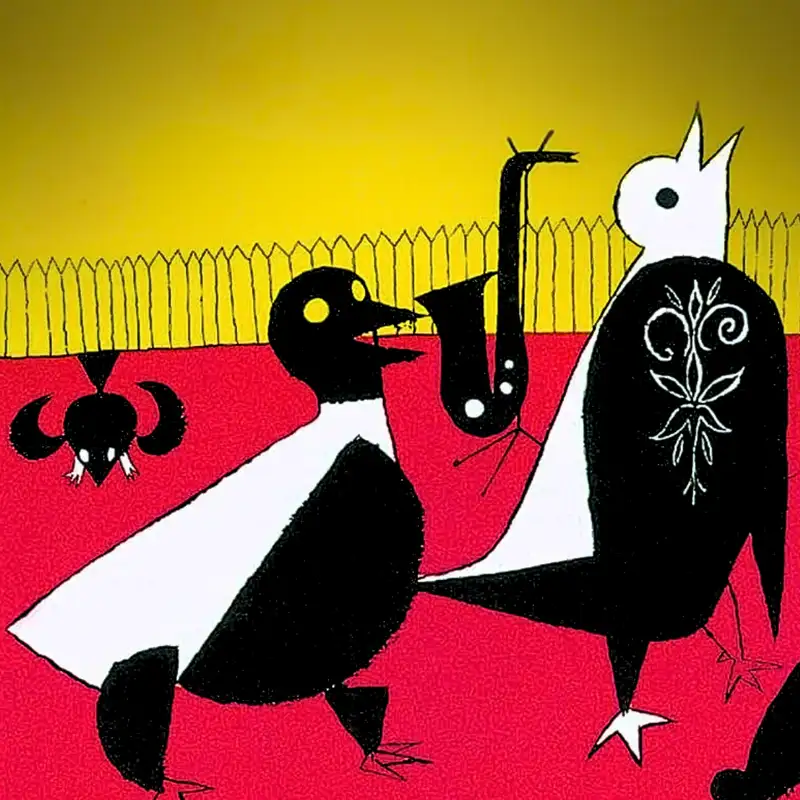
I'm not totally sure. I don't think this is the 1949 original one.
Okay, so The original with the six is gorgeous. It's just got birds drawn on it.
This is the six.
Yeah. That's just the six? Yeah. I don't know. I, I
thought I saw some April in Paris, Summertime. Yeah.
Maybe it's the second one. This is what I'm saying.
Yeah. This is so hard to tell.
Yeah. But that one, not this one.
Yeah. This one is a six for me.
Okay. Like, it's okay, but the, the pictures
are, like you said, the illustrations are
weird. Yeah. You got double M on there, but But
look at that picture of Buddy Rich and Ray Brown.
That's very cool. That's a great picture.
Very, very cool. Yeah, I mean, that is really good.
Yeah, that picture of Mitch Miller on the back.
That's killing. But the other one with just the,
the hand-drawn birds, I think Yeah is really good.
Yeah. Oh, that one! Yeah, yeah, I know which one you're talking about.
What do you got up next? Um, up next, you know
what? I'm gonna go a little, a little Oh, my gosh.
Well, yeah, I'm gonna go a little bit, uh... Well, why don't you do yours first?
'Cause I think mine's more of a departure.
Yours is I have Clifford, Clifford Brown with Strings. Obvious choice.
That's a great call. It's, it's, it's definitely It's obvious, but great.
Straight down the middle. Yeah. I mean, that would be an inspiring...
Like, that's actually one of the only things where there wouldn't be a dip.
Now, whether or not you could say Charlie Parker, but, you know what I'm saying,
like, that is an inspired record. As I'm saying it,
it's kind of a boring call, but it's a great album.
Yeah. No, no, no, you... It's great. So I got Hothouse Flowers by Wynton Marsalis.
That is interesting. Yeah, because it's different.
Like, I feel like Clifford Brown with Strings is kind
of close enough to this that You won this category.
That's a great No, I don't That's an interesting call.
I would just say, I'd say all these, but th- those three, oddly enough, I think
Hothouse Flowers is one of my favorite Wynton Marsalis records. There, I said it.
And I... Look, I wanna just say That's Lester Mattis's favorite.
Oh, interesting! I grew up with this album.
I don't hear people talking about that record a lot.
We, I, I know, we could do this. I know this album.
I knew your dad has good taste.
He does. Even before this, I knew that. But, I mean, Kenny Kirkland's
playing, oh, my gosh Killing on that. Wynton's playing, like...
And, and I think that because, like, you know, I was, I, I
said some stuff I didn't think was that controversial, but a couple people picked
up on the Grammy video I just did, where I said, "Think of..." I was comparing
1984 to 2026 Grammys, and Wynton won for Think
of One that year, and I kinda said, like, "This is not his greatest
album, and it hasn't really stood the test of time." I think Wynton's playing, and
his bands, and his records during that period, like the next year, um,
Black Codes from the Underground, and then I guess one year later with Hothouse
Flowers, incredible stuff. That was my only thing.
But of those three, that's not your favorite?
I mean, either Black Codes or Hothouse Flowers.
Yeah. But I'm thinking string, you know, like, for a strings thing
Yeah I think you can go from this, which is saying a lot, to that.
Incredible arrangements, Wynton's playing, Kenny Branford, Jeff Watts.
If you love this album, go check out Hothouse Flowers.
Yeah. That's a great call, Peter. Yeah, and a lot of
people... If you look at the record, you're like, "Oh, this is
'80s. This Wynton wasn't really..." No, it's It's cool the real deal.
It's cool. Awesome. Uh, man, this was cool.
This was really fun. Do you, do, do you read, or do you just listen?
Uh, I try not to. Okay, well, if you did, you
wanna check out something called You'll Read It.
Oh, our newsletter. That's our newsletter. Yeah, yeah, yeah.
Which, don't worry, it's not written by us. It's written by professionals.
Yeah. By producer Liz. Yeah. And, uh, yeah, go check that out.
You can go to you'llhearit.com to sign up for that, and then we're gonna spam you!
No, we're not. Peter! I'm sorry. We're gonna send you helpful things. There you go.
Till next time.
You'll hear it. You'll read it.