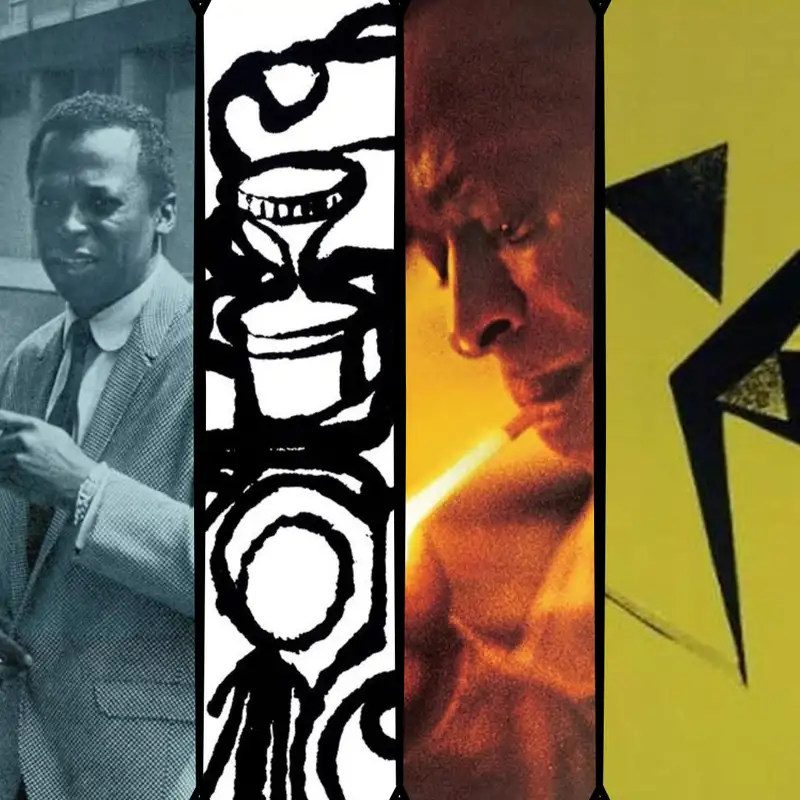
Miles Davis wasn't always an icon.
In the early '50s, he was at his lowest point personally and
professionally. Clubs didn't want the bother, and no label would
touch him, except one. Then, in
1954, he got clean, formed what would become his first
great quintet, and began to rebuild his life and his career.
He showed up at the Newport Jazz Festival, a last-minute addition to
an all-star group. A Columbia Records producer saw him
and tried to sign him on the spot. There was just one problem:
Miles still owed his label four albums.
So he gathered his amazing band, went into the studio for two days, and
walked out a legend.
I'm Adam Maness.
And I'm Peter Martin.
And you're listening to the "You'll Hear It" podcast.
Music: explored.
Explored, brought to you today by Open Studio.
Go to openstudiojazz.com for all your jazz lesson
needs. Peter.
Yes. Good morning.
Good morning.
"Guten Morgen."
So, we got a good one today because we're going to be checking out four
different albums today, and we've done similar episodes to this.
We did this during Herbie Hancock's Headhunters run.
We didn't do four complete records, did we?
No.
No.
No, and we probably won't listen to every track today, obviously.
I'm going home. Don't depress me.
Well, you just-
Don't suppress me.
Just chill. But we also did this during Bill Evans' trio,
the Waltz for Debby-
... Sunday at the Village Vanguard, Explorations episode.
And these four albums, we could do an episode on each of these individually.
But they go so well together, and the story behind them is so interesting.
Yeah.
As you alluded to in that brilliant intro.
Well, can I, and I just want to have one little quick caveat.
We
took a little bit of editorial license there.
Oh, yeah.
Because I said two days in the studio.
Just to be clear, those two days were six months apart from each other.
They were, yeah. They were in May and October
1956, is when both of these albums were recorded.
Yep.
But all of that is what happened. In July 1955, Miles played the
Newport Jazz Festival as a last-minute addition.
He was really coming off of, and he writes about this in his autobiography, which,
by the way-
Oh, it's so good
... I've got right here. Now, I don't know if you can see, this is my copy of this.
Literally, Peter, decades of coffee stains.
I can see that, yeah. Look at them.
Look at how brown these pages are.
Look at the patina on this.
The patina on this. I bought this in the '90s, buddy, when this came out.
Yeah. Did you leave that in your Ford Escort from the '90s for, like, 20 years and
let the sun come in on it?
This spent time in every single Chevy S10 I've ever owned.
It's one of the greatest music biographies because it's an autobiography.
It's controversial.
It's amazing.
Because I remember when it came out, reading it, and everybody
was like, "Oh, my gosh."
Controversial because a lot of people said it takes some liberties with
the truth.
Yeah.
Which Miles said that was not true.
But
it's super fascinating, the intersection not only of
stuff like what we're going to be talking today, '55, '56, where he goes into depth
on that, his memory of it, and really just his viewpoint.
We feel like we know Miles because of these records.
And I'm sorry, I interrupted you. You were saying, going through multiple records
we've done before. But we've never done four records.
And I don't know if this exists, that we could even do four records
from basically two recording sessions.
Yeah.
That's pretty incredible.
It's very incredible.
Yeah.
And as we were just talking about, too,
Miles was coming out of a real low period for him.
Yes.
Where he had a horrible addiction.
Yeah.
And he beat it. He was getting stronger.
He was kind of really-
What did they used to call heroin? It was like a monkey or the something.
The-
The dragon?
Dragon.
Yeah.
That's what it was, yeah.
But he got clean in '54, and he
started re-devoting himself to his music, and he was
signed to Prestige, and they were giving him, like,
$750 an album, and it was really just kind of like a
bargain basement deal that he had. It was not a prestigious deal.
He was not the Miles Davis that we think of at this point.
Right.
He was really going through it. But he's Miles, and he's talented,
and he's a visionary. And more than anything, he's so confident and knows what
he wants and who he is, at least when he's himself.
And he describes that that person who was on drugs was not him.
Right.
And that once he was out of that horrible situation,
that he got real clarity on what he wanted to do.
And luckily, he found four compatriots in this band.
Yeah.
That they were a real brotherhood for a couple years.
Yeah.
And we'll talk more about that, but-
Miles really describes it as his first great band.
The way he talks about it in his autobiography is more positive than
any other experience that he has musically.
He has a real fondness for this time and this band.
Yeah.
And you could hear it in the music. There's so much joy in the music.
You could tell that they were a real
unit. But he did play, when he was sort of getting
back on his feet.
Yeah.
He was asked to play at the 1955 Newport Jazz Festival as a
last-minute addition to an all-star band that included Monk.
By George Wein.
By George Wein.
Who was the first producer. Up until just a few years ago.
And it's really cool. They've released that concert live, and you can hear the
whole thing. And this is Miles and Monk playing "Around Midnight."
You can hear the seagulls in the background.
Yeah.
Yeah.
Fort Adams.
Newport.
This is good quality recording. You hear the bleed through on the-
This is really cool
... two-inch tape.
There's some really funny stories here in the autobiography about this.
About the drive home.
Back to New York.
Yeah. They all went back together in a car, and Monk apparently was like, "Hey,"
"You messed up my tune."
"You messed up my tune."
I didn't play the melody right.
And Miles, in his autobiography, was like, "I could've said that I didn't like what
you were comping, but I didn't." Which is really funny.
But George Avakian of Columbia Records heard him at that performance and
was just blown away.
Yeah.
And wanted him on Columbia. But as you said in your intro, Miles
still had four albums left to record with Prestige, and it's a
real fascinating time, Peter, because it's not that he had to
release with Prestige-
No. Yeah
... as we'll find out.
Right.
He just had to record them.
Yeah. It was up to them when they would release.
Well, that's what's so fascinating, is basically he starts recording for
Columbia immediately.
They make what's going to become "Round About Midnight" before he even makes this
stuff.
Right.
You know what I mean? And then this Prestige stuff is coming out all the way up
until 1961.
Which was by, what was that, Bob Weinstock?
Was he the-
Bob Weinstock. Yeah.
That was a savvy move for him, because it was kind of like, "Let's see what happens
with this Columbia," obviously, kind of blew.
Blockbuster albums and stuff for him to drip those out as well. But yeah.
It was a fascinating turn of events.
And apparently,
Columbia tried to just, they just were like, "Oh, we'll just buy out his contract
from Prestige." But Prestige was like, "No, no, no." They wanted a crazy amount.
Yeah.
That even Columbia was like, "No, we're not paying that." So, it kind of worked out
well for Miles, especially in terms of developing this band, the Sets and
Reps. They were doing a bunch of club dates.
Yeah. They were playing famous couple weeks here in St. Louis.
That's right. Yeah. Miles talks about those dates in St. Louis.
Peacock Alley.
His family being around.
Yeah.
About him feeling so good about everything, and they had a regular gig at the
Café Bohemia in-
New York
... Greenwich Village.
Yeah.
So they go into the studio for two days, and the very next
year, the first of these four albums.
So they make four albums in two sessions, essentially.
That's crazy. No second takes.
No second takes, apparently. Just all call-in tunes.
Yeah.
And it's a band that's playing together all the time.
It's a band that really love each other.
Yeah.
That are hanging out, having a good time on the road, and you
can hear just the ease at which they do it.
And it's a group of masters.
Yeah.
It's Miles on trumpet, obviously. John Coltrane on the tenor saxophone.
Ever heard of him?
Red Garland on the piano, who I want to go on a bit of a deep dive on.
Paul Chambers, PC on the bass, who was the youngest member of the band at 21,
and the incredible Philly Joe Jones on the drums.
Strangely from Philadelphia.
Fun fact. Philly Joe from Philly. They start
out with releasing "Cookin" with the Miles Davis Quintet, and it was
released August 1957, and it starts with a Richard
Rodgers and Lorenz Hart song, "My Funny Valentine."
The ease with which they just
slide into this intro.
Man,
the confidence and clarity of Miles' sound, that's what
that he would carry for the rest of his career, really. He was already there.
That Harmon mute sound.
Oh.
I love the way these albums are recorded, too.
So good.
Very simple-sounding recordings.
I don't know if they are simply, but it sounds-
Oh, very simple
... very basic, and it works so well.
Yeah. I was going to say. Apparently at that Newport gig, the Harmon was what
everybody was going crazy over.
Miles talks about it in there, and he was like, "Oh, I didn't know everybody would
like that."
Man, it strikes me how much Red Garland
and
Paul Chambers, how much of an influence they had on Herbie Hancock.
I never really noticed it like that.
Herbie Hancock and Ron Carter playing the same tune seven years
later once they were in the band, because
Miles kept a lot of this repertoire on these records, many of these tunes
for years, especially,
like "My Funny Valentine," and did it with the next bands and kind of had a
pretty tight repertoire up until the late '60s, really.
Absolutely.
Yeah.
Well, it's great you mentioned Red Garland, because it was such a huge,
incredible collaboration that
Miles had with Red, and Miles actually influenced Red
by encouraging him to play more like Ahmad Jamal.
Yeah.
Because Miles, again, talked about this quite a bit, that he was
influenced by Ahmad Jamal, that he
loved the space with which Ahmad played,
the way that he was so melodically focused, and he especially
loved Ahmad Jamal's light touch-
Mm
... on the piano.
Yeah.
And told Red Garland, "You sound best when you play like
that, when you play with that light touch, that" -
He said that right before he said, "But play what you feel."
"But play with what you feel." So
he did. He encouraged Red to play like Ahmad
Jamal. Here's Ahmad Jamal at
Surrey with the Fringe on Top.
A lot of the repertoire of Ahmad informed, influenced these
records.
Yeah.
Like five or six of the tunes.
That's right. 'Surrey with the Fringe on Top', is on these Prestige records.
And he plays a couple of Ahmad's tunes, doesn't he?
So hear that, way up high in the register, light touch.
Space.
Brilliant.
Yeah, so good. And I mean, so it's great we're talking about Red Garland.
I mean, this is really a quintet. Miles, in some
ways, as a personality, towers over this, but once you get
into these records, there's so much.
I mean, in a way, Paul Chambers, who's by far the youngest on here, is kind of the
one who steals the record in a way.
Because he's
so consistent. He's always there. Philly Joe, of course, is Philly Joe.
But I would say Red Garland. So all four of these records, I realized, start
with, we talk about how important the beginning of records are,
and even though we're going to kind of paint with a broad brush today on these four
records, they are four distinct records that were released over a year
apart. All of them, I believe. They're pretty stretched out.
All four of them start with Red Garland playing by himself.
I think that was an intentional thing that Bob and Miles made in terms of
producing this. Like with beautiful-
Great take, Pete
... classic intros.
Great call.
And they're all four, I mean, I have kind of my favorite we'll talk about, but
they're all four. I mean, this is the most iconic one, probably, the way that "My
Funny Valentine" is. Other than the one when-
No
... Miles says, Block chords, Red.
"If I Were a Bell," that's "You're My Everything."
Yeah.
Which is the second tune.
Yeah.
So I want to get one more track from
Cookin'.
This is "Blues by Five." You going to blow it?
Nah, the rhythm section's going to play it first.
Q go play it first, and we're going to come in. Here we go.
Right on?
Yeah.
Hear.
On the bass, hear that.
That's right on. It's the chords.
I love it, man. There's so much studio talk.
And this.
Oh, and they just fall into it. Oh.
So Red Garland doing his Red spread thing here.
Yeah.
And that chatter was not on the original. This is on the remastered version.
But the stuff on "Relaxin'" over here was all on the original.
Man, Philly Joe's bombs he drops.
Oh, the greatest. The greatest.
Backbeat.
Mm.
The conversation between Miles and Philly Joe, with the space that Miles
gives.
We, uh.
Woo.
This was a very influential trumpet. I mean, trumpet players geek out on this solo.
So good, man.
Crazy.
And that plan.
With the major to minor.
Miles playing his a*s off in this whole run.
Ooh.
Ooh.
Ah.
Man, Miles was like,
really one of, we talk about Charlie Parker, of course,
of that mastery of
bebop and blues,
like seamless integration.
Man, all the Trane stuff is there.
Yeah.
And then, like, Trane's take
on bebop is so different than Miles, right?
Let's
talk a little bit about Trane.
Yeah.
So, this is from Miles' biography.
He talks about their tour, their first tour.
"On our first tour after Coltrane joined the group in late
September 1955, we were having a lot of fun together, hanging out,
eating together, walking around."
From Chicago, we went down to play Peacock Alley in St. Louis.
Now, I was going to have a good time there, and we all did.
It seemed like everybody in East St. Louis came over to St.
Louis to see me play that week in the middle of October.
All my boys that I had gone to school with showed up, and it was a gas.
I was happy for my family to see me doing all right, off drugs and clean, leading a
band and making some money. I could see that my father and mother were proud of me,
especially after I'd told them about all the recording deals that I had going with
Columbia and all. Columbia, for them, was the big time, and it was the big
time for me, too. Anyway, everything just went beautifully in St.
Louis while I was there and throughout the whole tour.
I think a lot of people had expected Sonny Rollins to be in the band. Nobody in St.
Louis had ever heard of Trane, so a lot of them were disappointed until he
played. Then he just f****d everybody up, though some people still didn't like him
yet. By the time Sonny Rollins came back from Lexington to New York,
Trane was a fixture in the band and had taken over the place reserved for Sonny.
And Trane's playing was so bad by then that it even made Sonny go out and
change his style, which was a great style, and go back to woodshedding.
Mm-hmm.
He even went out on the Brooklyn Bridge a few times—
Right
... at least that's what someone told me— ...
to find a private place where he could practice.
Yeah.
So that little behind-the-scenes of that sort of shuffling in Miles'
band. He was playing with Sonny Rollins for a long time. Sonny leaves.
Trane comes in, really establishes himself during this time as this
force in the music. And by the time Sonny gets back, there's no spot for him.
Trane's-
Yeah
... taken that over.
Yeah, and I think he had to get Trane.
Trane was playing with Jimmy Smith, I think, right before this.
They had to-
Yeah.
Like Philly Joe
really lobbied for him, and Miles was a little bit like, "Nah, I don't know about
that." He's like, "I heard that guy." So, this really is the blossoming
of Coltrane, like this period. You can hear it.
This is like the coming-out party.
And Miles is like, control, his phrasing, his
understanding, his use of space. And I mean, I don't want to read too much into it.
Read the book if you're into this, but Miles definitely walks
through this in terms of his life. I
don't want to belabor the
stereotype drug addict in jazz. Hollywood's done that plenty of
times. But Miles talks about it there, about
how he went about kicking this habit, the confidence that
that gave him, and
with so many direct
musician friends. I mean, him and Charlie Parker were very close.
I didn't realize until I reread that how much, beyond just an
influence and mentor, but Charlie Parker was musically to
Miles. But I think Charlie Parker died right before this, like maybe '54,
'55, and that was a big hit to a lot of people.
I mean, they were like, "Charlie Parker is God." I mean, that was the thing the
musicians that looked up to him had said.
And so, I think for Miles, knowing that he was able to beat this
drug situation that was very hard, and then he was like, "You know what?
Now I'm doing it. I got my band." And a lot of people saw him as aloof and all
this. He talks about that in there.
He's just like, "I didn't want to go down the wrong path again," and like, "I'm
here to play music. They're not here to hear me talk." He was all about business.
Yeah.
The business of having a great band, and then
it all started taking off, as it should, right?
Yeah.
Well, Peter, that brings us to the next album.
Yeah.
The second album to be released in March of 1958, and it
is "Relaxin'".
Yeah.
Sorry.
I was getting these confused back and forth.
No, this is an amazing album. And before we talk about "Relaxin'", it has "If I
Were a Bell," the iconic "If I Were a Bell," and the block chords.
"False start."
Another start with Red Garland.
Yeah, and "If I Could Write a Book" and "Oleo" and "It Could Happen to You" and
"Woody'n You."
Isn't it Oleo?
Oleo.
Oleo.
I want to talk about Open Studio. OpenStudioJazz.com, Peter.
Yeah, let's do it.
So, we were talking about red spreads before.
And it's something that we teach over there. At least I love to talk about it.
It's a spread voicing where you play a simple four-note block chord
in your left hand, and you play these octaves in your right with a perfect fifth in
the middle. And Red keeps the perfect fifth, even if that perfect fifth doesn't
line up with the key. It sounds weird over a podcast, but I promise you, on a
video lesson, it makes a lot of sense.
So, if you're curious to know how these great musicians are
making the music, we try to demystify some of that for you-
Yeah
... at Open Studio. And you and I both have a ton of lessons on
almost all these tunes, I'm thinking.
Looking-
I've done a bunch just on Red Garland's introductions, because I'm in love with his
introductions.
100%.
Yeah, all his different kinds.
No, I have something on "You're My Everything" as well, because all of it is so
good. And I know-
I just did a lesson on "You Are My Everything."
Yeah, but I
know you have lessons on-
... "When I Fall in Love."
"Woody'n You"
"If I Were a Bell," "It Could Happen to You."
Because these are classics, my friend.
They are. They are classics.
Yeah.
So, if you go to OpenStudioJazz.com/YHI right now, you
can start your free trial. That's
OpenStudioJazz.com/YHI for
your jazz lesson needs.
Now, back to the show.
"If I Were a Bell."
Oh, relaxing.
Iconic. The greatest.
Red Garland.
I'll play it and tell you what it is later. Hold on, hold on.
We got to do that again one more time, Miles.
I remember when I first heard this, I was like, "Damn."
I'll play it and tell you what it is later.
That hi-hat.
RVG knew how to record some drums. Let's put that out there.
Ah.
That swing.
Do we like it? Yes.
I mean, it's effortless swing.
Yeah, it is.
Effortless mastery of swing.
Like, swing doesn't have to be .
What are you doing?
That's what I'm saying. It doesn't have to be that.
This is-
I'm saying it's
elevated. This is swing elevated.
You know, you go in the club, and it's kind of jankity, and they're like, "Would
you like to go to the other room?" And everybody's rich and good-looking and it's
all-
The champagne room of swing?
No, not like the hoochie champagne room.
Like the classy champagne room.
All right. Listen.
Let's jam.
And PC's bass is so up front in this mix.
We're going to talk about that a little later, but...
That's cool, because the piano sounds 100 yards away.
Miles has some perfect solos on here.
Go with what you know.
And the four, and the two.
How does he make that work?
I tried that, and the trumpet player threw his valve oil at me.
Well, you're not Red Garland.
Damn it. Miles is playing very
St. Louis-style trumpet here. It's swinging
clean though, coming out of Clark Terry.
Technically proficient.
With the bass so high up in the mix, it's like
two melodies going on, Miles' and PC's.
It is. It is like a counterpoint.
Yeah.
And Red's chords are almost like a snare drum hit.
Yeah, exactly.
Oh, coming off of here.
You can hear the coaching from a distance.
From here it comes here.
He's like, "Miles, I got to have something to say."
So great.
Amazing.
One take.
One take.
Yeah. All these tunes have that first-take energy, did you notice that?
Yeah.
Oh, boo-yah.
So many great phrases.
Trane's using a lot of space on here too. A lot of space.
Hey.
Oh.
Man, PC is like a machine on this.
He's like AI baseline.
His whole career.
Just perfection.
AI.
F*****g precious.
Oh.
Oh,
they turn it around.
Hot take, are these albums just the biggest flex in music history?
Yeah.
First takes, four albums, two days.
Oh.
That Ahmad Jamal thing?
Yeah, very Ahmad.
All right. Red Garland is so swinging.
Oh, yeah.
Clarity of language.
Thinness of sound from RVG, but still.
Just fluency.
So good.
Fluency.
Chopping the wood. Uh-huh.
That's a signature of Philly Joe Jones.
Move.
Man, it's kind of
stunning when you think about these records.
You could be like, "Oh, these are simple standards," but they made them standards
for the jazz world now.
Absolutely.
And there's no letdown on any of these solos. There's no lull.
They're all amazing.
Yeah.
They're all good.
Well, there's a couple of really big, but it's mainly just like
you could show up to the gig anytime and you're going to be happy.
It's not like, "Oh, you should've been here for the first set.
That was really killing."
No, everything is a banger.
I always direct new
jazz pianists, like pianists who are getting to the point where like, "I want to
transcribe a solo," transcribe some Red Garland.
Yeah.
So easy to hear and understand.
Yep.
And also, each solo
is a little theory lesson.
Yeah.
Teaches you how to play the changes.
Yeah.
All the bits.
He does the basics so well, in even block chords, which is not necessarily
that basic, but he does it in a very simple, basic way.
Like you were saying, with the Red spreads, and the way he goes in, and the usage
of it.
Yeah.
He's like a tastemaker.
He's a tastemaker.
And it's not just Ahmad Jamal. It's like a
combination of Ahmad Jamal-
Nat King Cole. We got a little Nat King Cole.
Nat King Cole, Erroll Garner.
Bud Powell, for some of that bebop language.
Yeah.
Erroll Garner.
Yeah.
Oh, the way he pulled back on that.
Uh-huh.
Turnaround.
I wish I could hear a little better over the bass, but other than that.
But honestly, and I know this is the RVG, but I wouldn't change a thing.
Yeah.
I wouldn't change a-
No, I agree
... a tone.
I couldn't imagine it being...
Man, some of this stuff is
some of the most copied stuff in modern jazz.
Just by me.
Yeah.
All of us.
Oh.
Red Garland, nobody does that octave like Red.
No.
Or PC.
Okay. Another great studio chatter is the beginning, and this is
legendary.
This is classic.
The beginning to "You're My Everything" with the false start.
You're on my everything, Red. Hold on.
When you see red light on, everybody's supposed to be quiet.
Everybody's supposed to be quiet. You're costing tape then.
We go, Miles.
All right.
A killing intro.
Play some block chords, Red.
Block chords.
All right, Rudy.
Block chords are in.
Ah.
And like, PC just playing.
Do we have any bourbon here?
I know. No, sir.
Bourbon.
Oh, those double stops.
And Philly Joe's choices of what not to play here.
This is very romantic.
Damn.
What a tune, too. "You're My Everything."
Harry Warren. Or sorry, Harry Warren, excuse me.
PC's just basically playing chords.
Yeah.
I know. PC's overplaying, but it works.
That's when you know you're a great bass player.
Right.
And at the beginning, at first, he's just kind of like, boom, then he's finding it.
But it's just...
Any other tracks from "Relaxin'" that you've got to--
Honestly, the whole "Relaxin'"-
Well, if you want, we can wait because my apex moment-
Okay. That's great
... is going to come back.
We'll get to the next one, which is-
But wait. Actually, can we first, there's some good...
Can we listen just to the top? Okay, so I'm obsessed with the studio chatter on
this record.
It's amazing.
I think it's some of the best stuff.
So we-
By the way, this was the only one that had the studio chatter in the original,
right?
Yes. I think there was a little bit at the end on some things on the other ones.
Okay.
But the only ones with these extended ones at the beginning.
Because that-
"The Blues by Five," that wasn't original.
Yeah.
Yeah.
No, but
on the "If I Were a Bell."
Oh, yeah, that was always there.
I'll play it and tell you what it is later.
Because like-
Man, I'm going to tell you, that, sorry.
There's a Honda commercial where he says that, so it must've been a thing.
Like in the '80s.
Miles said it.
Yeah.
Yeah, that's cool. But that, can you play it one more time, just that first part?
I'll play it and tell you what it is later.
Okay, so
this, and then the
way he counts that off, that was so inspiring to me when I first heard
this record. I don't know why. There's something, and
this was a very early record for me when I got into jazz, but I'd definitely heard
other stuff. But I'd never heard a jazz musician talking
on a record.
Yeah.
It was like a ghost.
Yeah.
Even though Miles was still alive then.
Yeah.
And I actually saw him live not that long after, and then I got to meet him.
But, the thing about it was, something about even the way
that hi-hat,
because you hear all the music that comes later.
And so, the only other reference point I had for that as I started to get into this
music was live records. And I think that this very much falls
in the pantheon, live at the Black Hawk, live at the Plugged Nickel, where you see.
But they're not talking. And Miles was not talking at all on those records in terms
of announcing. There was a little bit maybe, or like live at Carnegie Hall and
these different things. But something about the humanity of that and the way the
elegance of how that can go right into the recording.
It's not shtick or anything. It's just, you see
the flow of the recording. You could imagine, because
it's got that first-take energy, and then you find out later as you research it,
"Oh, these were all first takes." They were the only takes.
But the confidence, and
that's just something that's always inspired me when I'm in the studio.
It's like I want to be able to just be like, "Oh, okay, we're playing.
Bam, you're on." And it's not like, "Okay, come on, guys, we've got to do this."
It's just like, "All right. Let's go.
Let's do it."
"Time for it." The professionalism of it. That's what struck me.
I was like, "Damn, how do they do that?"
Some of my most favorite moments are with musicians who,
when the red light is on, they are on.
Yeah.
And it's like, I'll never forget the first professional recording session I was on.
I made a mistake in a chart, and I was just doing the arrangement.
So, I just made an arrangement that had a mistake in it, and I got vibed hard by
these really great pros. And I won't name names, but they're great people that
you've heard of.
Quincy Jones.
And-
Rod Temperton
... and they were right because they were like, "Time is money," and they were
there to do this session, and then serve the music, and you've got to be on your
stuff.
12-year-old Adam was like, "Sorry, guys."
It
pushed me to never have that feeling again, for sure.
You know what I mean? But it's a great feel. I honestly love the first take, man.
I love the feeling of freshness and newness.
And if you can do it, and, it's not like it's perfect.
We did it yesterday, didn't we?
We did.
Yeah.
It's not like it's perfect playing, like where everything's perfect.
No.
You know what I mean?
Yeah.
You've got to be able to just take some mistakes with that first take because-
But-
Or just imperfections, not mistakes.
You know what's interesting? Yeah.
It's not perfect, but these, I think every one, some of these tracks I
know better than the others, but I've heard them all a lot.
I think these tracks, these two sessions, these four records from two sessions,
I think they're kind of more perfect.
They're not perfect, but I think they have less mistakes
than definitely they have any business having, being all first takes.
That's the amazing thing. But I think it's less than even "Kind of Blue." "Kind of
Blue's" got some-
Yeah, absolutely
... some wonderful mistakes.
A lot of those are first takes.
Yeah, that's true. Well, right. But they did multiple takes, I think, on
everything.
They did two or three.
Yeah. But, these, I think, no, because they said they only had
time to do one, and that was the plan, like, "We're going to go in and knock this
out." Now, they're a working band. They're doing club dates for months at a time.
Yeah, they're probably playing all these songs-
... live all the time, right? It's not like he's just-
But in general, some of these solos, and we're going to get to that on my apex
moment, are like-Perfect solos, one after another, where you're like,
"I wouldn't change a thing on that."
Now.
And the comping, everything is like-
Everything is great
... it seems like it was pieced together like a mosaic.
Oh, put this there, and it was. But it was done in real time. In the studio.
Yeah.
In the studio.
Cool.
Okay.
Next up.
So we're going to come back to, we'll come back to some on this.
Okay.
Yeah.
Next up is Workin! This was the-
Oh, wait. But there's some more good chatter in here. Sorry.
Oh, yeah. What's the chatter?
Okay, so go to, well, the beginning of Oleo.
So the beginning of Oleo is great.
I love Philly Joe's pattern.
It's like you're getting-
1,001.
Hit the red light. Let's go.
Turn red light.
Number one.
Number one.
Just like we did before?
Yeah, watch the tempo, Paul, will you?
Yeah, let's keep it up there.
Keep it up there.
Oh.
That's a great trumpet sound. Recording,
I mean.
This is classic.
They're phrasing it exactly together.
Swing activated. Bud Powell stuff.
Very. Very Bud.
Okay, we can come back to this.
That apex. Yeah.
It's crazy.
Yeah.
It's crazy.
Yeah.
It's good to hear them
address things like keep the tempo up.
Yeah.
These are five masters.
Oh, that's actually the biggest, if you want to find mistakes, there's a lot of
tempo fluctuation on these records.
Yeah.
And I don't think it ever gets in the way of the music somehow.
Yeah.
There's one, I think it's Ahmad's Blues or Blues Backbeat, one of those blues slows
way down, but it's so gradual that you never notice it.
Yeah.
Cool.
Cool, cool, cool.
Apparently, they were not recording to the click track.
They did not use a click on these albums.
The next one of these albums to get released was Workin!
Oh, that's another great start.
With the Miles Davis Quintet, released December
1959. Another Miles Davis album.
And that was a long time to hold off three years, at that time.
Every stuff was getting released two months later.
Yeah.
"It never entered my mind."
Just...
Absolute heartbreaker.
Yeah.
Okay, can we pause it there for just a second? We got to.
No, we
get to hear it twice, see? Wait, no, pause. You don't have to...
Okay, let's talk about the intro. Apologies, we're a little out of tune with
each other.
I never really... These things
that are actually way simpler than you think they are.
Don't be snobby about a major triad.
Yeah.
Man, just the simplicity, the beauty of it. Okay.
It's awesome.
This makes it so we get to hear it twice now.
Okay.
See?
Don't get fended. You good?
Yeah.
All right. I put the oh in fended.
Is there a little...
Oh, no, it's the left hand he's dialing.
It's very
cinematic.
Oh,
PC making the perfect choice.
"It
never entered my mind."
They go back, they commit to that.
Oh.
Ka, ka,
ka.
Four, one.
"It
never
entered my mind."
Miles took a lot of
liberty with the chords on this. He rearranged it a lot.
Oh.
Were musicians just better back then? Is that what it was?
Yes.
These weren't old guys. They're 30 years old.
30 years old. Yeah, no, they were great.
They're playing like old dudes.
I mean, I could-
And they're playing with the expectation that everyone's going to do
something beautiful throughout the whole damn track, and then they do that.
And then they do.
There's no like, "Oh, are we going to do something cool?" It's just like, "No,
we got it." They're really playing like old people.
They're grownups doing grownup things.
They're doing grownup things.
Next up on this album is- ... this became a standard. Four.
Does Philly play confidently? I can't remember.
Yes.
I mean.
Yeah. Yes.
Da, da, da, da. Da, da, da. Da, da, da. Da, da.
This is a Miles Davis original. Is this by Miles?
Or is this one he-
Well, Sonny Vincent claims he wrote it.
Yeah. But it's got Miles on it.
Oh, it reminds me of some Bill Evans compositions.
I mean, Miles Davis compositions. And Sonny Rollins.
Ha. Ba-da.
Swing.
Time to swing.
Boom. Roasted.
These albums are-
These are like jam session records. It's just like the greatest jam session ever.
But they are what I think people who think we don't know about
jazz, this is what jazz sounds like.
Right.
Sounds like this.
Well, I don't know about that. If that was the case, everyone would love jazz.
They should. They should start here.
These are great albums to give people as a starting point.
Absolutely.
Almost better than-
Gateway drugs
... "Kind of Blue" is such a singular album.
Yeah.
It's so its own thing. But these are a great entrée
into what you're going to get with the best of jazz.
Yeah. But don't you feel a little like that,
especially some of the ballads on here, they're very closely
more connected, except for the production, the sound, even of
Miles. That's the main separation between that and "Kind of Blue." Miles is very
much, it's not like, people make it like, "Oh, Kind of Blue, Miles started
playing modal." He was already doing that on here.
But that record has such a distinctive sound and concept, but to me, Miles is
already there in terms of the beautiful phrasing, the Harmon mute, the ability to
connect with the audience, like on a gateway level.
Yeah. No, that's true.
With the beauty of it.
It's true.
And it's a different kind of swing.
It's a different kind of swing.
It's a different kind of swing. That's that Jimmy Cobb,
Philly Joe Jones. That's that beautiful diversity of approaches that Miles-
Great take of,
Dave Brubeck's-
... "In Your Own Sweet Way."
Yeah.
Man.
Philly comes in late on a bunch of stuff, and I'm here for it every time.
I know.
The way he does it is so cool, man.
Oh.
I think they're listening to each other.
Trane's solo on this.
Oh, so great.
And Miles is,
he's already at his technical peak, I think. He maintained it for a while.
Especially with the Harmon. Mm.
Suss. Let's suss it out, baby.
Trane with that almost no vibrato.
Right? Just playing the note.
Presto!
Oh.
Just using the melody to start the solo.
Yeah. Man, for them to record so many tunes in a day,
it's kind of stunning too, that's what I'm saying, the
consistency of these.
Yeah.
You would think you record all that, a certain thing, you'd be like, you wouldn't
really be locked in. They're hitting a high level.
But that's also the great thing about doing one take.
If you can nail it, now you're saving your energy to be able to do twice, three
times as much material. Which is basically what they did.
But there's some other stuff. Before this, Miles was, they used to do three
recording sessions in a day. Literally three records in a day sometimes.
But they was shorter. That was the 10 inch instead of the, this was the 12 inch.
All right. Do we want to listen to anything else on Workin'? Workin's great.
There's so much.
The Miles blues.
All of these. The only drag about doing all four albums in an
episode is we can't actually listen to all like-
Yeah
... 30 something tracks or whatever.
You want to move on to Steamin'? That's the fourth.
Let's go on to Steamin'. The last one. This was released in August '61.
Dude, this is like another generation now.
Like five years after they recorded.
The Beatles are out by now.
I know. It's crazy. And this does start-
Jazz is dead by this time.
This does start, by the way, Miles talks about this too, about this string
of albums. He says that this band and these albums made him famous.
Yeah.
They made him well-known to a wider
audience. They made his music-
Did you say wider or whiter? Because it was both.
It was both.
It was.
But-
He talks about that.
Yeah, he talks about that.
Yeah.
And it just made him a superstar.
This is when he got with the first really big booking agents.
Yeah.
I mean, he had played and toured a lot, but this was like him.
This was him.
Superstar.
He's now Miles.
Yeah.
After they record, he walks out of that second session, and he is now Miles.
With this band and this music, and then he's releasing stuff on Columbia.
This whole time too, Peter. By the way, also-
Big records. Big records
... like '57, Birth of the Cool, the whole album-
I know
... finally gets released, all those-
Right, 10 years later.
There's ten inches, speaking of those. 10 years later.
So he's having this moment in the late '50s, obviously.
I don't think they would, one thing they weren't great at in the record industry
back then was exclusive contracts. They hadn't mastered that concept.
Listen, if you go to Miles Davis' discography, it's like during this time, it's
like Prestige was releasing one, Columbia's releasing one.
Yeah. Dial.
Dial. Yeah, exactly.
Random.
It's all these rando labels that are releasing-
Yeah
... Miles Davis albums. Had to saturate the market a little.
And then he played on at least one Blue, well, that was, no, that
was-
Cannonball's something else?
Oh, that was Cannonball's record. That's right.
That was Blue Note.
Blue Note.
That was Blue Note.
Yeah.
So we talked about "Ahmad Jamal" and "'Surrey with the Fringe on Top'."
We listened to that a little bit. That is what starts out the
final recording here of Steamin' with the Miles
Davis Quintet. Again, released August 1961.
Another Red Garland intro.
Yeah. He starts every record.
Starts pretty much every tune, also.
This is from the musical "Oklahoma!"
Which,
Lorenz Hart-
Not, I am not a fan.
Was not a fan of. If you ever saw the film "Blue Moon."
Neither was, Ethan Hawke was not a fan, either.
Incredible. Just the whole movie, him just s******g on Oklahoma is great.
It's a corny song, with the words.
Yeah, with the words, but this is not corny.
Ahmad did it up.
Chicks and ducks and geese.
Listen.
Red. Just doing those tenths down there.
Woo.
There's a lot of subtle arrangement.
Like, you think, oh, they're just playing it like a jam session, but there's a lot
of arrangement.
Even on the ballads, like-
Oh, yeah
... "You Are My Everything," it's very sophisticated arrangement.
Very simple.
Yeah. Oh, what's that blues they end on this hymn, I forget, on the end of one of
those blues, they end on this, like, hymn vibe.
"Beard Blues?"
"The Trane Blues?" I think.
It might be "The Trane Blues," yeah.
Uh.
Like this?
That little counterpoint line.
We'll see. Do you think they have, like, three-six-fives on this record?
And solo breaks?
Oh, this.
Man, that's damn near a perfectly recorded trumpet right there.
Like, you really feel Miles.
It's so direct.
Oh.
Woo.
Man, Philly must have been a great listener beyond music.
Maybe not, that'd be funny if he didn't. He listens so well.
He's like the guy that's like, "Yeah!"
Yeah.
Yeah. Yeah,
buddy, I know exactly what you're talking about.
Yeah.
Man.
I want to skip ahead a little bit.
I want to hear some more Red. We haven't
heard nearly enough Red Garland.
Woo.
As I'm saying, like, how are they doing-
It's all good, it's all bangers, dude.
Man, there's no, like, bleh.
No.
Oh.
That's a tough little tasty part of the piano to pull off, too.
Yeah.
Da, da, ka, ka.
Man,
PC and Philly are dial-- they are locked in, that ride and the bass.
Ka, ka.
Oh, and the hi-hat, too.
This is almost like a Jimmy Cobb kind of...
Hi-hat's perfect.
Yeah.
Like, dynamically.
Right.
Newsflash: Philly Joe can play the hi-hat.
Philly Joe Jones, the greatest.
Look, I've been saying that a lot on this episode, but these guys are just so
next level, man.
I think that's the other thing, is like, the level,
Trane is not, like, just, he's
cutting loose, but he's not on another level from everybody.
Well, okay.
Everybody is right in the A tier.
So that's-
Or S tier.
That's right.
What's the highest one?
S tier.
Like, it's very even. Even Miles.
That's true.
You know?
Well, this is what was going to be one of my hot takes, but I'll do it
now-
Okay
... because you just mentioned Trane is not, like, outrageous.
Yeah.
Trane is not quite Trane yet.
Right.
That's the thing, he's just getting his Trane-ness together.
Right. He sounds like-
But this isn't 1961 Trane.
Right.
1963 Trane.
Where everyone's trying to keep up with him.
Yeah.
Yeah.
This is, like, him still
gathering his sound together, his thing.
Looking over his shoulder for Sonny Rollins is what it is.
Yeah. And honestly, he's about to, we mentioned Miles coming out of his lowest
point-
... to make this. Trane's heading to his lowest point during this time.
Right. That's right.
And eventually gets fired from this band.
Like, basically, Miles and him get in an altercation-
Right
... in a dressing room a couple years later because Trane was having addiction
issues of his own.
Right. Which Miles could've been a little more understanding, having gone through
that, but, yeah.
And Miles is a businessman.
He's trying to run a band.
Right.
And so Sonny Rollins actually comes back into the band after that.
But Trane would get clean and do this exact same thing.
Trane would get clean and refocus his efforts and become-
Yeah
... that sort of, like,
mammoth player that he became. And it's so funny because those two musicians, even
though they're the same age, had this similar arc at different periods.
Right.
Tum, tum.
I mean, we could listen to every tune.
"Salt Peanuts."
Yeah. Ba, ba, ba, ba.
Philly.
First time I heard that, I thought someone threw a drum kit down the stairs.
Yeah.
I was like, "What?"
It's so good.
Ooh.
Hey.
Mm.
Oh.
Oh.
Oh, effortless swing. Relaxed.
So fast to be that relaxed. Literally. There's none of this.
We don't think about Red as this chops monster, but-
Right.
Red's like...
That's choppy as hell.
That's choppy as hell.
Oh, yeah.
That's fast.
He didn't fall behind on one.
Wow.
Woo.
I like Miles kind of scrapped up that, but he came back and played it again.
He's like, "I'm going to get that s**t." Did you hear that?
Oh.
Because this is not Miles' like-
Yeah, that's killing, though, man.
I love, too, that these are a mix. This is the blueprint, too,
for how
post-bop, hard bop jazz would be for a while.
There's a mix of Great American Songbook standards-
Yeah
... and of standards by their contemporaries, like Sonny
Rollins, 'Oleo,' 'Woody'n You.' They got, on this album, there's a
Monk tune, 'Well, You Needn't.'
Which has controversial changes as well.
There's Era Changes.
He changed it. Sonny Rollins.
Oh, the When I Fall in Love is great.
Yeah, this is all bangers. This is all the ballads, the mid-tempo, the couple of
really up-tempos.
The last track on the album, When I Fall in Love.
This is so great.
So this was
the
template that George Clooney wanted at the beginning of Good Night, and Good
Luck.
Oh, that's what he said.
Yeah. With Dianne Reeves singing. And this is the tempo we did it in Every Day.
The same tune.
I'm sorry, Dianne Reeves singing. We did it instrumental.
That's right.
Should we get George on the phone?
Yeah.
Can we get
Sam Moore? George Clinton on the phone?
Friend of the pod? Well, friend of ours.
I don't know about friend of the pod, but we didn't mention the pod with him,
somewhat.
We assume he already knows.
Yeah, of course.
We like to
rub it in his face.
All right, Peter, this is a blast. You have on here, we had our If I Were a
Bell from Relaxin'.
I'll play it and tell you what it is later.
Right.
The hi-hat.
You have a couple here that I really like from 1961, another
version with Miles.
Oh, yeah.
Who's this band? Do you know?
This is-
A few years later.
This is Wynton Kelly.
All right.
This is the Black Hawk.
Oh, the Black Hawk.
Black Hawk, San Francisco,
Saturday night.
So it's a little bit,
not much faster.
Same hits, same arrangement.
Yeah. But then-
With Jimmy Cobb, and then 10 years later
... four years after that-
Yeah
... 10 years after they recorded the original, the Plugged Nickel.
They're still playing the tune.
Avant-gardish.
Yeah.
Chatter, still. Well, live chatter.
Live chatter. Ron Carter, Tony Williams, Herbie Hancock.
Oh.
This is freaking fast.
Yeah.
And Miles' whoo approach.
When's the Plug Nickel album?
Deconstruct it. Oh.
Which one? Was it the Plugged Nickel show?
The whole box set?
Box set?
I'm down for it.
The '90s box set?
Yeah.
Yeah, so there's a bunch of these things.
They're just painting in the abstract at that point.
Yeah. But that was Miles, man. Miles took this, and
he was thrifty with the material. He knew how to take
this stuff through different bands. Let's talk about some categories, my friend.
Yeah, desert island track. We could do a track, or why don't we do a track and an
album?
I like it.
Okay.
Because there's four.
There's four albums.
So mine, I've always been drawn to Relaxin'.
Now, I think part of that, that was the first one I had of all these.
Mm-hmm.
But I think it's the strongest from beginning to end.
But I'm also a little bit, because all the studio chatter on it, I
love that so much.
Yeah. It's either Relaxin' or Steamin' for me, but I'm going to go with Relaxin'
too. I think Relaxin' is an
S-tier Miles Davis album.
It's incredible.
Yeah.
And then,
for the track, I would say Olio off of there, and it's going to be one of my apex
moments.
Let's hear your apex moment.
Well, my apex moment is
the whole track. But no, the transition.
If we go towards the end of Miles' solo.
I think Miles' solo is so good, but I think 'Trane, it's really the way he starts
the solo, but the transition.
Miles pretty much plays a perfect solo.
And PC is walking perfect lines.
But the way 'Trane starts his solo.
We're not there yet, but
this last eight bars.
And then it overlaps.
Do, do, do. And then we'll 'Trane it.
Oh, my gosh.
This is the first 'Trane solo I ever learned. I was like...
It's a good one. You can really hear everything without the drums and everything
too.
Oh, and then Philly right here.
Hey.
It's like a-
Like a bugle call thing.
It's like a bang.
That's so great.
Streepy.
Honestly, you could put any of the transitions-
... between Miles and 'Trane. I know.
Between Miles and 'Trane, any of those transitions could be an apex.
Yeah.
We've talked about it before.
This is a great-
The greatest hands off in jazz history.
Yes. Yeah. And this band, in general, okay, now we're hitting on it.
The masters of the transition.
Wow.
The introductions, going between solo.
Like
Philly Joe Jones.
Little details.
Ding, ding, ding.
These are head charts, right?
But those little details make them really, really special.
And a lot of that stuff, it's so... You try to do some of this, like we all
have, and it's like, "Ugh, it didn't quite sound like..." Because the inspiration,
the impetus for them to play it at the time was so,
they had such an awareness of the overall arrangement.
And nobody's being greedy on here.
And even Philly Joe is probably the most obtrusive, but he's being
obtrusive like, "Hey, hey," at the right times.
Yeah.
And Miles, he's coming in. So there's this honoring of the
overall architecture that really makes all these little
details and transitions work great.
Yeah, but-
What's your apex moment?
Well, hold on. I still have a desert island.
Oh, desert island.
So definitely, my album is Relaxin'.
But my track, ironically, is this.
Oh, yeah.
It never entered my mind, the first track on "Workin'"-
One of the great starts to an album ever.
It's unbelievable. It breaks my heart every single time.
Yeah. Even this part. And then when Miles comes in, forget it.
No, the whole thing, man. But this piano line specifically, because it's
and like, PC...
Honestly,
we're about to do some Radiohead on the show.
Yeah.
Radiohead pulls from this kind of stuff. You know what I mean?
Yeah.
This kind of ethos-
Yeah
... is right in my wheelhouse, and it's honestly also
very Ahmad Jamal-ish.
Yeah.
To have that line like that on that triad.
Yep.
All right. See, we got your apex moment.
Yep.
My apex moment is from "If I Were a Bell," and it is that
Trane also entrance.
You know what? That was my
original one. Trane solo break on "If I Were a Bell." Apex.
I think it's the greatest.
It's so good.
It's so funny. We
both picked-
Sweet.
Hold on.
We both picked Trane entrances.
It's one of the greatest solo breaks ever, but Miles sets it off already
up a minor third.
The fact that he's far away from the mic and walking towards the mic, playing what
he's playing.
You're feeling the presence in the studio.
I'll never forget the first time I heard it.
Great production.
I almost fell over.
Great production.
I still freakin'!
And then Red's doing the perfect thing. Philly does the perfect initial fill.
It's still, you're right, it still gives you chills.
It's one of the greatest solo breaks.
It's like Louis Armstrong, "West End Blues." It's up there.
Because that's the thing, you take one little solo line, solo
break, because the architecture, the placement of it, but it's just one
line. It's the awareness of what's happening around it.
Yeah.
It's like if you built this door, a beautiful door-
Here we go
... just sitting on the sidewalk.
Go on, paint your picture.
You know what I'm saying? It's just sitting on the side.
But now all of a sudden, you place it in a building where it's like, whoa.
Oh, yeah.
You know what I mean?
Yeah.
I can picture it now.
You don't go in buildings?
I do.
You don't open doors?
Hey, man, when one door closes-
I love that you're always like, it's like you have metaphors ready to
go, Peter. You have these-
It's like a tumor
... imagery. You're an author, man.
Auteur.
You're an auteur.
Right. Haute couture.
Bespoke playlist title. What do you got?
If this was a playlist on Spotify-
Yeah
... before, what do you got?
Well, the one I really want to do is New Jersey Audiophile.
Oh, that's not bad.
You know.
That's not bad.
Because this is recorded in Jersey at a certain place, but I'm actually going to
call this one...
I'm not going to do that. I'm going to do "In Da Club."
"In Da Club"?
Like 50 Cent.
Why?
"In Da Club." Because this has the- This, um-
Your Spotify playlist titles always have a "duh" or
there's always a...
I'm from the streets, man. What can I say? A Z. I like to add Zs.
You got a Z.
Martinz.
You add a D to s**t. Yeah.
No, the reason is "In Da Club" because bespoke playlist, there's other stuff on
there.
Okay.
Right?
Okay.
And so I'm thinking Plugged Nickel, whole Black Hawk.
Oh, yeah.
Because this is like, it's a studio record, but to me it's a live record.
It's a working band that's been in the clubs.
I don't think this is the first time you've-
Ahmad Live at the Pershing, that would be on there, too.
"In Da Club."
"In Da Club." D-A. Da.
Mine, my bespoke playlist title is Contractual Obligations,
and it's just albums where the artist made it.
It's like, "Here, my dear."
Oh, right.
It's like this.
So would you say contractual obligationss, with a Z?
With a Z? We can.
What are your quibble bits?
Quibble bits. Actually, for me, the only quibble bit I
have on this is-
Actually, I want to change the name of this category.
Okay.
Quibble bits or hot takes.
Okay.
How you doing?
So you could either do a quibble bit-
Your hot take is that you're changing quibble bits.
Well, the problem is, is sometimes I don't have a quibble bit, and I really got to
reach for one.
We could just say... We've said non before.
But a hot take is like the opposite of a quibble bit.
It's like, "I got a hot take." You know?
Did I have quibble bits on "Money Jungle"? I can't remember.
You had a few.
Okay, so my quibble bit on this, and it's definitely a quibble bit, not a hot take,
but it's very slight, is the bass sound, oddly enough.
But I have to qualify this.
Oh, I'm sorry you don't love great bass sounds?
This, I don't think is a great bass sound.
Ooh.
But-
That is a quibble.
But it's so far up in the mix.
That might be a hot take, honestly.
Maybe so. PC's playing so good, and hearing the lines, it affects
the music a lot, I think, actually, in a very positive way.
So the placement in the mix I'm cool with. I just don't think it's a super...
Do you have any of it isolated, any of the bass?
Yeah, I do, actually.
I just don't think it's like an... I've heard more natural, like actual sound, how
PC sounded. To me, this doesn't... It sounds good.
It's a little like, a little bit of a nasal.
I know it's not an amp, but it
just doesn't sound super natural to me.
But I get it. He's got it pushed up in the mix.
It's very clear. It's just not super natural, but this is a
small quibble bit for me. The piano sound on this record, actually,
I'm okay with.
I'm not okay with that.
You got some artifacts there.
Yeah.
Okay, interesting. I have a hot take. I don't have any quibble bits, honestly.
I do have a hot take.
Yep.
Hear me out.
I'm listening.
This is the greatest rhythm section in the history of recorded music.
That is hot. That's red hot.
No, it's a hot take.
The greatest rhythm section ever.
In the history of recorded music. I think PC, Philly Joe, and Red Garland,
specifically that unit.
Can't they just be great? Why do they have to be the greatest ever?
Well, because it's a hot take, buddy.
So Tony Williams, Ron Carter-
It's a take
... and Herbie, boo.
No, no one's booing anybody.
Okay.
I think this is, if it's not the greatest, because
I realize that is-
Wow, you fell off that mountain quickly.
No.
I mean, barely-
I was trying to be a-
Wait, I'm falling.
Trying to get a hot take going. I just think, let's put it this way.
There's nobody better.
There's nobody better. I like that.
There's nobody better than-
I could go with you on that
... than these three musicians.
Yeah.
And let me tell you why.
And playing this music, like this kind of arrangements, this period, I could
agree that it's the best.
Let me be specific-
Yeah
... of why.All three of them as a unit are
so swinging. The groove is so incredible.
There's those little details, the transitions, the intros, the things that they
play together, the way the ride cymbal and the bass lock up, the way Red Garland
does his Red rhythm, which is like that and of four, and of two anticipated-
He just calls that rhythm.
I know he does, but we have to classify it for contractual
obligations. But the way that they work together as a unit-
Yeah
... supporting other soloists is as good as it can get.
And then on top of that, all three of them are
world-class, top-tier, S-tier soloists in their
own right. Red Garland is
just a complete monster on these albums.
He is crushing every solo. I mean, crushing every solo.
Incredible language, fluent language, choppy when he needs to be.
Big spread chords like Erroll Garner, like we mentioned.
Philly Joe plays some arco solos on here that are unbelievable.
He's one of the greatest bass soloists ever.
And,
sorry, PC. And Philly Joe is playing some of the
greatest, most transcribed drum solos in history-
Yeah
... of straight-ahead music.
Yeah.
I just think that individually, they're all the greatest soloists on their
instrument at this era,
or arguably some of the greatest soloists on their instruments in this era.
And then as a unit, they are an unstoppable engine
of swing under Trane and Miles, and I just think there's no one better.
So in summary, you love this rhythm section. Got it. Check mark.
All right. Stem-ometer, what do you got?
Five. Straight five.
I got a four, so we're not too far off there.
That's a couple weeks in a row we've been five, four.
Yeah, no. I think it is fair. Like I said, you
could show this to someone as their first jazz album, and you wouldn't go wrong.
These beautiful ballads.
So that would make it lower.
Well, lower than a five for me.
Yeah.
But
they still get John Coltrane on here doing some stuff that, there's still-
But this is some of the most accessible
Coltrane, wouldn't you say?
It's true. Besides maybe "Blue Trane" or something like that.
Yeah. Well, even that, he's kind of going crazy on that.
He's kind of going crazy, yeah.
But no, this is a solid in the middle.
I feel like this is tailor-made five.
Okay, the big question.
Yes.
Is it better than "Kind of Blue"?
No.
You have no?
Well,
ah. I have no. I could almost say
"Relaxin'" would be equal for me.
Well, you don't like Red Garland.
I love Red Garland. I think Red Garland, I'm going to
say no.
Okay.
What do you say?
Wow, I'm shocked.
Well, are we saying one in particular?
"Relaxin'" I feel like is the strongest. That's what I'm taking.
I'm very close, but I'm not saying better than.
I'm saying equal to "Kind of Blue."
But the question is not is this better, equal, or lesser.
I'm sorry?
It's a binary question.
Excuse me?
I've said
maybe.
Pardon me?
I've said maybe. Okay, sorry. Hypocrite.
Thou art and
jo soy un hypocrite.
Accoutrements. Can we ask ChatGPT who did these album covers?
I got a nine on these because I really like them. We don't know a lot.
We're not going to go in deep, only because we don't have time.
We know all about it.
Oh, yeah, we know everything.
But I do like the one with Wynton Kelly. That one's cool.
Actually, I love them all. That one's different. There's the black and white one.
I absolutely love them all. I also agree, nine is the way to go.
That's fun that the Prestige had a Blue Note-looking cover. That's cool.
Yeah.
But they're
great.
Yeah. Up next, what do you got?
Kayal Beat.
Why not?
"Round Midnight." Same era.
Live at Newport.
"Round Midnight" is the same band from on Columbia.
Yeah. Exactly.
I'm going to say "Round Midnight" because that's a fun one.
Okay. Other albums that you might like from-
Sorry, "Round About Midnight."
"Round About Midnight," right. Oh, we don't have to do that.
Good. Man, this was fun.
Oh, it's a blast.
So if you guys like to get some behind-the-scenes stuff, we have a newsletter.
Don't tune out now because we got other fun stuff coming. Not really.
Man.
We have a newsletter. Go to you'llhearit.com.
And we have some other accoutrements of ourselves.
Actually, to be honest, I haven't been on you'llhearit.com in months, but I hear
there's fun stuff happening.
Come on.
We still have the SpeakPipe?
No, you spend all your free time on the chat board at you'llhearit.com.
There's no chat board.
I don't know. I've never been there.
Do we still have the SpeakPipe?
We do have a SpeakPipe. You can leave us a message, and we'll listen to it.
We don't know where
it goes.
But hey, if you do want to go on a deeper dive on any of this musical stuff, don't
forget to go to openstudiojazz.com/yhi.
That's openstudiojazz.com/yhi, and you can sign up for a free
trial and get lessons from Peter Martin.
That's right. Good stuff. All right. Well, till next time.
You'll hear it.