I'm Adam Maness.
And I'm Peter Martin.
And you're listening to the You'll Hear It podcast.
Music explored.
Explored, brought to you today by Open Studio.
Go to openstudiojazz.com for all your jazz lesson needs.
Peter, we got a lot of cool stuff going on-
Yes
... at Open Studio right now. We've got new courses coming out-
Yeah
... from Larry Goldings.
Yeah.
Daniel Anastasio-
Yes
... on classical piano.
Wait, say that again?
Daniel Anastasio on-
I love the way you say that name
... classical piano.
Classical.
And by the way, a brand-new course called Jazz Piano for the Bandstand from
you and from me.
A collaborative affair, much as this podcast is.
Very much like this podcast, except we're sitting in front of two beautiful grand
pianos.
You just looked at them.
I just-
I love that
... I glanced over to check-
You kissed one of them
... because I love them.
Yeah.
Anyway, go to openstudiojazz.com.
That's openstudiojazz.com for all
your jazz lesson needs. Peter.
Let's do this.
I am buzzing today.
You are.
I am buzzing today. Not only is this one of my all-time favorite albums, I think
this is one of the greatest albums of all time.
I really think this is peak performance from one of our peak
performers, Joni Mitchell's 1974 masterpiece, Court and Spark.
To me, this is where I step into Joni fully.
Mm.
I love folk music. I love-
You and quite a few other people
... blue. I love all that stuff.
Yeah.
But to me, this is where I went from interested
to obsessed with Joni Mitchell.
Yeah.
I listened to the hell out of this CD so much, I think
I bought three of these CDs in my lifetime because they kept getting soda
and coffee on them in my pickup trucks over the years when I was a kid.
I love it so much. Every song. Musically, she goes to
another level. But I also think lyrically, this might be her most
slept-on album, because there's so many great stories, so many incredible
lines in this album. I'm so geeked that we get to listen
to this music today.
Isn't it great? I love it as well. Isn't it great, though, when we have
an album like this that you say that, "I bought it at least three times.
Coffee stains on it."
Oh, yeah.
It's like a book-
Yeah
... that you put notes in and that you savor, and that if you
give it away to someone, you almost want to, because you want to go get another
one.
Yeah.
Because you get to kind of discover it again-
Yeah
... with that fresh copy. You know?
I know.
Now we've got Spotify and Apple Music. Isn't that fun?
Whatever. This will be with me for the rest of my life.
Yeah.
I will have a physical media copy of this in some
form or another for the rest of my life-
Right. Yeah
... and I will cherish it. So-
And then it's also, we should say, I think this, well, it's Joni Mitchell's
best-selling record, I believe, of all time.
Yeah.
Right?
Yeah.
And so this is a lot of people's entry point, I think, either at that time
or later, and it's always fun when there's a blockbuster album like
this-
Yeah
... for an artist, and there's a lot of, I think, artistic
validation-
But-
... of that, because that doesn't always happen, right?
Yeah. This is very similar, I think, to Michael Jackson's Thriller.
Mm.
Or Herbie Hancock's Head Hunters.
Both of those albums were their best-selling albums of all time.
Miles Davis, Kind of Blue, perhaps.
Miles Davis. And they're also some of their greatest artistic achievements, and I
would put
Court and Spark in that category of-
Right
... yes, it's her best-selling album, it's her most commercially successful album,
and it's one of, if not, I think, the most
artistically successful albums.
The achievement of this is unbelievable.
Yeah.
And the story behind it is really cool. We'll get to it in a second.
I just want to do a little bit of catching up with Joni.
Yes. Let's do.
So Joni discovered in 1967,
she gets signed to an album, and really it's all through David Crosby,
who she was sort of dating, and then they produced her first
album together called Songs to a Seagull in 1968.
She's already writing songs for other people at this point, too, but this is sort
of her introduction as an artist to the world.
It's "Cactus Tree."
Mm.
There's a man who's been out sailing in a decade
full of dreams. And he takes her to a schooner,
and he treats her like a queen. Bearing beads from
California with their amber stones and
green.
He has called her from the harbor.
He has kissed her with his freedom.
He has heard her off to starboard
in the breaking and the breathing of the water
we-
Even in that introduction on her first
album, you can hear
she's already separating herself from
folk singers-
Yeah
... her contemporaries.
Yeah.
The melodic and, you could hear other examples from that album, of
harmonic sophistication that she's already bringing at a very young age here in her
first
efforts, is already pretty staggering.
Yeah.
Pretty staggering.
And that ability to... It's such a big part, I think, of her very
distinctive voice
and her artistry, that ability to make these melodic leaps-
Yeah
... that inform the harmony-
It's unbelievable
... in such-
She's the greatest
... interesting and unusual ways.
She's the greatest.
And when we talk about distinctive, and I think we're going to see this as we lead
up, and definitely in Court and Spark, and everything that she's done up until
now is, when we talk about distinctive, Paul
Simon, Michael Jackson, Marvin Gaye, all these great singers,
Stevie Wonder-
Yeah
... that have this distinctive voice.
They're copied a lot and, well, I would say Joni Mitchell has
been super influential on songwriters and singers.
She's not actually copied successfully very much.
How could you?
Yeah, exactly.
Yeah.
That's the distinctiveness.
It's like trying to copy Thelonious Monk.
Everybody's going to be like-
Yeah
... "Oh, yes. You're doing your Joni Mitchell thing."
Yeah.
It's so distinct.
But very influential.
Very influential.
Very influential.
And by the way, also, we're not You and I are musicians.
We're piano players, which means we love the math of music.
Yeah.
We don't talk a lot about lyrics on this show-
Right
... I don't know if you've noticed. But she is a lyrical gangster.
Oh. Yeah.
That is-
That might be her best
... ridiculous lyrical output.
Yeah.
That is unbelievable imagery. And this is the theme of Joni's career is, she's
a musician, she's an artist, she's a performer. She's a complete artist.
She's a painter.
Yeah.
She's a poet.
Yeah.
She's a musician.
Yeah.
She's an incredible-
Producer
... performer.
Yeah.
She's a producer. She does every...
Her art-
Mixer. She remixed her own album.
She-
This one, actually
... the craft of art is what she does.
Yeah.
Very well, at a very high level.
Became a band leader, too.
In multiple disciplines. She plays several instruments.
She's one of the great vocalists of her generation.
She's one of the great songwriters, she's one of the great poets. Unbelievable.
Her second album... She'd now go on to make, Peter, an album of the year,
an album a year, sorry, for the next four years.
So she does five albums in five years-
Yeah
... before we get to Court and Spark.
So we got-
'69, '70, '71, '72
...'69, her second album. Oh, how about this?
Rows and flows of angel hair
and ice cream castles in the
air and feather
canyons everywhere.
I've looked at clouds that-
Yeah, it's just both sides now from Clouds, Peter.
Yeah.
That's her sophomore effort.
Mm.
She goes on to make Ladies of the Canyon the very next year, 1970.
This, of course, brings this to our attention.
Woo.
They paved paradise, put up a parking lot
with a pink hotel, a boutique and a swinging
hot spot.
Don't it always seem to go that you don't know what
you've got till it's gone. They paved paradise- Big Yellow Taxi from Ladies of the
Canyon
... that became an important sample.
A very important sample. The very next year, she makes an album that we've covered
here on the show last year.
Yeah.
Blue, in 1971. One of my favorite tracks from Joni,
California.
Sitting in a park in Paris, France.
Reading the news and it sure looks bad. They won't give peace a chance.
That was just a dream some of us had.
Still a lot of lands to see, but I wouldn't want to stay
here. It's too old and cold and settled in its
ways here.
Oh, but California.
California.
Man. Jo-
We talked about it
Yeah
... maybe the best use of California in a lyric-
Yeah, it's so great
... of a melody.
And I mean, you've already heard it on every example, and we're going to hear it
quite a few times in Court and Spark. The master of the major seven.
Buddy.
With,
the emotional pull of that-
The greatest major seven composer ever, possibly.
Yeah.
And with the lyrics?
Yeah.
Ah.
Yeah.
Melody.
1972 ends her five-year, five-album run with For the
Roses. This is You Turn Me On I'm a Radio.
Notice too, by the way, everything we've listened to, acoustic guitar heavy.
Yeah.
Lot of one to four-
Right
... stuff going on chord change-wise. Very simple.
Sophisticated, simple.
Yeah.
But nothing
like what we're about to hear.
Right. And I'd say everything has been...
Driving into town with a dark cloud above you.
Also in the category of folk, you could put it there.
I-
A little sloppy with the genre maybe, but yeah
... folk rock, folk pop. Yeah, for sure.
Not to typecast it, but-
It's a great album
... but that's going to change.
So in 1973, after this album and this run that she
goes on, she
starts to tweak her musical vocabulary.
Mm.
She starts to hang out with some jazz musicians. Not a great idea.
I'm just going to say that right here.
No, but she meets, Tom Scott and the L.A. Express.
Yeah.
Who are in LA, obviously.
And she takes a couple years off, and she writes
this album, Court and Spark, and there's such a different feeling to this from
everything we... I mean, there are hints of this kind of stuff in what we just
heard in those albums that we just heard, but this is like, oh my gosh.
Not only that, but she's almost 30 by the time she makes Court and Spark.
Yeah.
She's 24 when she makes her first album.
She's
30 years old. She's-
She's lived some life
... lived some life. You could hear it in her voice.
Her voice is a little more mature.
Mm-hmm.
Her playing has gotten very mature.
Yeah.
Her piano playing is very mature on this album, and the songwriting
blossoms-
Yeah
... into this, one of the richest harmonic and
melodic color palettes that we've ever heard up to this
point, along with incredible lyricism, along with incredible melodies, and a new
production sensibility-
Yeah
... from these jazz musicians. So Court and Spark
starts unbelievably with the title track.
That's a theme that plays on this album-
Yeah
... is that minor seventh interval in those dotted quarter notes.
Lucky to be neighbor with a sleeping role and a mad man's soul.
He thought for sure I'd seen him dancing up a
river in the dark.
Her voice is lower.
Yeah.
Looking for a woman to court
and spark.
And the voice with piano as opposed to voice and guitar.
She brings another flavor.
Such a beautiful production moment.
Ah.
Hi-hat and the steel guitar-
Yeah
... on this.
He was playing on the sidewalk for passing change.
When something strange happened, glory train passed
through him. So he buried the coins he made in People's Park
and went looking for a woman to court
All of a sudden, this modal interchange thing is happening.
She's borrowing from all these different keys.
Her harmonics palette has gotten incredibly sophisticated.
Seemed like he read my mind. He saw me
mistrusting and still acting kind.
He saw how I worried. Sometimes
I worry sometimes.
But it's not a gimmick, Peter. It's serving the song, the story of these lyrics-
Yeah
... which are
insanely rich.
All the guilty people, they say they've all seen the stain on
their daily bread, on their Christian names.
Mm.
I cleared myself.
Christian names.
I sacrificed my blues.
In these moments-
And you could complete me.
Where she just-
I'd complete you
... lets the song speak for itself.
Ooh.
His eyes were-
Is that Larry Carlton?
... the color of the sand in the sea.
Larry Carlton's all over this album-
Yeah
... so I wouldn't be surprised.
The more he talked to me, the more he reached me.
But I couldn't let go of LA.
City of the fallen
angels.
Fallen angels, LA.
Chills, buddy, chills. Musically, lyrically, the story of the album has
just been told.
Yeah.
It's like we just
got an incredible introductory chapter-
Yes
... to what we're about to hear.
And even though it's just the introduction,
and it's very much like
if you listen
and you like it, how could you listen and not like it?
But it draws you in to what's going to come next, but it also has a little bit
of a
preparatory epic flavor to it.
Oh, 100%.
You know what I mean?
We're about to go deep.
Yeah.
Yeah.
It's like with the little hints. And I want to throw something out, and I never
totally thought about it because I've always felt that Joni
Mitchell's lyricism,
her composition, the way she plays guitar, the way she plays piano, the way she
sings, the way she navigates a melody, the way she creates a melody,
all that stuff is so well intertwined.
Yeah.
Right? I want to just throw this
out there, and we can explore. You can give me your opinion, but we can also listen
as we go to see,
are her lyrics sort of the top, the king?
And then everything else is important, but it's almost like everything
serves the lyric.
Yes.
You know?
Yes.
Like the harmony-
It serves the story.
Yes.
That's the highest level.
Yes. Sometimes it's so weird, and the timing, and even when she'll go
to a funny number of beats in a bar-
Yeah
... it's almost because that's the cadence of the story as she's
telling, because her lyrics are very much like you're telling somebody-
Yeah
... like the greatest storytelling.
Yeah.
It's not about rhyming this and rhyming that.
It's about taking the listener on a journey.
She's doing right now, on this album, something that it would take
three men in Tin Pan Alley to do.
Mm.
A musician, a lyricist, and an arranger-
Yeah
... to make something great.
Mm.
Right?
Great point.
An orchestrator, right? She's all of that right here.
And an accountant. You forgot about that.
Yeah. No, but she's
playing three major roles that used to be done by different people, at the
highest level.
Yeah.
That's what's so incredible about it, because she sets us up with Court and Spark,
that title track, which feels like something big is going to happen.
Right.
And you know what she does next?
Yes.
F*****g delivers.
Oh, yeah.
Now the guitar is driving. Oh.
Help me, I think I'm falling in love
again. When I get that crazy
feeling, I know I'm in trouble again.
I'm in trouble 'cause you're a rambler and a gambler and a
sweet-talking ladies' man.
Come on.
And you love your loving.
Not like you love your freedom.
Wow. This reminds me of 1974. These are some of my earliest
memories. I was four years old. I mean, not of this record.
It does. It sounds like 1974.
This sounds like the '70s, yeah.
It sounds like LA to me.
Yes.
It sounds-
She's one of our greatest LA real writers.
I mean, writers about LA.
Yeah.
A Canadian-
Yeah
... taking our jobs.
Yeah.
Help me, I think I'm falling.
Every one of the help mes, where it, "Help, help."
Yeah.
She falls off of it in a harmony.
And they build. Structurally, they build on each other every time.
It's unbelievable. It's a real call for help.
Hot, hot places come down to
smoke and ash. We love our loving.
And great artists
have that ability to make it sound '70s without it sounding dated.
Like it's totally its own time.
It's timeless.
Yeah. It's timeless, and it also takes you specifically back to that
time.
And you want to be there.
And again, we're going to hit our flat seven.
That's the theme.
The parallel fifth.
Now the best moment for me, my apex.
Oh, didn't it feel good when we're sitting there talking.
Or lying in our beds-
Woo. Open up. Open it up
... you danced with a lady with a hole in his stocking.
Ooh, the mix on this.
Oh, Sam.
Flawless.
Yeah.
Didn't it feel good?
Feel good.
A little Stevie influence there on the Bee Gees.
Didn't it feel good?
Oh.
Didn't it feel good?
Take that melody for granted now because we've heard it so much?
Yeah.
That's such an insane melody.
Yeah.
So beautiful.
Yeah.
Unexpected. Also, Peter, just so you know, this song
runs directly into the next song, "Free Man in Paris," so we're going to let it run
directly in.
Okay.
And then the two songs after that kind of are one piece as well.
Yeah.
Which I think is a really cool thing.
I love that.
That's probably Carlton.
Love this.
Larry.
It's that great LA
session-
Yeah
... playing at the highest level.
These cats are... We'll talk about L.A. Express in just a minute.
They're a really incredible group of musicians.
It's going to fade, but it's going to feel like we're picking right back up with
the next track, "Free Man in Paris." Check this out.
Same key.
Same tempo, too, right?
Close.
You know who this is about, right?
About?
David Geffen.
Oh, yeah, David Geffen, right. Of course.
In Paris. Yeah.
"The way I see it," he said-
Oh, yeah. Right
... "you just can't win it. Everybody's
in it for their own gain. You can't please them all.
There's always somebody calling you down.
I do my best and I do good deeds, yeah.
There's a lot of people asking for my time.
They're trying to get ahead. They're trying to be a good friend."
And she knows her range is-
Oh, I like that
... the nuances of each of the little micro range. She's a master of that.
And she writes for that. I mean-
"I felt unfettered and alive. There was nobody calling me up
for favors."
Woo.
"And no one's future to decide."
It's so good, dude.
"You know I'd go back there tomorrow.
But for the work I've taken on. Stoking the
star-maker machine."
You know what a flex it is to write an
artistically viable and beautiful song about a
record executive?
I know. It's so literal, too.
We really feel for David Geffen.
Right.
Oh, he's so busy.
Well, he wasn't a billionaire yet.
Being a star maker.
To his credit. He wasn't quite a billionaire.
But she does it to us. She's like, "Oh, yeah, he's trapped in his
wheel, in his hypnotic..."
Yeah.
I deal in dreamers and telephone
screamers. Lately I wonder what I do
it for. If I had my way. I'd just walk through
those doors and wander. Down the Champs
Elysees.
Champs Elysees
Going café to cabaret.
That's a hard lyric to throw in there.
Leave it now for you and I. Find that very good cafe table by and by.
Going cafe to cabaret is a great line.
I was a free man in Paris.
I felt so unfettered and alive.
Nobody was calling me up for favors.
Ben.
And no one's future to decide.
We don't throw the G word around on this podcast very often. We really don't.
Gig?
No, genius.
Oh.
She is legit such a genius.
We throw that around every week.
We use it sometimes, but she is truly-
We don't throw it around a lot. We usually just say it.
Just occasionally. Just once an episode. She is truly a genius, man.
Has there been a record from '71 through '75 that we didn't use
the G word in?
What, gangsta?
No.
Okay.
She truly is a genius.
Yeah.
So, Tom Scott and the L.A. Express, so it's Max Bennett,
John Guerin, Larry Carlton, and Tom Scott were this jazz fusion band
in LA.
Yeah.
This is what they sound like on their own from their
self-titled 1976. This is "Midnight Flight."
Hearing an album is one thing, but trying to play this stuff is a whole
other thing. But that's exactly what we do and teach at Open Studio.
World-class musicians, real instructors, all in one place.
Go to openstudiojazz.com. That's
openstudiojazz.com. Start your free trial today.
Back to the show.
Tom Scott involved in some very important records in the '70s.
Tom Scott's a bad-
His name keeps coming up
... he's a bad dude.
My dad had a ton of Tom Scott albums too, by the way, when I was growing up.
Yeah?
Great music.
Remember, he usually wasn't on the cover. It'd be some mosaic picture or something.
Oh, he had some covers.
Oh, he had some covers?
He had some covers.
Okay.
But yeah, I know what you're talking about. Yeah.
Yeah.
Starsky and Hutch, baby. Come on, man.
Sing it the vibe there. That's the L.A.
Express, but you can hear the sort of jazz influence that's-
Yeah
... that's running through this, but what they-
And that was the sound that, I'm trying to think, they did a TV soundtrack,
Tom Scott too.
Oh, the L.A. Express did?
Yeah. Or I know Tom Scott. That's the sound-
Yeah
... of the '70s. That's how great-
Yeah
... television bumper music was. Theme song stuff.
Oh, it was so good, man. It was so good.
It was so... Up until the early '80s.
Okay, the next two tracks, "People's Parties" and "The Situation Game" are both
short, but they definitely bleed into each other.
In fact, for years, I just thought this was one song.
Man,
that's so good. So good.
Woo.
All the people at this party, they've got a lot of style.
Very Paul Simon setting she's doing here, by the way.
They've got passports, smiles. Some are friendly, some are cutting.
Some are watching it from the wings.
Some are standing in the center giving the get some
thing.
Oh, no baby gets attention and her eye paint's running
down. She's got a rose in her teeth and a lampshade
crown.
Wilton Felder on bass. He's great.
One minute she's so happy then she's crying on someone's knee.
Saying, laughing and crying, you know it's the same
release. I told
Cry for a song, beauty. Cry for Eddie in the
corner thinking he's nobody. And Jack behind his joker and
stone cold Grace behind her fan. And me and my frightened
silence thinking I don't understand.
I feel like I am sleeping.
Can you wake me?
Yeah.
You seem to have a broader sensibility.
I'm just living on nerves and feelings-
The fact that she holds it for this
... with a weak and amazing mind. And coming to people's parties fumbling deaf,
dumb, and blind. I wish I had more sense of
humor. Keeping the sad news at bay.
Throwing a lightness on these things.
Laughing it all away.
Here's
the
harmony.
Laughing it all away.
She could've done a whole other verse chorus of that, but she doesn't.
Laughing it all away.
Love that.
Laughing it all away.
We're going to switch the palette a little bit, but it's going to feel very
seamless, although not on this. Yeah.
It will.
Again and again the same situation.
For so many years.
We're in three-four now.
Tethered to a ringing telephone. In a room
full of mirrors. A pretty girl in
your bathroom. Checking out her
sex appeal.
I asked myself when you said you loved me.
Do you think this can be real?
This.
Still I sent up my prayer. Wondering
where it had to go.
And that harmony there is not-
Heaven full of-
Joni goes there occasionally, but that's not part of her regular rotation, so it
has even more-
... astronauts and no hero.
I'm going to back it up. Listen to this.
Listen to how the Rhodes comes in here, the production.
Where it had to go.
With Heaven full of astronauts-
Ooh
And the Lord on the ground.
Oh, isn't that so-
That's Buddy. Sam, Joe Sample's on a lot of this, but I don't know
specifically what tracks
But one poor, helpless human is lost and alone.
Where does heaven clamor to be found?
But in the struggle for higher position.
In the search for love-
She uses on this album, and a lot of her albums, those plagal movements.
Yeah.
Those movements that come down in fourths instead of fifths.
So not like a perfect cadence-
You hang on so heavily
... but a plagal churchy thing that she does. Yeah.
Fun fact, when I was young, I confused the plagal and the pagan
cadence.
Exactly.
It was very confusing to me.
Exactly, yeah.
To serve I'm willing.
I love this line right here.
Like the church, like a cop, like a government-
Like a cop. The way she says like a cop.
Yeah
You want me to be truthful.
Oof.
Sometimes you turn it on me like a weapon though.
And I need your
approval.
Still I send up my prayer-
There it is again
Wondering who's there to hear.
Dare I say, like Sondheim-esque? Almost?
Yeah.
That little move?
A little bit. Yeah.
Somebody who's strong and somewhat sincere.
Send me somebody who's strong and somewhat sincere.
Man, her lyrical directness-
Just, they go
... I think because there's other great folk writers that do that.
But because of her harmonic
sophistication-
Yeah
... at the right time.
Yeah.
But mainly her melodic leaps and stuff-
Yeah
... it makes it so she can get away with-
Yeah
... that directness that's so exciting.
It's like a movie maker-
I know
... that just shows you the story exactly as it is, but all the drama is built into
it, right?
I know I'm going to get hate for a lot of Dylan-heads.
Yeah.
But it's like if Bob Dylan had more musical chops.
Ooh.
No shade on Bob Dylan.
He said it.
No, he's
the greatest lyricist. But Joni Mitchell is up there.
Yeah.
Can do
what he does, and also-
Yeah
... has this unbelievable musical prowess.
Yeah.
It
almost makes me emotional how good she is in this period on this album.
The harmonic moves, the melodic moves, but then also the stories she's telling
are sometimes very funny-
Yeah
... sometimes very heartbreaking.
And she's so-
Very human. Always very human
... very human. Also very human and just like, to me, this is one of those things,
it's like when I see a great film or I see a great show, a great
concert, where I'm just like, man, human beings do a lot of s****y things to each
other, but sometimes we do this.
That's right.
You know what I mean?
That's right.
Sometimes we make this for each other, and that's really, really beautiful.
I agree. And I think that directness with the
lyrics, but such lived
experience
behind them, so the stories are just joyous or
heart-wrenching or-
Yeah
... whatever she's putting across.
But that combined with, as we said, the harmonic sophistication,
but not to the point of, I actually don't really buy this like, "Oh, she went jazz
on this." To me, that's not what this is about, because a lot of her ...
There's nothing
so crazy that she invented harmonically.
I think her genius with the harmony, certainly you compare it to other folk or rock
artists, you could say, oh yeah, she's using a lot more
sophisticated harmony, but this is not like full-on jazz or anything like that.
No.
Or substitute.
It's the combination of everything.
It's the combination-
The sum of the parts
... but it's also the taste-making of when she uses them.
Yeah. That's really good, yeah.
It's always connected with the lyrics and the melody.
And the same thing with the melody.
She'll do a lot of diatonic major stuff-
Yeah
... but it's like she knows right when to land with that lyric, right at that major
seventh, and the emotion-
Yeah
... and then the combination. Rhythm
Well, the four, right? Lyrics, rhythm, harmony, and melody.
I don't think anybody's better, especially during this period.
There's one person I would put up, I'd put them in the same league, Stevie Wonder.
Yeah.
As being able to master all those. There's a lot of great writers that can do the
three, but then you add the lyrics in and how that becomes sort of the
tastemaker.
One more element to your formula. The fifth element we'd like to say is-
I love that band.
Great. Is on this album specifically, the sound.
Yes.
Like when that Rhodes comes in, it comes in with a purpose.
We're going to call that Joe Sample, because I love Joe Sample.
We don't know if it is Joe Sample, but it's probably Joe Sample.
Yeah.
But it's like when that comes in and it's like it puts butter in the dish all of a
sudden.
Right. And which is really, I think is more a testament to the, obviously great
playing, whoever's doing it, but the mix.
Yeah.
Right?
The mix is unbelievable.
The placement of it, the chorus.
Buddy we're in '74. This is the king of the kick drum right here.
It's literally the greatest.
Everything ascended to '74, and it's just been, and now
'74 to AI slop mixes now, right?
We're getting now to the point of the album.
You did yesterday.
I love AI slop. We're getting to the point of the album where the next two songs
might be two of the greatest recordings that Joni ever made.
And the first one of those two, stick around for the one after this.
So everything before this-
Slop. Crap.
And now we're finally getting...
No, everything before this, genius, but this, "Car on a Hill" and "Down to You"
are, I think, this
run is the apex of the album for me.
It's at the right place on the album.
This is some of the great session playing.
Oh.
I've been sitting up waiting for the show to begin.
Just that little intro.
I've been listening to the sound of the beginning.
There's a couple of chords on this track that are heartbreaker chords.
Yeah.
Say we are over three hundred.
Or melter.
Have no, maybe heart melter chords. No business being so emotional.
Yeah.
But they are.
Waiting for a car.
The placement of them.
This little pre-chorus.
He makes friends easy, he's not like me.
I watch for judgment anxiously.
Nowhere in the city.
That, yeah.
Can that boy be.
Yeah.
Waiting for a car.
I'd give my right arm to be able to write something like that.
Climbing, climbing, climbing the hill.
Edit. Hear it out.
Yeah.
Ah. There's that theme again.
Oh, yeah.
Climbing.
This is very-
Happy
... actually very Stevie-ish.
Yeah.
Climbing.
High-level flute playing, by the way.
Yeah.
There's the theme.
Oh.
That's crazy.
Climbing.
This is kind of Dan-esque there.
Very Dan-esque. This whole thing has a Steely Dan-
Yeah
... tinge.
In our small sphere.
But this is a little more human.
Still no buzzer, they don't appear.
You said it.
All right, turn it off.
Mute that out. No, man, it's got a little more edge.
It's clean, but it's got a little more edge.
It always seems so righteous at first light.
This line here.
When there's so much laughter and there's so much spark.
This.
When there's so much sweetness in the dark.
Sweetness. Joni.
Sweetness in the harmony and the lyric.
Where the chord goes in the lyric to the chord.
Yeah.
When there's so much sweetness in the dark, and it goes to that-
Like minor 11.
It's like a minor 11 thing.
Help yourself.
Unbelievable.
Weird '70s segues. I love it. I'm here for it.
Thank you, Joni.
Yeah.
This is unbelievable. That theme of that
three over four. Dun, dun, dun, dun, dun.
Yeah.
That's throughout almost every song on this album.
That was on Help Me, too.
There's something that's on Help Me. It's on Court and Spark.
It's on Free Man in Paris. And then Peter, next up,
I don't know, do you love perfect songs? Because we got one.
Mm.
Everything comes and goes.
Marked by lovers and styles of
clothes.
Mm.
Things that you held high and told yourself were
true. Lost or changing as the days come down to
you.
Down to you.
Constant stranger, you're a kind person, you're a
cold person too. It's down to you.
You go down to the pickup station craving warmth and
beauty.
You settle for less than fascination.
Clever net.
A few drinks later you're not so choosy.
When the closing lights strip off the shadows on this strange new
flesh you've found.
Joe Sample. I have to tell you, Sam-
Clutched in the night to a lack of fig leaf
... Joe Sample.
You hurry to the blackness and the blankets.
To lay down an impression and your
loneliness.
In the morning, there are lovers in the street. They look so high.
You brush against a stranger and you both apologize.
Incredible
horn.
Old friends seem indifferent, you must have brought that on.
Old bonds have broken down. Love is
gone.
Wow.
Ooh, love is gone. Written on your
spirit this says so.
David Crosby on some BVs there.
Yeah.
Love is gone.
Transition.
A bassoon?
A little bassoon solo, buddy.
I forgot about that.
Bless you.
Thank you. Bless you, my brother.
This is so epic, man.
Tempo. Push, pull back, push.
A little sharp 11.
It's so good. So good.
When this was a multi-platinum record with all this?
Yeah, man.
That's crazy. What a time.
French horn?
Poly chord?
Ooh.
An E horn there?
Yeah, or oboe. Clarinet.
I wonder how much of that's Tom Scott.
He's listed as woodwinds.
Everything comes and goes.
Pleasure moves on too early and trouble leaves too
slow.
So good. Pleasure moves on too early.
Trouble leaves too slow.
You finally got it made. Bad news comes knocking
at your garden gate. Knocking for
you.
Ooh.
Constant stranger. You're a brute, you're an angel, you can
crawl, you can fly too. It's down to
you.
It all comes down to you.
So sick, dude.
Mm.
It's so good.
It's just great.
Okay, we haven't even talked about, we've been talking about Joni the
lyricist, the arranger, the composer.
Yeah.
Guitar, piano. We haven't really talked about the voice.
Oh my God.
Right.
This-
Are we just taking that for granted, though?
We are taking it for granted.
Right.
So,
all this stuff-
Like the instrument.
Yeah, the instrument itself. This is what I was saying when we started it.
It's like you can hear a clear delineation between the album before this.
Let's skip ahead here.
Oh, honey, you turn me on. I'm a radio.
She's getting there, right?
Yeah.
But compared to what we just heard-
Yeah
... it's like it's getting, there's a lower resonance that she,
especially earlier in her career, didn't have yet.
Right.
And she's really
come into her own vocally here as well.
Yeah. And I've always felt like the way her, for sure, her voice,
as all voices evolve,
it was at a pivot point, maybe a little bit.
But also the way
her voice was recorded on this album.
Yeah.
And that's always, shout out to Henry
Lewy and Ellis Sorkin, the engineers.
We never give the engineers enough-
No, they crushed this one.
But all these decisions-
High fives all around, guys
Yeah.
Incredible.
And how the decisions are made. I know Joni's always very involved with that
process, too.
Yeah.
She's very much, she's one of those types of musicians.
But I always felt like this was
just the quintessential way to present
Joni's voice.
Yeah, I agree.
There's a lot of variety over the years, not just as she evolved,
but the way she was recorded. But I always felt like this, because there's so much
beauty,
obviously, in her voice. She has a beautiful voice.
Yeah.
Right?
Yeah.
But then she has so much control. So there's a purity
there that she can go in and out of, that she totally controls.
This is not unique to her, but this is like when you're in that S
tier of vocalists that have an incredible voice and can control it, and then you've
got the
lyricism and all, and the phrasing.
Yeah.
Oh my God.
And then you capture it great, like you said.
And then, and when it's captured great, and I don't know, to me, this
kind of voice, the more direct, the more simple.
It's not huge either.
Yeah.
Her voice is big. It's a big voice, but it's not presented in this
grandiose way. It's just
the facts, man.
Well, that's what's so great about it, is it feels intimate.
Yeah.
It feels like you're having a conversation with someone.
But it's like if you're taking a picture of someone, a beautiful portrait, not a
whole bunch of, but really natural lighting.
Yeah.
Right? This is a very natural way to record her voice.
Next up is "Just Like This Train."
Oh, yeah.
I'm always running behind the
time.
Just like this train.
Ooh.
Shaking and
The bricks complain.
Her four to two.
Can we get some more pedal steel around here, buddy?
Yeah. Joni's four to two, back to one game is-
Done
... is unmatched.
Unmatched.
Truly.
Her Lydian too.
Her Lydian stuff on this album is incredible.
Yeah, if you don't know-
Her four to six is pretty damn good too.
This chord, you hear all over. This is when we talk about Lydian stuff.
Yeah. Sharp 11.
But this is more even, which-
And it resolves up, like
... I think what she did this is like
a
D over C, right? So it's like a D seven with the seventh in the bass
where you can resolve to that G. But she's using like
There was a major seventh in there too, I think.
Was there also like?
Yeah.
Yeah, it's gorgeous.
Just so harmonically sophisticated.
And she works into the writing how she connects the melody and the lyrics, we talk
about, with the harmony then. And so this is a harmonic concept, right?
Lydian, these are chords, this is vertical.
Yeah.
Her understanding.
She was somewhat famously didn't have a lot of theoretical knowledge of this
stuff.
Mm-hmm.
I think there were stories about her being in the studio and she's playing these
minor 11s and stuff.
She's doing shapes. Yeah.
Yeah. And somebody said, "Oh, that's that minor 11." She's like, "What is that?" So
by-
Which, by the way, everybody, is totally cool.
Well, yeah.
Yeah.
Look at the output.
No, some people feel like you've got to wait till you know everything. You don't.
You just-
Well, if you're not Joni Mitchell, you've got to know everything.
No, you don't. You just use your ear.
Yeah.
You do what you want.
Right. But it's like the output, but her ability
to... There is a part of theory,
actually, that is about understanding the
unspoken emotional impact of different sounds.
Yeah.
And we always think about it as, like I said, the vertical, right?
Because it's a chord.
But when we're singing, as pianists we'll play it, but singing, you can never,
unless you're Lea DeLaria, you can't sing more than one note at a time, right?
Yeah.
So, that's the most natural connection which great
vocalists and great writers like Joni-
Yeah
... understand on a level that's harder for us to understand.
But it all comes down to what is the emotional impact of the sharp 11?
Not what's the math of it. The math explains it, but then the
ability to go there when it's kind of happy, but optimistic, but it's a
little bit-
Yeah
... forlorn. And you can't say what it is. That's why we have these sounds, right?
You know what she does a lot on this too, speaking of all that, is like, if she's
in the key of C here,
she's got these, we talked about the plagals, right?
Where she
Take it to the church. Yeah.
And when she uses the Lydian sound, she'll do something like that, right?
She'll go from this closed, kind of like really warm but
boxy progression, and then she'll let the sky open up.
Yeah.
By doing that sort of like-
Yeah
... sharp 11 Lydian sound.
Because at that time, it's as much about where it's going to go.
Exactly.
You know?
Exactly.
And she's got that control.
Next up is "Raised on Robbery." I think this is definitely Joe Sample on the
clavinet here.
Yes. This was the only one I always knew it was him.
Ah.
I love you, Joe.
He was sitting in the lounge of the Empire Hotel.
He was drinking for diversion. He was thinking for himself.
A little money riding on the maple leaves.
Along comes a lady in lacey sleeves.
Huh.
She said, "Let me sit down, you know drinking alone's a shame.
It's a shame. It's a crying shame."
I've always thought like-
People say the sugar's sweet but they never taste the pain
... this is a track
where it's like, is it blues? Is it Americana? Is it country?
Is it folk? It's kind of everything, right? Rock.
Kids what I'm drinking, I was raised on robbery.
It's almost like a Fleetwood Mac because they could get away with doing this too.
Fleetwood Mac or Elton John.
Elton, yeah.
Something like that. Billy Joel, maybe.
Yeah.
I'm a pretty good cook, sitting on my groceries.
The lyrics of this are actually amazing.
I'm off to my kitchen, I'll show you my best
recipe.
Oh, control.
I try and I try, but I can't save a cent.
I'm up at the midnight cook, trying to make my rent.
I'm rough, but I'm pleasing, I was raised on robbery.
And even though there's so much thick backgrounds on this, this
track, I think on the whole album, is the most where she's placed in the mix.
It's almost like inside of the band.
Yeah.
Like almost underneath.
There's something on her voice too, some kind of delay or reverb or something
that's-
Yeah.
It's very intentional, I think.
Taking her back a little bit.
Yeah.
Yeah, right.
Yeah. She's just in there, right?
Rusty bought a '57 Biscayne. He bought it and then ditched.
He drank up all the rest at Sutter's Kitchen.
And what would you call this groove?
He was drunk that whiskey, I was raised on robbery.
This is like a classic '70s rock groove to me.
Like this-
Yeah
... feels like-
But doesn't it have a little hint of shuffle on it too, though?
Not really.
That tickles. Yeah.
This feels like
anything from Rod Stewart during this time.
Don't say that.
Maggie May, you know?
Yeah.
To, like
you said, Fleetwood Mac or-
Yeah. It's got that drive
... Emerson, Lake & Palmer.
Yeah.
Well, maybe not that, but that kind of genre, right?
Yeah.
And it's really kind of an outlier on this.
But it'd be hard. Could you imagine make a chart and be like, '70s rock vibe?
Yeah.
Because that could be a couple things.
Yeah. Next up is "Trouble Child." Great song.
Penultimate, right? Yeah.
This is a well-sequenced album. I forgot about that.
It is so well-sequenced.
Wow.
Almost perfect.
Yeah. Perfect.
Up in a sterilized room where they-
There's that Lydian again. Yeah
... teach you to be lazy.
I feel like we, as jazz players, we waste that sound too much.
Like-
It's so powerful when she does it.
I know, but it's like she's using taste.
We just throw it around as a-
Easy
Countermelody
... bright and shining with all values known.
Dazzling you, keeping you from your
own.
Yeah.
Where is the lion in you to defy 'em when you're this weak
and this
spacey?
So what are you gonna do about it?
Chuck Findley on the horns.
You can't live life and you can't
leave it.
Yeah.
Slide.
Advice and religion, you can't take it.
You can't seem to believe it.
The peacock is afraid to parade.
You're under the thumb of the maid.
Yeah.
You really can't give love in this condition.
Still you know who you need is-
Troubled child
... me. They open and they close-
All right, Peter, we're gonna-
Yeah
... end with a cover. The only cover on the album.
Yes. Or is it? Yeah, it is.
Yeah, it's a cover. This is by Annie Ross of Lambert, Hendricks, & Ross.
Right, Lambert, Hendricks, & Ross.
And this is actually
written, the melody is from a solo by saxophonist Wardell
Gray.
Right. I always thought it was...
Well, you've got the facts. For some reason, I always thought this was James Moody,
but it's a famous solo.
Oh, you're gonna have to argue with Wikipedia on that take.
Oh, I'm sorry. You got the-
It's gonna take fun.
Do you have the Premium membership?
It's a blues. This is a blues.
Yeah, and it's just, I think it's... Well, look.
I want to experience this, as I said, coming from where we just were-
Okay
... because it was always a little jarring to me.
Okay. Okay, sure.
Yeah.
"Twisted."
I mean, the playing's great on it.
Chuck Findley on this album.
My analyst told me that I was right out of my head.
The way he described it, he said I'd be better dead than
live.
I mean-
I didn't listen to his chat
... Joni's technique, incredible
I knew all along that he was all wrong.
And I knew that he thought
I was crazy, but I know I don't own.
My analyst told me that I was right out of my head.
He said I'd need treatment, but I'm not that easily led.
He said I was the type that was most inclined.
Went out of his sight to be out of my mind.
And he thought I was nuts.
Hmm.
No more ifs, ands, or buts.
I mean-
They say, as a child, I appeared a little bit wild with all my crazy
ideas. But I knew what was happening, I knew I was a
genius. What's so
strange when you know that you're a wizard at three?
I knew that this was meant to be.
Now I heard that little children-
Chuck Findley's killing it
Geez
... were supposed to sleep tight. That's why I got into the
vodka one night. My parents got frantic, didn't know what to
do. But I saw some crazy scenes before I came to.
Now, do you think I was crazy? I may have been only three, but
I was swinging. They all laughed at Angry Young Men.
They all laughed at Edison and also at Einstein.
So why should I feel sorry if they just couldn't understand the
idiomatic logic that went on in my head?
I had a brain ever since they know. They used to laugh at me-
I mean, technically what she's doing is off the charts
But you don't dig it
... and I rode electric buses. All because I was-
I wanna hear what you think
... so damn intelligent.
Hold on. I wanna hear Cheech and Chong.
Okay.
That was a pump up.
Good driver, huh? Talk about chickens twisted, crazy, hoopty shooby.
You hear Flip City. My analyst told me that I was right out of my head.
Oh, yeah.
But I said, "Dear doctor-
I had some great Cheech and Chong albums from this era
... I just thought that you were scared."
Hell yeah.
Yeah.
Comedy LPs.
Because I have got a thing that's unique and new.
To prove it I'll handle-
The mix on Joni-
... half of you
... this is the only track on the album which I think is weird
Once you're wanted.
Well-
Like, she's not with the band.
And you know two heads are better than
one.
It's a jazz tune without a jazz mix, isn't it?
Yeah.
Yeah.
Yeah. And I love the mix on this album, and it's kind of like an ad.
There's some other albums I know like this, like an add-on track.
I agree.
It just doesn't make sense to me.
I agree it's an outlier, but I still find it delightful.
No, it's-
And I feel like you're a no-fun guy right now.
We can't have fun around here?
And you know, but you know what?
No.
On hearing it again, I hadn't heard this in a while, Joni's singing is stunning on
that.
Yeah.
I mean, she's not, I don't care about this, is she a jazz singer, is she not?
I mean, she's singing that. And if you wanna call that jazz, then yes, she
absolutely is. That's not her main jam, but she has these connections.
To me, actually, now that I'm remembering, it's like the rhythm section, to me-
Yeah
... is a little bit like-
No, I hear you
... dink dink dink. I know.
I hear you. It's, uh-
And Chuck Findley's killing it. And I mean, once you push into something that's
gonna date it a little bit,
like, I'm jumping, I'm putting on a costume, right?
Mm-hmm.
And we're gonna go to jazz land for a second. We're gonna go jazz hands.
Mm-hmm.
It's got a little bit of that. It's so well done that it kinda works, and Joni is
the connective tissue, I think, from everything. What did you just write down?
Are you cursing me?
Yeah.
Are you stealing my password?
Yeah, yeah. No, I'm-
What's going on?
... I'm, yeah, I'm just writing about, "Must get new friends."
I'm just kidding. I'm just kidding. I'm just kidding.
No, I'm writing down my categories because it's time for some categories.
Okay.
Peter, what's your desert island track?
I wanna know what you think of it, though. Hold up.
You're kind of shirking your responsibility on that, Twisted.
I agree with you about the rhythm section, and I agree with you about how it was
recorded, but I do think it's really fun, and I think her performance is pretty
amazing.
Yeah.
Like, she-
Do you think it fits on this album?
Is it an app...? Do-
Does it take away from what may be a perfect record in some ways,
or in that category, at least?
It does not.
I think so.
I think if it were the third track, it would.
I think because it's the last track, we're going out on a bit of humor.
It's almost like the credits are rolling on a very-
Yeah
... on a very fun, because there's other funny moments in this album.
Yeah.
There's humor throughout it, and so I feel like she's going out on a
light-hearted moment.
Yeah.
And I think it's really fun.
Fair enough.
Yeah.
Fair enough.
It's only two minutes long, too. It's a very short way to go out.
Yeah.
Okay. Desert island tracks.
Only problem is it's two minutes-
What do you got? What do you got?
... that mess up perfection. That's what they say.
Desert island tracks. So I think,
I'm really ill-prepared. I mean, I think I'm gonna go with Help Me because I've
always loved that. And like, waking up in the middle of the night thinking about
this record.
But, Down to You. Hearing that, I hadn't heard that in a while.
That's-
That's some, that's unbelievable
Yeah. So I want to go either one. Can I go two? You can go two. Okay.
I'm going to go with "Car in a Hill." I think "Car in a Hill" is
now, after many years, it's so
incredible. Mm-hmm. And I love the little epic moment in the middle, and when it
comes back with the
. And just that one chord
when she sings the lyric, "So much sweetness in the dark." Here, I'll
queue it up here. Just the apex. After it comes back from the epic part.
When there's so much spark. When there's so much
sweetness in the dark. Waiting for a wonder-
It's one of my favorite moments in music. Yeah.
That line with that chord, I think, will always
give me goosebumps. Mm. Never fails to give me goosebumps. That's great.
That's saying something. Yeah.
Apex moment, what do you got?
Okay, so I love the transition from "People's
Parties" to "The Same Situation." I was remembering- That's good ...
on LP, it just goes straight through. Great, yeah.
Man, can we give a shout-out, and one of the, can we bring
back, or should we just- Love it. I miss it.
It's really the medley, the '70s medley, right? I miss it.
You know it if you- Superwoman into Where Were You When I Needed You. Yes.
From the radio, you never would know- No ... but it's just one song. Yeah.
But when you get the LP and you start to love it and you're like, "Oh." It's
fantastic. And then there's no bump going into, oh.
We still had it during the CD era, but we seem to have lost it during the Spotify
era. Hell yeah, we did. It sucks. Yeah. Yeah. I love you, Sweden.
Spotify, not so much.
For me, I have the bridge to help me.
Hot, hot places come down like rain.
After the second verse.
Salt and ash. We know our names.
The drums go to the bell of the ride cymbal. Yes.
This is all very tight through here. Yep.
But not like we.
All of a sudden, everything starts to open up.
And that's the- And her melody, "Oh, did it feel good.
We were sitting there talking, lying in the dark," is unreal. Yeah.
Back to that. Yeah. That's going to set it up.
Oh, did it feel good. We were sitting there talking.
Or lying in the dark.
Convertible tops down.
We danced through the midnight.
We're up in the canyon roads.
And we had a hole in the sky.
You could smell the saltwater. Yes. It's so amazing. The Covasure.
Yeah. Covasure water. Snob-o-meter, what do you got? Oh.
On a scale of one to 10, how snobby is this album? I'll tell you what I have first.
I mean- I'll tell you what I have first. I think it's a, oh, I'm sorry.
I'm sorry.
Peter, I'll tell you what I have first. Is there somebody else in the room with me?
I feel like I'm alone. I have a five.
Why did you tell me first? I knew there was a reason I was ignoring you.
Okay, good. No, don't even say anything. Yeah, that's it.
I'm going to go two on this. What the what? This is Joni's biggest hit.
That's true. Everybody loves- Okay ...
there's some people that
feel like they're not sophisticated enough, no, I wouldn't say that, to
appreciate Joni. She's
in that rare breed of artist that you could almost
say everything that she does,
except for people have a low level of attention span nowadays, but if it was
back to when people weren't so distracted, you could say everything she does is
a one or two- Yeah ... recorded. Yeah. You could make an argument. I hear that.
So that's why I would say two. And this is her biggest hit record.
I put five because I do think some of the sophistication, some of the arranging
as an album,
I don't know. It's not Drake. It might be her, but it's still her best selling, but
there's still these amazing chords. I don't know. Yeah.
But that was the time though. It's a tough one. Yeah. It's a tough one.
Okay, new category. Yeah. New category from Producer Liz. Yeah.
Is this Joni's best album? Yeah, I
think so, but I don't know her
total output enough to really say that, and so that's a safe answer for
me that her- Yeah. I would say that, right? Yeah, the correct answer is yes.
That's what I said. I know. You said, "I think so," which- Hey, Adam, can I go
first?
You said, "I think so," which is incorrect. It is yes.
So the correct answer for me or for you? What's your answer? It's yes. Okay.
It's for everybody it's yes. What happened to the other categories? I don't know.
Liz, what happened to our categories? Accoutrements. Accoutrements.
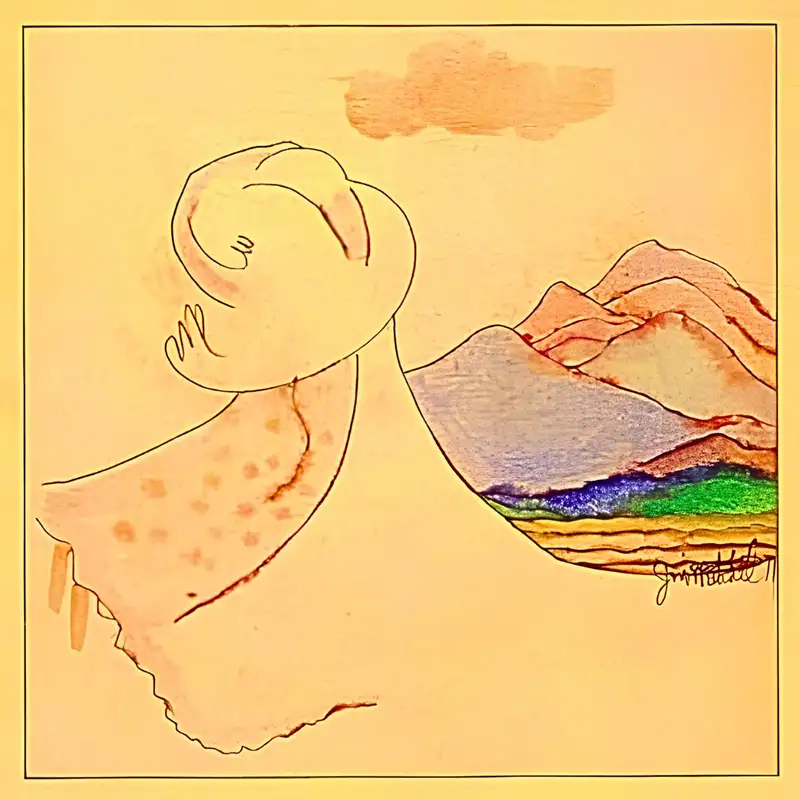
Joni did
make the cover herself. Yeah. Which is, again,
super gangster. This is the cover. Because Joni Mitchell. No.
Joni Mitchell is an art gangster. Yeah. She's the greatest.
Yeah. Thanks, Joni. Multitalented. Thank you so much, Joni.
Thank you, Joni Mitchell, and thanks, shout out, Tom Scott. For sure.
Joe Sample and the whole- Yeah, the whole crew ...
whole band, except on the last track. Unbelievable. Okay, till next time.
You'll hear it.