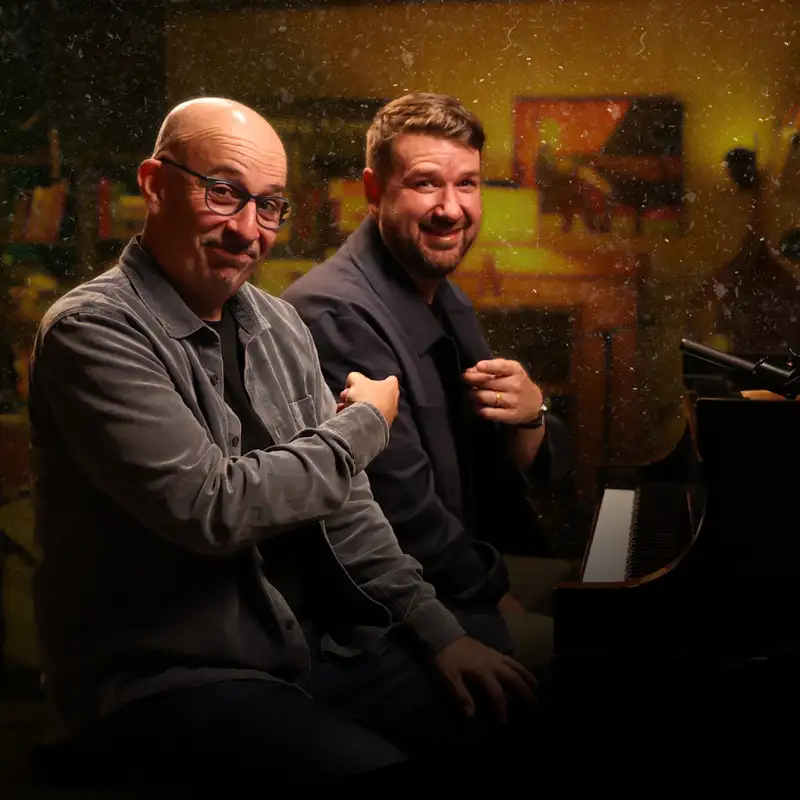
I am Adam Manis.
And I'm Peter Martin.
And you're listening to the You'll Hear
It Podcast, music explored, explored,
brought to you today by Open Studio.
Go to open studio jazz.com for
all your jazz lesson needs.
Peter?
Yes.
We've wrapped up If I do so myself,
another incredible, maybe the most
incredible season of the here podcast.
Honestly, it was a real blast this year.
It was thinking all these episodes for
you all listening to all this great music.
Think about the music you listen to.
Oh man.
It started with Steely Dan's Asia.
That's right.
That's where we started.
The year we started last year.
We set the, we started on the mountaintop
and looked out over the valleys
and the other mountains and said.
Gosh, we're gonna go climb some
other mountains, my friends, man.
So many highlights.
Yep.
A few low lights.
Well, yeah, but not that many.
We're not gonna name 'em.
Um, but we thought that, you know, with,
uh, putting on a a, a button on the
end of this year that Yeah, instead of
talking about some music that we would
talk a little bit about New Year, new you.
Ooh.
And.
The antidote to that?
Yep.
To the optimization.
Old or old you.
That would be the antidote.
Technically that's me every day.
Uh, no.
I thought we could talk about something.
We hint at a lot around here at
the the You'll Hear It podcast and
something we address directly at Open
Studio all the time, which is the.
Living a musical life.
I'm glad you said that.
Wait, let me look at my agenda.
I do have an agenda here.
And what does it say?
He's a how to live a musical life.
Are you a sound effects artist?
No.
That's right.
That's amazing.
Well, no, I was gonna say we
have no agenda, but we have
a little bit of an agenda.
But if we do have one, it's
about, yeah, how can we.
For selfish reasons ourselves, continue
to live, enhance living a musical life.
But mainly just talk with you guys
and the community, the, the wonderful
you'll hear at community that's
developed about what that means,
you know, living a musical life.
Uh, because every time I hear it.
Uh, it just puts a smile on my
face and I start hearing beautiful
music of, of different kinds.
You know, that's the
point of it kind of yes.
You know, is to like, the point of living
a musical life is to sort of get out
of the mindset of I have to set goals
and achieve them all the time, right?
There's nothing wrong with setting goals.
In fact, very useful tool,
but so often in today's like
modern social media landscaped.
We're, we're constantly pitted against
other people and comparing ourselves.
Yeah.
And to their ridiculous, often fake,
uh, daily routines that they'll
post of like, waking up at 4:00 AM
and then you say a mantra for an
hour with your wife on a treadmill.
You know what I'm saying?
These kind of people, oh, when
I wake up at 4:00 AM you should
hear what I say to my wife.
It's not, it's not a mantra
and it's not very positive.
I can tell you that right now.
But no, you know, I got stoics telling me
to walk down the street without a coat.
In the winter, which is
cool that that works.
That does work.
But, but here's what I'm saying is
like, yes, setting goals and having,
having goals is super important.
And understanding how to, to
work a, a checklist and set up
a routine is good and important.
But also the best musicians,
the best artists that I know.
And, and just speaking to artists,
but really to people in general
is like, like if you're, if, if I
know someone who's a really great.
Musician, it's not because
they're really good at making a
checklist and then checking it off.
Mm. It's because they've committed
their life to including music and their
art right into damn near every aspect.
I mean, I know people who are really
talented runners like yours included.
Well hopefully know some
better ones, but yeah.
Thank you.
But I, and I know you have, you
know, workouts and you, you've had
coaches at various stages and, but.
It's more like running is more than just
that your, your Strava account to you.
Right, right.
It's like a, it's like a, a
philosophical, almost, dare I
say, spiritual part of your life.
Yeah.
And I, that to me stands out as what
I wanna talk about is like, I think
we get too inundated and we get too,
uh, uh, self-imposed, uh, with like.
Improvement, optimization,
hacking, you know, goal setting,
all of it can be very useful.
Yeah.
But with a little bit of perspective.
More importantly, it's setting
up your life to include the
things that you love in it.
Mm. And that first, the first step
of that, um, in this journey for me,
and maybe we can start here, is like.
Determining what it is you love
determining what it is Yeah.
You want in your life.
Yeah.
A lot of people don't even know.
That's right.
That's right.
And I think, um, this may be, you
know, hearing you describe it, it
like that gets me thinking that living
a musical life and getting to know
what it is that you love and enjoy
is an area where I think we can be.
A little bit selfish about the
nourishment that we have from music.
Hundred percent.
Yeah.
And that's a good thing because I
think as musicians and, and no matter
what it is we do professionally in
this world, um, but certainly I think
musicians or like what we do, what
we're trying to do here with the
podcast is very service oriented, right?
So like we're trying to, you
know, share music, share different
outlets, uh, different outlooks.
On music, ways to enjoy it,
different angles to view it.
You know, maybe another prism
we're turning a little bit.
And mainly just to sort of, you know,
commune and, and commiserate with each
other, with the listeners, uh, and
share in these, these glorious recorded.
You know, cultural artifacts that we have.
And so like, there's a lot of
service to what we do and, and I
look at myself as a musician as
basically being a server, right?
Like I'm kind of put
here to sit at the piano.
I have a skill and that, but that's
not to just make me feel good.
In fact, that's not even the primary.
Reason for it.
It's to make, to uplift other
people's lives, to give them
some, some nourishment, right?
Mm-hmm.
To give them some selfish satisfaction in,
in listening to something that they enjoy.
Just like if you go to a, a, a great chef,
you know, they're, they're serving fruit.
You can go, you can make your own food.
And a lot of times
that's what we're doing.
Yeah.
But you're going to someone to serve
you food, to get you to look at the
world in a different way, to be a more
positive, you know, to have this network
effective positivity so that we can maybe.
You know, counteract some of
that adversarial algorithm that
you mentioned on social media.
And so I think when we are in the
service industry, it's okay to look
at the other side of the musical life
as a sort of a selfish thing, right?
For sure.
You know, in that we are
consuming, being entertained.
Um, with music and, and, but,
but how do we go deeper and
connect that with our playing?
Or maybe we're not players and we
never wanna play an instrument,
but connect that with how we look
at the world, how we interpret
lyrics, how we interpret harmony.
Like when we talk about harmony in
music, how do we, how do we bridge
that with harmony of human beings?
That's great.
Oh boy.
Did I just jump onto another mountaintop
that I can't quite climb to, I
don't know, harmony of human beings?
We've got a new thing to shoot for here.
Well, let's, let's maybe start
with just a couple, like, let's.
Define a little bit.
Uh, get, get down a little bit into the,
to the granular bits of like what we mean
when we talk about living a musical life.
Mm-hmm.
Like the first principle I think of
and, and what prompted us to start
using that term is the sentence,
there is no finish line to this.
Right.
So I think a lot of people.
I know me personally, have felt at various
times in my life that I need to be able to
do this by this point, or if I work hard
for the next eight months, then I'll be
right, then I'll have it transformation.
Uh, it's gonna be a transformation
that starts at a and ends at Z and
that is not how a lot of life is.
No, that's just not how, and
also that's not how any of
the artists that I admire are.
Mm. It's, it's, it's a little
bit bigger than that, but, but.
Uh, the sentence, there is no finish
line to like learning jazz piano, right?
Is a lot, is freeing for a lot
of people who think like, oh,
I've gotta achieve something.
Um, because what that means
is you already have it now.
Like what you want, you already possess.
Right.
The greatest players in the
world have a true sense of like,
I am, I'm giving you something.
This is something I can present to you.
And they're still always
working on their craft.
Right.
So like the working on
your craft never ends.
Mm-hmm.
There's no finish line to it, which
may feel at some point, like daunting,
but also it's like, no, no, no.
That means that you.
You're not gonna be at a, like, you're
not gonna go to sleep one night a,
a beginner jazz pianist and wake up
the next day a great jazz pianist.
That's not gonna happen.
It's all you right now, and you have
permission to give people something
interesting with what you have, the
tools you have right now, and we're
always just working on those tools.
Right, right.
It's this, it's this paradox of.
Of, I already have everything
I need to be a great artist.
Right.
That's true of everybody.
It's true of a, of a toddler.
Like you already have everything
you need to connect with someone.
Delight them, nourish them.
Mm. It's all inside us already.
We're, as a human beings we're.
It's our birthright.
We get that.
Yeah.
When we get born and the rest
of the journey is, is spent.
Honing those skills
and making them better.
And just because you are, you are
not as far along on the skills path,
doesn't mean that you don't deserve
to do the other thing at any time.
Right.
And once you realize that you get to
make great art whenever you feel like it.
Yeah.
And you're all also get to
keep working on those skills.
It also sort of takes the.
The, it, it decouples you as a
person from the art that you make.
And so often the living musical
life is also a great term of
like, um, it's a musical life.
It's not, it's not you, it's not.
Your value is not wrapped up
into what you achieve musically.
Right.
Right.
Which a lot of people were taught
from a very early age, from some
questionable teachers probably,
that they either weren't a musician.
Right.
They didn't have what it took, they
weren't, and that their, their value in
music was wrapped up in their skillset.
And I'm here to tell you.
That is not the case.
No, I mean, it's like I, I, I firmly
believe, I know that all humans are
musicians, right in, in that all
humans have the potential from birth
to be able to connect with music.
Whether that's as a listener, as a
musician, as a singer, we're all given
voice just like we're all writers.
Now, if you're, if, if, if you're,
if you're not in the privilege.
State of being where you learn how
to write with a pencil or learn words
or learn a language or something.
That's something that has to be developed
and nourished and, and you know, from
parents or caregivers or whatever.
But I think the potential is there.
We all have that heartbeat.
We all have that.
You, you know, that sort of
innate internal desire to con, I
mean, it's a powerful force now,
does everybody connect with it?
No.
And you know, does it become
a self-fulfilling prophecy?
Unfortunately, for many.
I'm not musical.
I'm not a dancer.
I'm not.
I wanna be all that and I am all that.
You know what I mean?
Yeah, yeah.
And, and I think we're all athletes too.
Like, because we all move.
Right movement.
Like it is, it's like the difference
between thinking about am am I an
athlete because I move around the
world or am I I an athlete because
I can win at a particular sport, you
know, or hit a certain time in a run
or jump over a certain, no, no, no.
I mean, now that might make you
an Olympic athlete or something.
But an athlete is, is somebody.
A human who connects with the
movement of their body 100%.
And revels in that like live.
Live a moving life.
It's a live a musical life.
Right.
It's a great analogy because if you're
waiting to be a professional tennis
player, if that's what your goal is, yeah.
You are like, okay, I'm going.
Or I'm just gonna be like
a top level tennis player.
You know?
When that doesn't happen, you might be
like, well, I guess that's it for me.
And movement.
Yeah.
You know what I mean?
But it's just like that's not how.
That's not even how
professional tennis players are.
Right.
You know what I mean?
It's just tennis is their
life and for professional
musicians, music is their life.
That doesn't mean that you have to forego
everything else for your particular life.
It could be this balance thing.
But I love what you said about everybody
is a musician, which is something that
I was, I was kind of hinting at too.
Like it's proven out to me.
If you've ever been to a huge
concert at a huge stadium and
heard the crowd sing along, yes.
Or at a sporting event and
you hear the crowd singing or
chanting something together.
Wasn't that on the, the Prince
record that we just did?
Oh my God.
They're all singing in Paris
and, and Prince put on the album,
he said, background singers,
6,000 Parisians on this date.
You know, it's the most powerful
thing we can do as humans.
And it's connective, it's connective
tissue, and everybody can do it.
And is everybody in that crowd, you
know, uh, uh, Ariana Grande, right?
No, no one can sing like,
you know what I mean?
Like right.
But it sounds incredible when we, is
that what we went to for our top vocals?
I like that.
I was thinking about, I was
just trying to That's good.
I like it.
She can sing.
Yeah, she can sing.
Come on now.
I didn't know we were gonna
go there as, as, as, as the,
the, the mono lips of singing.
Arianna, I love you.
Please come on the show.
I think you're amazing.
Um, no, no, no.
But uh, but it's the, it's the comradery.
It's the con, it's the human
connection that elevates, like, once
you realize you're part of something
bigger, like living a musical life.
I think is very much with
connecting as a listener as this.
I mean, I love this idea of
the singer because almost
everybody can do that, right?
Yep, yep.
You know, and it's really not
about, are you Ariana Grande?
Or maybe even better.
But I mean, it's, it's about like,
like, because you talk about, you
know, tribalism and a mob mentality,
we always look at that, unfortunately
in the modern world as well.
Not only the modern world
historically as a negative thing,
but what about all the beautiful.
You know, the mob mentality
of 6,000 Parisians singing
background as Prince directs him.
That's a nice mob.
You know what I mean?
Oh yeah.
Like that elevates people.
'cause when you're part of a
choir, we've all done that before.
You can sing better than on your own.
You know?
You literally could.
You literally can you, you, you
get swept up in that living life.
Anybody who's ever been to a church and
you're sitting next to that old guy.
With the big bass voice.
Yep.
And he just, he just unleashes a
little outta tune, but super resonant.
Oh, you know, gives you that
confidence that, oh vibe, my gosh.
I singing so loud.
Um, so, so just to recap the
first couple principles here.
There is no finish line.
There is no day where you go
night, where you go go to bed.
A bad musician to wake
up a great musician.
No.
Uh, there is just you.
Being an artist and working on your
skills again and again from, whether
that's you or Herbie Hancock, you're
both doing the same thing and you, that
leads us kind of the second principle.
You already have what you need.
Yeah.
To make.
A connection with people, with your art.
You have enough skills, even
with seemingly no skills.
You have it, you just need to do it.
You need to be, have confidence
in your light that you're
sharing with other people.
Um, and then, and you have
to, you have to stop me.
And so, uh.
Like, it's actually a
form if you're a musician.
Like we're talking about kind of
two different things that I think
we naturally connect more, but we
should just say like, even if you're
a listener, I'm still including that,
strangely enough in the musician side.
Oh yeah, sure.
Because you're, you're, you're
tapping your foot to it.
You're singing along or something.
You're already a. Mus musician.
A lot of times we think, well,
I never learned an instrument,
so I'm not a musician.
Doesn't mean you can't connect with music.
Right.
But if you are a musician, no.
Like you say, no matter what level
you are, you're a little selfish.
If you're not sharing that with
the world or sharing that with
your spouse, or sharing that with
your children, or sharing that with
somebody, uh, because the world doesn't
just need Herbie Hancock, you know?
Um, the world needs all different levels.
It just needs more music.
And if you go back to what we would call.
Unfortunately, primitive cultures
that are still around a lot of these
so-called primitive cultures are very
advanced in terms of the way that they
treat very inclusively, everybody,
part of their tribe as living a
musical life like you talk about.
Cultures in which communication
is done via music.
Beautiful music, not just like it's, you
know, uh, ring a ding, ding on an iPhone.
I'm talking about like calls between
villages and all these kinds of things.
A lot of the primitive things we've
got, we've lost our ability to connect
with the same way when there's a typhoon
coming or something, we, you know,
how do we get in touch with like our
bodies, you know, telling us something
bad and the weather's coming if, if
we don't get an iPhone notification.
You know?
Yeah.
We can connect with these
things if, if we're willing
to do them, they're all there.
I mean, communication is, is one
of the primary reasons that humans
created music in the first place.
Yeah.
Is so that I can hit a drum in a
certain way and a couple miles away
that the village down the street
is like, oh yeah, yeah, yeah.
Uh, bad.
You know?
You know Kelly?
She had her baby.
Yeah.
It's all good.
I'm like, Hey, congrats Kelly.
What is this the village
idiot you're talking about?
That's me.
That's me, buddy.
No, I love that man.
Um.
Yeah, it's, and celebrations.
I mean, think about that.
Like, so intrinsic, intrinsic in, in,
in the celebratory process has is music
and the more so-called primitive the
culture, the more it's part of it.
Um, I mean, I think that's something
that a lot of, you know, people
still do connect with music.
Think, I mean, like everybody wants to
have music at a wedding, at a funeral,
at these important human events because.
You know, music is one of those, uh,
uh, elements, you know, language, music,
food that can be, you know, elevate and,
and be a connection and nuanced part of,
of the most important things in life.
Yeah.
I mean, yeah, if you're at a Prince
concert in Paris in, in 1987,
that's its own moment, right?
But I mean, there's musical moments.
Available to us at all different times.
I mean, I remember a time and, you
know, talk about a selfish, uh, self
nourishment, uh, type of situation
walking, uh, in the museum, Darce
in pa, we're talking about Paris
got me to thinking about that.
And I had, this was kind of early on
with like one of the early iPods, I
think, and I was like, you know what?
I'm gonna put on some revelle as
I walk around and look at these
beautiful French impressionist.
Paintings.
And it was one of the, I mean,
I still remember how I felt like
listening to that beautiful music
as I'm looking at these beautiful
paintings that sort of matched, it was
like some kind of crazy wine pairing
with the perfect food or something.
So, I mean, it's like, that's
a very decadent, you know, uh,
sort of, uh, selfish situation.
But I think that that's.
Very much along the lines of music
as celebration, music as nourishment,
music, as connection of humanity.
Like, you know, any, anytime we're
using music to elevate like our
vibration and our collective, you
know, connection as humans as opposed
to all these things that are in the
world that are gonna push us down.
That's the antidote, right?
Mm-hmm.
That works.
You know, across cultures
across, I'm not trying to be
globalist, it's not about that.
I'm just saying that like human humanist.
Right.
For sure.
Human connection for sure.
It's a big part of it.
Yeah.
And big reason why we do it.
Yeah.
One more.
What makes us human?
You know, one more answer that and
then we can finish the podcast.
Adam.
Simple question.
Baloney.
What makes it a good bologna sandwich?
It makes me feel connected.
Nice.
Um, one more principle I
just want to hit on here.
Yes.
For living a musical life, and this is,
you know, we talk about this with a lot
of our open studio members all the time.
Like I, I do, I have a,
I have actually a Monday.
Uh, an ongoing Monday zoom call with
all of our open studio members called
Living a Musical Life q and a, where we
talk a lot about all of these issues.
And another thing that comes up a lot
is to, and this is sort of the final
principle that we'll talk about on
this show, but it's something that
you can apply right now, which is to.
Define your own taste and follow
your musical heart, right?
So a lot of people will ask us as we're
teaching jazz piano at Open Studio,
and even on this podcast like, um, you
know, for listening recommendations
or what should I transcribe or
what piano should I check out?
And, and definitely that's a great way
to learn and discover, yeah, new music.
But when someone says like,
what should I transcribe?
I always say.
You know, I have my sort of like
beginning, oh, you know, red
Garland, what is this thing called?
Love is Good or whatever.
But I'm also like, what's the most played
song in your, on your phone right now?
Like whether that's Spotify or
YouTube or Apple Music, whatever,
like what's the most played song
of the past six months for you?
Hmm.
And do you know how to play it?
Right?
Ooh, what's your favorite song this year?
Did you learn how to play
it if you're a musician?
Certainly you would wanna learn how
to play your favorite song, right?
Yeah.
And so many people are like,
that's not connected at all.
Like they, they're waiting for, I don't
practice Taylor Swift on my piano.
That's what they're saying.
Yeah.
No.
They're waiting for an expert to say,
this is what you should be practicing.
This is what you should learn.
This is a song you should learn.
Yeah.
But I'm giving you permission now
to do what again, the greatest
musician, like we've been so
fortunate here at Open Studio.
To be in close contact working
with a lot of the greatest
jazz pianists in the world.
Yeah, and one of the things
that they have in common is
they follow their musical heart.
They follow their curiosity.
Of course, a lot of them are in
reference to masters that they've
studied with and will check out their
music and the music of the people
that came before them naturally.
But they also.
Have a very clear defined sense
of their own musical taste.
Yeah.
And they have the curiosity to go
figure out what it is they like
about what the music that they like.
Mm. And I'm giving you permission to
not just, uh, listen to and figure out
what Peter Martin is telling you to,
or what Adam Manis is telling you to,
but go learn your favorite song Yes.
On your instrument.
Go learn how to play it.
You know why?
'cause you're gonna
learn it so much deeper.
You're gonna, you're gonna.
Feel an immediate emotional
impact and know how to create that
emotional impact in other people.
Because you know what it feels like.
'cause you love this song.
Yeah.
It's hitting you in some way as opposed
to me saying like, go learn a song that
you don't have any connection with.
Um, which is not, again, not something
you shouldn't do, but like also you
gotta follow your own curiosity.
Another question we get asked all the
time, Peter, is like, how do I know
when I'm done practicing something?
And the answer is, is like, first of all.
You're never done practicing anything.
We're working on like 10 or 12 things.
Just from the different angles, right?
Yeah.
Yeah.
It's like technique repertoire,
melody, rhythm, harmony, whate.
Like there's, there's about 12
things we figured out one day.
Yeah.
Around the studio here.
Yeah.
Uh, big buckets that we're working
on and they go back like probably
hundreds of you, hundreds of years.
These are not things we invented.
That's when you walked in.
Today I'm practicing a
freaking B major scale.
Right.
And I'll, I realize I'll be 80.
If I lived to 80, I'll be 80
practicing a b major scale.
And that's cool.
Like I'm.
That there's only a couple of things
that we really are working on.
That's right.
And so when someone says, how
do I know when to move on?
It's like you don't have to have, you
know, Vladimir Horowitz level mastery of
every technical aspect before you move on.
Right.
Follow your curiosity,
follow your musical heart.
When you're ready to move on, move on.
Go.
That's right.
Go.
You can come back.
You're gonna be back anyway.
You gotta come back.
You gotta come back and yeah.
And then the thing that you go move
on to, you're gonna get bored with,
and you're gonna come back to this.
You're gonna move on to another thing.
But follow where your heart is leading
you and you will always be working
on something that keeps you at the
instrument that keeps you engaged
and something that you care about.
And that's the most important thing
is like, man, what do you like?
What do you love?
That's right.
A lot of people can't answer that.
Figure out what you like and what you
love, and then figure out how it works.
Yeah, that's it.
Absolutely.
You know, what do you think about this?
Um.
I'm talking about, you know what?
What do you love?
I'm just wondering when people say,
well, I don't know because like, is it
as simple as, wow, that sounds great.
I love it.
Like as soon as you hear something,
because I think there are instances where
you have to kind of warm up to something.
You know what I mean?
Like you have to Oh yeah.
Maybe hear it.
So, you know, like there is a time when
like Peter and Adam say this album, I'm
like, I'm not really feeling that Prince
album that they just, but the more I
listen to it, the more it's growing on me.
Totally.
You know, so it's like giving yourself
a chance, not only in your practice in
terms of like, when is it time to move on?
Is this something, is
this a direction I love?
But also I think in our listening taste,
I mean, only because, look, ideally, we
all from a very young age are exposed to
all the great musics of the world, equally
for eight hours a day by our parents.
And so we grew up with this, you know,
very poutama approach to music, uh,
understanding things around the world.
But that's not the reality.
Like we're so influenced by
our parents taste, right?
I did not.
See on my bingo card, PAMA
becoming a buzzword around
open studio at the end of 2025.
Here we are, if you know, you
know, if not, here we are.
If you're not, don't bother looking it up.
It's not worth the gag.
Don't worry about.
No, it's a great question.
So, but this is, I think, something
that all listeners and artists
are working on all the time.
Right?
It's like, so, you know, like
we just released the Sign of the
Times episode, and that's not
an uh, uh, album I grew up with.
Yeah.
And the first time I heard it
I was like, Ooh, I don't know.
What this is.
Yeah.
I don't know if I like it.
Like when I hear, you know,
the, the early print stuff, I'm
like, oh, I know, I like that.
Yeah.
Because I, I, I already
have a reference to that.
Yeah.
Late seventies, early eighties thing.
But this, I'm like, what is this?
I don't know.
And then, but this is what great art is.
Yeah.
A lot of times is like, but it's, first
of all, it's Prince, so I know that.
I trust this artist.
Right, right.
He's not a like, oh, I'm gonna
hit a couple good albums and
then it's all downhill kind of.
Yeah.
I'm gonna give him the
benefit of the doubt, right.
A little bit.
And I'm gonna give it a couple listens.
And then maybe also,
maybe I don't like it.
Like maybe like I happen to really
love side of the times, but maybe
I don't and that's fine too.
I got a lot of other print stuff I
like or, or other artists I love like.
And you don't have to force just
'cause everybody else likes something
or, or Peter and Adam say it's great.
Doesn't mean that you
have to think it's great.
It's just like, it's just, you know,
when you have, like for me, I have a
lot of friends, you're one of 'em that
when they say, Hey you should check
this out, I'm gonna give it a listen
and give it, give it a fair shake.
Right?
Right.
I'm gonna come with in good faith
that, and I think that's good.
I have that too.
It's definitely with you and
different people like, and it's
not even about, oh, I only trust
people that have as much or more.
Musical expertise than me.
It's more like I trust people that are
open-minded to a point, not open-minded in
the sense of like, oh, I love everything.
Everything's great.
It's like, if everything's
great, nothing's great.
Right?
Yeah, that's true.
But also understanding that
there's a spectrum of what.
It is not necessarily like, like I
don't think there's any denying, some
of these albums are great, but just
'cause something's great doesn't mean
it has that deep resonance for you.
And that's okay.
It's totally true.
'cause like you already mentioned,
and we've acknowledged many times
on the pod, it's, it's, it's, it's
a feature, not a bug, that we have
connections due to nostalgia with music.
We talk about, you know,
certain celebration points.
Um, you know, at my wedding
we played Anita Baker.
And like those songs are deeply,
like, if I really go back and analyze
them musically, maybe I'm like,
oh, this isn't the most exciting
thing, although it probably is, or
the playing, but it's always gonna
have this connection point for me.
And so like, that's, that's, that's a
beautiful thing, you know what I mean?
That's a great point that the, the
emotional connection to music is.
Is as important as actually
the quality of the music.
You know, this season, earlier this
year, we did a, that episode on
Herbie's head, hunters Band Run.
Yeah.
Right.
Which included a little album.
I don't know if you've heard
of this, but I I, I love it.
1976 is Secrets.
Yes.
Right.
Let's just say Adam did show up to
that episode very early in eager.
Dressed in his Sunday's.
Best, I can tell you that much.
And you know, secrets.
I went to go buy some headhunters
at the borders and Sunset Hills.
Yeah.
They didn't have thrust,
they didn't have the original
headhunters, but they had secrets.
So that's the one I bought.
Yeah.
That's all I could afford.
'cause I was 16 years old.
Yeah.
Cruising around in my 84
s 10 listening to secrets.
And when we were listening to that run, we
were listening to the Head Hunter's album.
We were listening to Manchild, we
were listening to Thrust and Secrets.
I realized, I was like, you know what?
I could, like, secrets isn't
the greatest of this run.
Like definitely thrust is amazing.
Like thrust is like the peak of this run.
Right.
But I, yes, will always
go to secrets first.
Yeah.
And it's because it has this lifelong
connection where I connected with
it so heavy when I was at a very,
you know, impressionable age.
And so for me, that'll
always be my favorite.
I recognize.
Yeah, it's not maybe the most cohesive
of that run, but that doesn't matter.
It's my taste.
And that's a good, like, uh, that doesn't
mean that's a feature, that's a feature.
It's not a bug.
It's like, oh, I'm right or wrong.
It's like, no, this is my jam right here.
This is what I like.
Yeah.
And I think just looking into next
season for, I'm so excited about 2020.
Well, you dear listeners
are already in 2026.
We are about to embark as we time
travel, but like that's really.
What we're trying to do here
is not to be taste makers.
We're just trying to share Yeah.
Right.
Share things that excite
us and, and like really.
Focus and, and not genre specific at, at
all, but try to get stuff up into that
area, not of we're gonna rank them now.
And not that you have to love
everything, but that you're in the zone
of like, it's okay to like this more.
And all these are great
albums on some level for sure.
But how, how the rank choice, it's
like rank choice voting, right?
Yeah.
You know, it doesn't have to be e exact,
but we're trying to do stuff that's
beautiful, has substance and resonates
with people that That's exactly right.
And you mentioned that, that.
That we love, we we just put
together next season, which is
gonna be a really good season.
Yeah.
And we were like, well, classical coming
at you, we were talking about like, well,
what are all these things have in common?
And it's really just albums that
you and I have some kind of deep
affinity for or connection to.
Right.
You know, and that's at least
one of us, if not both, at
least one of us, if not both.
And that makes a huge difference for us.
Like if you're, if you're wondering
like, why is this not just.
Straight ahead Jazz, or why is it not
just Michael Jackson's asked that on this?
We could, we a couple people,
but it's because we're just
doing albums that we love.
Yeah.
Regardless of where it comes from,
that's literally what our agenda is.
It's literally the only, yeah.
The only criteria is that one of us has
to love the album that we're listening to.
That's it.
Yeah.
Yeah.
Good.
Well, I'm excited, man.
Adam, thank you for everything
this year and, and all the.
Thank you guys to the listeners
for being here with us.
Hell yeah.
We hope this helps you in just some
small way to live a little bit more
of a musical life and that's what
we're gonna be doing on the pod here.
So this is a safe place for you to
tune in to live your musical life.
And at Open Studio come if you want
to get better at jazz, piano less.
If you wanna go next level, if
you wanna go next level, you
know, and not just jazz, piano.
Like we are primarily, like, I think
that the instruction, especially what
you're doing with, with, uh, with your
specific instruction and courses, is about
leveraging jazz principles to pretty much
be able to play anything on the keyboard.
Well, mostly the stuff from secrets,
but yeah, for sure, for sure.
All right.
Until next year, you'll hear it.