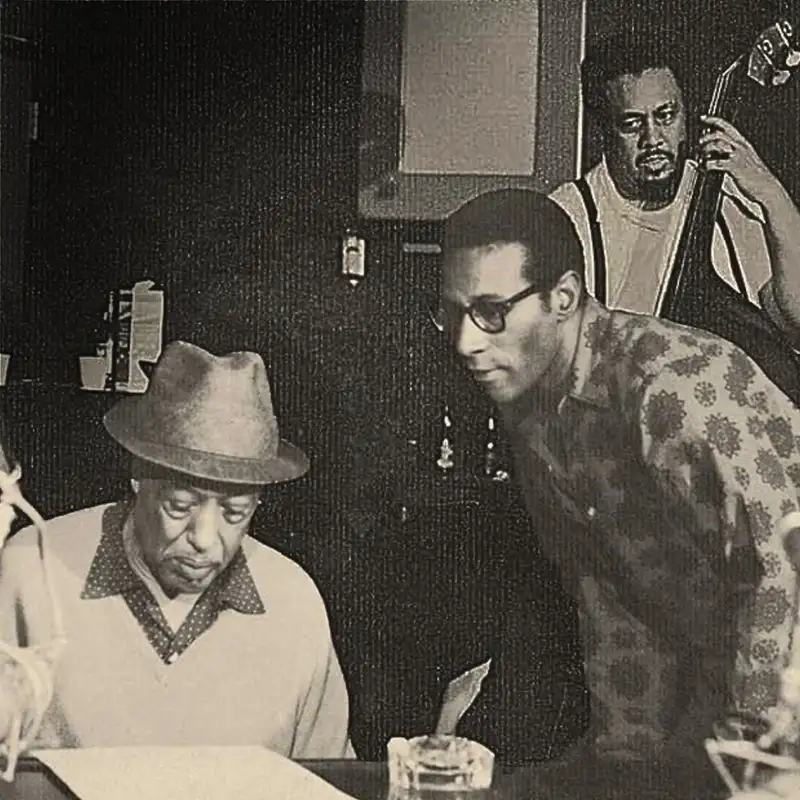
Some called it ridiculous.
Others say it's the greatest piano trio album of all time.
You've got Charles Mingus, a powder keg of talent and temper, kicked out of Duke
Ellington's band once for attacking trombonist Juan Tizol.
You've got Max Roach, one of the best drummers who ever lived, an intellectual
bandleader who demanded only the best from his side men.
And then there's Duke, a seemingly untouchable legend.
Nobody told him what to do.
All three of them in a studio,
one day of recording.
It's "Money Jungle."
Does it work?
I'm Adam Maness.
And I'm Peter Martin.
And you're listening to the "You'll Hear It" podcast, music explored.
Explored, brought to you today by Open Studio.
Go to openstudiojazz.com for all your jazz lesson
needs. Peter Martin.
Yes.
Welcome into the show. Are you prepared for
perhaps the most tense album we've ever
listened to-
Yes, I am prepared
... here on the "You'll Hear It" podcast? Are you ready for this?
I think I'm ready for it. This is
a controversial record, I think.
This is a very interesting record.
It's a weird record, and I'm just going to go ahead and put it out there.
Yeah.
This is not a great record.
This is not your favorite.
Well, not only is it not my favorite, for sure, I don't think that this is a great
record, and I just want to say that because I know that this is apparently a
beloved record.
One of our most requested records here-
Yeah
... on the "You'll Hear It" podcast.
This is, of course, "Money Jungle" by Duke Ellington, Charles Mingus, and Max
Roach. It is a veritable supergroup
of jazz musicians who were around in the early
'60s. This was released in February 1963, recorded in September
1962 at Sound Makers in New York City on the United Artists label, although
I think eventually it would move to Blue Note.
Is that-
Well, I think they got bought up by the whole-
Oh, that makes sense
... EMI Toshiba, so it was released.
When I first heard this in the
mid-'80s, it was released on CD.
Yeah.
Actually, a similar format to this, with a couple of the alternate takes, not all
of them, but on Blue Note. And it was also remastered, I
believe, and maybe even remixed, I'm not sure.
So-
And I just want to put it out there. I didn't mean to be harsh by saying...
I should've said I believe. I don't think this is a great album.
Yeah.
But I'm open, and I'm excited to explore it with you and with our dear
listeners. And look, let's just put it out there.
Not everything is supposed to be great to everybody. You know what I mean?
Well, it couldn't possibly be.
Well, no, it couldn't. And I-
Although, this podcast is pretty much fat with albums-
Right
... as we know.
But I think
that one difficulty we have within the jazz world, and this podcast is just
about great music, and exploring music-
For sure
... together, and celebrating music, right?
Yeah. Not just about great jazz. This is about great music that we love.
Yes. And because this is a record that I know a lot of people
love, it's important, right? Whenever something stands the test of time-
Of course it is
... it's not about... And we're going to pick it apart.
And I've got notes, my friend.
Well-
But that doesn't mean that it's not valid.
Your opinion is just as valid as my opinion.
Just because
we're music podcasters or jazz pianos, I don't think that that gives us any more
authority to say what somebody likes or not.
But for me, I'm such a fan of all three of the artists that are
on here.
Well, that's it, isn't it?
Yeah.
You nailed why it's even worth
giving this album a shot in the first place, is because it is
these three heavyweights.
And Mingus and Max Roach are kind of in their prime right
now.
Yeah.
I mean, they're right in it. And we'll get to Duke Ellington and his later career.
I have a hot take on this, actually.
Okay.
But I think this is some peak Duke Ellington.
He's had many peaks, obviously, by this point.
I think he peaked a week later. That's what I think.
Well, we could talk about that, for sure.
But it's, to me-
As a pianist
... I really enjoy this album. This is not a
monthly listener for me.
Mm.
But I've been a fan of it since I was a teenager, and I come
back to it occasionally because it's such an incredibly crazy
document of a very tense day between three
very larger than life personalities.
Mm.
Three mega-talent musicians, and-
Big personalities
... big personalities. The question, does it work?
I think that just kind of depends on what you're looking for as work.
If you're looking for something that's just like toe-tapping, feels good, feels
bright and shiny, this is not that.
Yeah, but I'm going to start to push back a little bit on that-
Push back
... in terms of, yes. There's a lot of things.
We don't always want happy, toe-tapping, let's go back to the swing era.
It's not about that, but I think that there is, for me, the
production on this record, the engineering, is of such poor
quality. I would say somewhat objectively-
I agree with that
... poor quality.
I agree with that.
The
recording is some of the worst I've ever heard of Duke Ellington.
Agreed.
Even going back to the '30s, the piano's out of tune.
Now, we could say, "Well, these are incredible artists." It's like, no.
I mean, yes, they're great artists, but that doesn't mean they're great artists
every time, and I think it's part of our lionizing of these artists.
We give it a disservice in jazz when we're like, "The production doesn't matter."
And I'm like-
Well-
... "Eh, it kind of does"
... before we get too much further into it- ... let's listen to a little bit.
Okay.
This is the opening track, the title track, "Money Jungle."
Charles Mingus on the bass, Max Roach on the drums, Duke Ellington on the piano.
I do like the way this record starts.
It's killer.
It definitely sets the tone, right?
Mingus is menacing. He is menacing.
Mingus-
I don't know. That's the only word I can think of
... man.
His choices of what to play.
He was a powder keg.
Yeah.
This is notoriously, kind of a
frighteningly angry musician.
Yeah. Well, and look-
Huge player.
I know, but all that is sound-
Enormous artist, but...
I'm just saying musically, even if you didn't know any of that, I think we have to
take the document for what it is. Right? So, the music as it unfolds.
But he's menacing in terms of, not only is he not really
supporting what's being played. I don't know.
Those first 30 seconds are so great, and to me, it just starts to fall apart.
I feel bad because I'm talking over this, and I want people to judge it on their
own.
I mean,
there's good stuff happening, obviously.
So this whole album recorded in a day.
This is obviously a minor blues, "Money Jungle."
I mean, are they locked in?
Is Charles Mingus and Max Roach as a rhythm section locked in?
I don't think they are.
And I think-
There's just so much tension, isn't there?
Well, tension is fine, but I'm saying, are they locked
in as a rhythm? They're swinging. It's not like there's only one way to
swing, but they're playing a groove and I feel like, it
sounds to me like they're throwing off the Duke Ellington-
But is Mingus playing a groove?
No.
He doesn't leave that groove and go, ba ba ba ba ba ba.
I mean, he starts out in the beginning, he's like, da ding ding.
But I mean, Max is swinging.
What he's doing here.
He's menacing.
I mean, what happened to support the soloist? Hello?
I don't think it's about that right now.
Like, Duke's playing some nice stuff, but he can't...
Between the sound of the piano and what Mingus is doing.
I think Max Roach is doing the best that he can.
I'm not trying to blame this on Mingus. I'm just like, I don't get it.
Every time you kind of want to get it in there, in terms of the groove.
All right. So it should be said-
It's a minor blues. This is the other thing. This is a 12-bar minor blues.
It's not that you can't play it any way you want, that's fine, but the expectation
when you start a record like this, and Duke is playing the way he is-
Yeah
... and it's not that there's one way the rhythm section has to play, but
Max Roach is playing that, and it's great that
Mingus brings his thing to this, but the tension
is, there's no establishment of the groove outside of those first...
I feel like this
cut, and in some ways, this album peaks at the first 30 seconds of this first
track. There's beautiful places that come in-
No, hard disagree on that. There's some really great moments after that.
Yeah, but I mean, I don't know, man.
We always talk about how the first track sets the tone.
I mean, again, this is just-
I mean, there's definitely-
... if somebody listens to this and is like, "Oh, my God, it's so inspiring,"
that's great.
Well, just for some context-
Yeah
... there was a lot of tension at this session. So this is a one-day session.
Max Roach is complaining, apparently, about Mingus's playing to everybody
that'll listen during the session.
But Mingus kept playing louder and louder, almost defiantly-
Yeah
... which is why I'm saying, I think Charles Mingus had some just unresolved
personal issues with some of this.
These guys, by the way,
I think had all played together in various combinations-
Yeah
... at some point. Mingus and-
Mingus and Max Roach had both played with the Duke Ellington Orchestra when they
were young.
At certain times, that's right.
Really.
And famously, we talked about this in the "Ah Um," Mingus "Ah Um" episode-
Yeah
... that Mingus got kicked out of Duke's band because-
Because they had a fight with Juan Tizol, right?
... Juan Tizol, composer of "Air Raid"
And there were various stories about that.
But even just a few years earlier, like
seven years before this,
Charles Mingus made a quartet record plus Max Roach.
This is "Haitian Fight Song." So they're playing together.
Yeah.
It's not like they don't like each other.
Right.
You know what I mean? They're playing together.
No, I mean, didn't Mingus recommend, like, Max Roach was
the first, when he was talking to Duke Ellington, or maybe it was the other way
around,
that I think Mingus said, "I want Max Roach.
That's what's going to make this happen."
Absolutely.
And Duke Ellington was like, "Cool."
And by the way, just a little bit of lead-up for all of this.
I can't believe we would have to do this, but if you don't know how we got here in
the first place, Duke Ellington was in his 60s at this point.
He was 63 years old when he made this.
He was one of the most famous musicians on the planet-
Yeah
... at that time, and had been for the last 30, 40 years, starting
with...
Da doo.
Now, that's locked in.
1930.
Da doo, da da doo, da da doo.
There's elements of this production that are superior to "Money Jungle."
I agree. Don't mean a thing if it ain't got that swing.
Also-
Oh
... you might recognize this one.
That's a better piano sound.
It's a Billy Strayhorn composition, "Take the A Train."
Yeah.
Huge star, Duke Ellington. Max Roach came up playing,
is a generation, or maybe even a generation and a half, younger than Duke
Ellington. Came up playing with bebop musicians like Charlie Parker and Dizzy
Gillespie and Bud Powell. But famously-
Ah.
Clifford Brown
... had a breakthrough with Clifford Brown.
Some of the great... How have we not done this, Roach? Can we slot this in today?
We've got to do that.
Man, that drum sound-
Oh, the production is-
... this is Mercury
... superior. 10 years earlier, by the way.
Yeah. Piano sound, Richie Powell.
Ooh. That Sonny or Harold Land?
Oh, they're about to swing out.
That's not fair.
No, it is.
Okay.
And I know what lovers of this record are saying to me right now.
"Okay, boomer, you want it to go back to just Spang-a-Lang and Spang-a-Lang."
Yeah.
Maybe.
But there's some more context I want to put in here.
So just a couple of years before Money Jungle,
Charles Mingus, he had been building his reputation for years and years.
Again, came up playing bebop-
Yeah
... with some of those heavyweights, but started making his own albums, had the
breakthrough. We did this last season, 1959's Mingus Ah
Um.
One of the most important jazz records.
Ah.
Horace Parlan on piano.
Yeah.
Again-
Yeah, the production level.
Yeah.
You should check out our episode last season for that one.
Yeah, that was a great one.
But you might remember, on that album, Open Letter to Duke.
Yep.
The name of the track is Open Letter to Duke.
So Mingus paying homage here to one of his heroes.
He was a massive... I mean, you hear it in his greatest, I mean, all of his music.
Is there a bigger influence on Charles Mingus in terms of his compositions than
Duke Ellington? I don't think so.
I don't think so.
Yeah.
But just, again, in the lead-up to Money Jungle, Max Roach had started
making some really important music with a message.
1960's, We Insist.
We Insist, yeah.
This is Tears for Johannesburg. This is a masterpiece.
I think We Insist is unbelievable.
This is three years before Money Jungle.
Yeah.
I
would love to listen to this with you at some point too.
Yeah.
It's great. All those-
Let's switch this one in today.
All the next records.
This is a great record to play.
Well, I wanted to play Tears for Johannesburg because it does kind of like, there
is some DNA in this.
Yeah.
It's around the
relatively same time period for Max Roach.
And,
the sort of vibes, and I think the message, and the sort of, I want to say
the sensibility of these three musicians, was actually a lot closer than
the tension in this album would make us
believe was there.
Mm-hmm.
The next track is Fleurette Africaine.
I mean, that's stunning bass work.
It's amazing.
Yeah.
It's
pretty.
Yeah, but that piano. Ugh.
Sorry. The tuning.
Shout out to the producer for not getting the piano tuned.
Sorry.
It matters.
Fleurette Africaine.
Okay.
Just gorgeous. I think it's gorgeous.
I think it's great up until about 30 seconds before.
Okay, not even talking about the piano tuning.
That's not anybody's fault that's playing on the record, but
it is somebody's fault, and it is part of the whole package of it-
Well, it's-
... and it takes away from it.
The piano sound is atrocious.
It's atrocious.
Yeah.
And Mingus, it's stunning what he starts with, but what he starts doing around here
is, if you listen to what he's playing all through the rest of the
track, I mean, yeah, he's playing some beautiful stuff, but it's
very incongruous with what Duke is
playing. Now, this, I think, was the first time he ever recorded this
song. And this is a beautiful... This was originally called La plus
belle Africaine. It's one of Duke's, not his most famous songs, but it's been
covered a bunch, really well.
It's a beautiful song.
It's a beautiful song. Newsflash. But not only by 1962 was Duke a great composer.
That was many years before.
Yeah.
So,
there's no quibble bit that I have with the compositions, which are all Duke's,
except for Caravan. No. Actually, not even that.
Juan Tizol.
Yeah. But these are all, and there's, I guess, a whole story about that, how-
Mingus' nemesis
... Max Roach and Mingus were salty, because the
plan was to share. But I just think that that track is, as beautiful as that song
is, this is not a great version of it after you get past about a minute and a half.
I really love what Mingus does in the beginning of it.
I agree.
It's an incredible choice. And also, it's-
But I mean,
this is the thing. There's great moments on this record.
These are great musicians. But I'm saying it's not like...
We do a disservice if we say because it's great musicians, it doesn't matter what
the production is. It doesn't matter if they,
maybe for good reason, because there's some alter, not altercations, but
whatever-
No
... acrimony in the studio.
There was.
That's fine.
Yeah.
But then, that doesn't mean... But, I think it's to say, "But
they transcended all that and made a great record."
No one's saying that, but you have to admit, having three
of maybe the top 10 musicians of their eras
on their instruments in the studio together, and the fact that there is a story of
there was acrimony in the studio. And it's like, what is going to happen?
It makes it interesting, but it doesn't make it great.
It's like George Clooney and, who's the "Pretty Woman" actor?
Sorry. Julia Roberts.
Yeah.
They made a little movie, both incredible actors, I would say,
right?
Yeah.
They made a movie together-
Okay
... a couple years ago on Netflix. I don't know if you saw it.
I did see it, yeah.
Did you think that was a great movie?
Not a great movie.
Right.
Yeah.
But that doesn't mean they're not great, and we could say, "Oh, but to have two of
our generation's-"
Don't come for us, George and Julia.
George Clooney's a friend of the pod, friend of ours.
But,
no, but I'm saying, it was a romantic comedy.
I don't remember the whole thing. Whatever. It's on an island or something.
Yeah, they were-
Yeah.
... kids were-
So you could say probably two of our-
... they were divorced, they were getting back together
... best actors of this generation, especially for romantic
comedies. So of course, no one says, "Oh, that was great." They're like, "Eh, it
didn't quite come together." And I think it's okay.
But-
In jazz, in classical perhaps, and maybe some other genres, but definitely in
jazz, we have a problem with this. I think it's a disservice
to tell people, "This is one of the 10 greatest jazz albums of all time."
Who did that?
Well, I've seen it on a lot of lists. Oh my God, this shows up all the time.
Yeah.
And it's not that, "Well, in my opinion it is." People do it because, yes, it's
maybe a contrarian pick.
Guilty as charged. I did a whole YouTube video with 10 contrarian picks.
But they were all ones that I love. I feel like this is a record that people say
they love because they get shamed into it a little bit.
And I was a little bit one of those.
I don't know if you did.
I will say that.
So what's your history with this? When did you first listen to this?
You sure about that?
You sure about that?
I listened to this on CD. It was recommended to me
by Wynton Marsalis, I believe. It was being
recommended a lot around that time.
He gave me some incredible record recommendations,
and I'm pretty sure this is one of them.
And it was just coming out on CD, so there was a little bit of resurgence in that.
And,
yeah. Anyway. I also don't think we can just make a
record important because we say it's important or because there's three masters and
they got into a fight at the studio on the day and somebody stormed out.
That doesn't make a great record. It makes a great story.
Can I give you my take on this?
Please.
On why this makes these lists.
First of all, I think that if you're of a certain sensibility,
there is something
interesting about hearing what would these guys do in one day in the
studio together. And just because it didn't come out in the way that you might
expect, it's still kind of cool to hear, right?
For sure.
The idea of, if you're a fan of all three of these guys, which I am,
it is interesting to hear their choices here. And especially following Duke's lead.
I love the idea. There's no getting around the story of-
Who's following Duke's lead? Well, Max Roach kind of does.
Well, that's But that's what's so interesting, is what is Charles Mingus thinking?
I know.
What is he thinking? But this is great.
This is super intriguing.
But this is what great art does. It doesn't have to be beautiful.
It doesn't
even have to sound good. This is an art record, and this is like, it makes
you question, "What the hell is going on here?" And that's fun.
That is a great intellectual exercise.
Now, does that make it a commercially viable album or whatever?
Does it deserve to be on these lists?
I think for some people, the packaging is unbelievable.
It's one of the best titles of a jazz album ever.
Oh, for sure.
"Money Jungle" is an incredible title of an album, of a song.
The front cover, black and white picture, Duke, in
his
60s.
Shout-out jazz wax. Wax times.
Our other two,
in the generation before.
It's incredible, yeah.
It's so beautiful, and I think that does a lot of heavy lifting for people's
imaginations about what happens in this.
But I will say, Peter, you are not alone, and you're in actually some very good
company. Miles Davis hated it. In 1964-
Oof
... "Downbeat" magazine presented Miles with a few un-
Vindication.
... with a few unnamed tracks and asked for his impression.
They played "Caravan" from "Money Jungle," and he said he couldn't rate it, and
record companies should be kicked in the a*s for releasing it.
I mean, that's
a little harsh.
Miles says, quote, "What am I supposed to say to that? That's ridiculous.
You see the way they can f**k up music? It's a mismatch.
They don't complement each other. Max and Mingus can play together by themselves.
Mingus is a hell of a bass player, and Max is a hell of a drummer, but Duke can't
play with them, and they can't play with Duke."
That's hyperbole going over, but he's not wrong, is
he? I mean.
I say he can't play. Of course, they can play together.
But I kind of agree with that.
Track three. "Very Special."
Oh, wait, before we go to this-
I love this tune.
Yeah.
And by the way, this is like "Take the 'Coltrane' Light."
Totally.
Yeah.
You know, one of the thing about communication you were saying and about
acrimony in the studio, I want to just point out, and maybe we can catch these as
we go so that we don't have to listen to them all at the same time.
But there's some very interesting things happen at the end of some of these tracks.
Yeah.
I'm convinced that they're little musical F-yous to each other.
Oh, really? Okay.
Which would make sense, and it's one of the most intriguing things.
Is there one at the end of "Very Special?"
I can't remember about-
A very special ending?
... but "Money Jungle," there is. If you want to maybe listen to the way that
"Money Jungle" ends.
All right. Let's go to the very end of "Money Jungle."
Yeah.
What do you mean by a musical F-you?
Well, I mean, just
Max
wants to get the last word in, which is great.
To me, this is one of the more interesting,
intriguing, if you talk about intriguing. Like, there's a kind of musical battle.
That's what I'm saying. What is happening?
And then finally, Max is like, "Done.
Stop!"
What is going on in here?
That might not have been happening. Maybe there was a love fest.
But no.
But it sounds like that.
According to all accounts, it was not a love fest.
Yeah.
All right, let's check out "Very Special." I love this tune,
actually.
Okay. Oh, this has a great F-you at the end, actually.
It does.
I remember now.
What is
happening? It
really sounds like Mingus is throwing Duke off.
Man, Max is swinging.
I don't know, man. That's pretty good.
This is something. I mean, it's...
Woo.
Ah.
Duke Ellington. Come on.
Woo.
I think we're turning him, everybody. I think we're turning Peter.
Newsflash
We're turning him back.
Duke Ellington's a hell of a jazz pianist.
But a week later, the whole rhythm section's really
swinging.
That's true.
They're, I don't mean to say just,
but they're playing over a 12-bar blues, right?
Yeah.
And they're not entirely locked in.
Duke Ellington is, if you compare the way he's playing over this-
I disagree
... to ba-day-ba-de-doo-doh-
I'm still-
... ba-day-ba-di with Coltrane and them.
I'm not saying you have to play it the same way-
This feels locked in for me
... but you're playing the same kind of tune.
I don't know, man. I like what's going on here.
Duke's playing it better.
It's a different vibe.
Man, Duke's playing-- I mean like-
Well, the piano sounds way better
... the piano sounds better, and that's all part of it, but he just sounds more
comfortable. Which is fine. There's always going to be different comfort
levels.
Duke a little bit uncomfortable still is going to be great. Yeah.
All right. Hold on. I want to hear the musical F you at the end of this one, too.
He's already starting it. You hear?
Charles Mingus.
Oh, that's just a standard.
That was the... Okay, fine.
So you mentioned what happened a week later.
Oh, w-
But that track ended, they end it really abruptly.
If you hear before this, it's just kind of like dung.
About a week and a half after they recorded this album, Duke Ellington,
who, and I might go into a little tangent here, but Duke
recorded with another musician who was a generation younger than him.
Yep.
An album called "Duke Ellington & John Coltrane" with Duke Ellington
and incredible tenor saxophonist John Coltrane.
We listened to a little bit of that in, I think it's season 12-
Yeah
... when we listened to that sort of like-
Ballads and
... Coltrane ballads thing.
Yeah. The impulse stuff.
And the opening track on that is called "Take the Coltrane," another blues, and it
sounds like this. Very
special-ish.
Yep.
Huh.
So good. So you're right, though, Duke Ellington on the "Duke Ellington & John
Coltrane" album-
Yeah
... does seem a little more comfortable.
Well, a lot more comfortable-
Yeah
... than he does on "Money Jungle," probably because half-
Would you say he sounds better?
I would say he's playing
more comfortably. He seems a little freer.
I do agree with you that Mingus might be throwing him a little bit on some of this
stuff, as Mingus would throw anybody, honestly-
Yeah
... with what he's doing. But also-
I think, too, I don't want to just say it was just on Mingus, because if
you accept that Mingus and Max Roach were not really locked in on a lot
of this, that's going to throw off the piano.
Oh, yeah.
The trio is such a-
It would throw off anybody.
Yeah. It's the three, but there is still that rhythm section, if that thing isn't
there, but-
There's a reason why Oscar Peterson always sounds swinging.
A, he's Oscar Peterson, but-
Yeah
... always Ed Thigpen and Ray Brown are always locked in.
And look, the argument could be made that Oscar Peterson never
put himself out on the ledge like Duke Ellington did here.
100%.
So that's valid.
Yep.
But then again, not everybody has to do everything.
Because we have a comparison a week later and a couple years
before-
Yeah
... with what I think for Duke Ellington, to me, is a much more superior...
We're just talking about his
playing. The compositions, I don't think there's different levels to his
composition, but I've never heard a bad... These blues is some of...
I know he wrote some of these in the studio.
Of course.
He could just do that. These are not master-
There was no rehearsal at any of this, by the way.
Right.
There was no rehearsals.
Yeah.
They were just going for it.
Yeah, but he could do that.
Can I give you my Duke Ellington hot take?
Yes.
So-
Please
... as we've gotten older-
Yeah
... I don't know about you, but I've been paying attention to certain musicians now
for their whole careers. Right? So it's like someone like you or like Brad
Mehldau. I've known you since before you and I actually knew each other.
Mehldau.
Or Brad Mehldau or Herbie Hancock.
I've known Herbie Hancock my whole life-
Yeah
... essentially. And I've watched what he's done.
By the way-I don't know if you know this. Herbie, amazing musician.
He's good.
Incredible.
Send me a playlist.
Herbert Hancock, undeniably great.
No, but it's interesting to watch people as they have the arc of
their initial popularity, when they really hit, and then
when the sort of culture shifts them out of the zeitgeist-
Yes
... to a new zeitgeist.
You're talking about like Sinatra, man.
We talked about it with Sinatra.
Oh, that was right around the same time.
And then to see how they respond to that and what they do.
Yeah.
And I'm going to put out, my hot take on this entire album is that this is the
start or maybe the middle of a run in Duke Ellington's last
stage of his career, or maybe-
Yeah
... penultimate-
Last 10 years. Yeah
... last, yeah, 10-ish years, that he does better than almost anybody.
Mm.
He shifts from being one of the most famous musicians in the world, who owns
the swing genre-
Yeah
... who invents so many of the musical fingerprints
that we all still lean on today, honestly.
Yeah.
Orchestration-wise, composition-wise, even just the setup of how a
band is owes a lot to Duke Ellington-
Yeah
... and his work in the '20s and '30s and '40s.
But in the '50s, '60s, and '70s, early '70s, right before he passes-
Yeah
... he goes into this phase of making incredible art.
He shifts to be this art musician, making art songs, collaborating
with younger musicians, making these suites, these elaborately-
Mm
... composed and arranged pieces for his big band, and collaborating with all of
these musicians, recording a ton when he's in his 60s and 70s.
And I just think it's like he nailed this better than almost anybody.
I would put the only person who's maybe-
Like an artistic final act
... the only person who's maybe done this better, but not on the scale of Duke
Ellington, is someone like Charles Lloyd, who's perhaps better now than he was at
his first peak.
Mm.
You know what I mean? But Duke Ellington nails his final act.
He's not trying to be, "Bum, ba-da, ba, ba, ba."
Mm.
I mean, he's still touring around with doing that stuff-
Yeah
... but he's also making "Money Jungle." He's taking risks when he doesn't have to.
He could just coast on-
I agree
... "Take the A Train" forever.
I-
You know what I mean?
Yeah. And I mean, I agree with what you're saying in terms of
this period, and I mean, he did stuff with the big band that was very, talking
about the New Orleans suite.
The Paris suite.
The Paris, yeah.
Incredible.
And
I agree with that. But I just think this is a miss in terms of that.
I love that he took this chance, and you're right.
But I mean, if we say everything is
great art just because Duke Ellington put his hands on it, I think
that just does a disservice. I'll read this,
and
this is not to restrict anybody from loving this record, I hope.
Different strokes for different folks, right?
All I'm saying is
we can
believe and understand and appreciate and revel in
this final act for, I don't want to say final, it was a long, whatever, 10, 12
years. This beautiful period at the end of his artistic career.
An incredible period. Yeah.
We can celebrate that and understand the arc.
Unlike some artists, they do their thing and whatever, that he was like a crescendo
and he stayed relevant artistically.
It's not about, "Oh, I'm going to play rock and roll because that's where the
wind's blowing." It's just like he wants to try different things.
He's out of college. "Yeah, let's try it." I think we can appreciate that and
sit in that truth of that without saying that
everything that he touches is going to be a great document. That's my only thing.
And so when we-
But that's subjective, though. I mean, this is a big swing. I'll give you that.
I know, but no, but some-
It's a big swing, and you say it's a miss, but I think for a lot of people, this
was a hit.
Right. But I think for a lot of people, it's a hit because they're told it's a hit,
and that's just what I want to give people license.
I know I was like that, so am I personalizing this too much?
You might be.
Maybe a little bit.
I mean, but I think a lot of people genuinely,
like I said, I'm not listening to this
even once a year, but whenever I come back to it, I'm like, "Oh, it's so weird, and
what a cool idea," and it kind of is a mess.
I agree with both of those.
It's kind of a mess.
I agree with that.
And it's kind of great at the same time that it's a mess.
Oh, I agree with everything but that part.
I'm just saying. All I'm saying is mad respect to Duke Ellington for even trying
stuff like this.
Oh, absolutely.
I mean, if you think about Louis Armstrong, the greatest musician of the 20th
century-
Yeah
... up there.
He tried weird stuff.
Well, but he also just did a lot of, his last act was a lot of like,
"Hello, Dolly-"
Right
... and recording pop songs that he's singing and really embracing sort of the
celebrity-ness of his persona.
Yeah.
And Duke certainly had that. He's doing this probably better than almost
anybody except for maybe Miles, but Miles is like a different story altogether.
Yeah.
No, I agree. He should be celebrated for this and
for taking the risks and trying different things.
I
don't think that the expectation...
It's just weird in jazz how we're like, "Oh, because he did this and because these
greats are together, and because the album cover is great, then this is a great
album," and that we can't talk about the production and the engineering.
That can kill a record. It doesn't mean, you set the
bar when the production is at a lower level.
The bar has to be set so high for the performance to come through.
It's like we talk about listening to the early Louis Armstrong recordings, where
because of the technology, he transcends the
technology of the microphones and where he's going to be placed where you can hear
that beauty and humanity. And so, look, I'm not saying, "Come on, Duke.
Play it back like you did in the '30s and '40s when it was the good old..." No,
that's not, like I say, we have a-
No, you're not
... we have a week later to prove. I just think his playing is just so much
better. Like anybody. I mean, Duke Ellington's a human piano
player. He's great, but I mean, you've got to have the stuff.
I mean, sometimes you go in there, and it just doesn't quite click.
All right, I'm going to try to...
Can I just throw this out there, too?
Okay.
Jazz at Lincoln Center website, that has this as one of the 10 great or 10
essential
jazz piano albums, and this is where I think there's a little bit of danger.
"Despite being praised mainly for his big band endeavors,
Duke Ellington's trio work proves to be a treasure all of its own.
The collaboration between a young Max Roach and Charles Mingus with the seasoned
bandleader offers up a dazzling post-bop mishmash of a trio album."
That's just not even true. Duke Ellington's... Duke's
original compositions offer a free canvas for exquisite improvisation, blending the
styles of each musician, yet preserving their individual artistry, all while
securing Duke's spot in the pantheon of jazz greats.
It's just such a, I mean-
Thank you, Claude.
What's he say?
Thank you, Claude.
I know. It's like an AI, I don't know.
The thing is, I like your take on this, this like weird and
experimental art music.
100%.
Yeah, but then say that. This is an important,
and essential jazz album because stuff happened on here that had never
happened before, and it's going to challenge your brain, and it's got-- Say
something, but don't be like, "This is a great yada-dada-dada trio record," because
it's not in that vein. Maybe there is something I'm missing.
I remain humble with this stuff, and I'll always come back to it.
Well, especially if you look at the trio records from around this time by people
like McCoy Tyner, by people like-
Hello
... Bill Evans-
Hello
... by people like, well, I mean, Herbie Hancock and his Quintet-
Wayne Shorter
... quintet stuff.
Yep.
Wynton Kelly. Really incredible-
Yep
... stuff going on.
Sonny Clark.
But I'm going to try to get you back again.
Okay, sorry.
I'm going to take you to "Warm Valley."
So this is, I think, from the '30. I mean, this is
'39, '40. Beautiful.
Kills him every time.
You know, that's Peter's soul leave his body.
Just so you know, the piano out of tune.
If it doesn't bother you, that's great, actually, because it's a great...
This is great, but it's not Duke's best solo piano playing capture.
It's going to be great all the time, but there's little things in it that are...
And his touch is incredible, like his phrasing.
Yeah. What do you say, Peter, to the people, just to counter, again, your point of
some of this stuff. To sort of the piano out of tune and the sound
quality of this gives it that like sort of wabi-sabi of like, it's not perfect,
right?
Maybe.
It is flawed, and it-
Maybe
... so to some people, that is a feature, not a bug.
Well, talk about flawed, when the rhythm section comes in, I think. Well, no.
It
takes away, like you want them to come in and pick it up.
Oh, out of tune, and like- And why is he walking there?
The relentless hate is so-
It's not, I'm not-
I'm here for it, man. I'm here for it.
No, we're talking like-
It's great.
No, I'm saying this is not an F or a D.
So it's not art. You put an F in front of it, it's not.
Of course, it's art.
This
is just not like there's a lot of other Duke Ellington.
He recorded a lot. This is a lot better stuff of him playing.
Ooh.
It's a great composition. I mean, this is one of his-
I think-
... most popular, so just playing it, it's going to be good, even on a crappy
piano, even when-
But again, what if the rawness is something that people find attractive?
You know?
If that's so, that's great. I just don't want people doing it because they're like,
"Oh, this is a great record, so I have to like it."
There's definitely some of that.
"This is an important record."
There's definitely some like-
"Ah, I got to be..."
You know? There's definitely some cheesy dude who's just like, "I love 'Money
Jungle,' babe." You know? Like-
We got to put this in the bomb meter on this record.
Well, for sure. But like, I do think a lot of people
appreciate sort of like
how kind of funky all this is.
Yeah.
All right. That was "Warm Valley."
Wait, is there?
Oh, is there a musical essay you want?
No, I don't think there is. I don't think there is.
Okay.
I can't remember.
I don't want to miss a single one of those.
Next up is, this might be, hmm, this might be-
"Wigwise" has a great one.
This is my favorite. This might be my favorite.
What's up next?
"Wigwise."
Oh, "Wigwise."
I love this tune. Sounds like monk.
Yeah.
Weird tune, though. It's got like cool changes, then goes real blues-
I love that sort of-
... in another key
... contrary motion thing that happens.
Yeah.
I think it's swinging.
I mean, it's fine, it's just weird.
I don't know. And yes, it is swinging, but
swing is not binary. It's not like-
No. No
... it's not swing or it is. I mean, sometimes, but
it's not
all the way in there to me.
That's all.
See,
Mingus and Roach are not...
I hate to say, I'm not trying to be like, "Oh, these guys can't play." This is the
problem with jazz, too. It's like you can't say anything. You can't say anything.
I'm just like, "They're not locked in right now."
Well.
And you could say, "Well, that's an artistic decision."
It was.
But they're just playing a straight blues.
Just like-
But they really were having problems in this session.
Well, okay, but that's like, okay, they bring you out your
dinner that you ordered at the restaurant, and it's like something's
undercooked or whatever, and you're like, "This isn't right." No, no, no.
They're having problems in the kitchen.
You're not going to accept that as
a diner, as somebody that's eating that food.
And so with this, it's like, yes, this is high art, but it's just music for people
to enjoy, and you shouldn't... I don't know.
I mean, yes, that's the causation of maybe this, and
I think that that's why it's not some of Duke's best playing, because the rhythm
section's not locked in, whatever, the acrimony, the piano doesn't sound
great. And so because you have incredible artists, that's going to push it up more
than me playing it. Yeah.
And at some-
But it's not going to make it great.
At some point during the recording, Max Roach said something to Mingus that made
him stop what he was doing-
You love this story.
... put the cover on his bass, and storm out.
Duke ran out after him and convinced him to come back.
Producer Alan Douglas said, "That's one of the visuals-"
Alan Douglas.
"... I will never forget. I remember leaning out the window, looking up towards 7th
Avenue, and seeing Duke Ellington chasing Charlie Mingus up the street."
You love that. You're all about the lore.
I do love the lore.
The lore is-
But you can't disconnect all of this with what it is.
Most people do. You know what I'm saying?
If somebody's like, "This is an essential jazz record,"
and you listen to it, how would you know that?
You shouldn't have to go research that.
No, of course not.
If you love it, it's interesting to add that story on, if you're a
music nerd or whatever.
All right, hold on.
And I would just say, Alan Douglas, and this is nothing personal, I don't really
know. I know that he was a
runner for Duke in Paris.
Hold on. I don't want to miss the musical fu.
Oh, yeah. Turn it up. This is a big one.
I love that you love these.
Yeah.
They're off there.
Huh.
Gotta let me just go.
Killing it.
That's great.
Yeah.
Okay, Alan Douglas.
Yeah.
Alan.
I also say that's a little bit of a
letdown in terms of production, even them going on an argument, even this getting
released like this. We don't talk about this enough in jazz, the production, the
engineering. That's part of the team.
We fall too much into just like-
I agree with this
... let the geniuses, whatever happens, they're going to transcend. Why?
Why do we got to do that in jazz?
I do agree with this.
Go on.
I think it's kind of a shame we only got a couple Charlie Parker
recordings that don't sound like total trash-
Right
... production-wise. It would be great to get some kind of hi-fi recording of some
of those older artists.
Yeah.
Even Art Tatum, man. It would be awesome to hear him on a great piano
recorded in a modern, or even a context that, I guess later on-
But that was, yeah
... it happened a little bit. But-
Yeah, this was not because of tech.
By 1962, that was not because of technology or restrictions.
No, you're right. Absolutely. We're past "Kind of Blue" here.
We're past "Time Out."
Yeah.
We're past some of the most gorgeous sounding albums of all time.
Will you accept that, yeah, and I'm not saying this should've been glossy, or it
should've even been cavernous like "Kind of Blue." It's not about, oh, it has to
sound a certain way. And this is always objective, right?
This is not objective, I'm sorry, subjective.
This is just my opinion, but I'd be interested to know yours.
The production on this record, how would you rate that?
Poorly.
That was exactly the word I was going to say, poor.
Yeah.
Right.
It doesn't sound great.
Like a D.
Yeah.
Although Ds get degrees, I was told recently.
Ds do get degrees. Yeah, it's not very good.
Yeah. And so to me, I don't think you can have a great
record without,
it doesn't have to be A-level production, but it becomes very difficult when it's a
D. You know what I mean?
Mm.
For me.
For me, it's true.
But it's all sliding scale, right?
So we're only going to listen to the first, thank God, right?
No, we're only going to listen to the first seven tracks that were on the original
LP, which you have here. By the way, I noticed your LP that you have in front of
us, not opened.
Is that because you're going to return it, Peter?
Well, no. I'm
not a fan of wax time. And shout out, if I'm wrong.
No, this is represented on Amazon.
Don't cancel my Prime account. I'm canceling it myself.
Actually, I'm going to after this.
I didn't know you were such a Bezos head.
I'm not. I'm just saying, they represented this as an original print, like a
new pressing that was licensed. This was fairly expensive.
I was excited to get this.
Hey, don't-
I wanted to dig back into it.
If they're going to send us free stuff, maybe wax time? Shout out.
No. But this is somebody that just stole it, basically, and they're selling it,
and Amazon's letting them do it anyway.
So I'm not going to return it, but I'm not going to open and celebrate an
unauthorized reissue that, so nobody's getting publishing rights or anything
like that.
Well, the second to last track on the original-
Oh, you didn't want to go deeper than that
... LP pressing. Not really.
The Boces.
Deboche and Deboce are on-
They're texting you right now. They're like, "Shut up."
Yeah, they're like, "Hey, yeah."
This is "Caravan." Juan Tizol's "Caravan."
Yeah.
Ooh. That's so good.
Oh,
man.
Yeah.
So great.
What's
Charles doing?
You can definitely feel the discomfort from Max Roach, I think.
Maybe I'm reading into this.
No, absolutely.
Because I don't know what they're, it feels to me when Mingus just start, it's
not like, oh, we're... Because that can be so exciting to do that.
They don't lock in on the idea of loosening up.
They have a different, and I think that Max Roach, the way he starts this-
Yeah
... is very, are we getting to categories yet?
Because that's where we sort of-
Yeah, let's get some categories. Oh, well, I want to hear the end, because there's
a good fu ending here, too.
Well, this is my-
Oh, this is good.
We've got to go back earlier.
Okay.
Okay, so my apex moment is actually the very beginning of this, if we could play
that just as a refresher.
This is also my apex moment.
Oh, it is?
Yeah, of the whole album.
Yeah.
Mine, too.
Because this is when they're all locked
in.I
love Duke's entrance. This is my apex moment.
That's great.
That's my favorite part of the whole-
The fact that Max Roach just sticks with what he's doing.
Yeah.
But the other half of my apex moment is the way this thing ends, and specifically,
the very last thing that Max Roach plays.
But I think
it kind of falls apart at the end, and maybe that's what they meant.
No, man.
Don't be scared.
Is there a form thing going on here, too?
I mean, Mingus is super menacing on this as well.
We talked about that at the beginning.
I think the form does get off on this.
They just
let Duke have
it. Now that's an F you. That's an F you.
Or it's a-
But it's a bookend.
It's a button.
I mean, architecturally, it's great.
But I just, at least in my mind, it's like Duke's got
this, "Da, da, da."
Look how much fun we're having listening to this album.
You're telling me this isn't a great piece of art?
He's using those great voice things.
All this discussion.
And then Mingus is jumping in. It's like, no, you don't need to do that.
I mean, you're Charles Mingus, so you can, of course, but it's not needed.
And then it's like, "Dong, da." It's ending.
And I can just see Max Roach sitting there and like, "All right.
Y'all done yet?" And then when they finally finish, he's like, "Da, da, da, da,
da."
"Just where I started it."
I honestly do want to know what's going on in Mingus's head as he's, on this
day in particular. What is he thinking when he's doing all this stuff?
There's some train wreck bass playing on this.
I mean, he's such a brilliant musician.
He can do whatever he wants on that bass, but there's such odd
choices throughout the whole thing.
I think there's some train wreck or car accident kind of moments, quite a
few of them on the bass.
Yeah.
And so there is that like, "Oh, my gosh.
What happened?"
You know what?
Like... Yeah. Sorry.
You know what problem with some of this is, too, is when there's acrimony, right?
When there's this kind of personal tension between-
Yeah
... the personalities. I don't know if you've ever been in bands like this.
I've been a part of bands like this.
I try to keep myself out of the mud of this kind of stuff- ... as much as I can.
Yeah.
Because I don't think it makes for good music or-
You don't like conflict
... a healthy soul. I don't mind conflict.
That's why I'm surprised you like this.
But no, I mean, we have conflict all the time, but when we have conflict, there's
usually grace involved, right?
Right.
And good faith. Like, I-
"Ba, da, da, da, da, da."
Okay. Maybe not on that. No, but you know what I mean.
If you and I have conflict-
Yeah
... which we often, which we're doing right now, right?
Right.
I know that you're coming at it from a place of good intentions.
There doesn't seem to be the case of that in this-
I know
... recording where-
I know
... there's not this grace given to each other.
So when they're not locked in, it's not like, "Oh, no, we're going to figure this
out. It's going to work out." That tension is something to be resolved.
It's just kind of like, "No, F you."
And it just feels-
We're going for it.
I agree. And it feels like, to me, Duke Ellington, for most of this record, if not
all of it. I mean, I haven't analyzed every minute, but I've listened to this a
lot. Duke Ellington and Max Roach are approaching
this like
a piano trio
recording.
Yep.
And the way of playing. And it's not to mean, like, "Oh, we're going to play like
the olden days." No, with all the possibilities that an
assemblage of genius players. It's like if somebody's writing for a string
quartet, they've been doing that for hundreds of years, but it doesn't mean you
can't bring something new to it. But that's the format.
The piano trio is one of the greatest, most balanced. You have a big band.
You have a concert band. You have a piano trio. You have a saxophone quartet.
So different artists define it, but the form is there.
And so you have a lot of latitude within that.
But they don't come together as a trio.
I think that's my thing on this. Now, had they recorded another day when they
weren't fighting,
had they done more takes? Again, production, I blame production on some of this.
It's like, no, you've got Max Roach, Charles Mingus, and Duke Ellington.
Yeah.
This is close to a great... I don't think this is far from a great record.
I just think because it's so much put up there as great, I'm like, no,
don't let the producers off the hook.
Don't let the artists off the hook, either, in terms of like, they could...
Don't you think those three could have made...
They were supposed to do another record. They were on contract to do another.
Yeah, they had a contract for two records, then they could not get them to agree to
another one because this was such a bust.
Yeah. So maybe it wasn't meant to be.
Yeah.
But I know that three incredible instruments could come together.
Now, is it going to be tight like the Oscar Peterson Trio playing together for-
No.
Yeah, no.
Rehearsing after the gigs every time.
No.
Spending time together.
But Duke can fall in-
Golfing together.
He can fall up into a situation like he does a week later and does pretty
well.
Yeah.
So I mean.
Before we get to the last track, "Solitude."
And, sorry, and Charles Mingus and Max Roach have proven on many
recordings. You talk about Massey Hall back in '40 whatever with Dizzy and
Charlie Parker.
Yeah.
They're locked in on that. So they know how to lock, I mean that you know.
Oh, yeah. I mean, in the
Charles Mingus quintet plus Max Roach, they're locked in.
Right. So to say that like, "Oh, no, on this, though, they're going for some other
style." No, they're just not locked in.
I don't know if they're going for it. It just wasn't happening.
What?
Wait, what'd you say?
Okay. He's pulling. I'm trying to lift him up. He's pulling me down.
No, but I think that we owe it to this music to say when it's not
happening. It's not a train wreck or disaster. I know I used the car.
There's parts of it, though, but that's okay. You know what I mean?
If everything is great, then nothing's great, right?
Peter, before we get to the last track, I just want to talk a little bit about
these last two songs, "Caravan" and "Solitude." I know that you
actually, I mean, if you want to get Peter Martin's take on this, you have lessons
on both those songs-
Yes
... on your course, Jazz Piano Method, here at Open Studio.
We talk about go to openstudiojazz.com for all your jazz lesson needs.
If you don't know, this podcast is presented by a platform that you
started, oh, some years ago-
Yeah
... in which you, me, great pianists like
Aaron Parks, Emmet Cohen, Fred Hersch, Sullivan Fortner-
Yeah
... Geoffrey Keezer, teach lessons on, make video courses on, do live
classes on.
Mm.
It's called Open Studio Jazz, and your course, the Jazz Piano Method,
is our crown jewel. You do a new lesson every week.
You've done several lessons on "Caravan." I'm pretty sure you've done at least one
lesson on "Solitude."
Yes. I have.
I know it's one of your faves.
I love it.
Incredible, that course. So if you want to get Peter Martin's take on this great
music, and by the way, a lot of Duke Ellington's music, in fact, we're currently in
the middle of the Duke Ellington season-
That's right
... at Open Studio.
Open Studio program.
This whole winter, January, February, March, we've been working on Duke Ellington's
music. I've been teaching Satin Doll and Take the A Train in
our beginner jazz piano course-
Mm
... called the Jazz Piano Foundations.
New weekly lesson from me, and our intermediate-
JPF
... our intermediate jazz piano course, Jazz Piano Expansions.
So if you want to learn more, you can start a 14-day trial by going to
openstudiojazz.com/yhi. That's You'll Hear It,
YHI. Openstudiojazz.com/yhi for
your jazz lessons.
And you said a 14-day trial.
Yeah.
That sounds like it might be free.
It is free.
During the trial period.
A free trial. So, it's totally risk-free. You go, you check it out.
If you don't like us, you don't like what we're talking about-
Can I tell you a secret?
Yeah.
Okay. Is this a social Open Studio bubble here?
Well, now turn that-
No one else can hear.
Turn the microphone.
It's a 14-day free trial, and then we actually have a 30-day satisfaction
guarantee. So 30 plus 14-
Don't give the store away, Peter.
No, but I'm just saying, we want people that love your
lessons, love my lessons, love somebody's.
Just like not every album's for everybody, not every teacher, but we got some of
the great ones that are putting stuff out there.
But we only want people that-
Yeah
... this is a good fit. So come on in-
Also-
... it's totally risk-free
... by the way, we've got an incredible community of musicians there.
We've got this community called The Hang-
Yes
... where we have all of these discussion groups going on.
Oh, we're going to have a discussion about that.
Grad groups.
I know that's going to happen.
Oh, there's arguments about albums, just like we're having here today.
Yeah.
Again, go to openstudiojazz.com/yhi to start your 14-day free
trial. Back to the show.
Okay, Peter.
Yep.
Last track.
Yep.
Solitude.
One of the greatest jazz standards of all time.
Again, there are more tracks on the current Apple Music, Spotify, CD version of
this-
Yeah
... but this is the original LP ender, and I have a hot take about this as well.
Okay.
Ooh.
It's good.
Voice leading on that chord-
Mm
... was so gorgeous.
The correct change. Well, he's the composer.
Did you say the correct changes?
Yeah.
Oh, yeah.
He's the composer.
Mm.
Ah, too
good. Pitchy.
Mingus
doesn't need to be playing that. It's not needed.
It was incredible solo piano playing.
Mm.
Amazing.
It's so pretty.
Great orchestrator on solo piano.
I think this track should have just been solo piano.
Ah.
It goes from an A,
I'd say A minus because of the out of tune piano, but ah.
Ah!
Pitchy. Incredible ideas.
This is pedestrian like rhythm
section. It's fine, but it's not...
That's nice.
Rim shot. Mingus can put together a nice little phrase.
Okay.
It's just like them coming in and walking this far into it,
makes it... Hold up. Why are you stopping it now?
Does it feel this way to you, too?
Oh, just move it on.
This is the last track. How are we moving on to?
No, move it to the next.
No, but I'm saying,
can't the playing be great, and we can say overall the track doesn't
quite do it? There's better versions of Duke playing this solo piano.
There's a lot of versions of Duke playing this.
Yeah. And so, when they come in,
it's just, I don't know, it doesn't add, and they're walking, the entrances are
weird. Mingus is trying to catch some of those notes at the brit, but he doesn't
need to do that.
He definitely-
It almost sounded like they were rehearsing or, and then we can be like, "Oh, it's
the magic of the first take."
They didn't rehearse it. They didn't rehearse it.
I'm like, "No, do another take."Sorry.
You should have produced this album.
Well.
You look at him, he's like, "Yeah, maybe."
I was like, "Well, yeah." No, I wouldn't rock.
So this, but I want to talk about-
Do you like it when they go to that walking?
It takes a minute for it to get going. There are some great moments.
I'll play to the part when it gets going after.
Oh, okay.
I think we passed. We got to listen to the end of this, though, because this is the
big Mingus, the final F you at the end of the album, man.
Oh,
this is great.
But no, you don't have to imitate what he's doing.
Then
he forces them to the...
To the one.
Yeah.
Yeah.
Come on, man. I mean, it's hilarious.
You don't think that's fun?
I mean, it's-
What, we're not having fun anymore, Peter?
Oh, I'm having a lot of fun. But he's definitely saying F you, right?
Can we establish that?
No.
I just love your theory that every song in this album ends with a little bit of a
musical F you.
It is.
I don't know if it's true. Some of it just feel like buttons.
But I do-
They're F you buttons. You know-
Or just like it's kind of-
We all have stuff that it's-
... it's kind of like falling apart a little bit, which is-
Yeah
... kind of the theme of the album, is it's a-
But a song like that, it could've been cool if they come together and be like,
"We're just going to
play some blue. We're going to play free.
We're just going to make music." That would be so interesting.
Yeah.
But you're playing "Solitude," one of his most beloved.
And Du plays this beautiful, as he would do, almost like written out
sounding, just not jazzy or lounge piano, just beautiful.
Yeah.
Except for... You know what I mean?
And then you come to that, and it's just kind of like, hmm.
But we're supposed to be like, "Oh my God, this is great because it's weird."
So is "Solitude" your desert island track?
No, dude, give me a break. This is weird.
You're projecting. Is "Solitude" your desert island? What's your desert island?
Before we get to that, I want us to say this.
This is a difficult entry point to jazz.
That's my problem with being like, "This is one of the greatest jazz albums." I
feel like it's just like anything.
Like, oh, you want to get into French food.
You're not going to go to the fussiest thing. Oh, try this gist and this and this.
Okay, counterpoint.
And then, "Oh, I don't like French food." No, it's like give something that's-
What if you're a poser,
and you want to be like, "I'm so into 'Money Jungle.'" You know what I mean?
That's what I think is happening. I think this is an emperor has no clothes
situation.
It's a great entry if you're a poser. I'm just kidding.
Okay.
No, I think it just depends on what you like, man. It just depends on your taste.
Ah, man.
No, I know you don't agree.
No, we're taste makers, my friend.
I will-
We're taste makers. We're curators.
Oh, okay. What is your-
We have a responsibility.
What is your desert island track? Are there any tracks that you would take from
this album?
Oh, you're going to your first NBA game. Let me tell you what's exciting, defense.
Let's talk about-
Defense wins championships
Or...
No, listen. No, don't look at the dunk.
Let's concentrate on the triangle offense. That's fun.
Let's analyze that.
What is this, 1994? Come on.
Sorry.
Do you have a desert island track?
Um.
Is it "Take the 'Coltrane"?
I mean, "Solitude." There's no track on here
that... I mean, "Solitude," but there's so many other versions of this
I'd rather hear. I mean, maybe "Fleurette Africaine," because this
is-
It's really great.
But you know what? That's such a stunning composition.
Yeah.
This is not my favorite version of this.
Oh.
Could I call an audible and have us play a little something?
Sure.
Norah Jones
playing.
What?
Yeah, I mean, you know what? Because it's with Norah Jones, who I love,
piano. John Patitucci, somebody I love.
I believe it's John Patitucci on it, and Wayne Shorter.
And this is not about this, I just think it's
an interesting version of
it.
Yeah, Norah.
What is this song? Oh, it's "Blade." "Brian Blade."
"Brian Blade," yeah.
Patitucci on bass?
Mm-hmm.
Oh.
We got to do some Norah Jones, man. That'd be a fun episode.
Yeah.
Norah, great pianist.
All right. Yeah, no, I feel you.
Yeah.
And so that's my thing of like, that would probably-
So that's your desert island?
Well, no. I mean, "Fleurette Africaine." I mean, from the "Money Jungle" version would
probably be my one.
Okay.
There's some places in there where I'm like, "What?" But-
I'm going "Wigwise." I just love this.
And to me, this is what comes to mind.
Great song. "Money Jungle."
This is "Money Jungle."
Yeah.
Ah.
Ah. What's going on?
That's a good call. That would be my second one.
I think both of our apex moments was the intro to "Caravan."
Bespoke playlist.
And the ending.
What do you got?
Records that should not be on essential lists.
Okay.
Jazz records.
So weird.
I just made that up.
That's a weird playlist to make. I have jazz super groups, because it's kind of a
super group.
Yeah.
Okay. So,
do you have any quibble bits?
No.
I couldn't find any. Oh, we got...
Oh, my.
Is there anybody here still producing this? I think we're alone in the studio.
Do I have any quibble bits? Yes, the production.
The whole episode has been one play.
No, I hope I... Man, I feel-
It's not even a bit.
I've never gone negative like this. I feel bad, man.
No. Can I just say, Peter-
I just, I want-
... I'm so proud of you for actually being-
I'm just being honest
... honest and giving your actual opinion on how you feel about it.
I mean, look.
It's great.
We have so much, and we've explored the great art.
I mean, Max Roach is someone-
You're definitely going to get some hate for this.
Well, no, that's fine. I mean, all three of these great artists
have other things that I love.
For sure.
And so, like Max Roach, we've probably talked about the least.
We have, but we haven't done, like we got to-
Oh
... we're going to do Max Roach and Clifford Brown.
I mean, that was his thing almost. I mean, it was a partnership with Clifford
Brown. Some of the greatest recordings ever made of any genre were-
I mean, we said it at the top, Max Roach is one of the greatest drummers that ever
lived.
Yeah. I just feel like it's a disservice if we go, and look, if this is like,
what's the thing of don't dog out somebody's doggy bite or whatever that is.
Don't yuck on someone else's yum.
Yeah.
Yeah.
That's another way of saying it.
So if you love this, this is great. I would just say,
yeah. Anyway, don't love it just because you're supposed to, because you have
license. You know what you're supposed to love? Stuff that you love, okay?
My quibble bit is that I-
Well, I think it's my quibble bit.
Oh, what's your quibble bit?
I'm just kidding. We can both.
We know what your quibble bits are.
Yeah.
My quibble bit is that I honestly do think this is best
experienced with just the original seven tracks.
Now, there are four other tracks that have been on subsequent releases since the
original LP, and they're all good.
But because this is so intense, it's such an experience,
it is very
emotionally draining, this album, a little bit.
Yeah.
That-
I agree
... the 30 minutes, the seven tracks, ending with "Solitude,"
I think is the key to this. I've been listening to this in the buildup of this
episode in that way. And I listened to it once all the way
through, including all of the alternate takes and everything-
Yeah, me too
... which I-
Oh, I didn't do it with all the alternate
... I never liked those.
No.
But I really appreciate the original sort of
seven-track version of this that is shorter, and it is a little bit more of
an intense but thrilling short experience.
So that's my quibble bit.
I agree. I'm a little surprised that your biggest quibble bit is that it's not
presented. I mean, I think there's bigger quibble bits than that, but I do...
I will say this, the way-
The song-
... ending on "Solitude" is genius.
Yeah.
There's so much genius built into the compositions, I think.
Yeah.
That, to me, saves it. But the way that it ends, at the end of "Solitude," it's
actually appropriate. That kind of represents this record to me.
Like, it's so very-
Mingus barges in on the last-
Yeah.
Yeah, yeah.
It's a very honest-
Yeah
... like, there's acrimony in this.
It's just to me, it's so difficult because "Solitude" is like the least
acrimonious song written, maybe.
Yeah.
You know?
Well, just the way-
Now, it's very duking
... Duke starts it, too, is very-
Yeah
... interesting and beautiful.
And "Fleurette Africaine."
Yeah.
One of the... I mean, so there's so much beauty here.
It's just a weird kind of combination.
I have other quibble bits, mostly with the sound quality, but we talked about that.
Sound quality's poor.
Yeah, yeah.
And the piano tuning is poor.
Poor.
Did I mention that?
Snob-o-meter. How snobby is this album?
I mean, this is a 10.
I love it.
I think.
Oh, he's off the five. I have it-
Although it may be a one, actually.
No, no, it's a 10.
Okay, it's a 10.
I have it as a nine. I think it's incredibly snobby.
I do think this is, if you're actually genuinely trying to
understand jazz, this is a tough entry.
Yeah.
This would be a really hard-
An irresponsible entry, a little bit.
Yeah.
I think it's, but it's almost a faux, as in F-A-U-X,
snob 10.
I don't-
That's the way.
Again, I think it's totally subjective, man.
Okay.
I think there are people who genuinely love this album for totally valid reasons.
I like this album.
But to think it's-
It's not one of my favorites, but I do like listening to it.
I have loved listening to it in the past, and there's something-
Sorry, did I ruin it for you?
No, no, no.
It's just-
When I was younger, I really was like, I was a little bit more of like, "Oh, this
is so cool that they're doing this crazy stuff."
Let's start over at the beginning. Let me give it a different...
Can we listen to the first song again? I think I need to listen to this.
Yeah, let's start over. No,
is it better than KOB, Kind of Blue? Is it better than Miles Davis' Kind of Blue?
I'm going to put-
Now, usually it's even.
No. I've occasionally... No, come on. That was like Inner Visions or something.
Come on, man. There's no way.
Is it better than Kind of Blue?
No, it's not.
No. I have nah.
But would the ultimate jazz snob say yes just because-
I'm sure some people like it more
... it's not clean.
Yeah.
Yeah. Which is fine. Don't yuck on my yum.
Accoutrements.
I mean, accoutrements, I'm going to go nine.
Yeah, I got eight. I think it's really strong.
I would be damn near 10 if I didn't have the-
Almost a perfect album
... the waxed version, I might...
I actually can't think of a better title than Money Jungle. It's incredible.
Yeah, and I mean, the image, and like-
Poetry
... it does exhibit a little bit of the acrimony that was in the studio, but just a
little. I mean, you don't want it to be
like a YouTube thumbnail. Ah! You know, at each other's throats.
What do you got up next?
Oh, that microphone there and the stand.
This is high-level design here. Up next.
Okay. So,
the obvious choice is Duke Ellington and John Coltrane.
That's what I have.
That was up the next week. But I'm actually going to go to a record called Piano
Reflections, which-
Yeah, great call
... which was, I believe, from like 1953 or '54.
'54, yeah.
Yeah, something.
Duke Ellington Trio.
Maybe even '55.
Yeah.
Incredible trio record.
Great.
If you like this, but you're like, there's some weird stuff around it, like I was
saying, I think you'll love that because everything is in place.
So look, a lot of people will be like, "Oh, okay, Boomer,
you got to have it all clean and antiseptic and with a little bow on it."
I don't know. Yeah. To me, that. But again, different strokes for different folks.
Different strokes for different folks in this world. Silver spoons.
Well-
Confusing
... Peter, this has been a blast, man.
It really has been fun. Honestly-
Have we ever disagreed this much in an episode?
No, we've never disagreed this much, and I've loved every second of it.
Yeah.
I wish we had more albums that we disagreed on because it's really fun, and I
think you did a really good job of voicing your case, and I hope I did a
good job of voicing my case because I really like
all the tension and the weirdness of it. But I get why you don't.
So, my only ask for you is that just give your honest opinion of this.
Yeah.
Don't be like, don't think this is a record that you should like because
somebody who you think is more important or less important.
Just like-
Also-
How do you like it?
... by the way, if you like it, don't think that this is a record that you
shouldn't like just because someone-
That's right
... that is more experienced tells you not to like it.
No, I'm not-
If you like it, like it
... telling anyone not to like it. I'm just saying be honest about it.
And this is coming from experience. I was not honest about this.
Like, I kept saying, "I got to like it." And I do like it.
I think I expressed the parts that I like.
Yeah.
But overall, I'm like, "Eh, it's all right."
Well, until next time.
You'll hear it.