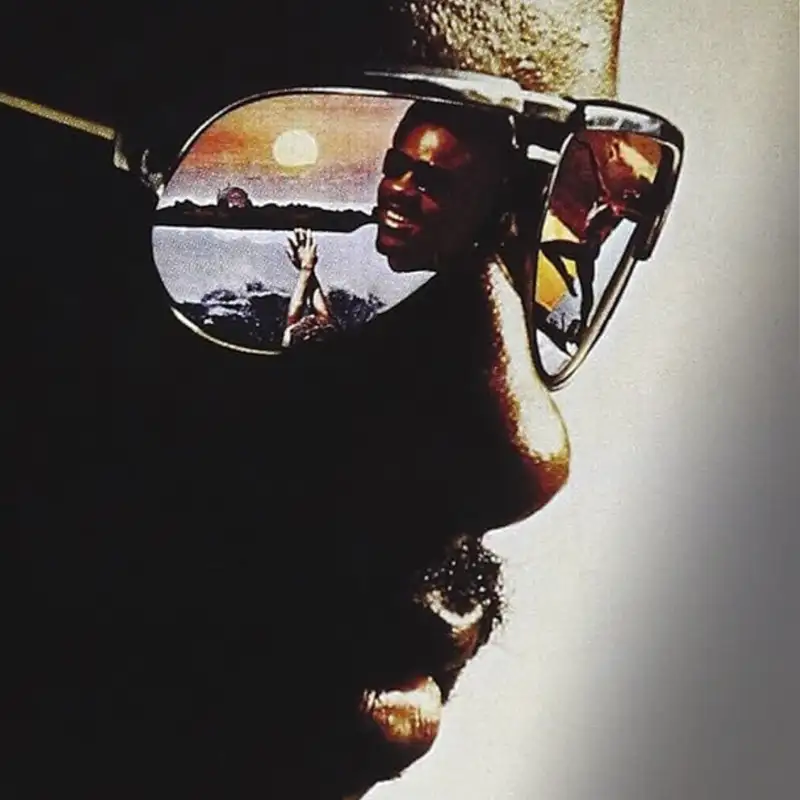
May 13th, 1971, Stevie Wonder turns 21 years
old, and his Motown contract expires on the spot.
For the first time in his life, he's free.
No more producers telling him what to play, no more Motown foreign
lists. Two weeks later, he shows up unannounced at a studio in New
York, knocks on the door, and asks to meet a thousand-pound
synthesizer named TONTO. He proceeds to play everything
himself: drums, keys, bass, harmonica, vocals, all
Stevie. The back of this album literally reads, "This album is virtually
the work of one man." This is Music of My Mind, and Stevie
Wonder is finally free to fly.
Every day I wanna fly my kite.
And every day I wanna fly my
kite. And every day I wanna get on
my camel and ride.
Ooh, girl.
I'm Adam Maness.
And I'm Peter Martin.
And you're listening to the You'll Hear It podcast.
Music explored.
Explored. Brought to you today by Open Studio.
Go to openstudiojazz.com for all your jazz lesson needs.
Peter, we're exploring like crazy today.
Oh my goodness.
We're gonna explore the hell out of this record.
Ste-
Hail yes!
Yeah, Stevie Wonder's 1972
Music of My Mind. It feels like, and I know it's not,
I know at this point he'd made 14 albums before this one.
Yeah.
But it feels new.
Right.
It feels like the start, it feels like a, an emerging artist somehow, even
though Stevie had already been making music for a
decade.
Right. Right. But I, I mean, it kind of is. It's like, it's a segue.
I think it's a pivot point. It's, this is the launch pad.
I wanna, I wanna nominate that we call it the quiet launch pad of his classic
period, and we'll debate what, what is inclusive in that.
So all the way up through-
Well, let's not even let's-
Okay. Okay
... let's, let's not go against each other yet.
But I mean, what we do definitely agree on, I think most people do, is that this
was the beginning of a classic period.
How far that goes, uh, is, is an interesting question.
But I say quiet launch pad because this was like, I mean, the record doesn't start
out quiet, you can hear that. It, you know-
It starts out so good
... and quality-wise, and like, this was kind of a revolutionary record from a
technological standpoint-
For sure
... from a sonic standpoint-
For sure
... from people's expectations of Stevie Wonder and those 14 previous
albums. Uh, but this was not, there was no big hits on this, no
Grammys.
Yeah.
You know, which basically, this was the only record over a 20-year
stretch from before this all the way up to, I think like In Square Circle or
something, into the '80s-
Yeah
... that he didn't have Grammys and/or hit singles from every record
except this one.
I mean, it's almost like this was an aperitif.
Ah.
This was, this was like-
The amuse-bouche
... the amuse-bouche.
Yeah.
This was like, everybody was like, "Wait, what, what is going on with
music on this album? Like, what is happening here?" It w- it felt, it had to have
felt, I wasn't alive, but it had to have felt so fresh and so new.
Yeah.
From an artist that you kind of already have known, it must have taken people
aback. But you're right, it's, it is kinda weird that there were no huge hits from
this.
Yep.
I mean, great songs-
Yeah
... just no e- enormous hits for whatever reason.
Right.
And yeah, crazy that there were no Grammys for this.
He started winning Grammys in the very next album, Talking Book, and then, you
know, won like three Album of the Year Grammys in the '70s.
In a row, yeah.
It was incredible.
Yeah. The next three I think all won Grammys.
I mean-
And, and Talking Book actually came out in '72 as well.
Yeah.
So it wasn't like-
Same year
... he didn't have hits that year.
Well, we'll talk about that. Like-
And the year before
... it's not like he went into the, uh, this run of albums that he's, that he's
about to make and just like was like, "Here's this album, and here's this album,
and here's this album." A lot of people might know or not know that, you know,
these tracks were done over, you know, the albums were done with different tracks
over different periods of time.
Right. Right.
So it's like all these sessions, just a bunch of songs.
Right.
So, right. Exactly. So let's get into that. So we're talking about May...
I'm gonna take you back to a little time that you might not remember due to not
being born yet. But I was there. I was but a infant.
I don't think I was walking yet.
Yeah, what do you remember about '72?
Not a lot, but I'm gonna take you back even more. 1971, right?
So Stevie Wonder turns 21, his Motown
contract expires on his birthdate.
Uh, that was part of the deal. Um, they, Motown throws a big party for him, Berry
Gord- Gordy, the whole thing. I'm sure there was the, the hope and expectation,
although probably pretty dim, that Stevie was gonna re-sign immediately with
Motown, and they're gonna keep on making hits, and everyone's gonna be making money
and everything. That's not what happened.
The, the day after the party, Stevie's attorney s- uh, served
Berry Gordy and M- Motown with a notice that says, "He's out of contract.
This is over. We're doing our own thing." You know?
Yeah.
In one of, what would become one of the savviest business decisions in the
history, uh, of the recording industry, and what would become a template for many
other huge superstar contracts up to this day, Taylor Swift and everything, really.
We, we, we talked about this when we talked about the Songs in the Key of Life
episode. We talked about the charts-
Mm-hmm
... on the Songs in the Key of Life. But a lot of people don't give Stevie credit
for, I mean, he's obviously a musical genius from a very young age, but don't
forget, he started in the music business at a very young age.
Right.
And he is incredibly savvy at the business part of this.
And this deal, I think, is, it really a testament to that, that he,
he bet on himself-
Right
... and he ultimately won.
Yeah. Yeah, and I mean, he was, like, they, you know, it was a 2% royalty
rate. He had made a bunch of money as a, as, you know, before he was 18, and then
even through when he was 21 with his contract, but it was on a really low royalty
rate, which was pretty typical at that time, but he was able to get a deal all the
way up to 14%, which I don't think had been done.
Um-
That's awesome
... and, um, and he was also able to retroactively get back half
of his publishing that they had been holding back on him for that time up to then,
'cause he'd been writing all this incredible music.
I mean, he deserves all of it and more.
Yeah. Yeah. Um, but what happened was, uh, just a
couple of months before this, a record came out that was called Zero
Time by this thousand-pound synthesizer and a couple
gentlemen, Malcolm Cecil and Robert Margouleff,
who had, uh, the band TONTO as well, and the Exp- Expanding Headband,
I think was the name of the band.
Yeah, yeah.
Uh, and they made this record, Zero Time, and it was not like a huge hit or
something, but Stevie Wonder heard it.
I just-
And I just wanna play you them kind of talking about this as opposed to me fumbling
my way through the history, because there's some great interviews that w- that are,
that are out there from the principals.
There's gonna be three individuals that are, kind of had their hands, obviously
Stevie Wonder had his hands all over this record.
For sure.
But there's two other folks as well.
The first album is the, actually the first alternative album in, uh, in I guess it
was 1971, wasn't it?
Yeah, 1971, TONTO's Expanding Headband, Zero Time.
And, uh, it was put out by Herbie Mann-
Uh, who had a label called Embryo, which was
distributed by Atlantic back then.
And that was how Stevie Wonder came to find us, was, uh, through that
album. He rolled up at M- Media Sound one day with the album under
one a- arm and a friend of ours on the other arm, a fellow
called Ronnie Beinko.
Yeah, and we didn't leave the studio for five years after that. Amazing.
It's so great.
By the way, a lot of buzzwords from the late '60s, early '70s in there: Herbie
Mann.
Herbie Mann, yeah.
Yeah.
Shout out. Great jazz flautist.
Embryo Records. Come on, now.
That was, like, his vanity label on there. Yeah, it's great stuff.
Yeah, so this record, Stevie, I mean, he had just heard it...
Well, it could've been before March, 'cause it came out in March of '71.
But I just wanna give you a little bit of a sample.
You ready to have your ex- your head expanded?
Hit me.
Right, with an incredible expanding headband.
Did you put something in the coffee here?
Yes.
Excellent.
That's
dope, actually. It's really
good.
This is some of the more accessible part of the record I, I was able to find, too,
just to let you know. But, I mean, it's, you know, the-
I mean, there are electronic artists who are trying to do that today.
I know. I know. And I mean, we, like, we think about, uh, I mean, so
yeah, of course, this sounds dated in a way.
I mean, it sort of places it at a, at a time, maybe like a, a documentary is
going on about, you know, some plants that were transported from
one continent to another into a l- laboratory with a fancy accent or
something. But I mean, I think what you can hear, because just a
couple months later, this is happening.
Yeah.
Literally, like, f- in, in, in May, when he goes in the studio over Memorial Day
weekend, holding their rec- their record, this zero-time TONTO
record, saying, "Are you the guys who made this?
I wanna get access to that machine. I'm Stevie Wonder.
I have some ideas about what I can record." He's only, like, 10 days out of his
contract, and they, like they said, they go into the studio then for five
years and make some of the greatest recorded music of all time.
Man, I love that you just framed that TONTO like that.
Can you play that album again one more time?
Yeah. The whole thing?
"As we venture deeper into the Amazon for the feminist gecko."
Doesn't it sound like that would be-
Totally!
... like, the music to some grainy documentary?
Right. Right.
You know?
Would've, might've, yeah, might've led to, uh, Stevie's secret life of plants a few
years later.
Oh. Yeah.
But I think Stevie... Okay, so there's the technology of this.
So it's like, what is TONTO? There were synthesizers before this, right?
But, uh, TONTO was a very special thing because it was, you'll see
some graphics of this, it might scare you, may make you think you're in Star Wars
or, um, one of those other shows from the, from, from that time.
Battlestar Galactica.
I mean, I assumed if it was a synthesizer, it looked a lot like what we have on the
table here, which is, you know, two octaves, and it weighs about- ...
six pounds, maybe.
It was a ton, my friend.
Cost about 300 bucks.
It was a ton, my friend.
It was a ton.
It was priceless, literally.
Oh my God.
It's in a museum in Canada. I, I really wanna go v- can we take a field trip?
Let's go.
Let's do a field trip.
Let's do a TONTO trip.
Yeah.
Yeah.
Um, but yeah, so, so anyway, so there's Cecil, um,
and Margouleff. The, these two guys were instrumental
to everything that happened on this record because basically, when Stevie shows up,
they did have a mutual friend, this guy Ronnie Blanco. I love that name.
Isn't that somebody who's gonna drop you off?
Ronnie Blanco?
Yeah.
Yeah. Great name.
So he was playing bass, I guess, with Stevie.
They had some gigs on Long Island or something.
And, um, somehow Stevie's talking to him or whatever.
He finds out, he's like, "Oh, I know those guys." And Stevie's like, "Can you
please take me to them?" And it was over the Memorial Day weekend, and one of them,
I can't remember, I think it was, um, I think Malcolm Cecil lived in the building
or something. He said he was, like, getting out the shower, and he looks out, and
Stevie's wearing a, a, he describes it as a green pistachio suit-
Amazing
... holding the album.
Amazing.
And, and, and, like, they could've been like, "No, come back.
We're closed." And he's like, "No, I'll come down, open up the studio," and, and,
like, they just started creating.
They, they cut, like, 17 songs that first weekend.
Oh my God.
That, that spanned not only on Music of My Mind, but all the, all the way to
fulfilling this first phenom- well, it's a little bit unclear what the breakdown,
but there's definitely stuff that they used throughout the classic period of those
four records.
Can we just shout out bassist Ronnie Blanco, who introduced- ...
Stevie to these guys? Like-
Right, who doesn't play on any of this
... maybe the most important musician of the early '70s.
I know.
You know, without even playing a note on these albums.
Oh, it's so good.
Incredible.
Yeah, it says, "Bassist Ronnie Blanco showed up with Stevie dressed in a pistachio
green suit." I, I was having to check.
I was like, "Was it pistachio or walnut?" "He got dressed, ran downstairs, and
invited them in to see the machine.
They recorded 17 songs that weekend," so.
Unbelievable.
So you've got the technology in terms of they had this multi-timbral synthesizer.
And just to show people, like, show 'em, like, monophonic synthesizer, which was
the only thing available.
Well, yeah, so-
Like, it means you're not playing chords. Right.
Play one note at a time.
Right. Like, play a, play a C triad. Yeah, you can't do it.
Can't do it.
Yeah. So TONTO was pretty much, I think there were some other things, but it was
the only thing that people could actually get to work.
But again, I assume the TONTO, like this Yamaha Reface, just had a switch where you
can go from this to this.
Oh my God. Their mind m- yeah, except it included a whole room, and by switch, it
meant someone had to ac- it was, there was, like, a telephone operator.
And I, I assume it took four double A batteries, like this.
It did not.
No.
It, it, it took a whole village of, of power, so.
Um, so super exciting. So I wanna play just one more thing of sort of how they're
talking, and then we're gonna get into the music, the important part.
But I do-
Please!
... I do think please. I think this framing of,
like, the technology, so Stevie's got sounds in his
mind, but now he's got new sounds also. He's already written hits.
He's a great pianist, harmonica. He can play drums. He can do all this stuff.
One of the greatest singers who ever lived.
Right. Right. In fact, just that very year, 1971, his last
record, which had a huge hit on it, as did many of his, uh, previous one, you might
remember this from 1971.
Oh, yeah.
It's a great song.
Yeah.
Oh, yeah.
Very Motown. Very Motown.
Yeah.
I mean-
Whoo!
... QA, quality control. QC.
If you feel a little love.
Man.
Yeah.
Whoo! Tight arrangement.
So good.
Yeah.
So this was just a year before
The same year.
The same year.
This is 1971.
Oh, okay.
This is his last record on his junior
contract. Yeah, and so
you know, obviously he already had the voice, he already had the music, he had all
this, but he was hearing some other stuff.
Yeah.
And the, the Motown system at that time didn't really allow for that.
They were like, "No, we know what works.
We're about making hits." This is called Hitsville, my friend.
Yeah.
This isn't called Artistryville, although it was very art- artistic as well.
Absolutely.
Um, and I think what you saw here, then Stevie went on a limb.
He financed all this himself. He was out of contract.
Um, he, you know, found these guys.
They got into the studio, um, and you know, were able to
make four of the most in- four to, to six, depending on how you count
it, four of the most incredible records of all time within just a couple of years.
We talked about this on the Marvin Gaye, uh, What's Going On episode that we
did.
Yeah.
But it's like Berry Gordy and the Motown hit machine, right?
This like, this camp basically, or this, this university-
Yeah
... to make these superstars: Stevie Wonder, Marvin Gaye, Michael
Jackson, The Supremes. You know, inevitably, they get so
good at what they're doing-
Yeah
... that they wanna break out of the mold that the machine has
put them in.
Right.
And all of them-
Right
... end up making this incredible art later in their lives-
Yeah
... after Motown. But I do credit, you have to credit Motown for like
basically like upping the quality level of already great artists and
putting them all together, too, so they were interacting with each other and-
Yeah
... you know, talking about this stuff and learning from each other and working on
music together. And it's really unbelievable when you think about like around the
same time as What's Going On and then what Michael does later in the decade.
It- it's pretty ... And, and what, and what Diana Ross does later in the decade.
Pretty amazing.
Yeah. It's incredible. So one more clip of Malcolm Cecil talking
about kind of what was in the air at that time.
Yeah, Stevie was a keyboard player and his
principal, uh, need from us was to provide him
with the sounds and the technical expertise to enable
him to get what he had in his head. That's why we called the first album Music of
My Mind because it was music that was in his head.
He'd been carrying it around for several years because he
didn't own-
Yeah
... his own publishing. And he was very smart for somebody so young,
and he realized that he, there was a lot of money in
publishing. And, uh, he decided that when he came to
us that he had not written anything
substantial for Motown in perhaps five years.
And he had all these songs in his head, and, uh, he was just bursting to
get them out.
Yeah. And so it was like really fortuitous that these
three met, that Stevie met up with, um, Cecil and Margouleff
because they recognized as soon as he came
in... I mean, of course they know it's Stevie Wonder.
Like, he's, he's a star already, but they don't really...
I mean, he's little Stevie Wonder.
I, I mean, I don't know how in tune and how much they're keeping up.
They know he knows how to make hits, right?
But I don't think anybody could have predicted like the prodigious talent
and like just outpouring that he had.
Of course.
So they kind of trusted that. Of course, they, I think he sat down. Well, he did.
He immediately sat down, and they're like showing him the keyboards, the, not only
TONTO, but all the different things they have in the studio.
And they're kind of like, "Oh my God, we, whatever our other plans are in life,
like-
Let's change them
... this is the mission." Yeah.
Yeah, yeah, yeah.
And there was like no contracts. There was no like...
They said at one point, like six months into it, Stevie would just sort of like
give them money to kinda keep the studio going.
They ended up moving it down to Electric Lady Land later in the year, all the, the
keyboards and everything, so they could be in a more comfortable environment.
But like the three of them were on a mission, and like they would come in and, and,
and record. Stevie liked to work at night, famously. Still does.
He's like, he'd come in in the evening, and they'd work for 12 hours overnight.
When the sun came up, they'd be done, but then they'd come back.
Like that's, they just all got it, you know?
So it's like one of those times, no social media to get in the way maybe we could
say.
Yeah.
Like, no distractions or whatever, and it was an incredible thing.
Well, it's interesting to hear what he just said about how Stevie was saving these
songs, like the music in his mind, 'cause it does...
You know, I, I, I mentioned in the beginning how it's like, how this feels like a
first album almost.
Yeah.
And it kind of is in that regard-
It is
... if he's saving all this music. 'Cause you know there is this thing of like an
artist's first album is, uh, really, really great because they've been working on
it their whole lives.
Yeah. Yeah.
You know what I mean?
Yeah.
And then the second album is, is much d- more difficult because they got everything
out in the first album. It just turns out Stevie had about 15 albums worth of
material-
Right
... in there-
Exactly
... from the time he was a kid. It's incredible.
And when we talk about Music of My Mind, Talking Book, Innervisions, and fulfilling
this first finale to the classic four-
Wait, wait, wait
... those are all, like there's overlap from
'72, '73... No,
'71, '72, '73, and even into
'74. Probably among all those albums, there's a little bit of debate-
So-
... even among the people that there's a little bit-
Wait, wait, wait, wait, wait
... of conflicting information.
So you're not putting, you're not putting s-
Songs in the Key of Life
... you're not putting Secret Life of Plants in the classic period?
No.
Hotter than July?
Definitely not.
Definitely not.
No. No.
They're great records, but not even Songs in the Key of Life.
No, no, no, because, not because they're not classic.
I mean, Songs in the Key of Life may be the culmination of the c- classic period.
It feels like it is to me.
I could say that. But that was recorded in, in a very different way entirely in LA,
although a lot of this stuff was... That, that's another story.
They moved everything cross country, too.
But different production crew, a little bit of overlap, different
process. You know, Stevie's mature, m- much more people involved in the
record. Like, this record is darn near one-man band.
All four of those records actually, um, but this is the one that has the least...
You know, it has, um, Buzz Fight- Fightin'
on guitar on, um-
Yeah. I know, I hear what you're saying about it
... and then one R. Barrett solo. Like, otherwise-
I hear what you're saying. It's, it's the same-
Songs in the Key of Life is a bigger record.
I know.
It's great.
It's the same process.
Yeah.
But, but I think there's a flag on the play there, Pete.
Okay.
Yeah.
There you go. Traveling.
Yeah.
Um-
Wait.
Wrong sport.
Yeah. Sorry. Flag on the ground.
So, um,
so okay, let's talk about this. So when we talk about one-man band, I think a lot
of people miss that 'cause they think, "Oh, yeah, Stevie Wonder, he sings, and I,
sometimes I see him at the piano, and, you know, he can play the
harmonica really well." No, he played everything-On
this ra- record. So he played drums, he played bass, he sang, he played
harmonica, he played bass on the keyboards, he played the
TONTO. He did all these different things, and that in itself is
amazing. But you could be like, "Oh, I know people that are talented.
They can do that." But it's the putting it together to make it feel like
a band, to make it feel like an exciting experience at a time when the
technology did not involve, like, pasting things in and being able to
have automation and all these different things.
Like, you had to have literally the music in your mind.
Yeah.
And then be able to be like, "Okay, what am I gonna do first here?"
Yeah.
You know, sometimes it was drums, sometimes it was keyboards.
So I thought-
Well, I, I love what he does first here on the album, too.
Yeah. I'm thinking we could jump in that, and then we can kinda break it down and
see the different parts.
Let's do it.
Of course, it starts with Love Having You
Around. Lee!
Ah, it's so good. What a start.
What a great start. Have we listened to a great album that didn't start great?
No, we haven't.
No.
Mama, mama baby. Oh.
Baby, baby, baby.
Rhodes. Wurlitzer.
Uh-hmm. Baby, baby, baby.
Drums.
That's me.
Every day I wanna fly my kite.
And every day I wanna fly my
kite.
Whoo!
And every day I wanna get on my camel and
ride. Ooh,
yeah.
Man, he's got-
All these ad libs here
... yeah.
Yeah.
And this harmonic thing, it's very bluesy, but he immediately goes somewhere
weird.
Make a name for myself.
To the D flat.
Yeah, going up a minor third.
And every, every day-
So this is kinda telling you, this is not gonna be-
... I wanna get on my camel and ride
... your average gospel-y, bluesy, jazzy.
Ooh, yeah.
TalkBox.
And when my day is through.
Oh, move up another minor third.
Nothing to do, I-
Back down
... sit around grooving with you.
And then he pulls it all back together right here.
And I think of the love.
Whoo! Very gospel harmonic turn.
Having you around.
Pulls it together. And you know what? Sounds so good, let's repeat that part.
And I think of the love
having you around.
Whoo.
Yeah. Every day-
Second verse
... I'm gonna be your friend.
'Cause you have stuck with me through thick and thin.
Syreeta Wright, the lyricist on this.
And every day I wanna smile in your lovely brown
eyes. Your lovely brown eyes.
Say Syreeta Wright wrote the lyrics?
Yeah.
Every day I'm gonna get my
share. 'Cause I know you're gonna
take me there.
This drumming is so-
Man
... interesting.
Every day I wanna get on my camel and ride.
It's so unique. It's so funky.
Yeah.
It's so... Like, the pocket is so him.
Yes.
It's so singular.
Yeah.
Think of the-
To be able to-
... nothing to do
... play that hard in the pocket without, like, precision
tempo.
I sit around grooving with you.
It's not supposed to be on a grid.
And I think of the love.
It's so pocket.
And we talked about this when we listened to Innervisions.
Yeah.
How it's almost preferable to some of the really amazing studio cats he was-
Yeah
... doing on, like, songs, you know?
Well, they brought in Purdie on a bunch of these tracks-
Which is great
... but Purdie, Purdie's like, "I can't do, I can't, I can't replace that.
Leave that."
Yeah, yeah. Yeah, yeah.
Oh, bass.
Ah, ah, ah, ah, ah, ah. Ah, ah, ah, ah, ah, ah.
Ooh, the Songbox.
Ah, ah, ah, ah, ah, ah.
So there's already
a lot of technology on here, right?
So much.
Yeah.
Yeah.
But a lot of humanity.
That's the thing. We, we talked about this on Innervisions as well.
Yeah.
He's able to use this technology, which can seem like when we,
even when we listen to the TONTO album-
Yeah
... futuristic and it doesn't feel that way.
It feels earthy and raw and real, you know?
Right. Right, so good. So okay, I wanna just to jump back and just to sort of, just
to show people how this worked with the TalkBox and
his vocals, the background vocals, and then the rhythm section, and how he kind of
brought all this to life. So this is from the top, just...
Can I do this, just the vocals? Is that something that might interest you?
And backgrounds. And so by backgrounds, you might think, "Oh yeah, he's got those
three ladies that I saw him with on tour," whatever. No, this is all Stevie.
There's a little bit of Syreeta Wright I think on some things, but not this.
And so again, music of my mind. Like, he's gotta have all this in his
imagination, and then put it in one thing at a time, kind of imagining
what the end result is gonna be.
Please.
That's the beginning.
Mama, mama, mama. Mama, mama baby.
Baby, baby, baby.
Mama,
mama, mama.
Uh-hmm.
Baby, baby, baby.
That's the TalkBox.
Baby, baby.
Mwah.
Every day I wanna fly my kite.
And you, you hear how you can feel the groove-
Every day I wanna fly my kite
... just from his vocals? Even without...
And every day I wanna get on my camel and ride.
But you take the drums away...
Ooh,
yeah. Every day I wanna shake your
hand.
Yeah.
For in the world-
This is improv backgrounds
... make a name for myself.
It's got maybe Baby vibes, the improv backgrounds.
Yeah, yeah.
Every day I wanna get on my camel and ride.
And it's raw AF. But it's precise.
Ooh, baby. And when my day is
through. Nothing to do, I-
Sit around grooving with you. And
I think of the love
having you around.
Amazing.
Those bass and that-
Amazing, amazing.
And I think of the love
having you around.
So while all that great stuff is happening, you've got, here's the rhythm section.
Bass, and he's playing bass on keys.
Rhodes, maybe a little Wurli, I can't-
Yeah. There's Wurli, yeah.
And drums.
For sure. This is so sick right here.
And, like, the bass-
Damn
... the bass is...
Just a Moog bass.
Yeah.
Or a ARP bass maybe.
I think it's Moog.
Oops, a little... And then here's the drums.
Uh.
Just so much-
Da, da, da, mm, mm
... so much kick drum happening. It's crazy. That's great.
And you got the the heavy pan from the point of view of the
drummer. Mm, mm. Mm, mm, mm, mm.
Ooh, that bass... Damn, his bass drum is killing.
And then you got the keys.
We don't have great separation on that for some reason.
But yeah, just to hear the whole rhythm sec- I mean, it sounds like
three folks playing together, right?
Fill. Oh.
Ah.
Come on, man.
And then, um-
God
... should we talk about the trombone solo? Should we jump up to that a little bit?
Yeah. By the way, I love the way that...
I think that's a clavinet there, but it's got... But it's very muffled.
Like, the- it's, it's on a pickup, 'cause the, you know, those clavinets have
different pickups, like a guitar that you can select.
Yeah, yeah, yeah.
And so it's on a very dark version of that pickup.
Yeah.
Sounds so cool.
Yeah. It's awesome. We're gonna get some great clap at the beginning of the second
half too. So we're gonna jump up, Art Baron, the great Art
Baron, wonderful jazz trombonist and otherwise.
Yeah, he crushes this.
Yeah.
Hey, hey, hey, hey, hey, hey. Hey, hey, hey, hey, hey,
hey.
Yeah. Yeah, yeah.
Got the little chromatic horn.
And we play. We just
play.
We
play.
Then we come back.
And when the day is done. Yeah.
So he's got these-
Something to do
... these cool harmonic areas that he's been going back and forth to.
We get done.
That part of his voice is magical.
So good.
Having you around. Yeah,
yeah. And I-
And every time it's different
... share your love. And you have-
So much craziness in there. Anyway, I like this. I like this album.
I get it. I get it.
It's very-
Fun stuff, right?
... very good. Man, what a great track, too. Great song.
I mean, it's got everything, right?
It's got, like-
Coming out of the gate.
You know what it... Coming out the gate. You know what it is?
It's, it's also, it's like... It, because he's so young, 'cause
he's 21-
Yeah
... still has this incredible youthful energy.
Yeah.
We talked about this on Off the Wall, but it's like, it feels like a
young person that wants to prove himself, that has something to say, that's trying
to change the world with his music.
Yeah.
Man, it's so inspiring.
It's, it totally is.
As an old fogey, it really makes you wanna get up- ... and do something.
Yeah. I mean, this, this output is, is, was, was just crazy.
And then the thing about it is too, and I, I might have some, some...
a little bit of narrative on this too, but, like, the idea, we think of these
albums so well crafted in terms of the sequencing of
them, the combination of songs, the messaging of them, how they're laid out, even
from side A to side B, um, and they are.
There was a lot of craftsmanship that went...
The, the mix of them, the transitions.
Um, but these were not... They didn't work on one album and then
finish it. Like, you know, we've talked about the Steely Dan, the Asia,
Gaucho, um, Tapestry-
Mm-hmm
... which was done relatively quickly.
But it's like this is an output where you're thinking about the album, you're
starting it. For, you might move some things around, we're not gonna use this, and
then it's done. It's... This didn't have a starting and ending point.
This was just, like, three or four years of recording.
Apparently, they recorded over 300 songs.
Yeah.
And then when it would come time, Robert Margouleff and, um-
That's crazy
... Malcolm Cecil would, would go to Stevie like, "Hey, Motown's been calling a
lot. They really want a record." And he's...
And they're like, "Okay, let's talk about it.
Maybe we'll try this." And they would just go into the archive.
Actually, can we hear him talk about this a little bit?
Yeah.
If I can find the right thing. Yeah. Here we go.
Well, the thing that's interesting is that, um,
we never really kept track of the hours of how long a song took
because we never really sort of worked with a
concept, with Steve anyway, of ever
making, of now we're gonna do Music of My Mind. This is an album.
We have to do 12 songs and so forth, and then
we would concentrate on doing 12 songs.
We would work for an archive, for a library.
We were constantly in the studio. Some of the songs we
did in the first year ended up on Talking Book or ended up
on Fulfillingness.
Amazing. Amazing.
It was really generating material for a library is the way it worked.
It was an archive of songs.
That's a nice archive.
That's a great archive. You know, I, I mean, it, it really hits me as you describe
this setup that they had with the TONTO system and, and, and also these two men
who were, like, really helping to facilitate Stevie's vision on this.
Yeah.
But, like, it just goes to show, and this is just a...
this is a little bit of my own thing here, but how important a
process-
Mm
... your space is, your setup is.
Yeah.
Like, you put... I mean, the... Nobody could've just walked in
there and made this kind of music just because the setup is great.
Right.
But when you have a genius like Stevie Wonder, and you give him a space where he
can just seamlessly, frictionlessly-
Right
... go. There's no friction, right?
Right.
You just, there's a drum set over here. There's a synthesizer over here.
There's a clavinet there and a Rhodes there and a Wurli there, and the vocal mic is
always set up, and apparently, that's what, what it was set up like.
Yeah.
He could just go and, and, and explore, really explore the
space-
Right
... of the studio, and he does, and he creates, like, these four amazing
albums, you know?
Yeah, and apparently-
I don't think it happens without that frictionless studio.
No, you're absolutely right. The logistics of it are part of the artistic process,
and they started out at Media Sound Studios uptown.
That's where Stevie showed up in the pistachio suit.
But, um-
You keep saying pistachio suit.
I love that the pistac-
It's like it's a really important fact
... 'cause they've said it in like seven different interviews.
I do like... I like that it sets the scene.
I love it. It's so visual.
I do. Yeah.
But, um, part of the reason they l- they moved famously down to Electric Lady
Studios, of, of course, Jimi Hendrix's studio, Voodoo, a b- a bunch of great
things-
Yeah
... um, was about this very concept you're talking about, frictionless.
They didn't use that word, but check this out.
This is-
He could find his way around there, and when Jimi passedThere was a
studio, and it was like with Malcolm, me, and Stevie,
it was like putting our shoe in a ready-ma- our foot in a ready-made shoe.
We were able to get in there and to really get to work.
It was beautiful environment to work.
We started 4:30 in the afternoon and finish at 7:00 in the morning when the sun
was coming up.
Amazing.
Night after night, holidays, birthdays,
rains, sleet, summer, storms, you name it, we
were there. Never... It was... We called it Stevie time.
It was never a, uh... And we didn't have to leave and
leave because, uh, Crazy Daisy Toilet Paper's gonna be making a commercial
during the day, and I had to break down the drums.
Everything could stay.
Yeah, so that was the thing, that the other studio, they were still doing
commercial work, but they were very intentional about having the
drums, having the Rhodes, having the vocals, a kind of microphone
that Stevie could feel, and if he bumped into it, it wouldn't sha- Everything was
frictionless so that he could create at any time, so that he didn't have to have a
helper. O- obviously being, uh, sight impaired, he could
move around the studio without anybody helping.
So there was nothing getting in the way of him creating.
And when they moved to LA to the studio out there, it was the same thing.
They actually built out, uh,
a whole room and started renting it by the year.
’Cause they were like, "We just have to...
He's gotta be able to record at any time," and, and this is the one of the first
gift, the quiet launchpad, uh, that would come for over the next
couple years.
Man, well, and it's amazing that, that, that Love Having You Around, that first
track, wasn't released as a single and wasn't a hit.
Because it's-
Right
... catchy as hell.
I know.
Uh, the next track, though, was released as the first single on it, and this...
Ah, man, this might be my favorite song. The, uh, the...
It's debatable, but this, this is the song, honestly, of all of
Stevie Wonder... So, like, I got this on... Someone, someone...
Don't, don't tell Stevie.
Okay.
But my first listen to this one w- was when I was 16.
He's getting quiet.
And someone-
Something illicit happened
... a friend of mine made a tape.
Made a tape.
Of it. Like, you know, a Maxell-
Yeah
... recordable tape. So I didn't know wh-
Was that a special friend that gave you a mixtape, my friend?
It was a mixtape. Not that special.
Okay.
But, uh, so I just knew it from this tape.
Yeah.
And I didn't know what this song was. But this was the song...
And I, I also, I was like, I knew Stevie Wonder from, like, I Just Called to Say I
Love You at this point.
Yeah.
But I was like, you know, young and dumb and didn't know anything.
Yeah.
And, uh, when I heard Superwoman-
Yeah
... the, uh, track two, and the other song that is part of Superwoman-
I was gonna say, yeah. I was like, you get two for the price of one on this one.
Where Were You When I Needed You, which I, I legit thought were just two separate
songs because I was listening to it on a tape that-
Yeah
... didn't have any labels or anything.
I was like, "Oh, we're in somewhere..." This is music that I didn't know
existed.
Right.
Like, this whole genre of music opened up to me, and it's from this next
track.
Yeah. Here we go, Superwoman.
Mary
wants to be a superwoman.
Yeah, this is amazing. So he's-
But is that really in her head?
He's so relaxed here, too.
So relaxed.
Just-
I just wanna live each day to love her for what she
is. How did he fit together that weird synth intro?
It works so well.
And the interlude that happens between.
Oh, dude, that's-
Maxell on that
... it's on my list.
And all the things she wants to be she needs to leave
behind. ’Cause this is almost like a You Are My Sunshine kinda
track, this part of it.
Yeah.
You know, small.
Yeah. His drumming here-
I believe I know you very well
... again, it's very unique.
Yeah. Wish that you knew me too.
Very loose.
Very well. Is that chord something you'd be interested in?
We're gonna get into it. Follow me to the nerd nook, my friend.
Oh.
I love that Rhodes sound.
Man, the details. And I think I can
face.
Oh, and the way he alt- Very well. He alters it each time.
Very well. And I think I can cope with
everything going through your head.
And if you know this record, you're already looking forward to the next time how
he's gonna change it.
Oh, the next verse. Mary wants to be a superwoman.
And try to boss the bull around.
But does she really think she'll get by with a
dream? This might be my favorite moment, this second
verse, the- A woman wants to be a superwoman. All the BBs.
Oh, yeah. They're slowly layered in. I just had to say goodbye.
The variation from the-
Oh, yeah
... first verse of it, you know? Because I can't spend all my time.
That chorus on the Rhodes, perfect.
But. But.
I believe I know you very well.
Ooh, man.
Hold on just a
second.
Best background vocals. Best background vocals.
That background wor-
Yeah
... we're gonna go back and just hear.
First of all, that's some of the most copied type of background vocals, right, for
this song?
Yeah, see, he's copying it right now.
'Cause he's just like, "But."
"But." Very well.
I believe I know you very well. Oh, harmonic
counterpoint. So good. Wish that you knew me too very well.
Very well. And I think I can deal with everything going through your head.
Coming up on top. Oh. Very well.
Repeat. I think that I know you too very
well. Wish you knew me like I know you
very well. Very well. But I think I think I can deal with
everything going through your head. Amazing.
Very well. Three times.
Very well. Wish you knew me too
very well. Very well. And I wish I could think of
everything going through your head.
So this is all in the-
this first song.
Yeah.
Key of E, both major and minor. Very well.
And we're gonna transition-
Yeah
... to the key of F sharp.
Yeah.
So we're gonna go up a whole step. And the way he does it is genius.
And I think I can deal-
Oh, it's about to start
... with everything going through your head.
This was the end of the single on the r- on the radio, by the wayOf
course
It's a real shame.
Yeah.
'Cause what happens next is incredible.
I know. It's one of the greatest transitions ever.
It's back to the weird
new synth sounds, but beautiful.
The drums, the cymbals.
Now we're in F#
major.
Now we're in A major.
The chorus cycles perfectly in time
on the Rhodes. Oh, the
Moog bass, come on.
This is the greatest.
When the summer came, you were not
around.
Oh, space.
Now the summer's gone, and love cannot be
found. Where were you when
I needed you last
winter?
Maybe his greatest melody.
Man.
Maybe his greatest melody.
I, I'm reactivated.
Of all time.
I'm reactivated on this.
When the winter came, you went further south.
I mean, you and I-
But this is up there.
Yeah.
This is up there.
Leaving me in doubt.
It's the last song on Fulfillingness, that's a great, great track.
Where are you when I need you?
Ribbon in the Sky.
Like right now.
Ooh, go on, Buzz.
Our love is endless.
And like how he gets here without it being awkward, I have no idea.
But you say now you have changed.
All these synths here.
Oh, it's so thick. It was so open.
But tomorrow.
And how he got to so much ...
Will reflect-
The mix
...
last
winter's.
Let's talk about the mix. We're gonna do that.
Slapstick.
When the winter came.
And you're back, and smaller
... you were not around. Through the bitter
winds, love could not be
found. Where were you when I
needed you last
winter?
Oh.
My
love.
Woo!
Man, both the guests, great solos.
Yeah. The guests are additive too.
The buzz.
Need you baby, need you baby.
Oh. Those little descending chromatic, uh-
Our love is-
To the bridge? Come on
... never ending. But you say
now you have changed.
Tomorrow.
Okay, Motown would have never allowed him to like shove these two songs together.
No. We talked about this on the Talking Book album and the Innervisions album, but
the chorus of synths that you're hearing there-
Yes
... it's not like a, it's not like a polyphonic pad.
That's a bunch of mono synths that he's playing like individual voices.
Yeah. Yeah.
Incredible.
This love of mine that won't let me down.
Where were you when I needed you
last winter?
Oh, man, his, the lyrics.
My love.
And like his delivery.
La da da da,
da, da, da, da, da. Your
love.
Where are you when I need you?
Like right now.
Right now.
Right now. Right now. Right now. Oh.
Is that a Moog? A little Moog he snuck in there.
La da da da, oh,
yeah.
Where were you when I needed you
last?
Man.
Winter.
I can't tell you like the energy of a band that this is giving.
Like I can't almost comprehend...
I can understand how a band playing with each other, with that energy.
Yeah.
I could not imagine putting this in one instrument at a time by yourself.
It's just, it's like mind-blowing.
Not that you, somebody couldn't play that, but that you could give it this feel,
you know? This organic, communal feel.
Vision. Vision.
Winter.
Man, the vocal performance too. We don't talk about it enough.
We could-
I know
... we, we could talk about it, like that could be the only thing we talk about.
I know.
His-
Like that kind of ... When you talk about the one man band, like we forget, his
vocals are just revolutionary.
They're so-
And influential
... playful and they're so, like, he's just improvising
these melodies, seemingly improvising these melodies, these backgrounds, all these
things too.
There's a cool li- like he's got a bunch of great endings on this
album. Like he- Motown would've made him stop right
there.
And they would've made him stop five minutes ago.
That's true. Ding, ding, ding, ding.
No, it's a masterpiece. The- ... the whole thing is a masterpiece.
Can, can-
And on LP, this transitions right in, which is, you know.
All right, so great. Can we talk about the mix on this?
Absolutely.
I know, 'cause this sometimes people start to be like, "The mix?
What is that?" It's just like how the record sounds, right?
So you have these incredible, incredible elements, but what's very unique about
this record, and really during this time, there was not automated mixing.
At least, it was not readily available.
Meaning, like, you know, when you see the, the, this typical studio
look with, you know, the mini channels and all the faders, like the classic look
where it's like the producer's sitting there and the artist, and you're like,
"Should we push this up? Should we do that?" That's about the levels of the
different mics and the inputs and all that kind of thing.
But that had to, used to be in the olden days, and I even remember this in like
late '80s, early '90s, some like you couldn't automate that in any
way. So you'd have to listen back to what had been recorded once all the different
tracks are on there, and then adjust if you wanted a little bit more congas at this
time, or the drums, uh, for just-
Congas
... yeah, for one section. Or you wanted to mute out some of the background vocals.
And so especially for this kind of recording, where it's not recorded live
altogether, because Stevie's playing every instrument.
So he's going track, you know, he'll do the drums first maybe, then he'll add the
bass, then he adds vocals, then he adds key- whatever the order is, it's like
one at a time. And then he's got all this, and then it has to be sort of mixed
together. So they did a really interesting thing.
The three of them, Robert Margouleff, um, Malcolm Cecil, and
Stevie Wonder together mixed this record.
And th- they're talking about it a little bit.
When it came to mixing the records, Steve, myself, and
Malcolm would all be
at the console together
And we'd all have faders and moves and stuff to do.
Mm.
We called it Armstrong automation.
And, uh, pretty much the records were mixed that way.
Yeah, so they're all, like, as they're listening to it, it's like-
Like rehearsing probably, all this?
Yeah, you have to rehearse it.
Wow.
And then they also would say, like, sometimes they'd get a mix, they're like, "It's
so good." So then they'd print it, they bounce it down to whatever, two-track, and
then they'd come back the next day, or the next night, it's Stevie time.
Mm-hmm.
And, uh, they'd listen to it. They're like, "Oh, that's crap.
Let's do it again."
The mix?
So it was-
Oh my gosh
... yeah, that's be remixing it.
Wow.
You know? So.
Wow, very cool.
But it's such a big part of the process of, like, how the record sounds
to the end user, to the listener, right?
Yeah.
Of, like, how you're gonna... And, and there's so many just cool, innovative things
that they did on this record, so a lot of technology in there.
Um-
Peter, I just wanna just acknowledge something real quick.
Are we RIP-ing?
We're RIP-ing. The Reface is not working now, and we don't know why.
Right.
And I, I had so much cool... Just know, listener- I was gonna lay
some harmonic knowledge on you, but-
You guys, if- if you weren't-
Can't do it
... planning on being drug into the nerd nook, you just lucked out.
Yeah.
You know?
Yeah.
Hey, Peter.
And Adam here.
Just wanted to jump in real quick and say, well, first of all, I'm having a good
time.
Dude, I love Stevie Wonder so much. This might be our best episode.
It's, it's a good one. And it reminded me of how much great Stevie Wonder material
we have over at Open Studio Jazz.
True.
I mean, if you're a harmony nerd, a piano nerd, a jazz nerd-
A Stevie nerd
... a Stevie nerd, or you're aspiring, or you're Stevie Wonder curious in terms
of- ... keyboard or guitar, whatever, please come over and check out our stuff.
Yeah. Even though the little keyboard that we had here died-
Mm
... I actually have two lessons on my Harmony Games course, Peter, just on this
album, Music in My Mind. I have one on all of the modal interchange on the album,
and I have a full lesson on the last track, Evil, how Stevie Wonder
brilliantly modulates around that song.
They're great lessons. I've also got a whole course called The Harmony of Stevie
Wonder-
Very good
... where I do deep dives on exactly how to play, how to decipher
that beautiful harmony of Stevie Wonder.
Start your 14-day free trial at
openstudiojazz.com/yhi. Go to
openstudiojazz.com/yhi for,
oh, your Stevie Wonder needs.
Back to the show.
This is gonna make you feel better. We're gonna go on.
This does make me feel better. Thank you.
Is that a great Rhodes sound?
Oh.
Though they say you're not my friend.
You've been here through thick and thin.
And for that little girl, I love you.
Hell yeah.
And all I wanna do is talk about you.
A great pre here.
I'm here to say.
Open it up.
What are you gonna say?
I love you more each day.
Would you play that chord for me, please?
And I just wanna tell the world that I love you so.
Well, you are the sunshine. Vocal tone.
Though they put me down because.
Vocal percussion, yeah.
Yeah, that's great.
I love you as much as I do.
Okay. We're, we're, we're, we're gonna go, keep going through this, but I wanna
listen to... This is something I kinda missed until I came back and started
listening to this again. This kind of has some ASMR kind of vibes to it-
Interesting
... the way that it's mixed.
Okay.
Check it out at the beginning. Like, there's, there's a...
They left all the breathing in, right?
But not only left it in, like, you can really hear it in the mix.
A lot of times, you know, if a singer's about to sing something, they're doing
that. And whether or not you leave it or not, like, now a lot of that stuff is
taken out-
Yeah
... which gives it a kinda unnatural sound of everything.
No, I was gonna say, I really prefer when we take out all the humanity-
Right
... and, like, quantitize every drum hit.
Oh, you do?
Yeah, well, it's the best.
And how we unplug the Yamaha Reface as well.
Yeah.
But this is the thing. So yeah, they don't do that on this record at all.
When we isolate the vocals, you can hear that.
Actually, why don't we just go into the isolated ones, then we'll be able to tell.
But they really leaned into it on this, like, in terms of,
like, amplifying that in the mix. And you can hear some of the breathing, and then
the little bit of background sounds he's doing are actually kinda percussive and
part of the flow and the feel of this, especially at the
beginning.
So this is Fender Rhodes with the, with the chorus.
Hear that?
Though they say you're not my friend.
You hear that big breath there?
Yeah.
It's in time.
And for that little girl, I love
you. And all I wanna do is talk about
you. I'm here to
say
I love you more each day.
And I just wanna tell the world that I love you-
It's almost like background breathing
... so much.
I mean, it's a song about the little things.
Yeah.
I love every little thing about you, you know? It's very intimate.
Though they're putting you down because.
I love you as much as I do.
Is that cool?
But they don't know what you've done for me.
Come on.
Yeah.
You make such a happy man of me.
That bass is slamming too.
And I'm here to say.
But that's the mix. Like, that's putting it all together, right?
You get this beautiful-
I love you every day.
Now he's really bringing it up
... yeah. And I just wanna tell the world.
That whole tone scale is so down.
Yeah. This chorus too, and, and the background.
The chorus is unbelievable.
Oh, the background.
Baby. I love, I love, I love, I love every little thing
about you, baby. Oh.
Come on, dude.
Who's playing percussion on this track?
I love, I love, I love every little thing about you.
Every little, every little thing.
Baby. Mm, yeah.
Oh, transition.
Though they say that I am wrong.
Here we have a couple bars of transition.
'Cause my love is strong.
Man, the bass on this.
But there's only one that I place above.
Mm-hmm. Ooh.
It's God that I place above,
baby.
Great.
Girl, I just wanna say
I love you more each day.
Greg Phillinganes said that Stevie Wonder changed his life. He said it.
Gonna tell the world that I love you so.
Some folks say that it's strange
Ooh.
But my whole life you have changed
Breathwork. Oh, this is like early breathwork.
You say I oughta bend the world but not me
It's such a progression in this tune.
Oh, but I want to build my world
It's so open now, right?
About you. And I'm here to
say.
Love you every day, yeah, yeah.
Man.
Every little thing about you
Right. Stevie's mastery of the, the registers.
I love you so. Oh, oh, oh, oh, oh.
Yeah, yeah. I love, I love, I love, I love every
little thing about you, baby
Let's nerd out on some backgrounds
Yeah, yeah. I love, I love, I love, I love
every little thing about you, baby.
Every little thing about you. Oh, yeah.
I love, I love, I love, I love every little thing about you, baby.
You know I love, I love every little thing about you,
baby. I love, I love, I love, I love every
little thing about you, baby. I love, yeah.
I love, yeah. Woo.
I love, I love, I love, I love every little thing about
you, baby
Unbelievable.
Every little thing
about you
Oh.
I love, I love, I love, I love every little thing about you
Man, this is like... Okay, we gotta talk about something,
Adam. I, I, I think I'm gonna throw the gauntlet down now.
Okay.
I wasn't, I wasn't even planning on really doing th- this is a great transition on
this tune.
Amazing.
We need to just sit here and listen to the whole album from beginning to end.
That's what we should be doing.
This'll be a, gonna be a four-hour show.
But this is the thing. Superwoman, basically the last three songs we just
heard, Superwoman, Where Were You When I Needed You, and I Love Every Little Thing
About You. These three songs, I think, I don't know why I'm thinking about
comparing these to You Are The Sunshine Of My Life, but because that came out six
months later on Talking Book, and was a massive hit, top 10 hit, maybe,
maybe number one even, um,
I think these-
I think it was a number one hit
... all three of these are stronger song... I shouldn't say stronger.
I won't-
Because-
Here slander on You Are My Sunshine.
No, no, I, You Are My Sunshine is great.
I, I would say I think I prefer these three over that, and that's not slander.
You Are The Sunshine is a beautiful song.
You're definitely-
Everybody loves it.
You're definitely allowed your preferences.
I'm just a little bit surprised that-
But you're wrong
... some of, at least one of these wasn't a hit as well.
They're all amazing.
You know?
Honestly, they're all amazing.
I just-
I think Superwoman was the only one that was released as a single.
I love You Are The Sunshine so much.
I know it's, it's not as, uh, it's, it's a little different than these, but man,
it's one of my favorites.
But it's not that... I mean, I, wouldn't you kinda categorize them-
For sure.
Yeah.
For sure. I mean, there's-
I mean, they're kinda small. They're, they're greatly well-crafted songs, but they
start small with like-
Whole tone triads
... like we talked about with
Yeah, yeah, exactly.
Yeah.
And we talked about with, um, Sunshine is like,
the way he's playing Rhodes and even like drums, especially at the beginning-
Yeah
... it's kind of like a hotel lounge, like a really good rhythm section.
With this, you know like when you go into a hotel and then you're like, "Oh my God,
there's this incredible singer"?
And then you start listening-
What kind of hotel lounges are you hanging out in?
Hyatt. Hyatt.
Hyatt.
This is, this is the Amman. We're talking about the Amman.
No, but you know what I'm saying? Like, great musicians can be anywhere.
But they're, they're playing, he's playing every instrument, at least at the
beginning of all these, very simply.
Yeah.
Right? Very small, right? I mean, there's the synthesizers stuff on some of them
that are expanding things out. But at, at its core it's just, like, great musicians
playing together, but that's the weird part about it. It's one person playing.
Well, you know, you know what's awesome about this, this discussion though, Peter,
is like, 'cause we were talking about how they've made these tracks, you know, for
these first four albums, you know, all in the same...
It was just like a, a library of tracks.
Yeah.
It's like, it's kinda one big album, isn't it?
Yeah.
I mean, this is like, you-
All four.
'Cause you could hear-
Classic period. That's why we call it the classic period.
Not including You Are the Su- You Are, uh, Songs in the Key of Life.
But You Are the Sunshine could easily be on this album.
Yeah. Yeah, yeah.
It could easily fit into this. Actually, it's-
And it's that kinda vibe. It's like, it's not a ballad, but it's not, it's kind of
a medium tempo, you know?
Yeah. Yeah.
Okay. Now we're gonna move on, track number four.
Sweet Little Girl.
Yeah. So end of side A, and
this, well, I'm gonna let you speak on it first.
Wow.
But just as a reminder,
great start.
Hey.
That's the best part of this track.
The harmonica is crushing.
Oh, this harmonica.
That's kinda like his vocals. We don't, we take it for granted when he does it.
We take it for granted.
Yeah.
Yeah. Who else's-
Oh my God. Maybe the greatest ever.
Toots Thielemans and Steve, I mean, who el- you know?
Sweet little girl
Uh.
You know your baby love you.
Your love is driving me crazy, crazy,
crazy. Sweet little girl
Man, his playing is so good on this.
Sweet little girl
I bet, but his Rhodes playing, his harmonica-
You know your baby needs you
... like, this could be a novelty song if it was, if, if it weren't for all that,
you know?
Your love is driving me crazy
It's incredible.
Crazy, crazy, girl, I'm in
love.
Hey, my sweet, sweet girl
Oh, there he goes.
I remember when I first heard it, I was like, "Is this a country song?
What the hell is going on?"
You know you're driving your baby mad
I love when back of the throat Stevie shows up.
Yeah.
Oh, my sweet, sweet girl
Stevie's got range. No, no, no. And then it's-
You're driving me mad
It's almost got like a,
like...
Come on, baby
Come on, baby.
Come on, baby.
How many times I've said that to Heather McCorkle?
Come on, baby.
I give you cookies and candy
This part's weird.
I buy you clothing
This part's awesome. What are you talking about?
I still wanna be good
I love this character.
Skate a little. Nowhere.
I wanna sugar, honey sugar. You know your
baby love you more and more every day
Can you see, like, uh, the character has, like, droop, a droo-
Sugar, sugar
... kind of a droopy face, and he's really trying to be cool.
Right, right. No, this is, it's solely theatrical.
Sugar, sugar
It's like the, it's like the highest end novelty song you're ever gonna hear.
Sweet little girl
Oh. But then it's just so...
Man. Woo.
99% of the population singing this song would be schlock.
Your love is driving me crazy, crazy,
crazy Sweet little
girl.
Come on, baby
Man, the, the harmo- I forgot how good the harmonica playing is on this one.
You know your baby loves you
All right.
Is this the only piano on the album, like acoustic piano?
No, uh, no.
Oh, there's another one.
I think on, um-I think on Evil or Keep on Running.
Oh, you're right, you're right.
Sort of towards the end.
You're right.
Yeah. So yeah, but what, what's your feeling overall on this?
I mean, this is like... This, if this, if there's any song that if we were forced
to say is a little bit... Well, it's not out of place, 'cause Stevie's, like,
singing the r- I mean, like-
That's awesome. What are you talking about?
It's so in there. But it's a l-
But is it just the, it's just the character part that's the slow character part
that's kinda-
Yeah, and even the... It's almost got, like, it's almost going into, like, rockabi-
rockabilly a little bit. I mean, it's cool 'cause it shows his range and stuff.
It just, for me, this has always been the slightest bit of like a whoa.
The only place on this album.
I don't know.
Okay.
I feel like, man, I, I hear it's, it's kinda country. Like, you...
I could see this on the Smokey and the Bandit soundtrack.
Yeah.
You know what I mean?
But then when he was doing that, remember when he did the, the Ray Charles tribute
stuff when he was younger?
Yeah.
This is kinda coming out of that, too. And it's all great. It's all great.
End of side A. Um, do we need to t- do we need to get some batteries, drink some
water or anything? Can we charge ahead?
Can we turn the-
I have nothing to drink.
Can we turn this record over? Because we're about to hit a- another high point
right here.
R.I.P. Reface. Ah.
Clavinets. If you like your Honers with an H at the
beginning.
Bum, bum, bum, bum, bum, bum, bum, bum, bum.
Bum, bum, bum, bum, bum, bum, bum, bum.
I'm happier than the morning sun.
Oh, starting out with the two vocals. Oh.
That's the way you said that it would be.
If I should ever bring you inside my life.
I think this is the only track with no drums.
He's got that effect on his voice that he's used on other songs in this run.
Yeah. Happier than the morning sun.
Oh, the mix.
It's like a, a phaser or m- something.
Yeah.
Not a phaser.
That's the news you gave to me.
Chorus.
It could be a chorus.
Ri- it might be verbs.
If I should ever bring you.
Like, like phased verb or something.
Inside my life.
Yeah, something.
Four to one. Sam, Charlie, you know what that is, that, his vocal quality?
All my life I was alone.
This is the most Beat- the Beatles-ish-
It's the-
... influence that you hear, which Stevie was totally tuned into the,
to the Beatles at this time. He's talked about that.
Now I see your face all around me.
That would've been awesome coll- uh, collaboration.
Yeah.
If, like, the Beatles would've hung around for just a couple more years.
I know.
Every day I thank the Lord.
And then... I mean, they were so influential on Steve, on everybody.
And Stevie always had his ear to the, the-
Pop ground.
The sky.
But there, there's, they have s- some similar sensibilities, especially
arranging-wise and-
Yeah
... orchestration-wise.
And actually, it's interesting because this, Happier Than the Sun, first track on
side B, and Sweet Little Girl last on A, shows the biggest range for
Stevie.
Sun.
I also love-
'Cause this is not like soul, R&B, Motown.
No.
You know?
This is like a folk ballad almost.
Yeah.
Like... But I love the folk ballads he does where he's playing clavinet-
Yeah
... as the guitar.
As the guitar, exactly.
Essentially playing the role as the acoustic guitar.
And it's like, and it's the drums, too, 'cause it does...
And then he's got the
syncopations on the inner lines.
Ever since the day you came inside my
life.
Bum, bum,
bum, bum, bum, bum, bum, bum, bum. Bum, bum, bum.
Oh.
I love you.
I mean, it, it almost has, like, a, you're right, like a Beatles or, like, even,
like, a Led Zeppelin going to California kind of thing.
Yep.
You know what I mean? Like-
Yep.
It's interesting.
I love you.
Now and-
And Stevie can take influences and, like-
Yeah. There's, like, James Taylor-
... so directly apply or, like, no problem.
Like, no shame in his game for doing that, and personalizing it in, in a great
way.
I.
Now and-
Oh, what a move. What a move
Yeah, this is just, like, expert craftsmanship, um,
songwriting, you know?
Yeah.
And it goes on for two and a half more minutes. This is wonderful.
It reminds me of, like, the, that behind-the-scenes in We Are the World where he's,
like, showing Bob Dylan how to sing like Bob Dylan.
It's like he can, like, "I'm gonna do a folk song, but it's gonna be, like, the
best folk song." Like folk, acoustic guitar folk song.
Right.
And they were like, "Stevie, you don't have a acoustic guitar here." He's like,
"Yeah, but I'll-"
I use my Hohner.
"I'll use my Hohner clavinet and we're gonna make it work." I mean, it's
unbelievable.
Yeah, and it's, and it kind of is, it's almost disguised in a way, especially
because, like, for me, I listened to this album, this was not, like, a rate...
I mean, this was, I heard this obviously way after it, well, not way after it came
out, when I, whenever I got into Stevie.
But even, like, early '80s, there was a big...
Like, Stevie was really hitting big, and he had, like, Musicarium and, like, the
best of albums and stuff. So a lot of these records kind of came back or, or were
always there. But the idea is, like, this, he has a way of
cloaking a folk song or, like, a rock or rockabilly or c- or
country or, or whatever in his sound in a way that is
not, like... Everybody's just like, "Man, he was, he was making the best soul and
R and..." Like, this is not an R&B record. I don't think this is an R&B.
I don't think it's a soul record. I mean, that's a, or a blues record.
It's a Stevie Wonder album.
It's a Stevie one. And I know that's, like, cliche to be like, "Only..." But it,
but those elements are there.
Oh. Bro, you know how I feel about it.
There's, there's a, every artist is its own genre, in my opinion.
Right. But I mean, but this... No, I'm not... Well, that's great.
Okay, why do I keep playing that? That's really good.
Especially these great artists.
Like, this is a soul, R&B, this is a Motown record.
And, like, Stevie just sort of transcends it in a way.
But, like, what he's doing from this on is, like, that's some
genre-defying. It's genre-defying, but it's also inclusive
of so many genres. So it's like, it's, it's, it's a very, it's a
genius mix that he does. Like, he, he takes an influence without giving a s**t.
He's just like, "Hell yeah. If I like it, I'm bringing it."
Hey, Peter, do, I gotta, let me ask you a question.
Yeah, Adam.
Did you know, did you know that we do, uh, full performances of a track
from one of these albums on every episode?
Man.
At the end of the-
Can we do it at the end of today?
Yeah, let's do Superwoman. Um, not-
But only if you come up with a cool arrangement for us.
I'm gonna try my best.
Okay.
But did you al- also know that n- it's not just at the end of the episodes, but we
actually have our own YouTube channel just for the tracks.
Many of them are from songs from You'll Hear It episodes.
It's Open Studio Music, just YouTube, Open Studio Music.
And you'll see, you know, all of these incredible, uh, uh, tracks that
our team has put together here that we've played on.
Yeah.
Uh, Caleb and Bob have played on-
They're fun
... over the years, from songs from Off the Wall, from Thriller.
Yep.
From Songs in the Key of Life, from Asia, from-
Yeah
... I don't know who I'm hitting with the mic.
Charlie Parker with Strings.
Charlie Parker with Strings, we just did Just Friends.
Yeah.
Go check it out, Open Studio Music on YouTube.
On YouTube, there you go. Or Spotify.
Yeah.
Or wherever you get your music.Okay. Should we move on?
One of my favorite songs on the-
Oh, great
... I mean, they're all my favorite in their own way.
Well-
It's like, it's like nine, nine children.
It's like I had nine children, and they're, I mean, they're Stevie's kids, but-
Okay
... it's like I ... I don't wanna get too deep into this.
Throw the refer.
But this is, this one is one of my favorite.
Girl Blue. Amazing.
Yeah. Another great intro.
Oh.
Symbol abstractions.
Hello, morning. Good, good
morning to the one I
love.
Crystal ringlets paint a
picture of a golden sunrise
above. Little girl,
you say-
And the sun comes out
... you were all you had.
Quick chorus. I love it
... a visible dream.
But what is going on
with the drums?
I know.
Within your world of make believe.
Like, the way they're panned.
Oh, man.
You had plans.
And then, like, he's obviously-
VIP, VIP
... playing like three or four different percussion parts all around.
But upon that sky, the clouds begged blue.
It's thick. Tambourines.
Shifting breezes graced the air.
And this is the most unique-
Respectful of your glass of tea
... effect on his vocal, I think, on this whole record.
It's almost like the you and I verb on it.
Leaves on branches for your
pleasure.
Excuse me.
Upon a soothing breeze.
It's like-
It's so atmospheric
... it is. It's like he's painting this-
Little girl, it seems-
... thick painting
... in all my dreams.
Yeah.
Your happiness is
due. But still they
last, there in your past.
Events that make you blue.
Man, so this whole album-
Monsoon rains-
Great bridge
... wash away-
Bridge
... your mind.
I was gonna say something. I'm gonna wait
... yet stronger hopes.
Verse, chorus, verse, chorus, quick chorus.
Push them
aside.
Harmony here.
A look at life-
Unbelievable
... is what you need to
try. Image yourself-
I don't know how we're gonna do Apex Moment. This is like a mountain range.
I know, but this is-
Just like-
... a big song. This is kind of an epic song.
It's amazing.
Shining springs in place.
I forgot, man. Well, no, it's all amazing, but this is like-
Drops of rain wash-
I think the drums being so busy is what fits with the-
... against the sunpanes-
... with the epicness of it, you know?
... of your lovely face.
Little girl, be fair.
It's got that lilt.
Show yourself you care. Let others
care for you.
Before it's too late.
All these little harmonica things he's doing.
Yeah. Like ...
Like
chirps.
Chirps.
Take your heart's knocks along the way.
Yeah, but Stevie's ability ... Oh, he set that
up. He set that up.
So the, the greatest part about this song is the mix of minor and
major.
Yeah.
These descending minor chords, B flat minor, A flat minor-
Yeah
... G flat minor, and then this, like, F7, this dominant.
But then the lift up goes to B flat major.
Right.
Right? That's the two chord.
Yeah.
And the B flat major over D-
Yeah
... and then the four chord E flat. Just for our, our harmony new-
Yeah
... nerds out there. It's so sophisticated.
This whole album is actually a master class in what's called modal interchange.
Yeah.
Stevie is literally mixing on a lot of these songs.
Superwoman, this song, Evil, there's these, like,
mix of major and minor and all these chord progressions. That is a hallmark of his.
Yeah.
Like, that is something-
Yeah
... that he is a, a master of, something that other artists, you know,
uh-
Yeah. Other artists like everybody from, you know, um, Marvin Gaye
to Michael Jackson to Radiohead to-
Yeah
... a bunch of artists, uh, Hall and Oates use modal interchange.
Yeah.
It's a sophisticated harmonic device that is not just like three chords and the
truth kinda thing.
Right.
It is ... Nothing wrong with three chords and the truth, by the way.
Right.
But it is, like, a very high level,
uh, device that Stevie's using-
Yeah
... musically. It feels almost cheap to talk about it because of how deep this
album is just emotionally, this song in particular.
But that's the mechanism with which he hits the depth of emotion with it.
I mean, if ... Yeah
... is that, is that mastery of these harmonic tools.
Absolutely.
You know?
It's like how mathematicians talk about mathematics as this beautiful art that
is-
Yeah
... you know, like, like, to them, they see beauty.
Like, if you're a harmony nerd and you're into the math of harmony-
Yeah
... this is, like, some high level shit, man.
It is. It is.
It is just unbelievable to geek out on all this stuff.
It's, it's a great way you're putting it.
And I mean, it's like there's nothing w- wrong with a simple,
you know,
a bottle of French wine that's like ta- you know, nothing complex or whatever,
everyday wine.
No.
But there's also something nice with this complex Bordeaux that's got all these
layers that if you're willing to like ...
That's what this is-
Yeah
... from a harmonics ... And you don't have to know the names of the chords.
But you can know major and minor, and you start to hear, like, how are those-
Well-
Because if you ... I mean, and even rhythmically with all this percussion and
stuff, it's like this is, this is definitely that don't try this at home.
It's so dense.
There's so much s**t going-
Yeah
... on here. You better be Stevie Wonder to have that kind of vision, and you
better have these two, two guys plugging everything in and then mixing it, like-
For sure
... a real commitment because, like, this is a ...
This, this takes a lot to get this out.
This is not just, "Oh, Stevie Wonder is a genius.
He's in there doing this." This is a lot. I mean, they're working all night.
They're working 12 hours.
The thing with the harmonic stuff, too-
For five years
... with the music theory stuff as we, as we break it down, you know, um, uh, who
knows how much Stevie's thinking about all of this stuff, like, theoretically,
probably none at all because he's, he's, you know, the ...
just-
He's been doing it a while
... comes pouring out of him, right?
Yeah.
But, um, it, just like the synthesizer stuff, how it doesn't
seem, you know, uh, antiseptic
or, or, like, um, too spacey
or it's, like, fake or robotic.
Right.
He makes those synths sound organic and earthy and like-
Yeah
... a human voice. Same with the harmonic stuff.
Yes.
It doesn't seem so snooty-
Right
... or it doesn't seem out of reach.
Like, the way that he does it, it could get very, very fussy.
Yeah.
And it's-
If you see it on paper, you're like, "Holy, wow."
Yeah.
"Ooh."
It is not fussy.
No.
It feels so natural.
Yeah.
He's so good. And that actually is harder to do.
For sure.
Yeah.
For sure. To make the complex seem easy-
Oh, it's-
... is beautiful.
He's so good at it.
Yeah. I would say I do start to understand now why this, like, why this is a
launch. Like, this is almost like a buffer record.
Like, it was gonna take the world not that long-
They had to catch up
... the world had to catch up.
Yeah.
But if you think about, it was only a few months because-
Talking Book
... Talking Book comes out.
But I mean, like, this-
But-
Don't you think Talking Book, starting with You Are the Sunshine, that helps?
It does help.
'Cause he's like, "Come on, everybody."
It is. It is.
I, we're gonna, we're gonna get there.
Yeah, he just got to follow.
Maybe that was part of the thing-
Yeah
... as they're picking from the catalog.
But, I mean, I think to he- after you've heard 14 hit, you know, records of Stevie
Wonder, the Motown sound or what, like, this is jar...
I mean, for us to look back and be like, "Yes, this is the beginning of the period
and the harmony. This is great because of this.
It makes sense." But in real time...
And look, this was a w- this is a beloved record.
This is not like people didn't get it.
But it should take a little bit of time-
Yeah
... for people to like, "Oh, that's where you're going." I mean, anything great,
you can't, like-
Anything change, yeah
... just change up your thing and expect everyone to be like, "Yeah." The, the
masses, you know?
Yeah, that's right. Anything great and new is gonna be a little jarring at first.
Yeah.
For sure. And-
It didn't take long, though.
But now, I mean, we, uh, and like you said, hi- like, like, 2020 is the-
Yeah, hindsight.
Hindsight is 2020.
Hindsight is 2020.
Because we've, we've b- grown up with this. Like, we get to know this.
By the way, you mentioned, um, Hall and Oates. Just a little fun fact.
You know, uh, what they call them in Germany?
Mm-hmm.
Hall und Oates. Absolutely.
And do you actually know that the name of the band is not Hall and Oates, but it's
just Daryl Hall and John Oates-
Right
... always?
Nice.
Yeah.
I mean, no, I didn't know that.
Yeah. Okay.
Oh, okay, good.
Seems so long. Seems so long.
By the way, there is no bad track on this album.
No.
This is just, like-
No
... nine bangers.
Yeah.
I mean, he has so much of the
crazy synth stuff
at the beginning of tracks.
He likes to set the mood.
Yeah.
Yeah.
He's not scared. That's another thing.
I'm sure people were like, "What the hell's going on?"
Lady love and lady care.
Lady went away. Now we're in a classy hotel lounge.
Like the, like the c- the Park Hyatt in Tokyo.
Left me all alone to
suffer.
And now I feel it's not fair.
It's loose. For me to fall in love.
Man, he loves a two chord, doesn't he?
He's...
He does love a two chord.
Two minor, major, dominant.
It makes me question my whole harmonic perspective.
I don't use two chords nearly enough.
Two's a g- he-
Damn
... he loves a two, five, one. A backdoor two, five, one. Oh, he really loves that.
See, I'm messing this up, Pete. I'm messing this up.
Back door? But this is, you know what I'm saying?
Like, this is, this is like the jazz lounge-iest he
gets. He doesn't on, is there a song on Talking-
Um,
Intermissions maybe?
Intermi- there's another track that's kinda like...
It's been so long. And it's so, like, loose
in a, in a really appropriate way. Like- Since I trusted in
someone else. It's not rebuttal, but it's like- I'd like to see it all
for myself. It's been so long. You know, it's like the way
really good musicians would be reading something for the first time, where they're
like, "Yeah, I got it. Okay. Leave some space." Oh.
That the world
seems cold. On Jungle Fever, he gets to do some songs like
this. But I think
it's time
in my life to find myself
again. Okay, we're making this a jazz standard. This should be a jazz standard.
Come on.
Isn't that good?
Yeah.
So good.
Yeah. Seems so long. But that's the jazziest thing-
For sure
... I think feel-wise on here.
For sure.
You know?
Great song. Great song.
Um, what are we doing now? Ooh, look, he's, he's-
I'm going for it.
Okay. Go for, go for it.
'Cause I can't wait-
... for Keep on Running.
Oh, this is so good.
And Evil. The, I mean, it ends on such a bang.
Man, this is such a strong ending. Again, a
lot of crazy synth stuff at the beginning of the track, right?
And then we just go to church.
Yeah.
Yeah. This is like the, the back and forth,
right? But it's between a synthesizer and the deacon, you
know?
Clavinet there.
Man, what a vision to have to get those sounds, like-
Dude. Hear that, too? The pan of it?
It's electronic, but it's not automated.
No.
It's like human and, and, um, the
machine.
All these-
Humanizing the machine
... all these TONTO albums are amazing headphone listens, too.
Yeah. Oh, of course.
Yeah.
Yeah. So soulful. You keep on
running. Ah.
Shaft. Keep on running from my love.
Keep on running, yeah. Keep on
running from my love. Some folks say-
The drums here ... that you really, really bite.
All you wanna be is just a friend of mine. But I know.
Woo. The man who is gonna break your
heart. This feels like maybe one he had in the- You really sad this time
... in the head for a while.
Yeah, for sure.
Like, you know, this feels like-
For sure
... it could've gone on a Motown album.
Yeah.
You know?
Hey.
Woo. Keep on running.
Oh. And man, he played that a little sloppy on piano 'cause he wanted to for the
vibe, you know? You can tell. Keep on running.
Going down that blues scale. Keep on running from my love.
Clavinet. And then- Some folks say
that you really, really bite. How this can be so funky- All you wanna be is just a
friend of mine
... without guitar.
It's again, it's that clavinet.
Piano, clavinet.
That clavinet.
It's just piano, clavinet.
Man, it's making me feel like I don't play enough clavinet. I'm messing up, Pete.
Okay, wait, we gotta do something here. I gotta...
'Cause now I'm thinking, there's no, I don't think there's Rhodes on that, is
there?
I'm-
Which is amazing too
... it's just piano and clavinet, right?
Yeah.
Yeah.
Yeah, I wanna see if we can hear just the piano on
here.
YeahAnd then the clav. No,
that's the bass. Oh, ooh,
the ... The
clav on the dominant seventh.
It's panning to both sides.
Yeah. But that's the whole vibe, even without ...
Well, the drums aren't even coming in.
Whoa.
Yeah, man.
Woo. So it's really the piano that, even though it's sublimated in the overall
mix, I think that's what's holding it down.
It is holding it down.
Woo.
Clavinet, that's what's giving it that funk, right?
You like that? I don't like this.
I mean, you know, it's high-risk, man.
It's, uh
...
That piano, man.
Yeah. Tell me now when I'm done.
Claves in.
We'll lose it, we'll lose it. Amazing track. Amazing track.
All running from myself. All
running, yeah.
Ah, fun stuff. Thank you, Stevie. Stevie Wonder.
Amazing, man. Amazing.
So that's Piano.
And I love the piano sound on that. Um, it's, it's cool too, that, like, there's
just two tracks where he's using piano.
Yeah.
He uses it kind of in unexpected ways.
I also love-
Yeah, like on this, you would think, like, for that kind of vi- It's almost, dare I
say, pre-disco? Am I going out on a limb on that?
I was thinking about this. It feels a little ...
It does feel a little bit, like, more l- l- mid to late '70s than it does-
Yeah
... '72.
Yeah.
But I could be wrong about that.
He's looking around the corner for the groove.
It's, it's ... Or-
But to have it piano-based, instead of like-
Yeah
... and, and no guitar, but it's still so funky.
I mean, can you imagine being a musician around this time and hearing this album,
and being like, "Oh, my gosh. What are we gonna do, guys?"
I know.
All right, last track, Peter.
Okay.
I wanna listen to the whole thing. This ... And we can get in ...
Actually, let's get into Desert Island Tracks. We'll get into categories.
Okay.
So, uh, if you h- if you're new to the show, we know we have a lot of new people
here in the, in the show.
Yeah.
Because we've had a couple ... We're on a run, Peter. We're on a heater.
We're on a run.
I don't know if you knew that.
Is this our classic period?
This might be.
Four episodes.
It all, it's all down- it's all downhill from here, my friend.
Uh, no, but if you're new to the show, and-
Where you been?
and you like it, why not share it with a friend?
Oh.
Uh, like right now. Think of someone in your life who you think would get something
out of this episode, and send them a note. Send them a text.
Peter's actually gonna do it. Peter, if your friends and family aren't listening to
the show ... Actually, that's true.
All of my friends and family-
Hey, Adam
... they don't wanna hear me talk anymore.
I'm texting you. Oh, I don't need to hear you. That's fine.
Yeah, I listen to the show. Uh, no, but sh- share it with your friends.
Uh, we really appreciate you listening.
And, uh, yeah, we're really excited about this season. So, okay.
Um,
I wanna listen to this-
Yeah
... to this whole track, because, uh-
Oh, you were gonna tell them about the categories-
Oh, yeah, yeah
... for people that are new.
So we ... Yeah, for people that are new, we do, at the end of the show, we do, uh,
eight categories. And we, you know, this is kind of a fun thing.
They, they-
Yeah, we do
... they really matter, though.
Yeah.
They really, really matter. And so our first category is Desert
Island Tracks. Meaning, if you were stranded on a desert island, and you could only
pick one track from this album, what would you pick?
I would pick this last song, Evil.
Okay. So you want me to give mine, or should we listen to it?
Let's listen to Evil-
Okay
... and then you can give yours.
Big C chord. Why not?
Yeah.
Move on the bass, of
course.
Again, starting with those atmospheric synths.
Yep. How many tracks did he do that on?
There's such a gravity to this too.
He loves to end his albums with these epic pedals too. Have you noticed that?
Right.
Where there's just, like, this one low base note that drones.
Think about how many albums from this period have a similar vibe.
Right.
Evil.
Like, leave it with some weight.
Why have you engulfed so many hearts?
Please don't go. That's for, for the next, for an album's last notes.
Evil.
Evil.
Why have you destroyed so many
minds?
Leaving-
This is so him here
... room for
darkness.
Ooh.
The secondary dominant to the sixth chord.
Where lost dreams-
The secondary dominant to the four
... lie. Evil.
Now the groove starts.
Why do you infest all children's minds?
We're not just on the four chord, Peter. We're in a whole new key.
Oh, yeah. Stevie's got you.
With hatred, evil.
And he has so much space now. It is range starting down there.
Why have you stolen so much
love?
It starts to move up. Um-
Leaving
everyone's-
Let's do it again
... emotions lost and wandering.
Secondary down to the six.
Yeah.
Again, these amazing musical
devices.
Yep.
Evil.
Why have you taken over-
Uh-oh
... God's children's minds?
Now we're somewhere new. We're somewhere new. We like it. We like it.
Evil.
Vocal performance.
Evil. Before they could
really learn to see.
Think about where he started, and now where he's gone.
Your way
is not the way-
Do it again
... to make
life what it
should be.
Oh, like a choir. E flat.
You've destroyed, you've destroyed so much of this broken
world
D**n. Let me open this up.
Evil, evil
Oh, my God
Oh, you've broke, broken so many
homes
Vision.
Leaving
sweet love
all alone
Ooh.
An outcast
on the world
Oh.
That's a banger.
Come on.
That's, that's a great call. Damn.
Come on, man.
I might have to change my-
Isn't that amazing?
I was just like, I mean, could you, but if you're on a desert island-
Don't sleep on Evil
... with that every, every day would be-
I wake up to that, I go to bed to that.
Oh, my God.
Every day.
Your day would be so epic.
Oh, my God.
Like, in between, like, how are you gonna fill your time?
Yeah.
You're just looking forward to hearing that again.
It's so deep and I, I-
This is the shortest track on the album.
I know, it's only like three minutes or something.
It's crazy. Three and a half minutes.
Yeah, yeah.
Yeah.
No, uh, not to, again, I feel like it, it does, like, it's almost vulgar to talk
about the music theory behind this or the little nuts and bolts things happening.
Yeah.
But, again, if you're a math nerd about music, it's
so sophisticated what's going on here. Like, he leads...
So it starts off in C, the key of C.
Yeah.
And he leads you down a secondary downer to the A minor, then a secondary downer to
the four chord.
Yeah.
F major, right? So when you're at that four chord, it feels like, you know,
you could go back up-
Yeah
... to the key of C.
Yeah.
That, that's what-
Go to five and then maybe back to the one.
Right, you go F sharp diminished.
Yeah.
Then you C over G. Lesser hands, right?
Yeah.
But as soon as we're on that four chord, now we're starting the sequence all over
again.
That's a gutsy thing.
And he does it two more times.
Yeah.
So then he does the same thing and that's a, that's a perfect forethought.
Peter, that's not like a, that's not like a lift of a half step or a lift of a
whole step.
No, it's not an obvious-
It's a giant leap up, right?
Yeah.
So he takes this huge leap up and then he does it again
to B flat.
Yeah.
And then he does it again-
Right
... to E flat and then he ends on this crazy big chord at the end.
It's like, um, you know, uh, Johnny Cash's version of, of
Walk the Line where he, he modulates so that he can keep getting lower until
eventually-
Yeah
... he's just like, you know, uh, "Oh, the heart of
mine."
Yeah, yeah, yeah.
This is like the opposite of that where St- keep, Stevie keeps, like, modulating to
lift us up, but he's, like, going so far in these modulations.
Yeah.
It's insane. And it's also really unexpected.
Yeah.
Like, because he's, he's modulating using this chord that is, it feels like
it's in the key that you started in.
And before you even, I mean, it's like three chords later you're like, "Wait, are
we... We're somewhere new."
Right. Because it's somewhat relate- it's far away phys- physically.
Yeah.
Like, the key.
The key.
But it's related enough that it's hard to pull off.
It's hard to pull off.
Right? 'Cause it's like, wait, are we there or not?
It would be-
And I think he's, like, he uses the melody.
Ah.
The time, and then his range. Like, he starts down in that low tenor and, and-
And the whole arrangement just keeps getting bigger and bigger
... ah. It's like he had a plan for the whole thing, obviously.
Yeah. No, lesser hands, it's, it could be kinda clunky, but in-
Yeah
... Stevie's masterful hands it's unbelievable.
That's why you don't hear people singing this song.
So- It's, I mean, it's, it'd be tough.
Yeah.
What, uh, what's your desert island track?
Oh, oh, yeah, way to go, buddy. Set me up with that.
What's your-
Beat that.
What's your little track? I mean, I got Love Having You Around.
I love the way this record-
It's a great song
... starts just as a riser.
It's a great ...
Oh.
Lee!
You start your day like that.
It's a great start.
So we got the beginning and the last.
Yeah, yeah, yeah.
And you know, Stevie famously is great at starting and ending his records.
Just like his songs, and everything in between.
But I mean, he knows about balance and architecture of albums and
so, I mean, that's, that's a great thing. What you got as your apex moment?
And just to let folks know, this is, like, a top moment.
I mean, in a record like this, it's silly to say, there's so many.
That's what I was saying. This is so hard.
I mean-
It's like there's so many
... the apex moment's gotta be the last chord of of Evil, right?
Of... Well, that's, that's kind of the, the genius of this album is it's all
pointing toward a, a, the last chord of Evil.
Yeah.
Which is this huge apex.
Yeah.
It's the biggest moment on the album.
Oh, is that yours?
That is mine.
Oh, okay, good. Well, that makes sense. We just heard that.
So I've got apex moment, I love going to, for these slightly longer
ones, um, the transition between Superwoman and
Where Were You When I Needed You, which is weird and wonderful and just one of the
most, I'm gonna jump up to it.
It's very abrupt
and soothing at the same time, and it's
got...
This is really good.
And it's, like, clunky and human
and, and bringing in
the...
I mean, there's some music nerd stuff here.
It's so compelling.
He leans a lot on, on the G sharp minor sound.
Yeah.
Which is the tr- it's a, it's a chord that's in both keys.
Yeah. Oh, right. Really good.
It's an E major, it's an F sharp major.
Yeah.
I love the way he just, like, slides into this.
Oh, man.
You don't, like you said, you don't even know you're there.
No.
And then all of a sudden when the melody comes in, you're like, "H**y s**t."
It's just like, like you're walking around a corner and then you're seeing a new
part of the land that you've never seen.
And you're like, there's a valley below, and you're like, "Let's do it."
Amazing. Amazing.
And then in my opinion- ...
this Where Were You When I Needed You melody-
Yeah
... the whole thing, including the bridge- ...
it might be my favorite Stevie Wonder melody ever.
Better Than Your Last Song Of My Life. I agree.
That, "Mm, where were you when I needed you?"
Oh, that's great.
It's so well-written and so, so beautiful.
Yeah.
Uh, bespoke playlist. So if you were to put this album in a playlist
on, you know, Apple Music or Spotify with a bunch of other albums, what
would you call that playlist?
The Actual Classic Run.
Oh, so you would fill it with the four albums from the classic run-
Yeah
... and call it The Actual Classic Run.
Just so that-
And you would leave out Songs in the Key of Life, I'm guessing
... well, and Hotter than July and Musiquarium.
You're insane. You're horrible.
And a bunch of great records. I mean, yeah.
You're, you're-
Because they're not part of the classic run.
We can't be friends anymore. Uh, I, I-
What would you call it?
Spiritual Synth.
Spiritual Synth.
Yeah. That-
Thank you, ChatGPT. Okay.
Oh, come on.
No, it's good.
Uh, quibble bits. If there's anything you could quibble bit.
I mean, I kind of mentioned it before.
It's not a huge, I mean, Sweet Little Girl is, is not, to me, it's not a quibble
bit, but I do find myself jumping past that sometimes.
Yeah.
Um, but hearing it again, like, sitting through the whole thing, it's like, there's
so much cool stuff in there. It's, it's a very m- I, like, there's nothing
sonically, and I, that's what I was trying to find.
I'm like, there's something gonna be messed up in the mix or something weird.
No, it's really cool, actually.
Man, there's, yeah, even the stuff that I was always like, "It's weird," it's like,
oh, my God, that's the perfect place to have something weird in the mix.
Um, his vocals, they, he's flawless. Harmonica playing.
The drumming, I mean, I can't, I mean, some people would be quibble like, "Oh, he
played that fill sloppy." I'm like, he played it perfect for-
Yeah
... for what that was.
Yeah.
So I don't, I don't really have any.Stevie's perfect. What's your quibble bit?
Well, when I tried to fill out the quibble bit category, I just wrote without even
thinking about it, "How dare you?"
Ooh.
The quibble bits category. For even assuming there would be-
Okay, let's just cross that one out
... a bit to quibble.
No, but there could... I mean, yeah.
I don't have, I actually can't think of anything that I, I don't love.
Ooh, so that's an interesting thing. This is a perfect album then.
Yeah.
Are we gonna add that as a category?
It could be. Is this a perfect al- I mean, this is...
As, as far as, like, did he fulfill what he was going for? I think so.
All right. Well, dude, he didn't really do that until he got to fulfilling this,
his first for now.
That's just 'cause the title.
Okay.
Snobbometer. So this is-
Snobbometer.
You, you explain snobbometer.
Unexplainable. I'm giving... Okay, snobbometer is one, Aunt Linda, your dear Aunt
Linda would love this, who has more-
It's very accessible
... American accessible tastes.
It's broad.
Yeah. The Swifties would love it, but-
10, 10
... 10. Ethan Iverson and Alan Iverson.
It's gotta be an Iverson that loves this record. A real connoisseur of it.
Yeah. Yeah.
Um-
Stockhausen would like it.
Right.
Right, it's a 10.
Christopher Stark, our friend.
Yeah, yeah.
Might like it.
Right, yeah.
Right? Snobbometer. So I'm gonna go, I'm gonna go unusual.
I'm gonna drift off of my usual five, and I'm gonna go up to eight and say that
this is a little bit snobby because... Wait, is that what you got?
No, just congratulations. Just for finally...
What the hell, man? How many weeks were we fives?
Well, we've been, this has been hard.
No, but this, I, I-
Geez Louise.
No, it's weird 'cause I'm like, I'm not, this is not like an insider pi- Everybody
knows this is the beginning of the classic run.
Yeah.
Um, everyone knows this is one... But I do think that to
say... And I'm not gonna say this, this is the best out of these four or
five or six records.
It's like one big album, isn't it?
It's one big album, but this is a damn strong start.
It really is.
And I think the fact that it didn't win any Grammys, didn't really have any big top
10 hits.
Didn't have any hits, yeah.
You could say that it's the snobbiest of this. I mean, you know what?
The snobbiest of Stevie's records is Secret Life of Plants, of course.
Secret Life of Plants, which w- I would totally do on this show.
I love that record. Yeah.
We should do that on the show.
But that's a weird, that's a snobby rec- As soon as you say...
'Cause you imagine being like, "What do you like better from the classic run?"
"Secret Life of Plants." Snob.
Yeah. Okay.
Snob. A snob Iverson.
Yeah. Hipster.
But they wouldn't be wrong.
I have a seven. I have a, kind of a high one, too.
Okay.
For Stevie, I think that's pretty high.
Yeah.
It's not Secret... Like, I would put Secret Life of Plants at nine or 10.
Yeah, you could almost be like, "How could any Stevie Wonder be above five-"
I agree
... on a certain level.
Yeah. But, but I do find myself, I would say that this is, like...
It wouldn't be the first thing I would show someone who-
Yeah
... I knew had very broad tastes.
Well, 'cause in this d- day and age where everything is available at all times,
like, the, the, the genius and legendary status of Stevie
Wonder is, is well-known, right? So somebody that's like, "I love Stevie Wonder,
and I love The Beatles, and I love, you know, Ludwig van Be- Beethoven, and so
Stevie, of course, Innervisions," they're talking about...
Like, this one wouldn't necessarily come up, right?
Yeah.
As, as one of the top one or two.
By the way, just before we get to is it better than, can I just point out some
other albums that came out in this year?
Yeah.
So The Rolling Stones in 1972 released Exile on Main Street, which is-
Yeah
... one of their biggest albums. David Bowie released Ziggy Stardust.
Very big.
Steely Dan, Can't Buy a Thrill.
Can't Buy a Thrill.
Lou Reed, Transformer. Neil Young, Harvest.
Al Green, I'm Still in Love with You.
Mm-hmm.
And then on, like, the jazz side of things, you got Chick Corea with Return to
Forever.
D**n. Big ass record.
Weather Report, I Sing the Body Electric.
Yeah.
Charles Mingus, Let My Children Hear Music.
Mm.
Miles Davis, On the Corner.
Ooh, that's a good, that's a good record, On the Corner.
John McLaughlin's Ma-
We could jump on that
... Mahavishnu Orchestra.
Oh, damn. That's a big record.
It's a big record.
That was a big fusion album.
I know. But what a year, man.
What a year. S**t. Yeah.
'72, one of the all-time great years.
Yeah.
I think some Bobby Womack came out in this year, too, that was really good.
Yeah.
Uh, better than, is this album better than Innervisions?
Okay. Do we have to do Innervisions?
You chose it.
Well, I couldn't think of anything else. I mean, it ain't worse.
I'll, I'll, I'll accept that as an answer.
I'd say it ain't worse.
It ain't worse.
I think it's equal. I think it's the same thing, in a way.
It's the same thing.
Now, if they're both sitting there, which one would I take? Either one.
I mean, like, one day-
Yeah
... maybe the... Like, I, I, I w- I, I'm, the more...
This has been great for us to go through these albums, 'cause as much as I've
listened to them over the years, and as much as I love these four albums, the more
I'm realizing now in researching, like, they're one and the same thing.
Yeah.
That's always how it's felt.
I know.
Like, these are ones that you can, like, just mix and match.
Although they're so well-crafted, these albums.
Listen to this bad boy, like I've been doing.
Oh, man.
Beginning to end on LP.
Yeah, it's awesome.
Oh my God, from beginning to end. Everything on it, man.
Accout-
In order. In order.
Accoutrements.
Accoutrements.
Like, this is, like, the album cover.
Ban- I've g- Yeah.
The, the photo, the art, the inside ar- art, how the lyrics are
presented, especially on these LPs. They're amazing.
Man, this is 10.
I agree.
This is a 10. And shout-out Robert Margu- Margouleff, who not only was,
like, the engineer and the one, you know, programming and, and helping and doing
all this stuff, one of the two associate producers.
He was the art director of this, too.
No way.
Like, this was, this was kind of a small production team, considering, like,
especially how, Talking Book, how big it was.
Like, they were in there picking the stuff.
They didn't have, like, a bunch of entourage and stuff. He did the art.
Uh, Talking Book, Robert took the picture
of Stevie.
Damn.
Literally did the photograph. He's like, "After an all-night session, we went up by
the high..." 'Cause they were in LA by then.
Wait, do we have a bigger team to make the podc- that makes this podcast-
Yeah, no, this is
... than made Innervisions? Oh, that's sad.
They were in there for five years.
Okay, that's true.
But there is that.
Um, okay. Up next, like, if this were, if there were an autoplay after this album-
Wait, what'd you have for accoutrements?
Oh, I had 10 as well.
Okay.
Um, up next, what, what would be the next thing you would play?
I mean, Talking Book. It's the next, you know-
Yeah
... of the, of, of the classic four.
That makes sense.
Yeah.
I actually, I put Off the Wall-
Oh, four being in the classic, it makes sense. Thank you. Yeah.
I put Michael Jackson's Off the Wall, because I feel like-
Ooh
... it's a, it's a cousin of this album in the sense that Michael Jackson had
already made a bunch of music before-
Yeah
... he made Off the Wall.
Coming out party.
He was coming out of, out of the Jackson 5, Motown artist.
Yeah.
And then he makes Off the Wall as his own, like, declaration of
independence of, as an artist.
Yeah.
Just like this is, and it's amazing.
It's amazing.
Yeah.
And those are cool kinda bookends of the '70s, too-
For sure
... a little bit.
For sure.
Yeah. Uh, great. Oh, check into our... B- bend.
I haven't been doing this recently because I'm overwhelmed with
newsletters. But if you're looking for a new newsletter-
Oh, we got a good one
... we have a great one.
Yeah.
That's what people are saying.
They love it, yeah.
It's called You'll Read It.
Yeah.
And it's available if you go to you'llhearit.com. You can sign up.
It's totally free.
Yeah.
Well, it's free 99.
You sign up and you get some behind-the-scenes stuff and some stories about, uh,
these albums that weren't included in the show.
Uh, our incredible producer Liz-
Yep
... produces this newsletter, too.
And-
Shout-out Liz. Shout-out Caleb. Shout-out Ian.
Shout-out the whole Open Studio and You'll Hear It team.
Sam Maul.
Sam Maul.
Andy Stevens.
Andy Stevens. Charlie. Intern Charlie.
Intern Charlie.
Yeah. Um, I think we nailed it.
I think we did, buddy.
Should we start over or just move on to next week?
Let's do another version.
Until next time. You'll Hear It.