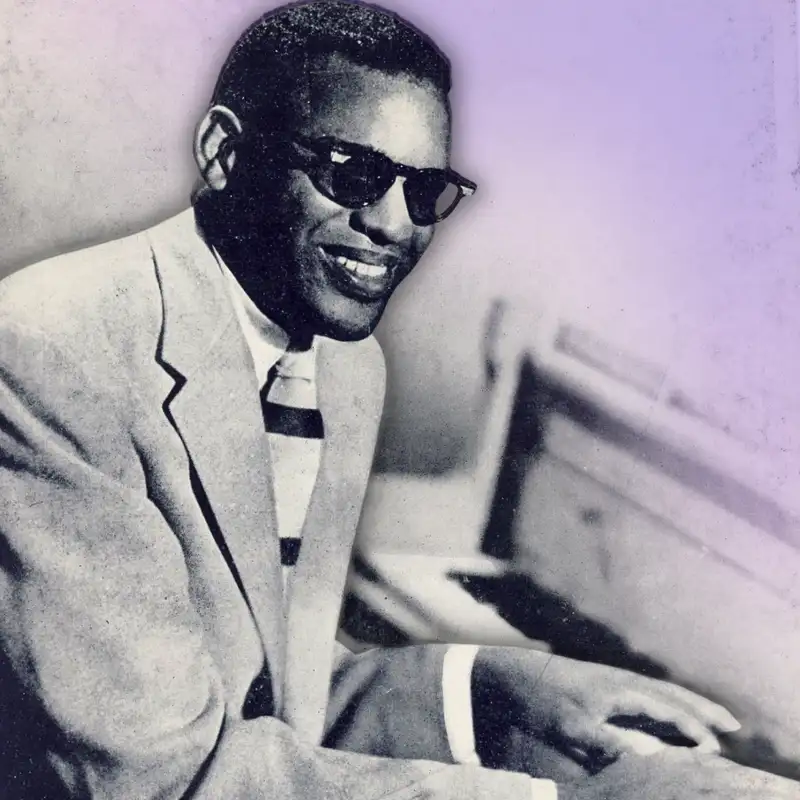
Ray Charles invented soul using his voice and his piano.
Then at the peak of his power, he set them both aside and went back to where it
all started.
This is Genius Plus Soul Equals Jazz.
I'm Adam Maness.
And I'm Peter Martin.
And you're listening to the You'll Hear It podcast.
Music explored.
Brought to you today by Open Studio.
Go to openstudiojazz.com for, oh,
your jazz lesson needs-
Yes, sir
... Peter, it's a big day.
It is a big day. We say that often, but this, we have
actual evidence at the table with this.
Yeah. We're listening to an amazing album-
Yes
... of an amazing person.
Yes.
The great Christian McBride is with us today.
What's up, Christian?
What's up, fellas?
It's good to have you here.
It's great to be with you, too.
Yeah.
I watch you on the YouTube.
On the tubes.
Gotta put the S on the end, YouTubes.
That's right.
That's the best version of us, so we'll try to keep that energy going for this
show. But man, we're listening today to a pretty amazing album, Ray
Charles, Genius Plus Soul Equals Jazz.
Christian, this was your pick.
Yes.
Why this album?
Well, I think when people say, "Christian,
pick one of your desert island recordings,"
everyone assumes I'm going to pick James Brown.
But you got to go deeper than that because who do your heroes listen to?
Yeah.
Even your heroes had a hero.
That's right.
And it's important to realize that while James Brown was called the
Godfather of Soul, the person who actually laid the groundwork
for soul music,
basically,
really the beginning, the genesis, is Ray Charles.
Mm.
If you talk to anybody who was around in the
mid-'60s, including the members of James Brown's band,
like Fred Wesley and Maceo Parker,
they looked up to Ray Charles. Everybody in
the whole pattern of
being your own
corporation.
Mm.
Had his own record label. He had a jet.
Yeah.
He had his own studio.
Yeah.
He had his
own building. Ray Charles was really
the man.
Mm.
He really set the tone for every independent artist that came
after him, and I'm sad that so many so-called
musicologists somehow think that
Black music started in 1965.
Mm.
Mm-hmm.
There's a whole lot of innovators and a whole lot of
groundbreakers long before the mid-'60s and Motown.
It's an interesting pull, too, because it's kind of a different kind of Ray
Charles album.
Right.
He's playing B3, he's playing a Hammond organ.
Yeah, a lot of B3.
Right? He's playing a lot of B3. It's with a big band, which we'll talk about.
Yeah.
Which that's not that unusual.
Yeah.
Ray did a bunch of different kinds of settings-
Yeah
... over the course of his career, but it's a really interesting pull.
And it's also, I remember hearing this record.
In fact, I think you might have played this for me when we were on
those tours in the early '90s. We used to come to your room in Japan. Remember?
Yes.
We'd all gather after the gig.
Yeah.
And you had a laptop. Well, first of all, we were like, "Damn, what is this thing
you got?" But you had all this music on there, and I remember, and we would
exchange listening. It was such an exciting time, but I think that was the first
time I heard it. I didn't hear it for a while, and I always assumed, and when you
brought this up a couple weeks ago, said you wanted to do it, I thought it was so
interesting because I always thought this was earlier.
But this was after Ray was already, this is after Georgia on My Mind.
He was a star.
Yeah, that's right.
He was a huge star.
Yeah.
So this could've been seen as a little bit of a risky move.
Yes.
He's got his own label, but he's coming over to Impulse.
This was one of the first couple of records on Impulse.
Exactly. The catalog number is A2.
Oh, nice.
That's great.
That's incredible.
Yeah.
That's really good.
Yeah, it's basically Ray Charles with the Count Basie Orchestra.
Yeah.
Quincy Jones did all of the charts that featured the
Basie band.
Right.
And Ralph Burns, who was one of the main arrangers for the
Woody Herman band,
was the other arranger, and they used
New York
hired guns for that, and Sarah Vaughan's rhythm section-
Right
... with Joe Benjamin and Roy Haynes.
Yeah.
Yeah. Well, let's listen to a little music.
The first track is "From The Heart." This is a Ray Charles original?
And there's some parts of this that I used,
when I first started learning how to write for big band, this was one of my go-to
albums.
Yeah.
So, there's a part in there that I used for, it
wasn't a straight rip-
Mm.
But in my-
Influence
... piece, "Blues in Alphabet City." I'll point it out.
If we're getting called out for- ...
doing stuff like Ray Charles, we're all in trouble.
Exactly. Right.
That's right. And this is a Quincy arrangement, right?
Quincy-
Yeah
... with the Basie band.
Yeah.
This is "From the Heart."
Whoo.
Already.
This part here.
Whoo.
Damn.
Freddie Green.
Yeah.
Ooh.
Ha, do it again.
So good, man.
One of Quincy's favorite licks right here with the 16th notes.
Whoo.
He uses that all the time.
Yeah. Whoo. Man, phrasing on this? Damn.
The phrasing right here.
Oh. Mm.
Whoa. This is so good
It's an interesting organ sound, right?
It's very. We're going to talk about that.
That's Jimmy Smith.
We'll talk about that.
We definitely
are.
Ah. Ah, man, the space and the patience on this.
I know.
Damn.
Wait, we said it's Roy Haynes, right?
No, that's-
No
... that's Sonny Payne.
Oh, Sonny Payne.
Okay, yeah.
Just no vibrato.
No, nothing.
No chorus.
Nothing on it.
Just straight up.
I love what he plays here.
Put a little bebop in there.
Yeah.
You said it.
It's kind of Bud Powell on organ a little bit.
There's for sure.
Mm.
Man.
Woo, come on.
The great Phillip Guilbeau, who played-
Yeah
...
with Ray Charles for many years.
That was Ray's guy. Yeah, yeah.
That was Ray's guy. Yeah.
Yeah.
Woo.
I love starting out the album instrumental for Ray Charles.
Right.
Woo.
I want to point out something at the end of the track.
Okay.
I want you to listen to the cutoff
and hear how the final chord rings-
Ooh
... just in the room.
It's otherworldly. The cutoff is perfect, and the ring.
Mm.
Just check it out.
Ooh.
That
feel
though.
Man.
Just floating. Just-
Floating.
Yeah. Yeah.
That feels so good.
That's a vibe.
Did Ray record this song on anything else?
I don't think so.
Yeah, it seems like it's like a-
That's specifically for that record.
Man, what a
vibe. And I'm thinking, like, 1960.
I think it was recorded in '60, came out in '61.
'60, right.
This is right in like... Oh, no. This is before
Sinatra and Basie at the Sands a couple years before.
Yeah, a couple years before, yeah.
But this is still later stage, like
big band.
Yes.
They get into a lot of groovy '60s kind of stuff.
Right.
But this is a little bit of a looking back, but the freshness. Oh, my God.
Oh, my gosh, man.
And Van Gelder, I haven't heard a lot of big band stuff from him-
Correct
... but he nailed it.
Man, it sounds so good.
Except possibly the organ sound.
I knew you were going to say that.
Well, I don't know.
I knew that's what you were going to do.
No, I want to ask. I want to know. What's your feelings on the organ sound on this
record?
Well, by 1960, Jimmy Smith was equally as big
a star. I mean, not as big as Ray Charles-
Yeah
... but he has certainly set the template for what modern
organ playing was.
Yeah.
And that was a sound.
Yeah.
So,
not that Ray Charles needed to follow Jimmy Smith in any way, shape, or form, but
that sound almost more like a
Farfisa organ sound or like a-
Yeah, like a Calliope.
Exactly.
Yeah.
But
I think he even said on that episode that maybe there's not even a Leslie
speaker on this organ.
Mm.
That it's just the dry signal.
Yeah.
And it certainly seems that way. Like I said, you can't hear any vibrato.
Certainly don't hear any like-
It's a little bit like the way Van Gelder records a piano, let's be honest.
Well, and also it says here-
That's what I mean. Listen
... Rudy Van Gelder adjusted the inside of Ray's Hammond B3 so it had more of a
percussive sound. He had done this before on other organs for other recordings.
Mm-hmm.
So it's even sort of a Van Gelder-
Really? He didn't do it to Jimmy.
He didn't mess with Jimmy Smith.
I mean, that sound.
Or Jack McDuff.
Yeah, those sounds are his-
Yeah
...
sweet and smooth.
Yeah.
And this doesn't have that same beautiful, bubbly attack that
those-
Yeah
... it's like a harsher attack.
Or depth, yeah.
Or the depth of like when Jimmy Smith holds a big chord-
Yeah
... it
blossoms almost, and this organ doesn't have that.
No.
Yeah. It's a very interesting sound. I mean, if it wasn't Ray Charles.
Well, that's the thing.
Right.
He still plays the hell out of it.
I know. I know.
Yeah.
I was thinking, how hard would it be to play some of those bebop lines on such a
dry instrument like that?
Right. Yeah.
Yeah.
It's really impressive.
Yeah. And he shows off the bebop stuff just like that's just a little
part of the other thing.
And I feel like he doesn't get enough credit for that.
I know.
Ray Charles is one of those kind of people where he did so many different things
so well.
Yeah.
At some point, you're just like, "Man, I'm sick of this guy doing everything well."
Yeah.
So you kind of overlook certain things, but he got his bebop together.
For sure.
I mean, on that opening line, I almost said, "This is annoying how good he is- ...
at all of this stuff," man.
Well, and just the fact that he's known as a pianist first, and then electric
piano.
Yeah, but he's also the world's greatest vocalist at this point.
That's right.
You know what I mean?
That's right.
Right.
Yeah.
It's
a little bit of a knack.
And an arranger.
Right.
Yeah.
He wrote a lot of his own arrangements.
Right.
Not on this album, but-
And band leader.
And band leader. Innovative.
How many stars came out of his band?
Right.
David 'Fathead' Newman, Hank Crawford.
Yep.
Marcus Belgrave is kind of nuts.
And is there, even beyond just the stylistic lineage, is there a James
Brown in terms of how he ran his bands?
Not even talking about him running his business without Ray Charles.
Does that even happen?
I doubt it.
Right.
I seriously doubt it, because everybody needs a template.
They need to look at something and go.
Either someone doesn't have it, or somebody has it and says,
"I need to figure out what that is."
Right. It's possible, at least.
Yeah. That's right.
Yeah.
Quick one. If "You'll Hear It Is All About Loving Music," then Open Studio is
all about living it. Courses, community, and conversations with
musicians who have done the work. Go to
openstudiojazz.com to start your free trial.
That's openstudiojazz.com for all your jazz lesson needs.
Back to the show. Well, let's go on to the next track.
This is "I've Got News for You." This was written by Roy Alfred, arranged by Ralph
Burns.
The band is screaming on this.
Yeah.
This is blues at its highest level.
And this is Roy on this, right?
No, that's still Sonny Stitt.
That's still Sonny Stitt. Okay.
Yeah, I believe.
Yeah.
Yeah, that was Ralph Burns.
Man.
I don't know, though. You know why?
They've got it as Sonny Stitt.
Those sound sort of like Quincy-isms, like digga-da-dee,
digga-da-dee.
Right.
Oh, instead of Ralph Burns?
It says arrangement by Ralph Burns, but...
You said before we met-
Ah
... that your life was awful tame.
Woo.
Well, I took you to a nightclub and the
whole band knew our name. Oh.
That's a great line, too.
It's true. It's true.
That's a great line.
I've got news for you.
He didn't make it up.
Woo.
Hey, baby.
I don't know, man.
This whole arrangement is-
I think this is cute.
It does sound-
Somehow your story don't ring true.
But, I mean, cute-
No offense, Mr. Burns.
Yeah. Yeah.
Well,
I've got news for you.
By the way.
Right.
Especially that ba-da-da. Yeah.
Can we just say, too, what a win for Impulse, for this to be their second album-
I know
... that they release.
What was their first?
And we gotta look it up. Great.
I know.
And then you walked in smiling with your
lipstick, oh, a mess.
Woo. Man.
Could anybody sing a break like Ray Charles?
No. Right.
He went out of time, like his sense of time-
Yeah
... he's just floating with it all.
And the band being able to-
Yeah. I know
... be in that space.
Oh.
You know.
It's so free.
Ah,
your story don't ring true, little girl.
Mm, trombones down in there.
Yeah.
Well, I've got news for you.
Ha.
Woo.
I love this right here.
Like how did it get from there to that?
How'd he get that bebop in there and do it?
Just throw some Bird in.
Yeah. Man, that sound is raw. It's
like no upright-
I was just going to say, you know what's so attractive about this?
Hold on, hold on.
Hold on.
Hold on. Hold on.
This scream here is like...
Oh.
Woo.
Man.
Here we go again with the bebop.
I mean, they are pushing this tape to its edge, too.
I know. I know.
Ray's voice is, the organ is, but especially the band.
Yeah.
It's on the edge of like-
They are screaming
... oh, my God.
Yeah.
Oh, you wore a diamond watch.
Little backbeat.
Claimed it was from Uncle Joe.
Woo.
When I looked at the inscription, it said,
"Love from Daddy-o." Woo.
Ah, come on, now.
Well, baby. Oh, little girl.
Oh.
I want to say I've got news for you.
And they're swinging.
If you think that jive will do,
let me tell you, oh, I've got news for
you.
Well, somehow your
story don't ring true.
Woo.
Oh, I've got news for you.
Oh.
Woo.
Damn.
Wow.
I love to think about-
That's the second track
... the great-
All the great vocalists have great screams.
Yeah.
Yeah.
They, "Wow!" So Ray's is the most distinctive.
It is.
But then you also have, obviously, James Brown.
Right.
Paul McCartney's got a decent scream, actually.
No, you didn't mention Paul McCartney.
I know, but he can't hold a candle to any of these.
But it is like-
He's trying to slip it in
... the wow.
Wow.
Kind of stuff. Prince.
Yeah, of course.
Whole other stratosphere in the voice of scream.
Yeah.
But that scream at the end is-
Michael Jackson.
Well-
I'm just realizing, he's very influenced by Ray Charles.
You can hear it in the-
Michael's scream is more of a, I don't know, there's something more melodic about
it.
Yeah.
You know what I mean?
But I mean, now, I just want to get back to Ray, the way he enters on that.
It's stunning. I'm still feeling that.
But that groove-
Oh, that slow...
Man, it's
just straight tipping.
Yeah.
But there's also this undertone of da-
Da-da-da. That's right
... like they never do it.
That's right.
But you feel that. Wow.
Which is why, talking to younger musicians, when they play those kind of slow
tempos, that's what I'm hearing, the triplet.
Right.
So they
Yeah.
There's some nasty stuff simmering underneath.
Right. That's how Elvin played.
Yeah.
You know?
Oh, absolutely. But can we just listen to how, I just want to hear Ray's, I
know we got a lot of music to get through.
We really do.
But just the way he enters, because to me-
Well, we might not get the whole album.
No, I mean, we can do what we can do.
Yeah.
Go back. Let's get some more of that.
I was going to say-
You know, it's like almost distorting the-
Yeah.
Yeah, it's like
It's right on the edge. Which is crazy because the big band never,
Rudy Van Gelder's got that under control.
He's got so much-
Right
... range, and that never distorts out.
But the organ entering just but when Ray's-
Gnarly.
Yes.
You hear that?
Very gnarly. It's dirty, but it's like-
Right.
But when Ray comes in with the vocals, man.
There's something about the way, the time.
Because it's like coming in.
You said before we met,
that your life was awful tame.
Ooh.
Well, I took you to a nightclub, and the
whole band knew your name. Oh.
I mean, you can feel it.
Man.
You can feel it underneath it the whole time.
Yep.
The whole time.
And he's just dr- he's not out of time, but he's in these other
places as if oh-
He's in the nook.
Yeah.
He's in the nook.
Oh, so good.
Next up we got
-
Oh, yeah
... standard. This is standard.
Yep.
"Moanin'."
But it was new then. I mean, he had-
Yeah.
Yeah. That's right.
Yeah, it was.
A couple of years old.
Yep.
Yeah.
Quincy did numerous arrangements of this.
Yeah.
He did it for this album. He did one for the Basie
Band.
Mm-hmm.
Just for the Basie Band.
Yeah.
He did one for his band.
Mm-hmm.
So there's at least three or four different Quincy
Jones "Moanin'" arrangements.
Yeah. And there's a lot of overlap between them.
A lot of overlap.
Yeah.
This is Bobby Timmons' "Moanin'."
He's
just personalizing it from the beginning.
Sloppy but funky.
Yeah. Funky.
That's just a
woo.
That's a very unique organ tone.
Yeah.
He changed up the sound on the second A, didn't he?
Yeah.
Yeah. Woo. Woo.
Dun, dun.
Yeah, that little-
Yeah.
Yeah.
Another
moment where the trumpets would blow your head off.
Yeah.
Come on, trumpets.
That's
crazy.
Woo.
That's a killing bass sound, man. Damn.
My mama done told me.
Here we go again.
He's got them. He's got them in there.
That's right.
That's crazy.
Great fall.
And this one here.
Is that Clark?
Nah.
Is that Clark?
Phil Guilbeau, yeah.
Okay.
Woo.
Woo.
That's a call back to the original recording.
Right.
Yeah.
Right.
Ba-ding. Man, those trumpets coming in low on top.
Right.
Ba-ding. That sliding in.
He messing with the vibe.
Yeah.
Oh, this is so good.
Come on, trumpets.
You know what, we're going to mix that right on top.
Yeah.
Yeah.
Right on top. We're going to put that right on top of the mix.
They're like, "We're getting that organ above the band."
Right.
Woo. Oh, that's great.
Man, you don't hear a lot of organ big band albums anymore.
No.
You know what I mean?
Yeah.
I had one.
Well
Yeah, right.
Obviously.
Wasn't there a James-
Shout out to Joey D.
Yeah, Joey D.
Wasn't there a James Brown, was James Brown's Dance Party?
What's the James Brown album, you would know this.
If only we had-
If only I had the world's foremost.
The one where he's playing organ.
Oh, there's so many of those.
I know, I know. I feel like there's one with a larger group, but I could be wrong
about that.
Yep.
Anyway,
next up.
There's an instrumental record, called
JB Plays Nothing But Soul.
Ooh.
Where he plays all, it's all organ.
Yeah.
Wow.
Awesome. All right, what do we got now?
Let's go.
Let's go.
Roy Haynes is on the next two tracks.
This is with
the New York
Studio
hired legends.
Right.
I know Clark Terry's in this,
and Sarah Vaughan's rhythm section at that time with Joe Benjamin on
bass and Roy Haynes on drums. And
I had a chance to be around Mr.
Haynes a whole lot, and he loved talking about
this record.
Oh, that's awesome.
I think,
if I'm not mistaken, this might be one of the most...
Like you said, this was a Billboard hit.
Yeah.
Yeah.
And to know that he was on the number one R&B single of
1961-
Yeah.
Yeah, that's very cool
... that stuck in his brain forever.
That's great.
Yeah.
"I'm on that."
Yeah.
Yeah.
Well, let's just talk about that real quick because I don't even think we've really
gotten into it maybe before we started.
Yeah.
This album was number four on the Billboard top LPs.
One Mint Julep, which we're going to get to, was number one
R&B, but this was on the top LPs-
Period
... for 48 weeks, period.
Yeah.
And it went to number one. In 1961, we think, "Oh, that's the big..." This was not
the big band era.
No.
This was a little bit past when-
This is right that blurry period when you're coming out of the '50s
into the '60s. The Beatles had not arrived yet.
But they were close.
They were about three years off.
Yeah.
But it was like the Sam Cooke era.
Yeah.
That's right.
Sinatra was getting hot all over again.
Right.
The girl groups.
Yeah.
Yeah.
Bobby Hebb, all that.
But even Sinatra was a little up and down during this period too.
That's right.
Yeah.
That's right. And even Motown wasn't really up and popping just yet.
Right. That's right.
They were still in the early stages.
And this was not like an expected or like what diehard...
And look, Ray Charles had crossed over in a way that kind of had never been done
for a Black artist.
Correct.
He wasn't the first, but he was huge.
On that scale, yeah.
On that scale.
That's right.
And so this was not exactly like a record that's like, "Oh, this is going to take
him to the next level with white America." It was not.
"Cue organ!"
But yet it landed, number four.
Yeah.
Very interesting.
Yeah. By the way, Ray is 30 making this album, 30 years old.
Quincy is 27 years old making this album.
And then what is the... Okay, let's listen.
Because I know you probably know about the Seattle connection and all that-
Yeah
... which I didn't even realize, which is fascinating.
It's very fascinating.
So, this is "Let's Go."
Just so far away.
Here we go.
That's that Woody Herman sound.
Oh.
And that's what I'm saying.
Yeah.
Right. The other one didn't sound like it.
Is it Thundering Herd?
That close voicing in the
saxophones.
Yeah. Woo.
This is great.
Haynes.
Go ahead, Mr. Haynes.
Yeah.
That's Bud Powell. That's straight up Bud Powell.
Yeah, it is Bud Powell.
Doobie, doobie,
doobie,
yeah.
You stay right on the heads, right?
Yeah.
I
think, is that Billy Mitchell on this?
Very
awesome.
Ah, there we go.
Woo.
Beep,
boop, bede, beep. Beep,
boop, bede, beep. Bom, bom, beep, boop, bede,
beep.
Woo.
Woo.
Hey.
Woo.
It's a big band
chart with a little bit of Ray thrown in in between.
Basically.
A, B, C, D.
Yeah, I was about to say.
That's what it is.
That's it.
Yeah.
I thought it was on ABC, though. Oh, well.
Huh?
That's the thing about this album, though.
It's as much about this band and these arrangements-
Yeah.
Oh, yeah
... than it is about Ray. Obviously, it's Ray's album, but man, there's a lot of
just featuring the band.
Yeah.
And Ray's coming in and just-
And he's able to achieve what, all the times I played big band as a
pianist, I don't know if you had this experience, it's like-
You don't get to do much.
And there's no space, so we usually just give up.
We're like, "F**k it." But he knows how to grab.
They're like, "Ba, ba, da, ba, boo, doo, doo, doo, ba, da, ba, da, ba, da."
That's right.
All loud and in your... That's the template, actually, of-
Right
... how do you fit into a chart like that?
Yeah.
It's fascinating, though.
And I also love that Ray was always
very generous with big band arrangers because,
what's the album, the follow-up to this
album?"Ingredients in
a..." Oh, what's the name of that record?
But, he uses
Benny Carter and Gerald Wilson as arrangers on that album.
Right.
And so he was always
letting the arrangers shine.
Yeah.
You know?
Well, obviously that's what he wanted.
I mean, that way it wouldn't get a get on here if it-
Right.
If he didn't want to be in the cracks, he would've been like, "Oh, lay out."
Yeah. Exactly.
Side A closes with the number one R&B
song from this album. Huge hit, "One Mint Julep." This
was written by Rudy Toombs.
Rudy Toombs.
Rudy Toombs, your favorite.
Rudy Toombs.
Rudy Toombs.
Never heard of him.
This was arranged by Quincy.
Perfect.
So not only did it go number one in R&B, but it went number eight on the pop
charts.
Damn.
This was a huge hit.
Yeah.
He used to be a great country guys.
I'm curious to how they described this,
like the groove.
Yeah.
Right.
Because, they weren't calling it funk in
1961.
Right. And it wasn't bossa nova.
Right.
But they-
It's probably more like a cha-cha.
Cha, yeah.
Yeah.
Yeah.
Yeah.
Swinging sixties.
You guys hear that tom?
Or the kick maybe?
Yeah. It's got a little Cuban influence.
Hear that?
Yeah.
That's Quincy with the sixteens.
Oh, low tom.
Yeah.
Woo. Hey.
New.
Hey! Just a little bit of soul now.
Ugh.
That set the tone for the sixties.
I know. It totally did.
Go on, Roy.
Yeah, he's pushing it.
I'm trying to think of other
Roy Haynes recordings that are anything quite like this.
Right.
Is there a-
I mean, later on.
Later on in his time.
Yeah, but he was playing with Trane in '61, wasn't he?
Yeah.
'62?
Man.
Ugh.
Ah!
So is this the only Ray Charles hit in which he
basically sings one line?
"Just a little bit of soul."
Right.
But how effective is that line, though?
Oh, I know.
That's what I'm saying. How effective.
Ray Charles to sing it, too.
Yeah.
You're just kind of laying in the groove there-
Yeah
... for a couple of minutes, and then Ray Charles gets in your ear.
Yeah.
Yeah.
Just a little bit of soul.
Just one little line.
That's right. And he's way back on that. He's way, way back on it.
Yeah, man.
Yeah.
It's great.
That's the classic. That's the classic.
That's the classic.
I mean, the band sings more than he does on that.
Right.
There's more BGs.
But you know that,
I hate to say it, but they really captured something there.
Oh, yeah. As a vibe.
Some of these recordings, that could've gone wrong. You know what I mean?
Right.
Like that vibe and, not wrong, but it could've not worked as well.
It could've been choppy.
Something about it. There's some magic in there.
Yeah.
Like that, "Ah," and all the breath.
Just everything is so put together perfectly for that.
And,
I think that's the combination of Ray and Quincy together.
Yes. Absolutely.
Those two had... Quincy always gave it up.
So Ray helped him along the way how to arrange.
Right.
Literally, he would sit him on the piano and be, "Here's what you do with your
trumpets."
Wow.
"Here's what you do with your trombones.
Here's what you do with your saxophones."
Yeah.
And, I think you can hear that those two just trusted each
other so much-
Yeah
... through every collaboration that they did.
Yeah, absolutely.
I think the Roy Haynes-ness of that track, too-
Yeah
... comes out listening to that. About keeping it, I don't know, there's something
about that
hit that he does on that kick. It might have been a floor tom.
Sound like a floor tom.
Could've been a floor tom.
Right.
But it's just put in this perfect spot, in this perfect way every
single time.
Right.
Man.
I mean, I
wonder if we will know that feeling again.
Like, we know that groove, that
sort of cha-cha groove, within three to four years is going
to turn into something completely different.
Right.
It's going to be like, boom ta cat, boom doom ta cat.
Yeah.
Yeah.
Straight out-
Yeah
... snare drum on two and four. Bass drum, boom, ti, boom, boom, cat,
boom, boom, cat, boom.
Or branch off the other way in like a boogaloo kind of scenario or something.
Yeah, but I mean, at its most popular version, it would be like
James Brown would take that and go-
Right
... to the next stratosphere with that.
Right.
But at that time, it was kind of like,
"Hey-"We're on to something here.
Right. We're getting a little sassy.
I don't really know what it is, but-
Right
... we on to something.
Wow.
That's great.
I have that.
So I wonder that feeling like you know
you're doing something different, but you can't put your finger on it.
Mm.
And then a couple of years later, you're like, "Oh, so that's what we were doing."
Wow.
So is this kind of-
We were pushing music forward.
Is this like funk lineage? Because there wouldn't have been the word funk yet,
right?
Big time. No.
Yeah.
I
think Cannonball was using the word, Horace
Silver was using the word. But
as a genre, no.
Right.
We were about a decade away from that.
Yeah.
But you know the bass.
Playing the
pattern, the repeated pattern.
Yeah.
Most jazz cats were-- I bet
even Joe Benjamin was like, "Man, what is this?"
"Where do I walk?"
Cha,
cha, cha.
Right.
Oh, this is fascinating, man.
But again,
we were talking about just the influence of Ray Charles,
for the funk lineage.
Yeah.
Yeah.
Right?
The tastemaker.
The tastemaker of that.
Yeah.
The fact that this is on a Ray Charles album.
Yeah.
Yeah.
And like you said, he's got one line on this.
This is not some big sung hit vocal
feature for him-
Right
... pop song kind of thing. But man.
And it wound up being a number one hit.
Right.
A number one hit.
Well, that kind of validates you if you're onto something normally. Not in jazz.
We run against that.
We run away from that.
We run away from that. Yeah. We're like, "Oh, that's some sass." So maybe-
You mean people like it?
Don't do that again.
You must be doing something wrong.
Don't do that again.
All right, the B side-
Side two
... starts off with, "I'm going to move to the outskirts of town."
Yeah.
Oh, that's Clark Terry there.
Oh,
yeah, definitely.
Yeah.
Yeah.
Here's where we nerd out a little bit because-
Okay
... Quincy uses the
double diminish
chords over here.
Oh, that's what you were playing over there.
Yeah, exactly.
Way out on the outskirts of town.
I asked James Williams about this.
I'm like, "Man, what is that sound?"
Yeah.
He's like, "Come over to the piano."
Yeah.
I'm going to move, baby.
I love when Ray uses this part of his voice, too.
Way out on the outskirts of town.
The sort of sweet-
Yeah
... high end of his voice.
You
see, I don't need nobody.
Come on, double diminish.
Yeah.
Always hanging around.
Woo.
Oh, killing it.
Let me tell you, honey.
We going to move away from here.
I don't need no ice man. I'm going to get you a Frigidaire.
And this is Roy Haynes on here.
Right.
Man, that
is so locked in.
Yes.
Way out on the outskirts of town.
Whoa. You see, we won't need nobody.
Always-
Is there an organ going on here?
Hit me one more again.
That's that double diminish when it goes up there?
Yeah.
Yeah.
So great.
Woo.
My mama done told me.
Yeah.
Ooh,
that
was Haynes. That was Haynes nailing that there.
Yo, big time. Roy Haynes, 101.
He is just padding.
He's old, man.
He's just padding underneath.
Oh, on the one.
Oh. Hogs better look like me when we move.
Oh, yeah.
Way
back to town.
Whoa.
We won't need nobody.
Always hanging
around.
We don't need nobody, baby. Oh!
Always hanging around.
Hanging around. Woo. Hanging
around.
Woo.
Man.
That bass trombone is almost like a keyboard.
Yeah.
It goes .
Yeah.
Yeah, like a synthesizer.
Like a didgeridoo.
Right.
Man. Well, our time is a little short, guys.
If we were to listen to one more track here-
Oh, man. Why are you doing that?
... on the second side, Christian, what do you think? What do you want to hear?
I will go with "Strike Up The Band."
Okay.
Just because I love how
he
bebops just enough-
Yeah
... to let you know he knows that language.
This is a Gershwin tune, "Strike Up The Band," arranged by Quincy.
Woo.
Woo.
And this one
sometimes feels more like Ralph Burns.
I almost wonder if they-
Ah.
They switched them out, yeah.
Yeah. Going with the patterns, right?
Yeah, yeah.
Right, right.
Taking it to the diminished.
Right.
Sha-ba-da-ba.
And this is funny, this isn't bebop language.
Some of that stuff is a little bit
Yeah.
Woo.
Woo.
I
mean
dare I say, a little Art Tatum-esque there at the end.
Right.
Yeah.
You know?
Little run.
Yeah.
Run going up. Oh, so great.
All right, guys, let's get to some categories here.
Okay.
Oh, yeah.
"Desert Island Tracks."
We have to explain some of these to our esteemed guests here as we go.
If you were to take one track from this whole album to a desert island,
which one you taking?
Oh, man. Really?
I know. The whole category's question are just terrible.
I'll go first to give you a little-
Go ahead
... a little vamp time. I mean, "Moanin'." I love that,
especially from what I've heard so far.
I loved
Ray's language there, his jazz
sensibility. I love that tune. I love that it was like a new kind of jazz standard,
and works great on the organ.
"I've Got
News for You."
Mm.
I think
the vocal performance on that
is
so great. The arrangement is so great. The energy of that song is so great.
It's hard not to pick "One Mint Julep" because of the vibes, but-
Yeah
... I'm going to go with "I've Got News for You."
I think I'd go with the opening track, "From the Heart."
"From the Heart."
All right.
It's just such a fail-safe way to start an album.
Mm.
That comes in just slamming, banging, the
horns, the rhythm section, just
the tempo, the language.
And it's also one of the tracks that
made me want to start learning how to write for big bands, so.
Yeah. I was going to ask you. After starting to dive into this record,
I was thinking about it, because I've heard your big band recently a few times, and
I know your records. I'm like, "Is this your favorite period
stylistically?" I don't want to box you in, but
it definitely sounds like it's the most influential, this type of
writing, this type of vibe for big band.
So, in that piece I had mentioned,
"Blues in an Alphabet City," that was the first big band piece I
ever composed.
And I wrote it for the Jazz at Lincoln Center Orchestra
in 1995. And at that time, I think a lot of
my references were, like I had mentioned, there was a little part in "From the
Heart" that I used,
and there was also
an old R&B hit from the same era by Jackie Wilson called
"Baby Work Out."
And there's a piece in that track
that I probably referenced as well.
So yeah, I think early '60s,
Oliver Nelson's-
Mm-hmm
... "The Blues and the Abstract Truth."
Right.
I think all those cats who were writing for big band at that time,
it was just a really
great time to be a big band arranger.
Yeah.
And once I started getting into it more, and people like James Williams
said,
"Get you some Thad Jones scores to study."
Yeah.
"But that's in the back of the book." "Take some time before you start getting into
that."
Right.
You know?
Oh, that's great. Yeah.
Quibble bits. If you had to quibble any little bit of this, if there was anything
you could change, just a small thing.
For me, I'm going to say it
The organ sound?
Yeah.
Yeah.
I'm with you on that.
Yeah.
I don't mind it some of the time.
Yeah.
Yeah.
I wonder what it would sound like if it sounded more like Jimmy Smith.
Right.
Jimmy Smith off, you know?
If it wasn't Ray Charles, I'd be like, "Who in the hell-
Yeah.
Right. Yeah
... approved this organ sound?"
Right.
Yeah.
My only quibble bit is the way that this wonderful LP smells and
the mold-
That's on you, buddy
... the mold it's giving.
That's your fault.
So I ordered this. I was so excited.
You could've gone to what's the name and-
I know. I-
Vinyl. Vinyl.
But it's like I wanted to get something, and this is original, which I'm excited
about.
Yeah.
I was more concerned, I wanted to be able to see the...
Well, first of all, this is not available as far as we know, and you can
say, maybe in another country, you can put in the comments.
As far as we can tell, it's not available currently on Spotify, on Apple Music, or
on Apple iTunes, which is where we usually go for original sourcing and buy the
tracks. So I wanted to have it for that, but man, this thing
smells like a dusty mess, man. It's like I'm a little bit, I'm not really high.
What's opposite of that? I'm down, I'm up.
Yeah.
I don't know. I don't know what these toxic fumes are.
Yeah. I hope you don't have to go to the doctor in a few days.
Just to be clear, your quibble bit with this albumIs that you bought an old,
dank copy? That's your quibble bit?
But look at the condition. This is damn good condition.
That's pretty good.
Yeah. It's kind of worth it.
Yeah. Anybody else got a quibble bit?
You know what? You guys agreed on it.
Just the organ sound.
Yeah. I would agree on that, too.
Well, let's stick with the album-
Yeah
... accoutrements. So, cover. I mean, the title-
This is one of the 10 greatest ever
... we were talking about how unique Ray is as an artist, right?
How influential, how genius he is.
Is there anybody else who can get away with so many album titles having genius in
them?
Genius. I know. That's what... But no one's got a problem with it as far as I know.
Right. Genius Ray Charles. Right.
Yeah, nobody's mad at him.
No.
Yeah. You can't be like, "He's not."
Yeah. I give this a nine, and the only reason I'm not giving it as a
10, I'm almost like, the 10, because you include the title.
I think the design of the cover, I love
Ray, and it's almost like
he's slightly out of focus, but even more like bokeh in the front.
I think this is brilliant. I think-
The saxophones.
Yeah.
The saxophone, like the color, even the sticker, "This album contains," just, I
mean, what a time when you're like-
That's so awesome
... put the hit on there-
That's right
... so they know what they're buying.
You've got to let people know.
Impulse, this is classic. Even what's shocking to me is this is, as you said,
A2 for Impulse, but they already had their design chops too.
It looks like an Impulse.
Big time.
Yeah.
Produced by Creed Taylor with the signature.
That's Creed. Hey.
Right.
How many times did we see that? All the way to CTI.
But I think the only reason I give it a nine is, should the title have been
Genius Plus Jazz Equals Soul?
Mm.
It could've been.
That sounds like a quibble bit. Yeah.
That is a little bit of a quibble bit, but it's great.
I got eight. I have an eight.
Okay.
I think it's really, really good. Like you said, the Impulseness of the-
Yeah
... packaging is already there.
Yeah.
And I love these Impulse albums, too, from the early '60s.
Like, all the McCoy stuff.
This really is starting to affect me. I was joking before.
All right. Well, keep it, come on. Do it.
Sorry, guys.
I'm starting to worry now.
My bad.
Christian, you want to-
Don't get sick.
Welcome to our guest.
Also, by the way, the liner notes and the detail, I mean, I know we say this every
time we have... I'm sorry. I won't open it up.
Close it up.
I'm going to keep that open.
Yeah. Oh, man.
But every time we have the vinyl out-
Yeah
... which is almost every episode at this point-
Yeah
... it's just like, why are we choosing to go away from this?
I know.
You know what I mean? Like, the experience-
And look at that picture
... of listening to this with you guys-
Yeah
... and having this available-
And holding, and seeing the picture of Ray
... and passing it to Peter-
I know.
... and watching him almost pass out, that's fantastic.
But having just every, just knowing who's playing on this album-
I know
... is amazing.
Right.
Even though apparently some of it's wrong.
Hey, you know.
With the arrangers. Yeah. That happens.
I would
give it a nine.
Nine.
Yeah.
Okay. All right. I got eight.
I don't know why I wouldn't give it a 10, but I think probably because
most Impulse records, particularly the artwork, is just
as great as the music.
Right. I agree.
I think Rudy,
somehow people, when you think of the sound
of Blue Note Records-
Yeah
... obviously Rudy and Blue Note are intertwined with each
other forever.
But I think Rudy's sound on Impulse records,
I mean.
Yeah. Well, we've said on the pod before several times-
Yeah
... I think, in general, his piano, because I'm not a huge fan of the Rudy
piano sound-
Right
... but it's more on the Blue Note.
On the Blue Note Rudy, yeah.
On the Impulse, I think it's-
Right
... fantastic.
Right.
I mean, obviously there's no piano on this, but I mean, in general,
and Prestige.
Right.
I mean, I think a lot of, I think part of that was the Blue Noteness of it all,
but.
Yeah.
Yeah. There's a vibe on those Impulse records.
Yeah.
Do you guys think about album art as you're making the album?
I mean, I'm sure you're both involved in it when it's
being done, but do you ever consider that as it's happening, or you just let it
kind of-
While it's happening?
Yeah.
I don't know about while it's happening.
I think once it's done, and you take it all in-
Mm-hmm
... then you kind of go, "All right."
"What do we got here?"
Right.
Yeah.
Yeah.
Yeah.
Yeah.
Apex moments. Peter, what do you got?
Come back to me. I don't have mine yet.
Christian, what do you got? What's your favorite moment of this whole album?
Oh, man.
Probably that scream the whole band makes on-
That's pretty great
... "I've Got News for You."
That's pretty great.
I mean, that is nuts.
That is insane. Also, the way it's recorded-
If I had hair, it would've blown it off, right?
The way it's recorded feels like it takes up the entire room-
Yes
... that you're listening to it in.
That's right.
Right.
It's like all of a sudden, the room is just filled with horns.
Right.
Yeah.
Right.
Yeah.
And even here, these speakers here, it's like you almost
feel like they're there.
Yeah.
Yeah.
You know?
Yeah.
Yeah.
You just see the brass in front of you.
Yeah. The production engineering on this,
besides the quibble bits about maybe the organ stuff, is stunning, actually.
Oh, yeah.
This is one of the best big band-
Yes
... recordings in the studio I've heard. I'm actually amazed.
I would say my apex moment is Ray's entry on "I've Got News for
You."
It's a great moment.
Yeah.
It's amazing. I could come back to that and just, and there's so many levels to it
I think you could explore that are just so fascinating.
The feel of what he's doing.
Yeah.
Obviously, how he's singing everything, one of the greatest voices in music
history. But it does-
Yeah. But the freedom, the rhythmic freedom-
The rhythmic freedom
... and the attenuation.
But like you said, you can feel that pulse happening-
Oh
... the whole time under all those breaks.
Yeah.
Yeah.
And I think you're right. Maybe greatest breaker
of all... Not breaker.
Yeah.
The greatest vocal breaks.
Blue Note breaks.
The greatest vocal breaks of all time.
Yeah.
You know?
Okay.
What's your apex moment?
Oh. Man, you know what it is? It's on the "One Mint Julep,"
every single ah, and the-
Yeah
... just a little soul.
Oh, yeah.
I know it's stupid and little, but those little moments-
Yeah
... I think that's why that was such a huge hit, honestly.
That was Roy Haynes' favorite moment.
Oh, really?
Yeah.
It just pulls you in. You know what?
Just a little bit of soul.
Because you-
I used to say that all the time
... like lean in a little bit.
Yeah.
Right.
You know what I mean? And it just breaks it up.
I just think it's really, really nice.
It's great.
Snobbometer. How snobby is this album from a scale of one to 10?
One being it's not snobby at all. It's very accessible.
Anybody would like it, to 10 being like, ooh, that's going to take some
listening to.
Probably a one.
I've got two.
Yeah.
I've got a two.
I've got 10
Are you serious?
Yeah. Okay, first of all, just so you know.
Come on, let me hear it.
We have a lot of disagreements.
I love it.
The only time we agree, because the snob-o-meter is broken, first of all.
It's not.
It's totally broken.
It's never worked right.
No.
It doesn't make sense. I don't even know why we do it.
Well.
The reason I'm saying 10 is, first of all, Christian McBride brought in an album
today that's not on Spotify or on Apple Music or on
iTunes or anything.
That's fair point. That's fair.
There's a certain snob level to that.
Although-
Can't even find it
... it was number four. Yeah. But it was also number four on the pop charts and a
number one R&B hit.
Right.
So how snobby could it be? So I could be off on that, but I just wanted to throw a
10 out there.
I'll allow it.
I mean, partially that's because, by this time, Ray Charles owned
his own masters, and I think even to this day, most of his
post-Atlantic recordings-
Yeah
... can't find a lot of them.
Right.
That's a real shame.
Wait till we get blocked on this episode.
Yeah.
We've got to talk about that later.
My goodness.
We might. Okay, up next.
Yeah.
So I'm going to go boring here. If you were to put together what would play
after this, I'm going to say Modern Sounds in Country and Western Music, and I'm
just going to go
right-
Oh, that's killer
... yeah.
Another great album.
Yeah.
I think there's a lot of k-
Bye Bye Love.
There's some kinship here where you can hear some.
I mean, it's obviously two whole different vibes, right?
Yeah.
But, yeah. What do you got, Pete?
I'm going to go Someday My Prince Will Come.
I know. Same year.
Miles Davis. So they came out the same year.
Oh, yeah.
I always like to think about different things that are happening, because a lot of
times, that's how I'll... And this is definitely a record I'm looking forward to
taking home, sterilizing fully- ...
setting out on the back porch, and then bringing into my home and listening to it.
I love it. Then turn it over.
Right.
Listen to this. And then if I want to hear more music, I usually want to go to
something else. But it's fun to be like, "Damn, this was all 1961?"
Right.
I love Someday My Prince Will Come.
Well, if you look in the
Impulse Records
calendar booklet-
Mm-hmm
... from that time, they probably did Africa/Brass not
long after this.
Oh, that's right.
Yeah.
Wait, isn't Haynes on-
Yeah
... some of that?
I thought that was Elvin on the whole album.
It's Elvin. Okay.
He might be on some of the
sessions, but-
Okay. But he was with Trane-
Oh, yeah
... a little bit around, like when Elvin-
Yeah
... wasn't available. That's crazy that he was.
So I say let's follow that up with-
That's killer
... Africa/Brass.
That's a great call.
No, and it's like the times when, I mean, we still remember this a
little bit, when the label would be like, "Next week, what's coming out.
Next month."
Right.
Yeah.
They have the little insert for it.
That's so cool, man. I miss those.
Oh, yeah. That's great. Okay, while he's looking that up, we're going to move
next. Oh, bespoke playlist. So this is like, what would...
If this was on-
It was Elvin on everything.
It was Elvin. Okay.
Yeah, that's what I thought.
That's a killer record, too.
Oh, yeah.
Oh, man. Africa.
That's Jimmy Garrison, right?
That's Art Davis-
Oh, Art Davis
... and Reggie Workman.
That's right.
Yep.
Bespoke playlist. This is like, if it was on Spotify, what would it be part
of? I've written something that I can't read right now, so.
Oh, it was my favorites. I got one.
Okay.
And this is just on the genius front. Genius plus genius equals genius. Come on.
Ooh.
Oh, okay.
I don't know what else is in the playlist but other geniuses, I would assume.
Yeah.
Okay. Not my best work.
No, sorry. I wasn't actually listening to what you were saying for a minute.
My bad.
What do you got, Peter?
I have S-T-R-E-A, and I don't remember why I wrote that or what that means.
Sorry. I'm just being honest.
Strea.
Strea.
Strea.
I don't know.
What's wrong with that?
You got anything, Christian, on that?
What will we call it?
Like a name of a playlist? Yeah.
What could we call it?
Let me see. Something with soul or funk in there, because it's
like
this is a jazz record, by all means.
Yeah.
But it's also a soul record.
Mm-hmm.
It's also a funk record.
That's great.
Before anybody was calling it that.
Yeah.
So-
The Seeds of Soul?
Funk before it was called funk.
Funk before it was called.
You know?
Yeah, I like it.
Last question, is it better than Miles Davis' Kind of Blue?
Oh, come on.
I know. No one ever wants to answer.
And this is-
Did we... I saw Ashley Kahn, who wrote the book-
Kind of Blue
... on Kind of Blue.
Yeah, great
And he was like, very-
We thought it would be funny. We thought he would laugh.
He was like-
Yeah, but he was just like, "That's a stupid question."
Yeah, he was like, "I don't think about music like that." And we were like, "Okay."
Yeah. I was like, "Well, you wrote the book on it, so."
Fair enough. Well, do you have a podcast?
He got all serious on me.
He was super jovial right up to that.
It was when I was at Newport, the last time we were at Newport.
Right.
I think it's so different. I don't think there's...
I think it's like-
Oh, don't shy away now because Mr. McBride is-
I am copping out. I am copping out.
I'm going to say no. I'm just saying no.
Yeah, I mean.
It's a great record. I don't think it's better than Kind of Blue.
All right.
But I've said many things are, so I want you to figure out.
I'll be quiet over on this side.
Yeah. I mean, it depends on what you're in the mood for.
Right.
Yeah. That's what I'm saying.
Good.
I think Kind of Blue's a more balanced meal. This is kind of heavy on the carbs.
Right.
The carbs being-
Organ
... vibrato-less organ.
Vibrato-less organ.
Crunchy organ.
Heavy on the carbs. I mean, carbs, we need to live.
Well, it's great.
But it can be a lot, yeah.
Well, Christian McBride, it must be said that we did have, like, six
James Brown albums picked- ... for maybe you would want to.
See?
Yeah.
But I was delighted when you picked this one.
Oh, so great.
This is a great pull. We're so glad to listen to this with you today.
Yes.
Oh, absolutely.
And it's been a pleasure.
Yeah, man. Thank you, man.
Great to see my friends.
It's a pleasure and an honor.
Yeah.
We'll have you back for James Brown if you want.
Please.
Or whatever else, or surprise us with something. It'd be great.
Yeah. I'll come up with, like, a Hank Williams album next time.
That'd be really fun.
You got it.
That'd be really fun.
And you can catch Christian McBride. Go to christianmcbride.com.
I was joking earlier. He has one of those artist sites that actually does not say
copyright 1997 on it.
Like yours.
Like mine. Actually, mine is offline right now. I have to pay.
Mine is so out of date.
Oh, man.
No, I don't know. But you can catch him live, catch his
excellent podcast, The Lowdown, SiriusXM,
the Christian McBride Big Band.
Yeah.
All of his wonderful projects. He's got 11 Grammys, so he knows what's up.
So thank you, sir.
Till next time.
Thank you, brother.
Yeah. You'll hear it.
Until next time.
Y'all will hear it.
You'll hear it.
Thank you.