What's up, Adam?
What's up, Jack? Jack?
Whatcha talking about? That's what's in your glass?
Uh, no, this is Coke Zero, actually. Oh,
Okay. Hey, Peter,
I was thinking today in honor of the album
that we're listening to Sinatra at the Sands, that instead
of playing the intro like we normally do. Yeah.
That we could, uh, sing a ding, ding it. I
like that. Let's do
it. You ready?
Fly me to the moon
and let me play among the stars.
Let me see what life is like
on Jupiter and Mars. How'd all
These people get into my room?
In other words, hold my hand.
Sing it, Pete. In other words, that's
A two chord, buddy. Oh
My bad. Darling
kiss me. Right on the soup coolers, you know.
Fill my heart with song
and let me sing forevermore.
Say sing. You are all I long for all I worship
and adore. You talking to me or Dino.
Do I like Basie? In other words,
please be true.
Other words. I love you.
You'll hear it now.
I am
Adam Maness. And
I'm Peter Martin.
Live from the Starlight Room in the beautiful Chase Park
Plaza Hotel from St.
Louis, Missouri. It's the You’ll Hear It podcast. Music
explored. Pruning Away today.
Music explored brought to you today by Open Studio.
Go to openstudiojazz.com for, oh,
your jazz lesson needs. Ringa.
ding ding. It's a ringa ding, ding kind of day.
Peter, we're talking about Sinatra, the chairman
of the board, the CEO, Frank Sinatra.
Sinatra at the Sands.
This is a live album recorded in 1966
with the incredible Count Basie Orchestra
with Quincy Jones conducting a lot
of heavy hitters on this album.
Yes. And a lot of swinging bangers on this album. This
Was a swing fest buddy.
You know what I love about this album?
And I love about having to pick,
this is our first time we've talked
about Frank Sinatra on the show.
Yeah. Oh, is we, we, we've said his name though.
We've mentioned it, but this is the first
album we've listened to, which
Right. It was also his first live
Album. Did you know that? I
did not know that.
That's a, which is crazy. That's a fun fact.
I've already felt like this podcast's been worth my time.
Thank you, Peter. You're welcome.
But, um, what I love about this tip, your waiter. Yeah.
I'm here all week. Try the View. Um,
what I love about this album in particular is that, I mean,
all the Sinatra stuff is swinging and great.
Yeah. And the ringa ding dinging and all that stuff,
but there's something about him with the Basie band Yes.
That brings out the both the best in both of them. Yes.
You know what I'm saying? Like, it's, it's, it's as good
as Frank is, is when he's in front
of this absolute swing machine.
Yes. And it is an absolute swing machine. Yeah.
I mean, they sound so good and are so swinging
and Count Basie, uh, at this point was in his sixties.
Yep. Still playing Great. The band's still swinging great.
Uh, young Quincy Jones. Yeah. Conducting his ass off.
Yes. Uh, and arranging
And arranging his ass off some of the great arrangements.
Yeah. And then Frank, you could just tell is loving it.
It's the, the vibe of the live album is loose,
maybe a little too loose, which we're talking about,
We talking about the album or the after party. What
Are we talking about? Well, it got, it's
pretty, it is pretty swinging,
but, uh, man, I love this, uh, this album so much.
It's so great. And I mean, you know, we're,
we're gonna talk about it, I think folded into
this story today.
Like, is this peak Frank, like Frank Sinatra.
What a amazing actor. Musician. Singer, of course. Comedian.
He gets into some comedy on here.
Um, heartthrob, all these different things. Icon American.
Yeah. Uh, acting and singing icon.
But this may be he was 50 years old. Yeah.
And he jokes about that and talks about that.
Um, and he, in terms of like vocally
and musically, this might be kind of peak, not
to say that he slid down.
I mean, I actually got a chance to hear him live
towards the end of his career.
And he had the chops still, he still had had the voice.
Yeah. He sounded good. Yeah.
But in terms of like, you, you know, the peak of the Vegas,
I mean, look, he, we always think about like,
this is right in the middle of it.
He, he'd been playing in Vegas for 15 years at this point.
He helped build Vegas. He literally helped build Vegas.
Yeah, that's true. 1951 was the first time he played in
Vegas, and this is 66.
So he's 15 years into it.
He sees, and he'd been coming off a little bit of a lull,
uh, in terms of, not in terms of his recordings,
but in terms of his popularity sort
Of. And there would be a lull
after this too. There would be.
Right. And the fir, when he first came to Vegas,
actually Vegas sort of revived his career,
even though he was like 35 or so.
Yeah. He'd been on a little bit of a lull, was going
through a divorce, was kind of in exile.
So it's really interesting,
the whole Vegas story that goes along with this.
But you can't really pull
that apart from what this event was.
Sinatra had just on two records
where he actually released like three records in 1966,
or maybe even four, which is crazy by today's standards.
But in the last four years
before this 1962, he released Sinatra
and Basie with arrangements.
He had already worked with Quincy Jones
before that, a young Quincy Jones.
But that record, this was his first record
where was all cues arrangements.
But the Sinatra Basie record in 62 was Neal Hefti and the,
and the Basie band, of course, sort
of legendary arranger in some we consider the greatest
arrangements for the Basie band.
Um, and then he did
Lot of loud, soft, loud, soft, loud,
Soft. Yeah. Yeah.
1964 without, was not with the Basie band.
It might as well be spring. It had a couple hits on that.
Mm-hmm. But it was a little bit of a lull for Sinatra.
And it was a little bit of a weird period
because 66, the Beatles.
Yeah. Yeah. We got a whole culture shift happening. Yeah.
I mean, huge rap. I mean, the Beatles were already out
there, of course, but we had Revolver, uh, from The Beatles
and Pet Sounds and the Beach Boys.
So like pop music was going in a different direction.
And I think it's easy for us
to think about like, jazz music.
And this is certainly a jazz big band, sort
of typical, not typical.
I mean, it's extraordinary. It is.
But in terms of like the standards, the swing beat
that like, it's very, very much a jazz record that we forget
that it was just a few years
before this that this kind of record would be a major hit.
And in fact, this record did chart up
to number nine on Billboard.
Awesome. So it wasn't like it wasn't still in there,
but I think for Frank Sinatra
and the popularity that he'd enjoyed, um,
before this, it was a little bit of a downslide,
but not to the audience that was there for the whatever,
two weeks that he played two sets a night,
uh, with this extraordinary
Band. Let's get into
it, man. Let's get into the swing. Okay.
Well, the great thing about this record too,
and if you haven't heard this, you're really in for a treat.
Um, is that like the record tells a story,
it was recorded over how many days was this something like,
yeah, maybe it was just a week.
But, you know, and they're using like different takes from
different times, but it's put together in a way,
like it's a set, like you were sitting there, the double lp,
and you'll be able to hear a lot
of the story from the very beginning.
Well, and just the Copa room. Sorry.
400 seats in the Copa room. Right, right.
So 400 seat theater, $25 tickets,
which would've been pretty expensive.
Yeah. For 1966.
Yeah. This was a, a pricey thing.
And that was just the loss
leader to get you into the casino.
The whole, the whole Vegas machine. That's right.
And look, I don't wanna get myself in trouble.
I don't know what the statute of limitation on getting, um,
taken down by the, I think wasn't Vegas pretty
mobbed up still at this point?
It certainly was before this had it gone corporate yet.
Sorry. You nervous?
You look nervous. Well, well, we don't,
not if Frank Sinatra would've had anything to do with
That. This has put a lot allegedly
in
front of what we're saying today,
Pete. People are saying
that it was not.
People are saying that it was mobbed up.
Um, so anyway, let's check.
I saw The Godfather too. I know.
Let's check this out. Come fly with me. Of course.
But this intro so great. Sonny Payne at the drums,
The Sands is proud to present a wonderful new show. Norm
Keenan at the bass, his music.
Can we get this guy to I know our show, please.
A music of Count Basie and his great band.
Come on. Woo.
Ah.
And the man, See where go do that.
The timing of this.
Here's Basie
Basie gonna Basie. Great
How'd all these people get
in my room. Oh, come
On.
How did all these people get into my town?
Come fly with me. We'll fly. We'll fly away.
If you can use the flu doubling. Some exotic booze.
There's a bar and Far Bombay. Come on, fly with me.
We'll fly. We'll fly away.
Come On, Quincy, come
Fly with me.
We'll float down to Peru,
Very few. Anderson Trump,
One man is flu for you.
Come on, fly with me. We'll float down the way
Sinatra lays in those phrases.
Once I get you up there. Where the air,
I feel like I'm on TWA airline, Pan Am Pan Am on a clip
and on an air clipper. Steven
Spielberg used this song, I don't think this recording,
but this song in, uh, in the Catch Me.
If You Can scene where Leo is impersonating
a Pan Am pilot surrounded by
Pan Am Stewardesses as they were called.
They were called
Mean. Check out this writing.
Just say those words.
Beat those birds down to
Acapulco Bay. Perfect for a flying
honeymoon. Are they say,
Could you imagine? This is the
first song in the set.
We Fly. I'm gonna gamble.
You're like, honey, take my money, honey.
I told you to go to Vegas,
Harry Sweet Addison. Come
On Back to the bridge.
Come on. Keep it simple. You could almost smell
the cigarettes in cologne
in this room, couldn't you?
It smells like bourbon and bad, like Canadian Club.
And Ave I'll be holding
you so awfully near.
You might even hear a gang of Angels chair, just
because we're together weather wise, wise. It's such a,
I made a few notes, but all the right ones
count bass, come on.
You just say that word.
I'll beat your bird to a Kago Bay
is perfect for a fly off.
Simmering. Save. Come on, fly with me. We'll fly. We'll fly
Pack Up. Let's fly
away.
Amazing. Yeah. So, I mean, that's a good start, right?
Yeah. That would be a fun start to the gig. Yeah.
Yeah, yeah. How many people fell off the wagon?
They came into Vegas. They
were like, I'm not gonna get a drink.
By the end of that tune. They're like, come on,
bring the Canadian Club. Let's do it. Yeah.
Amazing. Yeah. Great start.
Um, so yeah,
and that's sort of like, you know, I mean,
Frank Sinatra Come Fly with Me.
Like, that's such a classic, um, frank song.
But like, I think what, what you're hearing in that, um,
version, I was just looking to Oh yeah, of course.
Jimmy Van Heusen and Sammy Cahn Classic from 1954.
Um, what's fun about that song?
It was actually written in three four,
and I believe that Sinatra's the first one to do it in four.
That's how he kind of made it his own.
I could be wrong on that, but I know Sinatra asked Quincy
Jones to put that arrangement into four.
And I think the way that Quincy did that, I mean, look,
Quincy is like, he's sort of omnipresent from this point.
And really before this, when he first worked with Sinatra,
and even, even before that when he was playing trumpet with,
with Lionel Hampton and had a storied career.
But I mean, this was the point
where he became the superstar, kind of, um, like
taste maker, um, conductor,
obviously actually conducting the band,
but conducting the whole vibe, being able
to realize Frank's vision in a way that I think, I mean,
like, to me, of all this,
the different recordings I've heard of Frank Sinatra,
it doesn't get any, he's got other great recordings
and studio stuff that's amazing.
But in terms of like, him being able to connect with Jazz
and with the big band and Count Basie,
the whole band is a huge part of that.
But I think that that, um, Quincy Jones had
that unique ability to really pull, like,
to put, to set the table. Right.
I'm trying to think of how that would sound. Are
You still thinking about that? Three, four. Yeah.
Come down, come fly
with me. I don't
Yeah. I was thinking, come fly
With me.
That kind of thing. That's good, right? That as good.
That was good. Yeah. Well, that, that definitely was.
That's good. But like Frank trying to be like, I,
I mean I'm projecting now,
but for Frank Sinatra to be like,
I think I want it to be in four.
But then Quincy to put it into that,
um, that kind of a vibe.
And then Sinatra's Precision really being matched
by the band's precision.
Um, you know, Sonny Payne, I mean, just driving the band,
like all the right things happening, but also as loose
and confident as they are.
There's also like a precision
and a humility wrapped up in the way that they do this.
That probably for a lot of the audience from Peoria
or Chesterfield or whatever, it might've kind
of flown a little bit over their head. No
Chesterfield in 66.
Well, whatever it was called Gumbo Flats back then. Gumbo
Flats, you know, but you know what I'm saying?
Like this was above, in terms of musicality and artistry.
This flew right above. A lot of folks come fly with me.
He was flying above the radar on this one for
Sure. Flying high.
What's up next?
How about a little bit? We're gonna, okay.
Great thing about this album. All the tracks.
Maximum 40 minutes, man. They, it's just like
44 minutes. Four
Minutes. Sorry,
What did I say? 40 minutes.
Oh, 40
Minutes. What's, that's true too.
The maximum it goes.
That would be an unparalleled artistic achievement if all
of these standards were 40 minutes long. Four
Minutes. Four minutes. Yeah.
Um, but there's a lot of tracks.
This is a double on. We're gonna skip to track number three.
I've got you under my,
I have got you under my skin.
Cole Porter Classic. Of course.
I have got you. Deep in the heart
of me, so deep in my heart that
that's you really a part.
Me. I've got you
under my skin.
I have tried so not to in,
and I said to myself, this is what
A great song. Cole Porter
could write a song
Port. He could write it.
Indiana's finest. Who should,
Why should I, if this is a Quincy arrangement
Baby?
No. So, well that I've got
to you, man.
It's a super mature kind
of like restrained arrangement. Well, it's,
He's definitely nodding towards the Nelson or
Riddles, You know, famous. It might have
Been an orchestrated version of it, I'm not sure.
But
Spite of Comes the Night, every
repeats in my ear.
But, you know, you fool, you never can win.
Use your mentality. Wake up to reality.
And each time I do, just the thought of you makes me stop
before I begin
because I've got you under my skin.
Ha.
Run for cover running high.
Ask your boy, ask your
boy Percolate.
Woo Al gray.
Incredible solo.
Yeah. So look, great stuff on here,
Man. You know what makes, I
love all these arrangements so much.
And yeah, there's definitely, I think
that is a, a, a different arrangement.
Definitely nodding to the Nelson
Real, but I could be wrong about that.
Um, but what I would like our listeners to listen for,
if you're like wanting
to appreciate the music a little more,
and specifically like what does an arranger do,
you know Quincy Jones in this case.
So he is taking the song in this case by Cole Porter,
which is just the melody and some chord changes.
Probably a simple chord Yeah. Progression from the original
version, the sheet music or, or
however, whatever reference Quincy would use for this.
And then deciding what all
of these instruments in the big band mm-hmm.
Count bass orchestra are gonna do. Yeah.
Now you can hear very clearly sort of Mozart's rule
of three, you know about Mozart's rule of three, of course.
So I love it. Do you wanna describe it in detail? No,
I don't. I I just meant that
as an affirmation.
No. So like, uh,
it's basically like when you're arranging something like
this, there's no more than three melodies happening at once.
Right. Three main sections happening at once.
And you can hear it sometimes there's four in these.
There's not, but there's never,
like the saxophones are doing one thing.
The trombones are doing one thing.
The trumpets are doing one thing, Frank's singing over it,
and the piano player's doing another thing.
Like there's the rhythm section keeping some time.
And when Frank is singing a melody,
there's usually only one other thing happening in the
band behind him.
And sometimes those are combinations of sections,
like the saxes and the trombones or the, the, the trumpets
and the, and the saxes.
Sometimes it's one horn.
Um, sometimes it's a unison line that's happening.
And then like with the saxophones
and the trombones are playing, you know,
punchy chords underneath.
Yeah. Maybe for just a little more support.
But there's, there's really a great
symmetry to what Quincy is.
The balance to what he's writing in
these arrangements is really great.
Even when they do the famous
shout course when things are answering.
Yeah. It's never getting cluttered. So cluttered. Exactly.
Which is so easy to do if you're trying to write all
of these individual sections.
And, and of course you have, you know, all these players.
Um, really, really incredible tight writing on this.
Yeah. Uh, it's such a great way to describe it.
And I think also that ability, like in the solely section
and as it's building up and on a lot of the intros, like
Quincy's writing for Sonny Payne at the drums, like giving
that space because he can drive so much of that.
Like that's one of those three parts. Oh. Potentially.
You know, it's, it's like leaving
that white space in there to do that.
And the little places for Count Basie. Totally.
Like, I always like, don't ever end underestimate
his prowess at the piano.
It's very easy for us to be like, well, he didn't play.
I mean, the same thing you could say about Duke Ellington.
Like I played a lot of those arrangements with the big band
where it's like tacit, tacit, tacit.
Yeah. And then just a couple of notes
and you're like, oh, this is easy, but
It's so effective. So again,
if you think about that, like rule of three,
if you think about the, the melody lines
that you're arranging Yeah.
And then the, or the, the instrumentation
that you choose is the orchestration.
Right. And that's where it's like,
I'm not thinking about like, what are the trumpets gonna do?
Yeah. I'm thinking about Frank is singing this Yeah.
And the rhythm section is doing this
and I want one other thing happening.
Yep. That could be anywhere. Right.
And that the color you choose is part of the orchestration
of that and thinking about the line rather
than the instrument Yeah.
Can be really freeing.
'cause then you can use things like the piano
as just another extension of that line
that totally changes the character of it.
Right. Changes the vibe of the song completely.
Absolutely. And I mean, you know,
count Bei was a master at being just one part
of the whole orchestration.
Totally. We're used to as pianists being
able to be the whole orchestra.
And some pianists play within a big band like that.
But the great ones, I count Bey, duke Ellington
and many other, like knew that they're just one part of it.
I mean, it's also maybe easier
'cause it's their name's on the band.
Right. For sure. They can do whatever they want.
But it's like, you don't have to play all the orchestration
along with the orchestra.
'cause you've got an orchestra there. Right. Yeah.
It's like, but, but what's some fun, cool stuff
that you can do at the right time?
And Quincy knew how to highlight that.
And of course, Basie, it was just like second nature.
He could hear that in. Yeah.
We got a lot of jazz pianists that listen to this podcast.
If you're playing a big band gig,
if you're playing an orchestra gig, don't play.
Yeah. TAs it, learn those
Until, until it's like important that you play.
Yeah. And then it's gonna be even
more impactful. Absolutely.
Yeah. Um, now having said that,
we're gonna get into a couple of tracks here.
Where, which is more sort of along Sinatra,
like real classic Croner, uh, cronyism.
I don't know, is that a word? I don't know.
That's derogatory. No, it's not crooner.
Like what he was known for.
Beautiful ballads, stretching things out,
really leaning into the lyrics.
Um, which I think he balances out the set, especially
with these short tracks, tight arrangements.
Yeah. As he goes through this sort of Vegas, like look,
when you're going through all these tunes,
it can become like a Vegas review, R-E-V-U-E kind
of situation where it's like, oh, we're just gonna slam
through the hits and it's gonna be like a slide.
It's gonna be like a buffet where you're like,
it's a quantity play as opposed to a quality play.
But I think this is a big buffet,
and they are running through these things as getting ready
for the next dinner, the dinner set or whatever.
But the artistry with which they do it,
and the way he offsets it with these beautiful ballads
and slower temple things, we're gonna listen next
to the shadow of the, of your smile.
This is very interesting.
This is the fourth track on there, of course,
written by Johnny Mandel.
This was a pretty new song. A very new song was,
But he references that.
Right. Which is funny to hear him say,
check out this new number.
That's right. Beautiful new
Song. I know. I was like, it was in
the movie The Sandpiper,
but it was instrumental version.
And apparently, um, well, Paul Webster had written lyrics
for it and Sinatra on one of the flights back
and forth to Vegas, told Quincy Jones, he's like, man,
I think we should do shout of Your Smile.
And Quincy was kinda like, um, for, for this gig,
do you think you can learn the lyrics?
And Quin, uh, Sinatra's like, yes, I can.
And he said he pulled out a notebook
and started writing the lyrics out.
That's the way he would learn lyrics would write them down
and then write them again.
And he said he was like, and uh,
Quincy Jones said he fell asleep on the flight.
He wakes up, they're there, and he looks over
and it's like 20 pages of
the lyrics written out over
and over again. That's how he learned it.
That's a pro tip right there. Trying to learn lyrics.
That's right. I should have done that in our intro.
Ringa ding ringa ding ding. Oh yeah.
He's gonna talk about it. It's a very pretty song,
By the way. A new song as
the Esta
Yeah. Esta bill. Uh,
Star the show. The
Shadow Bill Evans of yours.
No. Bill Miller. Bill Miller. Yeah. Same thing.
Pianist for Frank Sinatra. Legend.
Shout out Freddie Green. This
is a new arrangement for Yeah.
Freddie Green. You know how hard
that is? That quarter note.
I know. That's not easy, man.
Will Colorado, that was His, that was his
Jam With this tempo.
Yeah. And
light the dawn.
Nice. Right there. Look into my
eyes, my love.
So the Esta is that Bell instrument famous from Dance
of the Sugar Plum Fairy, Harry Potter.
Yep. And which didn't exist yet, by the way. Oh,
Lovely thing.
Che Baker Monk.
Yeah.
Man, the guitar is doing so much of a
Heavy lift With the feel.
Yeah. It was far
To Woo. Sweet.
Edison Harmon Mute. Is that cup mutes on the trumpets?
I don't know. That's, I don't know. I just like
It. Haven't burned before.
Bring it. Ding ding. So,
Man, his voice is so rich.
So did all, But this is like,
This is what his voice was really made for.
Right. Which makes the swing
and stuff even more impressive. You know, and
Every little lovely Thing.
Like he's just sinat it now. Right. Yeah.
I'll be remembering. Oh,
Oh, the shadow Bow on the base
Smile.
Sweet. Your
lovely smile.
Yeah, you're right. It's really what he started out,
what he got famous for.
That's a good Right. Those ballads. The crooning. Yeah.
He's so good at it. He's so good at it.
I encourage everybody to, to go listen
to some really early Frank Sinatra.
There's some stuff that you can find, uh,
when he was a kid, basically.
Yeah. He's a teenager. Uh, in, was it Hoboken in Hoboken?
No, New York City with Tommy Dorsey. Um, oh yeah.
And, but even on his own, like, like his version
of I fall in love too easily
and he's like in his early twenties.
So gorgeous. Yeah. And his, his his take on that.
But I, I just wanted to highlight again,
guitarist Freddie Green.
Yes. For those of you who don't know fa very famous part
of this bassy orchestra. In fact, for
Many years before This, many years
before this famous for, he never soloed,
ever that I know of.
And all he did would chunk quarter notes. Yeah.
So if the tempo is 1, 2, 3, 4,
he says Yeah.
And even on a tune like this, which is like, um,
Wait, hold on. Lemme see if
I can, I'm gonna try to find
Some classic Freddie Green chunking here. Yeah.
I don't know if this is gonna work to ice.
No, that sounds like bass, doesn't
It? He's trying to, he's trying
to find the chunk. There it is.
So you can hear very muffled that you can hear that
that chunk of the quarter note happening.
That's all he did in the band. Right.
That was his ma his prime. It's not all he did,
but this his primary function and he was so good at it.
Yeah. That shadow of, of your smile performance.
It sounds better than this. What a feel. Yeah.
But that's why all this other stuff is
Happening. He's basically part,
he's like so
Awfully near So connected to the drums in the bass.
Yeah. Like as a unit,
they're just creating this like Mm mm mm Pulse this cord
note pulse that is infectious. Yeah.
And I mean to the point that this is called,
if you make a big man chart
and you just put some chords for the guitar,
and then you say, Freddie, Freddie Green,
Fred Green it, Freddie Green did, that's,
they every everybody knows, knows to do it. That's
Right. He's like the Kleenex
of tissue paper. Right.
Yeah. But what I was saying with the shadow
of your smile is like,
that's one of the hardest versions of that.
And you're like, I, it's 'cause of the tempo.
Because of the tempo. But you're like,
well, Adam, the tempo's slow.
But that's why it's so hard.
The slower it is, the harder, the slower it is,
the harder it is to be steady,
to be swinging, to be in the pocket.
And he never fails. The guy doesn't miss. Yeah. Yeah.
It's so good. Um,
and so look what I was saying about like Frank Sinatra on
these ballads on shadow, you smile.
I didn't mean, this is not no shade at all.
When I say this is what his voice was made to do.
I just mean like, that's not to denigrate the artistry
and the control Yeah.
That he takes his beautiful instrument and puts on it.
It's just, to me it's like that makes the, when he's going
super hard swing, like he can do that
and he executes all great,
but it's even more, it's kind
of like when a great pitcher gets up and does a home run.
Yeah. You're like, damn, they can do that.
But you're not necessarily expecting it.
You could say he's the shhe Tani of he's the show
Of Vocal. No, I mean,
we talked about, about this last, uh,
in the last couple weeks with Lauren Hill,
how it was like the total package at the time
that she released that Miseducation album.
Right. And like, but Frank Sinatra,
his whole career is this total package, first of all,
like the ballads thing is his original wheelhouse.
Right? Yeah. And for a lot of vocalists or
or music stars, that would be enough.
Right. That would be all they would need.
And, and in fact, people have built whole
careers off of just that.
Yeah. Crooning. Uh,
but then he ends up being like an incredibly swinging Yeah.
Vocalist who can take like, I mean, we, you know, the,
I've got you under my skin, the come fly with me,
we're gonna hear even more swinging versions.
Yeah. That you make me feel so young.
He is like phrasing in a way that is, uh,
just really high level.
Yeah. Really high level swing.
And then put on top of that, Peter, he's like one
of the coolest people on the planet.
Right. He's just like confident I'm, you know,
He was living in the right era.
Um, he's literally a movie star. He's handsome.
He's, you know, uh, just charismatic. He's funny. Yeah.
You know, like, it, it's, he's really the total, he
Knows how to dress. I mean,
I'm, He knows how to drink. Captain
Obvious here. Frank Sinatra
is like a total entertainment.
Frank Sinatra is cool. Thanks, man. But like, it's true.
This is really like, but think about that.
He's bigger than just like any
of one thing. He's this entire,
He's every man's man kind of, you know, women want to be
with him and men want to be him or whatever.
Sure, sure, Sure, sure, sure, sure.
How you told me right before the show. Sure.
That's what, that's why I say that a lot. Yeah.
No, but it's, it's, it's also like, you know, testimony to
Sinatra in that, like, think about this.
Tony Bennett recorded
with Basie like seven years before that.
I think 1959 ever heard of 1959.
We talk about 1966, maybe not the swinging this year
for the record for pop music,
but 1959 might've been the pinnacle of swing
and jazz in the, in the public, uh, you know, arena.
So Tony Bennett, you know who I, I mean,
I don't think it's any shade on, on Sinatra to say
that Tony Bennett is naturally a more,
I, look, I'm associating them.
They're both Italian American careful singers. No, they are.
They're, but I mean, Tony Bennett is a lot more naturally
swinging than Sinatra. Bennett,
You say swings as, you know what
I'm saying? For sure. But, so
for Sinatra to do this,
but he recorded with Count Basie in 59 Great Records.
He actually did two records. Yeah.
One for roulette, one for Columbia, yeah.
For both of their different labels.
And look, you're going with what's known
as the Swinging This band.
And, and at that time for, with a singer, even more
so than Duke Ellington band, in a way for like,
like if you're a singer going to Vegas,
like you can't get a swing in her band than this.
So that's a challenge for a singer.
Like, that's like saying, oh,
I think I can pitch, I'm gonna go with the St.
Louis Cardinals or the Los Angeles Dodgers. You
Know what would've been awesome to hear?
Like someone who I think at this time would be the only
rival to Sinatra,
but the circumstances of the time wouldn't allow it.
Who is probably better at him than almost all of this stuff,
including like, the vibe and, and the looks and everything.
Yeah. Nat Cole, Nat King Cole. Oh, well, yeah.
Like the most swinging singer. Yeah.
The most incredible ballad singer.
Unbelievable pianist that Sinatra, the gear
that Sinatra doesn't have is like the
musicianship is right through the roof.
Right. And charismatic hosted his own show, but Yeah.
Yeah. Yeah. I Well, that's a ja I mean, well he kind of,
it's almost like, but, but Nat
and Cole kind of went to the pop world the way
that Sinatra came from the pop world to the jazz world.
That's a little bit of a risk for both of them.
Yeah. But the circumstances of the, of the era was Nak
and Cole had a, had a ceiling put upon him
that Sinatra never did.
Of course. Yeah. Yeah. And,
and it's a shame that we didn't get to hear like Nak
and Cole live at the Sands with the Basie orchestra.
Right. You know what I'm saying? Right, right. Unbelievable.
Of course. Um,
but I mean, Sinatra knew that, like,
it's one thing if you're kind like, okay,
I'm gonna throw some, I know I keep saying no shade.
Like Rod Stewart did like some standard records. Mm-hmm.
They're not the greatest
swinging hist thing. Can you believe
That, rod? Come on the show. Defend
Yourself. Love you, love
me some Rod Stewart. But not those records.
But it's kind of like you can approach playing
with a big man as like, okay, I'm 50 now,
I'm gonna go and go to Vegas.
And like, you know, but,
but Sinatra was just like,
he understood like he was a huge admirer
of Sarah Vaughn and Ella Fitzgerald.
Yeah. No, he definitely, like, he knew.
Not really. He knew it, but he respected
It. No, I didn't mean to put
any disrespect on Frank at all.
I know. Because like, he, unbelievable. Unbelievable.
It's hard to, like, the more, you know, the more,
it's kinda like a jazz player being like, oh,
I really know classical music.
I'm just gonna jump over and do it.
As opposed to like, oh, that's easy.
I can just read the music.
No, he can do it. He could actually do it. Yeah.
Yeah. Um, cool. Alright. Good. Are we gonna
Do the tea break?
You, you're, you're pro, is that,
is that your desert track?
We're not doing the tea break. Is
that your desert island track?
Um, that's, we're saving that for what's age the worst,
So. Yeah, exactly.
Um,
although relative to other, we,
we, well anyway, we'll talk about it. Yeah.
I mean, honestly of the time.
Not terrible. Yeah.
So I wanna check out Street
of Dreams, which is the next track.
And then we're gonna start skipping. I mean, there's man,
everything is slamming on this record,
but this is some really great
Street of dreams. Good
Street of dreams.
There's Some good improv by the,
by the chairman on this.
Is there though? Yeah. I might have a quibble with that.
Really? Yeah.
Uh oh. Love laughs at a king
That's killing. Yeah.
Kings don't mean a thing on the street of dreams,
Man. This were rages dreams
Broken into can be made like new,
This kind of song. I
don't think anyone can do, I don't think anyone can do it
better than Frank Male vocalist, I
Don't know. Gold,
silver and
Gold. Like with the great
lyrics. Like he's, his delivery is
All you can hold up there on a moon.
Man. Sweet Edison
Ain't nobody.
Long as love is
Got a Little shaky towards the end.
That's true. I forgot about that. Well, that's good.
We, no, it starts
Off strong. A
little shaky. It's not really his thing.
It's not his, but he sticks on strong. Yeah.
Um, no, but I think for this kind of, this kind of a song,
man, Frank just, just kills
It, obviously. Well, I totally agree.
Every, everything outta here. But this was another thing,
like Frank was such a like, control freak apparently.
And like, so precision and, and detail oriented.
It's like everything. He wanted to know exactly what to do,
rehearse it a, a bunch.
I know some people that work with him too later on.
It was just like everything. Yeah.
He really wanted it to be right.
He came across as a, Hey,
how are these people getting in my room?
You know what's weird is I, this is so weird.
Everybody who's at the highest level is like that. I know.
Isn't that strange? It is weird. What a coincidence.
It is weird. Everybody working at the highest
level is super particular.
Right. And works super hard.
And once we around other people
like Quincy Jones, like wild. That
Wild? That's wild. How that works out.
Yeah. We'll
Go figure. Alright, let's check our notes.
Um,
alright, well this is crazy.
'cause not we gotta listen to at least a little bit of this
because, and this is Bill Miller.
Go on. Bill Miller. And
I think he was on a opera piano, a
Program where we sing a drunk song,
A drunk song.
He talks a lot about drinking on this album
And the way he talks about it, you
can't talk about it like this anymore. Well,
Drunk songs are usually done in small bars and bistros,
Bistros, bistros Three hours of the morning
usually talked or sung by a fellow who's got problems.
I don't think he was Alcoholism broad.
Flu to coop. Broad
Flu to coop. Flu
to coop
With another guy and all the bread.
So if, uh, you will assume the position
of a bartender.
Bartender. That's the way these guys behave.
So apparently there was an upright piano
and Cal Bey's Grand up there.
Oh, interesting. Yeah, it was a show. It was a show.
It's quoted a three. There's no one in the place.
Bill Miller Gray Piano's Perfect company
Set. You and me
Set him up.
Joe, I got a little story.
Mm-hmm. I think you should know
we are drinking my friend to the end
of a brief episode.
Make it one for my baby
Man And another
One piano jacked up out tunes still sounds,
Man, shout out Harold Harold Arland
and Johnny Mercer for writing such an incredible song.
The Punchline comes at this weird part. Yeah.
Like the setup of it is, is amazing.
Like, I, I honestly can't fathom writing a I know it's,
it's a silly drunk song or whatever.
Yeah. I can't fathom writing a song that is so sophisticated
and structured that sets up that punchline so Well, it's
Fantastic. Yeah. And it was, you
know, first,
first performed in the movie, sky's The Limit
by Fred Astaire, who brought a whole
nother kind of thing to it. Uh, but Harold
Arland genius, Harold Ar incredible, and Johnny Mercer.
And this was so, uh, good night and good luck.
Diane Rees does a great version of this.
And George Clooney as the credits are rolling in, in, um,
uh, good night and good luck at the end of the movie. And
She's, who's playing piano on that?
I don't know who's playing, but he's, he's incredible.
Sounds like Herbie Hancock.
Sounds like a combination of not
King Cole and Herbie Hancock.
Yeah. A little king Kenny Kirkland. Throw it in.
Uh, right. So, um, it's Peter Martin.
Man, Peter Martin's playing on that. Man,
This is really hard for me
to skip any tracks on here so far.
I did and I skipped over.
I got a crush on you, the Gray Gershwin
song earlier, which was, that's a good one.
I'm gonna start playing just less one,
but it's hard to, you know, this is Fly Me to the Moon.
Does it gimme any more iconic strength than this? No.
Johnny Mercer and Harold Allen.
Okay. He sounds cool.
Just saying Howard Allen, like the way he says it.
Sorry, I didn't sound cool saying that,
but check out the swing.
Somebody's like tapping their
foot or maybe it's just the vibe.
Check, check out how much it's swinging before Count.
Basie like as count.
His comping is off the charts, but check it out.
You hear that
Johnny Mercer and Harold Allen.
Oh.
Like, you can't come in, not swinging at with this
Entrance. Now this man here,
uhoh Uhoh is gonna take me by the hand
and he going to lead me down the right path.
Oh. To Righteousness and all that other mother jazz.
Another time in the right tempo.
Norman Keenan To the moon.
Lemme swing among those stars.
See, bring a ding
Ding. Right.
Is like on chopping the wood.
We chop in the woods. We man chop in the wood. Okay.
We, we might have to get like a Mount Rushmore
of just swing.
I forgot how, I mean, we're coming in. That hurts my face.
The swing so hard. No, this is like a stank my face.
But I think that all this lead up to it though.
He gonna lead me down this anticipation.
I don't know about all this. I don't know about
that. You're talking
To Lake Ju talking about jazz.
I don't know what that is, but I mean,
when they starts walking, bassy
Slimy to the moon and Frank swinging. Frank is
Swinging. Swing among those
stars.
Whoever's playing on Flu. See what spring is like. Chop
It. Chopping. You're right.
Oh, in other words,
Oh, When the band comes in,
we Freddie Green again. Oh,
Freddie. In other words,
Bodu baby.
Yeah. Listen to the rule of three here.
Like, listen to what's going on.
Fill my heart in song.
Let me sing forever more.
Man, this could
Be so corny too.
If you don't deliver on this thought.
I wish it could be so Cheesy
In, in other
words, to be true.
In other words, I love you.
Oh
Man. This trumpet section.
So Quincy's gonna move this
melody to all these different colors.
Yeah.
Back to the trumpet. Oh, to Basie the
Flute led the earlier To the saxophones.
Drums To the trumpet.
Why Don't you feel my heart with song?
Let The s is underneath it
Forever more. And
In these little stabs by the bra.
'cause you are all I long for all I
That anticipation Frank doing
And I adore Francis.
In other words,
Please be true.
In other words. In other
words, ah,
For this part, I, I
Love, That's such a weird pull.
You, Oh, sorry. We had to fade out. Automatic fade out.
I didn't do that. I didn't do that. What are you doing?
What are you doing? I just caught a wave. Oh man.
Man, it's so, I mean, I think that track,
especially like I almost forget that they're in a, you know,
the Copa room, what could be considered a little cheesy,
little mid-century modern.
That's probably cool. The Copa room, uh,
at the Sands Hotel in Las Vegas
with a bunch of people from Peoria.
Like, I, I start think,
the reason I'm saying this is why do you keep saying
Peoria? I don't why
slander for mid Illinois?
Shout out a, a famous person from, um,
oh, Richard Pryor from Peoria.
Look, I just say Peoria.
Shout out Richard Pryor's from Peoria.
Um, no, I said Chesterfield too earlier. Clayton Kirk,
Nobody knows about Chesterfield
Clayton, and unless they live in St. Louis, Missouri,
Everyone knows Peoria. No.
The idea of like, the way they're playing on this,
this sounds like the Basie band.
It sounds great. We all know that Sinatra.
So, but like the precision that they're executing on is
so a plus level for sure.
It's like the opposite of like, like if,
like what's the most derogatory thing?
Oh, they sounded like an old Vegas band.
You know, like we would use that as a little bit
der you know, some okay.
Musicians, but they're just kind of going
through the motions in the background while
the slot machines are going.
But like, this sounds like, like I, I almost forgot
how great of a band, the basic,
'cause we always think of Duke Ellington,
of course the Duke Ellington band.
That's the mo. But I mean,
count Basie band is right there in terms
of like individual players.
The section, I mean, Harry Sweet's Edison holds this thing
together with the, with his improv on this count bass.
He's comping Sonny Payne. Sonny Payne. Yeah.
I mean he doesn't get any better than that. Yeah.
And then Frank Sinatra is like his phrasing
and the little like, when he's doing those anticipations
and it's all great stuff. It's
Amazing. It's amazing. And
that, that song written
by Bart Howard in 1954.
So this song is only like 12 years old. I know. It's funny.
It'd be like a song written in 20,
thir in 2013 that we would play today.
Like a, like a a Taylor Swift standard. Yeah.
It would be like playing a Taylor Swift song. Okay.
But it's just made for Frank Sinatra when he comes in with
that first Fly Me to the Moon.
Yeah, it is. So like, his quarter note feels amazing. Yeah.
And his, the richness of his voice right now
after what I'm guessing is 40 years of drinking and smoking.
But see he was 50. Yeah. Probably
About four. Yeah, he is incredible.
I mean he growing up in the
tenements in Hoboken, you know what I mean? Uh,
Hey, hey. Can't say tenement,
Can't say everything, but, um, man. Yeah. Incredible.
Yeah. So good. Um, okay, I can't skip over this track,
but we're gonna go quick here.
This is, this is a cool thing.
They had a band number, they actually used
to do a whole band set,
like a warmup set. I dunno if they did on
This show. I listen to the warmup set in
preparation is really great. Oh,
Did they do it on this show? There's
a double album that contains a whole basey set
before this, which is fantastic. Yeah.
It's called like before, like
Sands Before Frank or something.
Yeah. It's great. But this is one I think
Can we, can, can
We just go back Yeah.
Real quick. I'm gonna go, I'm actually going
to take this a little bit.
I don't like what we have. Our system here is amazing.
It never fails except when it does.
Um, but I wanna just put this on.
Boom. Look at him moving, look at him, uh,
On Spotify so that we can hear the transition. Okay.
Oh Right, right, right, right. It's
super, oh, it's perfect.
At the end of Fly Me to the Moon
Words, words.
In other words,
I love his pullback here.
Hi. So effective.
I love, But listen to how quickly
You Yeah.
Oh yeah. Right David, it's a show.
It's a show. Like,
So Frank is Obviously still taking his vows here.
Yeah, yeah. One o'clock jump
just to throw a little bit that in there.
Yeah, absolutely. And then the whole thing's a show.
The whole thing's a show. It's a show. And then right
after the one o'clock jump on the album is the Tea break,
which is 11 minutes of Frank Sinatra doing it.
Basically a standup. Let's
Just listen to it. Right.
A standup routine. A standup routine that doesn't, I mean,
some of it is actually pretty funny. His delivery,
It's pretty funny, Is hilarious. Some
of it is, is not, uh, doesn't hold up well
to modern standards of whatever,
but it's, he's entertaining as hell.
The audience is super into it. He is.
And look like everybody, there's probably like, you know,
there's the time, there's contradictions, whatever.
But I just wanna say, I mean this is well documented
and was a big part of Frank Sinatra's life.
And um, like his work
for the Civil rights movement was like, was, was
apparently very selfless and well documented.
And especially in particular in Las Vegas.
You know, he somewhat single handedly changed the way
the African Americans entertainers
who were already being employed of course,
in full force at the casinos, um, you know,
as entertainers they had
to stay at different hotels on the other side of town.
They couldn't go out on the floor and stuff.
And Frank not really made a stand
and was like, this isn't right.
And then even had some of his bodyguards,
bodyguards his guys, you know, you know, going
with the musicians and the stars, Ella Fitzgerald
and stuff out into the thing.
It's like if anybody messes with him telling 'em they're
messing with Frank Sinatra
and a lot of the the, um,
mob Up bosses were running the hotels and stuff.
We're like, we're not changing stuff. And Sinatra was like,
cool, I'm going back to la
You're not gonna have your boy anymore.
Wow. You know, good for him. Talk, talk to your boy.
That's For next week. So look, we're no experts on this
and I'm sure there was all sorts of different, um,
things along the lines,
but there's always a couple of different sides to the thing.
And actually this would probably be a good time.
This is Quincy Jones talking about Sinatra.
This is him talking, I believe in 1964.
So Quincy first worked
with him like 59 60 when he was living in Europe studying
Quincy was living in Paris, studying
with nad Nadia Bullinger, the, uh, composer pianist.
And, and was, and Sinatra first kind
of, it wasn't his first big break.
Quincy had been doing stuff, but it was his first really,
really big break in high
Profile. Yeah.
I was sitting in my office one day in New York in
64 and the phone rang.
Okay. I picked it up.
I heard him say, this is Frank Sinatra.
I like what you and basically did together
and I'd like you to arrange and conduct my next album.
It might as well be swing.
That call from Frank was a major turning point in my
career and my life.
And then this is Sinatra.
Working with AC
and Quincy was the most exciting engagement I have ever done
in my life since I've been performing.
Jump Cue Quincy had
a key to the Basie band
more than any other orchestrator that I know of.
And I began to realize that he was a giant.
Yeah. So that's kind of, you know,
in their own words as we would
Say. Amazing. Yeah. Amazing
to hear.
Um, let's get to a few, um, Categories. Yeah.
Categories. Yeah. Desert Island tracks.
Peter, I've got one and it's actually the
next song after the tea break.
Yeah. Uh, after the the standup monologue. Yeah.
I, I don't know what it is. You know, this song is good.
It's not my favorite song.
There's something about the, the some
of the parts on this one.
I, I don't know. There's some real
juice in this performance.
Yes. That I can't get enough of this recording.
Oh, you're talking about, uh, you make me feel so young.
You make me feel so young. I Agree. I think this is
kind of a situation where Frank Sinatra turns this from a
good song into a great song like It
Delivery on it's a fine song. It's,
it's really well written. But there's something
special about this version
Now I think I better sing before I turn 51.
I mean 29, excuse me. Me.
Did they know how to come in swinging?
Was that like on their contract?
You make me feel so young.
You make me feel like spring sprung every time
I see you grin such a happy
individual the moment that you speak.
I wanna run and play high and see.
I wanna go and bounce the moon just like a toy. Come on.
Balloon. You and I
Swinging out.
We're just like a couple of tots.
I love the way he says tot Yeah.
Running around a lot of big four on this too.
Picking up all those, forget to me nuts.
You make me feel so young.
You make me feel there are songs to be sung
to be rung and a wonderful ling to be.
And even when I'm old
and great, I'm gonna feel the way I do
today tag
because you make me feel so young.
We're gonna keep going on this.
You make me young Transposition Harry, she
Edison. Make me think that spring
My leg won't stop moving. I know, man. Every
Time I see you Stuck.
And pretty soon we're actually gonna get to my,
um, apex moment of the album. I think
The moment that you speak Chopping the wood again.
Oh, chopping. Chopping the hell out of that
Wood Sassy.
The saxophones are playing sassy.
Just like a big
Sassy saxy. Okay. My
apex moment is from this
bridge all the way to the end.
We are just, he starts building
Tots, tots Running around the,
And the way they set up this last
Snatch it up, all those forget me.
Make young, you make me feel There are songs
to these song like of bes to be rung
and a wonderful fling to be.
And even When I'm old
and I'm gonna do,
you make, so
So
Get The shell on, come on, run into it, man.
Get into the casino. Go start gambling. Gambling.
I'll tell you what I know. To me that's like,
there's a bunch of moments like that.
But to me that's the one.
You know, I'll tell you what, there's not many times
where like I want to be anything other than a pianist.
I love playing the piano. Yeah.
I think it's the king of all instruments. Yeah.
But when I listen to that,
I wish I could play drums in a band like that.
I wish I could play. Just like, just like
You, you, you're, you're, you're the driver.
You're driving. It would, I mean it's like Frank's driving
it, but Sonny's kind of actually driving it.
Yeah. To to be Sonny Payne on that track would be like,
it has to feel amazing.
Oh man. You know what I mean? Nothing like it.
Nothing like it. Cool. Yeah. So that's my apex moment.
That's your desert island track.
My desert island track is actually come fly with me. Oh.
It's just, I mean, you know,
it's the iconic, it's, it's everything. What's
Your apex moment? So my apex moment
happens at at one minute
and 11 seconds of All of Me, which is an instrumental.
It's the next track on the album actually. Yes.
Uh, all of me classic standard written in 1931
by Gerald Marks and Seymour Simons
and Basie plays in some beautiful stuff on the entire track
and, and actually starts with melody.
We can listen to the whole thing up
until the, the one that break.
Wow. I'll start kind of in the middle 'cause we're
But the horn 32nd, the horn chorus that happens
after Basie states the first chorus of melody.
Yeah.
Woo. That's tight.
Why people talking man,
Now they're laughing because of that.
Woo. Counterpoint. Much count.
But you're right. People are mingling right now.
Yeah.
Right here.
Ah,
This is Quincy Jones at his finest career.
Yeah.
Back to basic.
So again, The line is going to whatever colors.
Yeah. The Arranger Quincy Jones is dictating
and it moves us emotionally in this way.
That's
That. Laying back on
that
Woo. I told
you.
Slutty pound.
That's it. Oh it's all good. The whole track is killing.
But that, that little horn chorus that happens in there,
I think is some of the best arranging on the whole album.
And it's great. Just, just beautiful to listen to
Quincy weave the melody through all
of the different sections and all these different dynamics,
all these different, uh, textures.
Just a real genius.
That's so great. So I've got that.
Okay, so I gotta fill this in.
I got a kind of secondary apex moment too.
I fell back 'cause Frank's not even on the,
this is making Whoopi another instrumental
but Al Grace plunger solo on this.
I am gonna play the beginning then I'll make
That I kind of steal the record a little bit.
A little bit sometimes. Or
Harry Sweet Edison.
Woo. I think Sonny Payne stole the record.
Sonny Payne,
Freddie Gray,
the cl they're clearing off the prime rib.
Yeah.
Dessert was definitely covered in gelatin of some kind.
FTC yellow number seven. Exactly.
Man Qs riding On this.
A lot of cigarette cases in the house.
So I gotta jump to end 'cause this is a long track.
But man, what they do at the end, this is,
this is some of the best pl plunger.
It's an actual plunger with the bell of the trombone.
I know. People are like, whatcha talking about plunger?
It's this right here.
And the riding here.
Yeah.
Really? That's pretty good. That's pretty good. That's
Pretty good. What about a bespoke playlist?
Peter, do you have anything?
Because I, I've got a good one. I think I got
Jazz meets the Slots.
Jazz meets the slots. Careful there swinging
At the slots. Uh,
I have Vegas, baby Vegas.
Vegas, baby Vegas. I like it. I like it.
Um, now you said we're not quibble bidding
Anything here. So instead of qui,
qui quibble bits, because I
Can quibble bit some of the, So we may
or may not have stole some of the spoken words,
quibble bits from the Great Movie podcast.
The re watchable. Never heard of that.
I thought we would heard of it. A category,
which is what's h the worst?
Oh, Some of the commentary is, yeah.
Is blue, it goes a little blue.
Not terrible. It's not like the
T break. I mean, you're
talking about what track
or what, what element
In General? Yeah, so
I think like
The talking during the
instrumentals age, the works for me.
Yeah. That has not age. Yeah,
For sure. Um, but
I mean, I think in terms
of like the playing the vocal, I mean, man, this stuff is,
it's very, it's different like aging versus like,
this definitely sets it at a certain
time, like from the beginning.
Yeah. Like it's a place in time,
but it doesn't, it's not like corny.
It's, it's, it's of, it's 1966,
but it's kind of 1956 almost in a way. It
Is, you're Right. You, you know, it's
so, but it's executed so well.
You don't care if it was 1936 or, or 2006. Yeah.
Uh, it's so well done.
But I think the whole tea break is kind of, you know, the, I
Was gonna say there's some sound issues
that I kind of have with some of Yes. Well,
Like There's it
that has like if this was recorded today, even live.
Yeah, I think it would, like you could tell it's,
they're sounds more full in the room than
what we're hearing sometimes. Right.
And it's a little uneven, like, track to track. Agreed.
I I, I guess they use different sets
and I mean, so like, that's, that's
to be expected, but Yeah.
Mean kind of minor stuff.
S ter, what do you Got? I mean, I got a one,
I rarely go one on this, but it's gotta be a one, right?
I'm just, uh, shocked. That's
correct. What do you got? I got a three.
What if it's a three of my, well be a five.
Okay. Uh, Is it, why, why not a one? Why a three?
Tell me you're thinking on that.
Um, you know what?
Because I think if you're really into big band music
or really into Frank Sinatra, this is great.
I think if you're just a general populace person from
Peoria, Illinois who doesn't know anything about, Hey,
Hey, why Shade on Peoria, man,
Come on. No shade on Pure.
But if, if like, like Sinatra
or big band music isn't your thing.
I think it's a lot. This is a lot.
It's a, it's, we're getting hit over the head
with some really like Thanks.
Yeah. Which is cool.
I mean, I love it, but I, that's the only reason I got,
and I still think it's really accessible.
I think of all of this stuff. It's really great. Yeah.
But that's the only reason why I was thinking.
It's just a lot of the, you know, ring and ding ding. Yeah.
Is it better than kind of blue? No. No. Uh, Aku months.
You got a nine? I got a nine. I
Got a nine. I mean, and,
and I think a nine is a 10 at this. Where?
Where's the cover? You got the cover here.
You know, one thing I wanna point out that's interesting,
and look, this is on Reprise, which is Frank Sinatra.
That's he's chairman of the board because he's the founder
and CEO of Reprice.
That's where his, I think he originally got his name,
but, um, no, no. The actual cover.
I don't have The actual cover. Okay.
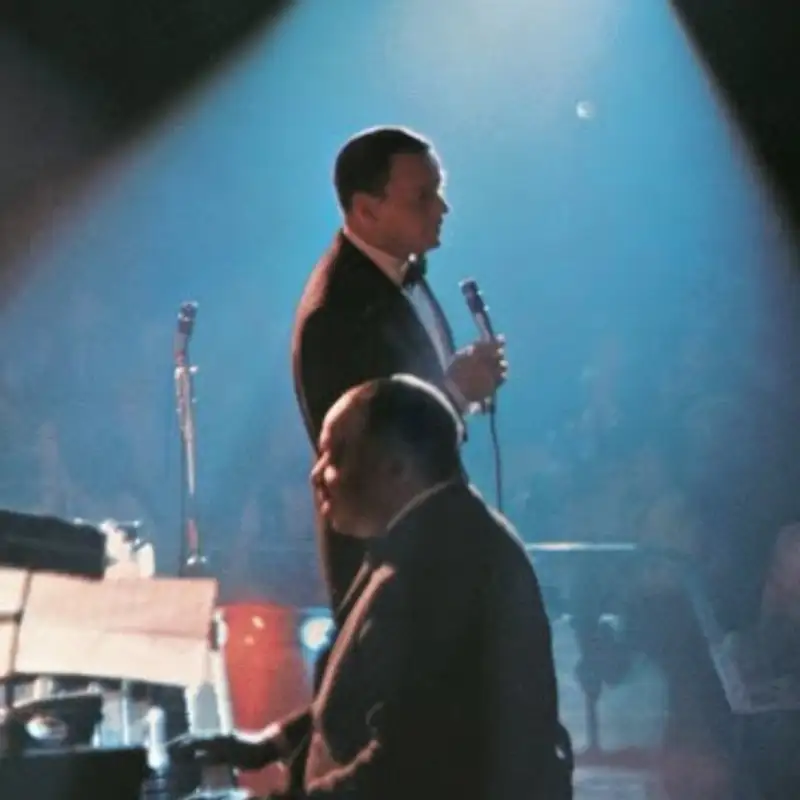
We don't have the actual cover. What are we doing here?
Oh, here it is. Sorry. Interesting thing
about this and we'll show. So,
So was the cover, uh, printed out black and white?
Pdf f Yes. I couldn't, I didn't know if we had any colored
to toner back there,
but, um, no basses in the foreground, which is like,
I love the composition of
This. Yeah, it's a beautiful picture.
But I mean, shout out to,
I'm assuming Frank Sinatra had some,
We'll have Caleb put up the actual cover, but Yeah.
Yeah. Had some, but it'd be very easy for it just
to be Sinatra and like of course Basie was, you know,
not a household name like Sinatra.
I mean, he's famous and he's known. Yeah.
But a little bit of like, you know, Sinatra,
like really literally sharing the spotlight.
Yeah. With Count Basie, which is great. Yeah. Awesome.
And Count Basie Orchestra
arranging conducted by Quincy Jones.
Great. Incredible topography.
Up next, what do you got? Uh, next?
I mean, I got, uh, we talked about Bennett
and Basie strike up the band 1959.
Very cool. It was also called Basie Swings.
Basie sings a great record and they did another one called
In Person that I'm not as familiar with, same year.
But it's really great stuff too.
I've got, uh, atomic Basie,
just another swing in Basie album. You like how Basie?
I Do like Count Basie quite a lot,
but Atomic Basie is great.
Peter, um, why don't you read this off?
Um, I'm Peter Martin.
And we wanna say thank you to our producer, editor,
and drummer, Kaleb Kirby. Sound engineer,
Sam Maul. Videographer
Andrew Steven, his government name. Designer Ian Martin,
producer Liz Hames.
Shout out and thank you to all these folks
and thank you to Bob DeBoo on base.
And, uh, next week it is our season finale.
We're finally doing it. Peter, what are we doing?
Prince? Woo.
Until next time, you'll Hear it.