I'm Adam Maness.
And I'm Peter Martin.
And you're listening to the "You'll Hear It" podcast.
Music celebrated and explored.
Celebrating today, Peter, that's a great adjective because we are
celebrating
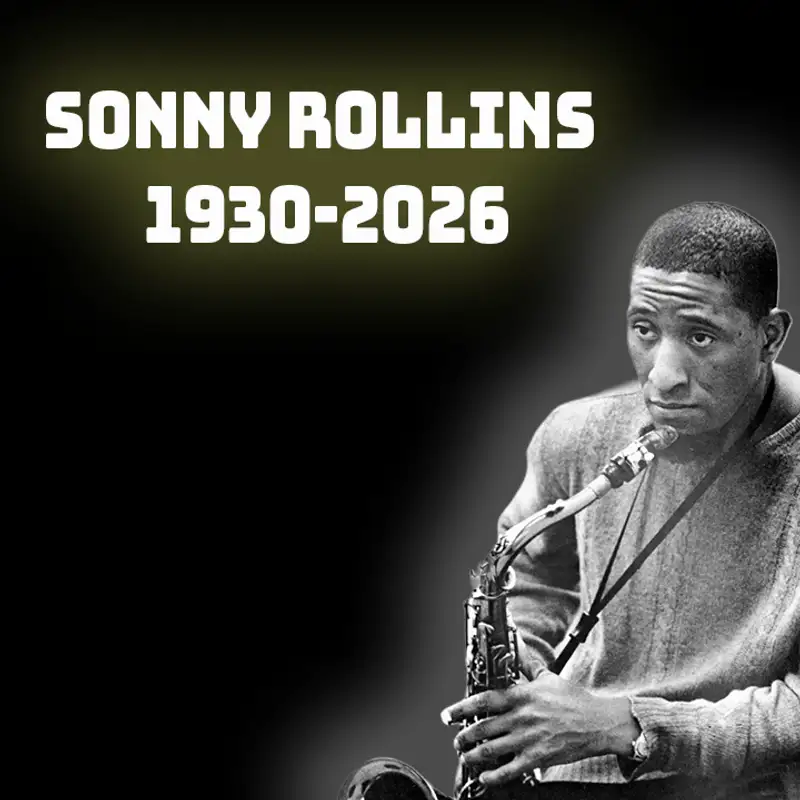
the great Sonny Rollins today.
Yes.
Whom we lost just a couple of days ago-
Yeah
... at the age of 95. And Peter, I'm so excited to spend this time with you, to
spend this time with our dear listeners-
Yeah
... listening to and celebrating one of the great musicians in jazz.
And, I love Sonny Rollins and his music and
incredible musician, but incredible human being-
Yeah
... as well, as we'll hear in his own words.
As far as I can tell, one of the most honest and
direct
musicians, improvisers, jazz musician, or probably of any type.
When we talk about great jazz musicians that could improvise, there's a
potential for a directness and a connection-
Mm
... between that performer's, that artist's
humanity-
Mm-hmm
... as a person, that can then come out, in this case, from Sonny
Rollins' horn. And, when you hear interviews, I got a chance to
meet him and to hear him play a couple of times, but mostly just to
hear stories from other musicians.
Yeah.
His music, even if you're like, "Wow, I wish I could've met him," you did meet him.
Mm.
If you listen to his music, you can meet him today, actually.
Yeah.
So, I think great artists have that ability, but I don't think anyone's ever done
it. Plus, just an incredible player. We're going to get into that.
Yeah.
But, in terms of the humanity coming out through improvisation, which is
such a difficult thing, you have to be
technically so great. Your ears have to be-- You have to have all these things.
And of course, Sonny was also a lifelong learner.
Yeah.
He always talked about that, really up until the end, apparently, but certainly in
interviews well into his 80s, even when he was pretty much retired.
Yeah.
He'd been semi-retired and then fully retired for decades, actually.
Well, we're going to talk about this a lot, but it's very evident.
He's the avatar of sort of the humble servant of the music.
Yes.
He truly talked that way about
humbling his ego to the music and putting his growth in the
music
above himself in a lot of ways. And there's countless examples
on record, but even in his actions throughout his life.
Maybe even to a fault into the extreme.
To the point where he had several sabbaticals, where he didn't give the world
the gift of his music because he wanted to go in solitude and
practice.
Well-
When he was already good
... but that's-
Documented good
... that's-
Great
... that's the humility.
Yeah.
Because he doesn't feel like, "Oh, the world's going to miss me." He's like,
"Something doesn't feel right, and I'm going to spend some time with it, even if it
means-
Yeah
... this or this."
Yeah.
Yeah. Just an incredible musician and a big loss
for music
now that he's gone. But-
A massive loss, and I think it's always, for me, and I
wonder for you, Adam, and for our listeners and
viewers out there, I always have trouble
adjusting when we lose a master like this because we're just listening, we've been
listening, I've been listening to Sonny all week, and we've been listening,
preparing for this today.
Yeah.
And so as soon as you start to hear him, these beloved records, and I've been
hearing some stuff I never really heard also, which is always
exciting. I feel like he's here.
Yeah.
And so there's a discordant thing to even say that we've lost him because
we haven't lost his music. We've lost the body, the
human from this world. But what a legacy.
What a gift. It's going to go on for hundreds of years, thousands of years.
I think that this is going to be some of the most interesting
documented improvisation. A true jazz
improviser. In fact, remember we used to have the-- Did you ever have encyclopedias
when you were growing up?
Yeah, of course.
Buy one at a time at the Schnucks?
Yeah.
Okay, good.
Yeah. And we didn't have a lot of money, so we only got to C, so.
You only got to C. Well, if you got to J or I for jazz improviser,
and you only had to pick one picture, you could put Sonny Rollins.
I'd be fine with that.
I think you're absolutely right. Direct connection from his heart to the listener.
Yeah.
It's like he's talking to you, which is why I'm so glad you mentioned we still have
him through-
Yeah
... this music. You can hear him talk to you.
Let's-
I think one other thing, just to frame this today, is let's remember, Sonny
Rollins passed away, as we said, just this week, 2026.
He was born in 1930.
Yeah.
Okay?
Yeah.
Now, I know you're not big on math-
Mm-hmm
... but that was a long time ago.
Yeah.
I'm not even going to make you add that up.
Yeah.
But Sonny Rollins stood, and I'm not saying he's the last of
the giants, but we're getting close, that stood firmly
as, not even as a youth, but as a young player in the bebop, like the beginnings of
bebop, really.
Yeah.
Connecting, playing with Charlie Parker, learning right at the feet.
I think Charlie Parker was 10 years older than him.
That's right.
So not even a whole generation. Miles was, well, it's his 100th birthday this year,
so five-
Mm-hmm
... ish years.
So Sonny was right. But the next generations
after that, of course, that we have all these great masters is wonderful, but Sonny
is a direct link and a connection.
He's-
And we're going to hear that in his music
... he's a bridge.
Yeah.
One of his most famous albums is called "The Bridge," but he-
Yeah
... is a bridge in a lot of ways.
He's a bridge to early, and the
first time I got to hear him play live was in 1986 in Columbia, Missouri, concert.
One of the first great jazz concerts I'd ever seen.
And,
he's a bebop player. He always-
Yeah.
I'm going to die on that hill.
Well, let's listen to some music-
Yeah
... because you mentioned that he was 95. He lived this big, grand life.
Yeah.
Born in 1930. The first track we're going to listen to, one of the very first
recordings he ever made, is with J. J. Johnson, trombonist J. J. Johnson.
Features John Lewis on piano, Gene Ramey on bass, and Shadow Wilson on the drums.
Whoo.
And if you were a person who was born when this recording session happened,
which was May 11, 1949-
I was not. Why are you looking at me?
... you'd be 73 years old today.
Right.
And that's when Sonny Rollins started his career.
This is "Autobahn." This is an original.
Sonny?
Sonny tune.
I believe he's 18 years old here.
Yeah. That's what I'm saying, steeped in bebop.
Yeah, you can hear it.
You can hear JJ.
You hear that Bird influence already on that bridge, right?
For sure.
Boom.
Already has that big breathy sound.
Yeah.
You know?
Yeah.
The resonance.
Yeah.
Not super breathy, like-
No
... Stan Getz or something.
No.
But there's some kind of whisper happening in
the tone.
Man, what a-
Yeah.
So, Charlie Parker famously, hugely influenced on
everybody-
Yeah
... with what he did. Horn players in particular, but pianists, everything.
He changed the game. But, I think for saxophone players, we've heard
stories, and when we lost Lou Donaldson, talk about another connection to this
period, just a couple of years ago.
The saxophonists that were coming up that were five years, 10, right
behind Charlie Parker, you pretty much either copied him or you
quit.
Yeah.
If you were talented and you were thinking about making music as your
life, we've heard this over and over again from people,
great musicians. He was that
masterful and revolutionary at the same time.
So, I think what you're hearing on this already, Sonny Rollins
had imitated and learned. So, he
knew Charlie Parker's stuff, but you're already hearing his little bit of a take
on it, right?
Mm.
He didn't get intimidated, although he did go and shed on his own a couple of times
for some years. Maybe that was part of it.
But just to say that he came at a time, and look, there's always a little bit of
luck with the calendar-
Mm-hmm
... for some of these super talented masters that come along
just once a generation or 100 years or whatever.
But that was a little bit of serendipity that Charlie Parker was setting the
bar at an all-time high for saxophone and for
revolutionizing the music that was still very much influenced by
what was coming out of New Orleans and Louis Armstrong.
It was a few decades, but that's still, Duke Ellington set the bar.
Yeah.
So, when you talk about bebop, you're talking about Charlie Parker, of course,
Thelonious Monk, Dizzy Gillespie, Max Roach, and all these.
Sonny Rollins is coming right into that.
Clifford Brown, we're going to get to that.
Well, we're about to land on Clifford Brown here.
It's a little bit of sink or swim, and Sonny swam.
So, we mentioned that Sonny's this sort of bridge generation between
Bird and Herbie or-
Bird. I like that.
But you know who else was born in 1930, was Clifford
Brown.
Oh, was he the same?
So, yeah, it's possible that without-
Yeah
... some tragic circumstances, we could've had Clifford Brown this whole time.
And Clifford Brown died, I believe, 1956.
'56, yeah.
So, think about that.
Is that 75 years ago?
Yeah. No, that's 70 years ago.
70 years ago, right.
Yeah. So,
right before he died,
Sonny recorded an album called Sonny Rollins Plus Four.
Yeah.
And this is with Clifford Brown, Max Roach, Richie Powell on piano, who would also
pass away in that car accident, and George Morrow.
This is "Pent-Up House."
Ooh.
Oh.
It's such a great guy.
This is Sonny's tune, too.
This is Sonny's tune, "Pent-Up House." But I do consider him and Clifford
Brown-
Yeah
... the same generation, simpatico-
Yes
... in the sound and the approach to the language.
And two players that-
It's different than Dizzy and Bird-
It is
... you know?
But they were super influenced by them.
Oh, Clifford.
Super influenced, of course, by Bird and Dizzy, but they were two that didn't
shrink-
And they-
... under that.
And just practically, similar
eighth notes.
Yeah.
The language-
Yeah
... rhythmically feels very similar.
Yeah. A very stylized approach to how to swing. Right?
Yeah, exactly.
Yeah. You even hear that from this, from the earlier 18-year-old
Sonny, because he's probably 25 or something by this time.
Yeah.
And this is one of the great bebop, post-bop, whatever you want
to call it, jazz standards. It's not played, I mean-
"Pent-Up House"
... for certain periods, it's played a lot. So, this is the beginning.
We're going to talk about this. Sonny, he's definitely known for
some of his compositions, of course, "St.
Thomas" being the most famous, but he had these great tunes.
"Valse Hot."
Yeah, that's another one on this.
We have that.
Max Roach.
I remember when I first heard this, I was like
"Oh,
this band."
Okay, so let's just talk about this real quick.
Sonny, 1955, he's living in Chicago.
Yeah.
He had come from his recovery, I think, within a year
or something in Kentucky.
Kicking drugs.
Yeah.
Yeah.
And is there working as a janitor, shedding like crazy,
but kind of plotting out the next step, and he had a chance to sit in
with Clifford Brown at a club in Hyde Park,
shout out South Side Chicago.
Mm.
And Harold Land either couldn't make the gig or ended up having to go back
to, he was from California, from LA.
Mm-hmm.
Something with his family. And so, they needed a saxophone player.
But at that time, this was a very hot quintet.
Oh, yeah.
Max Roach, and there was a lot of buzz around him in Down Beat polls and all
this kind of stuff. Some great recordings before this.
Richie Powell on piano, I think it was George Morrow-
That's right
... on bass.
That's right.
Of course, Max. And it's co-led by Max Roach-
Yeah
... and Clifford Brown.
And Miles was doing some stuff, but he was a little bit like, "Damn, that's a
good-ass group." You know?
That's right. Well, and they made these two albums, one under Sonny's name.
Right.
"Sonny Rollins Plus Four" with that quintet.
Right, which is the exact same quintet.
Exact same.
Yeah.
And I think a couple of weeksOr later or before-
Yeah, within the same month
... they made this album.
Ah.
Clifford Brown and Max Roach at Basin Street.
Man, this is my favorite Clifford Brown, Max Roach of all time.
This is a great album.
MRC Records.
"I'll Remember April."
The sound on it.
Richie Powell.
Richie Powell.
Richie Powell, Bud Powell's brother.
Yeah, younger brother.
Sonny, the way he comes in.
Was this Van Gelder?
At Basin Street?
Um.
I think it was.
No.
It might not have been.
Bob Shad.
So this is the iconic arrangement of this song.
Yeah.
All of these arrangements on this album are by Richie Powell, by the way.
Just want to shout out Richie Powell.
Oh, wow.
So this thing that everybody plays at jam sessions?
Oh.
Richie Powell.
Man, this is kind of the template kind of record.
For sure.
And we forget how much of a big part Sonny is.
So Sonny only played with the quintet for like-
A couple of months, right?
Six or eight months.
Yeah.
Because June, we're going to talk about what Sonny did then, but tragically,
Clifford Brown and Richie Powell, and Richie Powell's wife,
Nancy, all perished in a car accident
driving between Philly and
Wilmington. And
so, I think that Sonny Rollins, and he talked about this,
this was very much, you talk about the Charlie Parker influence on him setting the
bar high in terms of QA, like we talk about Motown-
Mm-hmm
... quality assurance. Sonny was
probably the most fierce QA guy in jazz that-
Mm
... I've ever heard of. Not only in the output of what he played, but the standard
with which he held himself. And a lot of these musicians at this time, that was a
thing, to be like, "You have to have your stuff together. You got to know this.
You don't come half-stepping," all that stuff.
But Sonny was on Mount Rushmore, or whatever's above Mount
Rushmore of QA. And so when he hooked up with Clifford Brown, even though it was
for a short time, Clifford Brown is the king of perfection.
The technique-
Yeah
... the feel-
Yeah
... the swing, the intimidation of other trumpet players.
Not for anything personal, just because of the way he played.
So, I think, again, serendipity, but also being
ready, beyond ready, when he came into that situation.
And then that really set him up, even though this tragedy of Clifford being gone,
he was already on his way to doing his own thing.
So that was already kind of planned.
And those next, '56, '57, '58-
Well, it's about to explode here
He's about to go on a run.
Yeah. And actually a lot of what we're about to listen to, or at least a good
chunk of it, was recorded before, in '53, '54, '55, some of these things.
Right.
All released, though, '56, '57, '58.
And shout-out to all these
great jazz records, Prestige, Contemporary-
Oh, yeah
... MRC.
The labels. Yeah.
Not shout-out to the small amount of money you were paying the artists, but
shout-out that you didn't make them exclusive contracts.
You couldn't, because you weren't paying enough.
Yeah.
But Blue Note kind of was.
But you'll see all these mixes of labels these guys have.
But it enabled us to be able to have, I think he made 12 records in '56 and
'57.
Insane.
And not just filler records.
All bangers.
And with different bands-
Yeah
... and different configurations.
Well, here's one that was released in '56 but recorded in '54.
This is Miles Davis' album, and this is a
classic album. This is a top 20 all-time jazz album.
Yeah.
It's called Bags Groove, features Sonny Rollins, Milt Jackson, Thelonious Monk,
Horace Silver, Percy Heath, and Kenny Clarke.
This is-
Percy H-
... Sonny's original composition, "Oleo."
Which is now, by the way, a jam session standard for rhythm changes.
Yeah. Wait, is Sonny kind of, was he under the
radar, one of the greatest, up there with Monk and Duke Ellington for
jazz standards?
Correct.
Okay. Why do we never talk about that?
I don't know.
He's correct.
Oh, wait, he played the melody correctly. Awesome.
Well, yeah. He's doing his Sonny thing.
Oh, man, his
phrasing.
Man, his intonation.
Oh.
This is Horace Silver, Percy Heath, and Kenny Clarke on the rhythm section.
Man, Percy Heath is killing on this album.
Bass players,
transcribe Percy Heath all over this record.
Some of the most perfect bass lines.
He's a part of Miles'
sort of ascension during this time.
Yeah.
He's in that band. Miles writes a lot about Sonny in his autobiography, but he also
starts making his own music. This is another jam session standard from his
album Tenor Madness. This is the title track, Tenor Madness, featuring John
Coltrane. Ever heard of it?
Now we're getting to Van Gelder.
Right.
Woo.
Trane.
And it's Sonny's album.
I know.
This is the first track, and he has-
And he gives it to Trane
... he gives it to Trane.
I think it's the only time they ever recorded together
in the studio.
These are two men, really-
Yeah, they're both-
... starting their prime.
Right.
Yeah.
Red Garland, Paul Chambers, Philly Joe Jones. Is that okay with you?
Yeah.
Yeah.
Definitely.
Is this Van Gelder Studios?
I believe it is.
From the bass, I'm like, it's got to be.
Yeah, Van Gelder.
And this was during this period. This wasn't even when he was in Englewood, in
what's still there.
It's, like, at his house.
It was at his parents' house. In the living room.
Produced by Bob Weinstock.
Let's skip ahead a little bit here.
Yeah. Woo.
There's Sonny.
Yeah.
Oh, Philly
JoeMan,
Sonny's mastery of the different registers
of the tenor saxophone, unmatched, even by Trane.
Yeah.
Oh, man.
What a sound.
He understood that instrument, right?
Another album-
I mean, John Coltrane is good, of course
... that's come out in 1956, also recorded in '54, just
like Bag's Groove. This is an album called Moving
Out, Sonny Rollins with Thelonious Monk-
Oh, I love this record
... and Kenny Dorham. This is More Than You Know.
Pianist is in the penalty box for the intro for some reason.
I like it. I'm here for it.
Oh.
Man, can we listen to this?
That's Tommy Potter on the bass, by the way.
Wait, wait. Sorry.
What are you doing?
I love the way Monk plays on this. Oh.
Sonny.
You're definitely getting that Coleman Hawkins influence we needed.
We should've talked about him.
Oh.
Hey, this is an interesting album.
This is the last track-
Yeah
... on the album, and this is the only track that has
Monk, Tommy Potter, and Art Taylor.
Everything else-
Oh, yeah
... is Kenny Dorham, Elmo Hope, Percy Heath, and Art Blakey.
Right. And this is a great record. Yeah, it's a funny little add-on thing.
There's some other great stuff. I think it's Monk's Misterioso.
There's a couple of really good Monk albums-
Well, we've got some-
... with Sonny, too
... queued up here because-
Oh, okay, good
... that's such a good relationship.
Yeah.
There is an album called Thelonious Monk and Sonny Rollins, so these two brilliant
masters get together three times.
Yeah.
A couple of great examples here. This is from that,
1957 is when it was released, but again, recorded in
'53 and a little bit in '54. This is The Way You Look Tonight.
Oh, yes.
Thelonious Monk, Sonny Rollins.
Good call.
Okay, we've got to play that intro again. We have to play it.
Okay. Okay.
Sonny.
Okay.
Thank you.
Yeah.
This is one of the greatest-
This is the s**t right here
... intros, period.
Yeah.
Maybe the greatest saxophone, and it is,
degree of difficulty-
That is crazy
... 11, right?
Yeah, for sure.
For sure.
And the degree of joy-
... infinite.
Yeah.
12, right?
Here it is again.
Hey.
Another Van Gelder.
Woo.
Tommy Potter and Art Taylor on that one.
Yeah.
Bass and drums respectively.
A.T. A.T., underrated.
For sure.
That ride cymbal, you can tell it's A.T.
Yeah, this is a great-- And then just the very same year, they
release perhaps one of Monk's most famous, most celebrated
albums and
Sonny's a huge, huge part of this sound.
It is
Brilliant Corners.
Mm.
And this is Bemsha Swing.
Yeah.
Featuring the great Clark Terry.
Great album cover, too.
Woo.
Tuner not called.
Hey.
It's on the Riverside label, Orrin Keepnews.
Ah.
Woo.
Yeah, Sonny was kind of the template, Trane, too, for sure,
during this period with Monk.
Yeah, for sure.
But for what would become Charlie Rouse-
Yeah
... influenced hugely by Sonny Rollins, but the way that he could
play with Monk and interpret his songs.
Woo.
Oh. I love Clark Terry and Sonny's sound together.
Yeah.
Brilliant Corners, Sonny's all over it.
Yeah.
The title track, "Brilliant Corners," is also brilliant and definitely worth
your time.
You know, one thing I'm thinking about, Adam, as time has gone on and now
we're definitely in an introspective, retrospective,
viewing of the legacy of Sonny Rollins, I think John
Coltrane, for a lot of people, has always,
just all different kinds of musicians and jazz lovers, has kind of sat
at this certain place as a tenor saxophonist,
as the GOAT. And look, why did I use that term? That's stupid.
I don't know.
But because people--
I don't know. You wished I hadn't, right?
You said it.
No, but I'm saying we put him on such a pedestal.
Of course.
We have a problem-
I do.
Right. Yeah. And I think partly because he
died relatively young, 1967,
and then Sonny was with us until just a few days ago.
There's a certain lionization of, like we talk about Clifford Brown, and
these are incredible, masterful artists that were hugely
influential well beyond their life on this earth, right?
Yeah.
But I think with Sonny, if you look at the different interactions, and we haven't
even gotten to his trio playing without piano, to his
solo pi-- I remember hearing him play solo saxophone at Lincoln Center.
Yeah.
I want to say it wasn't out-- I don't know why I'm thinking it was outdoors.
It might've been, late '80s, early '90s.
But I mean-I think that he may be the most
influential and revered among saxophone players,
in particular, even above John Coltrane.
It's not about above, but in a way that I think others-- If you talk about
Joshua Redman, Branford Marsalis, Chris Potter,
Joe Lovano,
the influence, the reverence, the connection-
Yeah
... and for sure, John Coltrane, of course.
Yeah.
And of course, Charlie Parker.
Yeah.
We're talking about the OG there, right?
It's kind of like saying,
as a pianist, I'm influenced by Bud Powell and
Thelonious Monk, or Herbie Hancock-
Yeah
... and Bill Evans and Chick Corea.
Yes.
Yes. Right.
You know?
Exactly.
All of it.
Right.
All of that, we all go through these eras where it's like-
Right
... and you hear tenor players. You can hear young tenor players-
I see tenor players
... go through their Sonny era.
Yeah.
You hear them go through their Trane era.
Sometimes you hear them go through a little Wayne era.
Yeah.
You know what I mean? And that's part of a lot of musicians' development and
growth, and of course, so many other people.
But I mean-
It's very personal. But those two, especially, I think you're right.
Those two, especially, are like-
Trane and Sonny
... at some point, everybody sort of spends time with them.
Right.
You know?
I just think that if you were to press me and be like, "Who is the most influential
tenor saxophone of jazz of all time?" I think I would say Sonny Rollins.
Mm.
Because if we talk about the tenor players from our
generation, from my generation, maybe even, yeah, Branford, Joshua
Redman.
I know I'm missing great people. But even not just tenor players, Kenny Garrett-
Yeah
... Chris Potter, and stuff.
Yeah.
I think that you hear a direct influence even more than Trane,
and maybe that's because Trane
is so influential to all of us, to pianists, to his quartet, to the whole thing.
And this is ridiculous that I'm even saying.
I don't want to understate the
influence that Sonny had, I think a lot of people, because he didn't
play a lot the last 20 years of his life.
And even before that, he didn't-
Well, I think-
He never was like-
This is sort of maybe just a cultural thing.
Yeah.
Because we lost Trane so young.
Yeah.
And that becomes very intense for people.
Right.
Right? We lost that connection with him, and we've
had Sonny-
Yeah
... this whole time until Monday.
Right.
You know what I mean?
Right.
And sometimes we take that for granted.
Yeah, absolutely.
And it's a good reminder that we're all here for a limited time, and to appreciate-
So basically, I shouldn't be sitting here saying he's the most influential tenor
player after he's passed. I should've been saying that these last-
This whole time.
Yeah.
Yeah.
Well, thanks for reminding me, buddy. Buddy.
One of the reasons he's so-- We're in the middle now of just, this is an all-time
run.
Yeah.
Almost unmatched, and-
It's the imperial period. That's what we're going to call it.
The imperial period. Well, we're about to go into a whole other
stratosphere because, in 1956, he makes, and in
1957, he releases
what a lot of people consider to be one of the great jazz albums ever. Right?
In the
highest echelons of jazz albums.
Yep.
It's Saxophone Colossus. The cover is iconic.
Every track is amazing, and it starts with one of the great
opening tracks of any album of any genre ever, and it's St. Thomas.
Woo.
We take for granted this calypso rhythm now, but-
Right
... this was
kind of a thing-
Yeah
... in 1957.
And this is Sonny Rollins. Both of his parents were from the Virgin Islands.
That's right.
So,
this is his lineage. This is his heritage.
One of the greatest-sounding records ever.
I mean...
Hey.
Max Roach on the drums, Tommy Flanagan on the piano-
But just the way Sonny-
... Doug Watkins on the bass
... is phrasing the-- Obviously, he wrote this, but
damn.
Yeah, this is another Sonny original. Also a standard.
You have a very famous version with Joshua Redman of this.
And like this.
Oh.
Woo.
Oh, man.
Man.
Chockfull of ideas. Dang.
It's one of the most perfect solos ever.
Man, I'm glad you said that. That's exactly what I was just
thinking. I was like, "This is in a small group."
Stratosphere.
Yeah. Not that a
solo has to be perfect to be great, but I'm thinking like, Giant
Steps, John Coltrane. There's a number of them.
There's some great solos that aren't perfect, but man.
Miles, what? The-
Yeah. I'm sorry.
It's perfect to life. I'll shut up.
Do you like this record, by the way?
It made all his phrasing decisions. Oh.
A virtuoso. He was a virtuoso.
So was Max.
Okay, this is great. We got-
Hold on. Wait. No, what are you doing? What are you doing?
Yeah, no, what are we doing?
We've got to listen to one.
Oh, this one again?
Anything.
We've got to listen to "Strode Rode."
Max Roach crushes this song.
This is kind of a perfect solo, too.
Yeah.
Damn.
The whole album is perfect.
Yeah.Man,
the way he bridges the calypso with the swing.
All of a sudden.
Yeah.
All of a sudden.
It's like Max Roach on 52nd Street. Oh!
Man, this is a very influential, oh, my God.
This is as influential
as Sonny's solo, in a way, for drummers.
Sonny comes back in with the most beautiful line.
I've heard some great drummers play this solo now that I think of it.
I mean, really great drummers.
Woo.
That's what I'm saying, Max, like Clifford, I think Sonny bonded.
You can hear it.
They bonded high QA. High IQ, musical
IQ, but high
quality.
He's playing the tunes, too, by the way.
Oh, yeah. Duh.
My goodness.
My goodness.
Swing activated. Incoming activated.
That's all I want to hear.
No, it's-
I wanted to get that far.
It's a great one.
That's unbelievable.
And look, I'm glad, actually, and we had toyed with starting,
but this was great. We're kind of at the apex moment of this episode, I feel like.
Yeah.
Because we were discussing what to start with, and you were like, "We've got to
start with this." And I was like, "Well, everybody knows that.
It's so great, of course."
Yeah.
But now that I'm hearing it again, I'm like, man, it's such a great time
when an album and a track, I mean, it's kind of like Kind of Blue and
Giant Steps-
Yeah
... and everything in 1959.
No, I mean-
Where something that's so great-
... Crescent, Love Supreme
... but it's actually great
... Live at the Pershing, the Now He Sings, Now He Sobs.
When something stands, yeah, for the right reasons.
These records, they sort of transcend even the artist that has made them.
Someone somewhere is listening to St.
Thomas right now and is like, "Oh, I think I like jazz."
Right.
You know what I mean? Like, "Do I like jazz?
I didn't think I liked it, but I like this.
Whatever this is, I like."
"I like this kind of jazz."
Yeah.
We need a category of, I like this kind of jazz album.
Maybe it's the Sonny Rollins I like this kind of jazz album.
Yeah.
Yeah. I have also Blue 7 cued up, which
is another.
Oh, I like Blues.
I mean, the whole album, honestly, we could do a whole.
We've done that.
We've done this, but we should do
Saxophone Colossus-
We're learning, yeah
... because it was early days, and we could do better.
But-
And it's a record, I think, that jazz musicians
don't talk about, study, reference, and recommend enough, actually-
Yeah
... amongst ourselves. I mean, there was a time when it was, because what happens
is this becomes, I mean, it's sort of like the New York
Yankees are, so I'm a Yankee, and at a certain point, it's like, I can't be a
Yankees fan anymore because everybody's a fan.
Yeah. And listen, we are going to miss a lot of stuff during this era.
I'm skipping over albums.
He's prolific.
We're not getting everything.
No.
And we're probably going to miss something that you all love.
And please put in the comments what your favorite Sonny albums, especially the ones
that we're-
Yes
... missing, because we're going to miss a lot.
He was so prolific, especially during this period, that it's just impossible to
listen to everything. I think the next big thing for me that stands out is an
album-
Ah
... released in '57 called Way Out West. This is frigging amazing, man.
And it starts with an "I'm an Old Cowhand," which is,
again, incredibly interesting choice.
And this was all Sonny's choice. This was not, like, a publicist or a
producer. This is his first time, and they recorded this in LA.
Yeah.
I believe Ray Brown was, isn't Shelly Manne on drums?
Who definitely was in LA. I think Ray was already living in LA.
Yeah. Ray and Shelly are the rhythm section.
So, he's playing with the local rhythm section.
Are those guys-
It's their local rhythm section, played with Ray.
But his thing was, he wanted to have the cowboy hat.
He was like, "Let's make it a vibe."
Yeah. The cover's amazing here, but it's-
One of the greatest covers ever
... and one of the greatest albums of Sonny's career.
Yeah.
We're on the trail. Another great drum setup, right?
Ooh, look at that bass drum sound.
Yeah, it's awesome.
Woo.
Woo.
How do you like your bass lines? Ray Brown style?
I love my bass lines Ray Brown style. Thank you very much.
Man, Sonny was so
flexible with material, with players.
So laid back through this, too.
Yeah.
I mean, if you haven't checked out-
Ricardo floating
... Way Out West, give it a go.
Is this his first pianist trio record?
Well, I'm glad you mentioned that because he's going to go on. I don't know.
It was one of the first.
But it's definitely the most famous, except for a live album he made the next year.
Yeah.
Which is, this was the first Sonny Rollins I ever
owned.
Mm.
I remember buying the CD when I was a teenager, before I had Saxophone Colossus,
before any of that.
I heard this before Saxophone. There was a period where this was kind of the one
everybody was talking about.
In the '90s, and it's not Way Out West.
It's a live album called A Night at the Village Vanguard.
It's got this pink cover of Sonny, this portrait of Sonny in
sunglasses, and this pink hue over him.
It's a Blue Note album,
released in '58, recorded in '57, at the Village Vanguard, which you can still
go to the Village Vanguard today-
Yes
... and you can hear musicians making albums and making great music.
And this is the greatest live jazz album of all time, in my opinion.
I know you have your Miles things that you like.
I wouldn't argue with you at all on this.
And we could say Live at the Pershing has also-
Absolutely
... got to be up there, but this has to be in the conversation.
It's in the Mount Rushmore. Come on.
Ah.
Wilbur Ware, right?
Wilbur Ware.
Yeah.
Elvin. Ah.
I remember when I first heard Elvin on this, I was like.
Yeah, Wilbur Ware, Elvin Jones.
Elvin Jones, brush style.
Oh, sorry. No, this is the afternoon take, actually.
Oh, this is the, okay.
Yeah, this is Donald Bailey and Pete LaRoca. My bad.
Oh, that's right.
Yeah.
They did an afternoon set.
Because they did same day-
Yeah
... different band, afternoon, different band, evening.
That's crazy.
Yeah, it's
great.
In some
ways-It's
my favorite Sonny
sound.
100% agree.
The way it sound.
This is my top three Sonny albums ever.
It's so pure and dry. Just specifically on his saxophone.
The playing is so
raw-
Yeah
... and pure, and beautiful.
But I think he is probably the top, even above
Trane, I would say, to have a sound that could survive
being recorded totally raw at the Vanguard. Trane, of course, was great.
Joshua Redman. Branford-
It's almost better,
Live and Dead at the Vanguard.
Right.
You're almost more just-
But man, you've got to be S tier to pull that off.
100. But you're almost more astonished about how-
I know
... beautiful that sound is.
It is, yeah.
It's really incredible.
I think it might be. I love the Van Gelder.
I have my quibble bits, of course, with the piano and even the bass, but I
think Van Gelder, the way he recorded Sonny, and saxophone, in general, was
genius.
Yeah.
Incredible. That contemporary, LA, The Way Out West, my
only quibble bit is Sonny's sound on there, I think is a little,
not his playing, and still, they captured it, but the mix is not on the
level.
I don't mind it. I never said-
I don't mind it. No. And that's not the greatest Ray Brown sound,
either-
That I agree
... recording.
That I agree.
But look, you can hear him, and it's great.
Yeah.
Well, we're nearing the end of this imperial period, as you say.
I don't know why I said that.
One of the biggest albums that came out around this time, which came out in
March 1959, was an album on Blue Note called Newk's Time,
and this is very highly regarded by a lot of people, this album.
Yeah.
It's not talked about a lot, I feel like, as much as some of these others.
But-
Is this the Tommy Flanagan on? This one was?
So Wynton Kelly-
Oh, wow
... Doug Watkins, Philly Joe are on this one.
Okay. Right. Damn.
If that interests you.
It does.
This is wonderful, and this track is called "Wonderful, Wonderful." Check this out.
Ha.
That was Wynton Kelly.
Woo.
Oh, the vibrato.
The title Newk's Time is a reference to Rollins' nickname, Newk-
Yeah
... which is apparently based on his resemblance to Don Newcombe, a pitcher for the
Brooklyn Dodgers.
Yeah.
Isn't that funny? Great album, Newk's Time.
But this is an interesting period, Peter, because I'm
going to quote from this section of Sonny's Wikipedia, which I think actually
sums up this period really nice. "By 1959, Rollins had become
frustrated with what he perceived as his own musical limitations and
took the first and most famous of his musical sabbaticals.
While living on the Lower East Side of Manhattan, he ventured to the pedestrian
walkway of the Williamsburg Bridge to practice in order to avoid
disturbing a neighboring expectant mother."
Today, a 15-story apartment building named The Rollins stands on the
Grand Street site where he lived, and actually, there's a petition going around to
rename the Williamsburg Bridge the Sonny Rollins Bridge right now.
Mm.
"Almost every day from the
summer of 1959 through the end of 1961, Rollins practiced on
the bridge next to the subway tracks.
Rollins admitted that he would often practice for 15 or 16 hours a day, no matter
what season. In the summer of 1961, the journalist Ralph
Burton happened to pass by the saxophonist on the bridge one day and published
an article in Metronome magazine about the occurrence.
During this period, Rollins became a dedicated practitioner of yoga.
Rollins ended his sabbatical in November 1961.
He later said, 'I could've probably spent the rest of my life just going up on the
bridge. I realized, no, I have to get back into the real world.'"
Hmm.
And it's one of the biggest legends.
The lore of Sonny is-
Yeah
... this two-year period where he stopped performing, stopped recording,
and just practiced for 15 hours a day, every day, on the Williamsburg Bridge.
Well, 16 hours sometimes.
Sometimes 16 hours. That's
monk behavior. Not Thelonious Monk, but-
Right
... religious, spiritual monk behavior.
Yeah.
"I'm going to sequester myself from
this thing." He was dissatisfied with his limitations, and, "I
need some time to go inward," and he did.
Serve the art. The ultimate thank you, Sonny Rollins, for setting the bar-
Yeah
... in a number of ways, but I would say that might be the most profound part of
his legacy is for,
and that's not shtick. It's
kind of become that, legendary status of this story, but
you don't just do that to get written a story about.
You do that out of some type of dedication and
service-
Yeah
... where you feel like you need to improve you as a vessel.
Everything we listened to was before that, so he was already great.
Yeah.
It wasn't like, "Ah, he's been slipping."
We heard what he just made in 1959. It was amazing.
Yeah.
You know?
But you talk about set the bar, and then he-
Yeah
... set the standard, and it's like, "No, I want to be here."
So the first album he made when he came back is called The Bridge.
Mm.
And it's one of his classics. It's an album that is very
revered. And-
And just to say, the Williamsburg Bridge, I don't know if you've ever been on
there, but there's car traffic, there's
subways as well.
Yeah, he would practice by the subway trains.
Yeah, but there's also, it's a walking commuting.
Yeah.
Still today.
For sure. Yeah.
Now it's a different kind of a hipster species-
Commuting out for your-
... walking back and forth.
For your matcha. Yeah.
But, yeah, it's very much like you're running on it, you're walking on it.
It's like a walkway.
Yeah.
And to be part, of course, he's a native New Yorker, and
to be part of that connection with the city, with the river, the East River, the
whole thing.
This is the opening track from The Bridge.
This features Jim Hall on the guitar, Bob Cranshaw on the double bass, with whom
Sonny would work lots. Ben Riley on the drums.
This is "Without a Song." It's amazing.
So
check out when Sonny comes in and plays the melody.
He's doing a lot of rubato playing, floating on top,
going in and out. That was one of his most
genius stylistic
stuff. Going in and out of time.
Woo, in.
He could be right in there. He could be right in there.
And then float a little bit.
Woo. Oh.
I don't know if it's just because you know the lore of The Bridge-
Yeah
... and the sabbatical, but his playing on this album-
Oh
... and everything else feels so
direct.
Yes.
Right? So with no fat.
No fat.
It's just like, here's what matters.
Yeah.
Just real effortlessly,
here's what I have.
Yeah, and it's not like he's stripping out the bebop.
He's very much himself still.
Or mistakes or anything or-
No
... it's all very accepting of what his
pure intentions are.
Yeah.
It is the highest form of improvisation.
Woo.
Man.
Incredible music.
Yeah.
"The Bridge," 1962. And so much music over the years.
He didn't stop playing officially until 2012.
Yeah.
Obviously, you slow down as you get older.
Yeah.
But he did a bunch of cool stuff. "Alfie's Theme" from the famous movie, "Alfie."
Yeah.
All Sonny,
with Oliver Nelson.
Man, his rhythmic attenuation, just within the way he
phrases in the vibrato and-
Yeah.
Oh. Super advanced rhythmically, too.
Did a bunch of great stuff in the '70s. A bunch of great stuff.
Was playing in the '80s-
Yeah
... was doing a lot of stuff.
That's when I first heard him.
But even in the '90s, I remember this album coming out.
This is "Sonny Rollins Plus Three."
Oh, yeah.
Again, this is featuring players that he had played with
in the '50s and '60s-
Yeah
... including Tommy Flanagan, including Bob Cranshaw-
Oh, yeah
... this time on electric bass.
Al Foster. This album features Jack DeJohnette and Stephen Scott.
Right.
Yeah.
Kevin Hayes played with Sonny in the '90s, maybe even early
2000s, too.
Yeah.
Playing with-
Peter Bernstein
... Peter Bernstein-
Yeah
... all the young cats in the day, and then I think he makes his last album in-
Oh, man. It's so good
... the early 2000s, I want to say, or mid-2000s.
Yeah.
And then officially retires from performing in 2012.
But he is on an episode of "The Simpsons" in 2013.
Oh, nice. That was his final. Yeah, even before
2012, it would be a big deal when he'd do a,
I don't even know if he was doing a tour.
It would just be a gig-
Yeah
... at a really great concert hall or at a jazz festival in Europe or
something.
Yeah.
And it was always an event. It was like, people were like, "Damn, that's Sonny
Rollins." So thank you, Nuke.
Yeah. Thank you, Sonny Rollins. Just amazing.
And to anybody listening, if you haven't heard Sonny before,
maybe you've just heard "St. Thomas" or something-
Yeah
... now's your time. Go on a deep dive-
Right
... and appreciate this great artist's work, because he gave so much to us.
And please put in the comments, if you're listening to this audio,
wherever you are, go to the YouTube and just put in the comments, what's your
favorite? I would love to. I know that there's a bunch of tracks that, I don't
know, even because some of this stuff, as you've been pulling this together, it's
been fun for me to discover. Very prolific recorder.
Yeah. Oh, yeah.
And so-
Dozens and dozens of albums
... tell us your favorite, but especially those hidden ones.
Oh, my gosh.
To me, that "More Than You Know" with Monk has always been something.
I'm surprised people don't know as much.
I think it's one of his most masterful performances.
But as we've said, he-
There's so many
... there's no, it's all S-tier from what I've heard.
All S-tier.
Yeah.
Or maybe put in your favorite Sonny solo.
He has some-
Oh, man
... of the most legendary solos on his albums and other people's albums.
Yeah.
And there's almost too many to choose from, there's so many.
Yeah, because the "Blue Seven" solo is legendary, iconic.
It's been broken down by music college.
There's so many different angles to see the genius of it.
This is "Blue Seven."
Oh, yeah. That's what you're playing.
Yeah.
But
it's also not
an untypical solo of his.
He's got dozens just like it.
It's not like he hit the mountaintop on this-
Yeah
... and then that was the only time.
It's true.
Oh, man.
Thank you, Peter.
This is great. Thank you.
Till next time.
You'll hear it.
Woo.
A little dip.