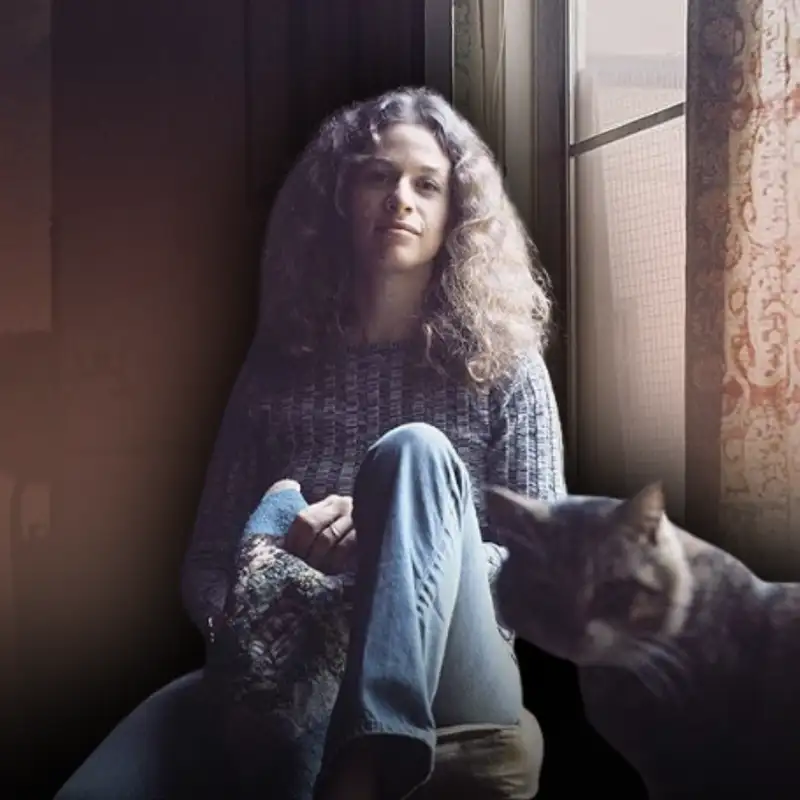
Today's album, Carole King's, 1971 Masterpiece Tapestry.
How does a quiet unassuming album become a monster
hit and an instant classic?
We'll explore coming up and you'll hear it.
I am Adam Maness. And I'm
Peter Martin. And you're listening to
the You'll Hear It Podcast, music
Explored, brought to today by Open Studio.
Go to openstudiojazz.com for all your jazz lesson needs.
Peter, we got a new season. I
Love this record. I wanna give you
a visual. Okay.
If you're not on YouTube, you
might wanna go over to YouTube.
He's hugging the record. Yes.
This is a great, this is a cozy
record, as the kids would say. It's cozy AF
Right? It's so cozy.
It's, I mean, it's organic, it's cozy.
There's a cat on the cover. There's
A tapestry on the inside. There's
a cat out of focus.
We're talking about none other than the great,
the legendary Carole King with her album.
Her Ooh, her opus. What? Opus. Okay.
Yeah. You know, come on. New season. Same jokes, man.
You know how this goes tapestry.
It is a masterpiece, man. Yes.
It's one of the greatest albums
of all time on everybody's lists.
And like, that's probably not everybody,
But Many, many people. But
it's not even controversial. It's so good.
The songwriting is so okay. But
Don't make it sound like it's like a quarter pounder.
Everybody loves it. This is some high art, my friend.
It is high art. No, it's, it's actually wonderful.
You know what it is. It's, it's high art,
but it's wonderful craftsmanship.
Like, we're gonna talk a little bit about just
what a great songwriter Carole King is.
I know that's a news flash for a lot of people,
but like, just the quality of like, oh, yeah.
How the lyrics tell the story in such a tight way. Yeah.
I mean, she's coming from this songwriter's background
and it shows, but also like how the music,
how the chord progressions, like lift the lyrics up,
tell the story that she's trying to tell.
She's a true master. And on this album, 1971,
she's 29 years old.
She's come into her own.
She's really, you know, she's a grownup
and she's doing her thing.
Uh, she didn't start that way though.
She started this business as a
16-year-old. Did you know that?
Yeah. Well, she started in this world as a newborn.
Well, if we wanna go all the way back,
but I like, I like where, I
like where you're going with this.
No, her first single was when she was 16 years old
in 1958.
It's called The Right Girl.
And guess what, Peter, even though she's 16, you know
what? It's really good. It
Is good.
She's singing it with a vibe, man.
Yeah. I mean, musically sound, catchy already. Yeah.
Uh, she wrote the song
and Don Costa did the arrangements to that one.
Um, and then around this same time that Right Girl,
the Right Girl came out,
she was also working at the legendary Brill building.
Yeah, right. Which is this legendary, uh, a songwriting.
I don't even how you describe it. It's a machine. Yeah. It
A factory's. A factory. A factory.
I've been in there before.
It's right on times in the building. Times Square.
Yeah. Yeah. It's in Times Square, right?
Yeah. It's like an office building still.
Um, and they have, you know, it's, it's like one
of those old with the elevator where you used
to have an elevator operator and the, the whole thing.
It's, it's, it's a cool place. Well,
There she was making a lot of demos.
So the process would be like a songwriter would wanna try
to sell one of their songs to like a big artist.
Right. And so they would have, wait, is
This before Instagram or, This was, yeah.
A few years before this
In lieu Instagram. Got
it. No. And so, and
so there would just be these songwriters hanging out in the
Brill Building and then these musicians hanging out
who would record the demos of these songs so
that the songwriters could then
pitch them to the big artists.
Carole King was doing that.
And for a while she was doing that
with another legendary singer songwriter, Paul Simon.
Hello. Who we've had on the show
with his incredible, so crazy.
After all these years album.
Uh, this is an interview that Paul did
with the incredible Terry Gross about that time with Carol.
Um, but the demos was really how I learned to record.
That's how I learned about recording technique.
'cause I was in the studio several days a week,
and for a while I did a lot of demos with Carole King,
and we worked as a, like a team
because she could play, uh, drums and piano
and I could play guitar and bass and we could sing the parts
and make up background parts and do it pretty quickly.
And what it was, was writers would, uh, have a song
that they wanted some specific artist to sing.
And, uh, they'd, you know, give you the song and you'd try
and make it a, a demo that would appeal.
That's Paul Simon. Yeah. On making demos with Carole Kings.
So funny. Like, she played the drums.
I know. And she played the piano and
I played They were tracking it. Yeah.
Yeah. But they were just kids. And here's a, a demo
that they made that Carole King and Paul Simon made.
Um, she wrote this song with her.
What would who someone who'd become her
musical and life partner.
Uh, Jerry goin, Jerry Goer.
This is called, this is Hilarious, dude.
This is called Short Mort.
Hey, short. Hey.
Short. He
Isn't very big.
He's small inside. He isn't very smart.
But he sure is wise.
You keep tall, Paul. You can Tall Paul.
They don't make songs like
this 'cause they're not allowed to. I mean,
Is this the greatest, most catchy body shaming
song since the two?
Fat Poka? I think it might be. She was 17. She was 17.
She was 17. That's her and Paul Simon, uh, making the demo.
She wrote that with Jerry Goffin,
who she would later marry. Well,
Right about that time Actually. Right
about that time. And right about this time when she's
17, her and Goffin had their very first big time hit.
And it was by, uh, uh, a group called The Shires. Yeah. A
Year later. 1960, a year
Later. Yeah. She was
17 when they wrote this song.
How
Good is that? That's it's
great. And it was a huge hit. Yeah.
This was a pop hit. This was a crossover pop hit.
And I believe it was actually the first number one
by any girl group.
Yeah. Um, girl group, you know, like,
like before The Supreme, it
Started the whole Girl Group thing. Yeah.
There was, there was boy groups,
but this was The Girl, the very first number one
hit Billboard Top hit. Well,
She had a, she had a lot more hits actually
after this, including this by The Drifters.
All you have to do is touch my hand
and something happens to me.
What a song. Yeah. I love that. And
I believe The Flow is like, she was generally writing all
the music and Goffman was writing all the lyrics.
Ob obviously, I
Think it gets blurry, but Yeah, it
Blurry. Yeah.
But Carole King went on
to write incredible lyrics as we're gonna hear as well.
Yeah. Tapestry Both collaboratively or on her own.
One more that she wrote for other people.
That is one of my favorite. Oh.
Because there's a version when I was a kid by the,
the Immortal artist.
Tiffany. Oh, Tiffany. Yes. Uh, but this The Prodigy.
The Prodigy. But this is from, uh, little Ava.
Oh, yeah. This
Is written by Carole King.
Yeah.
Yeah. And it's amazing, like
to see her so from the late fifties, kind
of when she came into her own, well,
early songwriting stylistically.
I mean, this is the stuff like my,
when my parents were in high school Yeah.
My dad too, you know? Yeah, right, right.
At that age, um, coming outta the, the, the doo-wop,
Or what do you Call it? Yeah, yeah. doo-wop. Yeah.
And all, all the songs have a doop kind of vibe. Vibe.
Right. All that, that 1, 6, 4, 5
chord progressions, you know what I mean? Chubby
Checker, big Hits, hits that whole song.
But then, I mean, it starts as the sixties come along.
And she was instrumental in, in that as a songwriter.
Like the music's changing.
It's, I mean, obviously The Beatles. Yeah.
Ever heard of them. They were kind of big with that too.
But it's so interesting to hear how it goes.
You know, what, from the, from that to Tapestry.
We're gonna show you that in a second.
But within 10 years. Yeah.
Ish. Well, a little, a couple years later,
she has a real breakthrough.
And this is not just like a breakthrough for a songwriter.
This is a cultural breakthrough. Yeah.
When she writes this song for the Queen
of Soul, Aretha Franklin,
Looking out on the morning rain.
I used to feel so inspired.
I believe that's a riff on camera killing it. I had
To face another day.
Mr. Good arrangements on this one
Before the day.
The Strings man. The horns and the string.
I think you've heard that before, haven't you? Little
Influence. I might have ripped that
off a couple times.
But what we're hearing there too, especially on
that Aretha Track, is like something we're gonna hear
throughout Tapestry, which is the gospel influences in
Carole King's songwriting lot. The Cross
Pollinization Lot. Yeah.
There's a lot of that going on.
And you know, that 12 eight feel and the,
And I believe this was one of the, I'm sure this was one
of the Muscle Shoals sessions with those guys.
I mean, the thing was Lady Soul,
that's the record on Atlantic.
Like this was a big record. Yeah. This was a massive, yeah.
Massive, massive hit. And, um, that's interesting.
'cause yeah, this was sort of, I guess sort
of towards the end of Carole King and Gerry Goffin.
Yeah. Collaboration and marriage and
Everything. Yeah. I mean, they really
did six, seven.
They really did try to make it. Yeah.
But it was too late, Peter. It was
Two.
Uh, but also with that tune
and we're going, that's gonna make it a little,
little foreshadowing that's
gonna make an appearance on here, right?
Yeah, yeah. Yeah.
That's written by, um, Carole King and Jerry Goffin
and also, so Jerry Wexler, you know,
famously produced Lady Soul Atlantic Records, the godfather
of that whole thing.
Apparently the way that song was written, he was driving
to New York and saw Carole King walking down the
street and they knew each other.
They worked together and said, Hey, Carol, I need a song
for, uh, for Aretha.
I'm thinking something natural woman. Something with that.
No way. Yes. And Carole King went home. Jerry Wexler. Yeah.
Jerry Wexler, like Natural Woman is like,
it's kind of a theme I'm working on.
And so Carole King took that, it's a theme I'm working on,
not for me, for Aretha,
you know, I'm exploring my feminine side.
And, um, so Carole King went home and her
and goin wrote, like, he wrote the lyrics
and she wrote the music supposedly in like
90 minutes or something Amazing.
That same night. And so,
because Jerry Wexler came up with the, the idea for it,
they gave him, they shared publishing
credits apparently without disputes. Well,
Here's this. Like, that's
Why he's listed as one of the composers,
A list of this run that happens
actually leading up to the Aretha.
Yeah. You know, you've got, will You Love
Me Tomorrow by The Shells?
Yeah. Uh, some kind of Wonderful by the Drifters Halfway
to Paradise by Tony Orlando.
Every breath I take by Gene Pitney, point of no return,
Every breath. I not
that way. That was later eighties
Point of no return by Gene McDaniels, take good care
of my baby by Bobby V the locomotion up on the roof.
Go away little girl. Don't say nothing bad about my baby.
One fine Day. Hey Girl by Freddie Scott. Yeah.
the Chiffons,, the cookies, like all these hits
that she had leading up to this.
But you're, as you mentioned,
Her BMI check. Oh my goodness.
Her aspect she's doing,
while they didn't make it in their
marriage, I think they probably
Made it, they made it individually, Financially,
financially doing great.
So they get divorced in 1968,
and Carole King moves out to
California and she makes some new friends.
Peter. She makes friends with people like James Taylor.
Yeah. And Joni Mitchell. Ever heard
Of them? Yeah,
I've, I've heard of them. Singer
songwriter vibes, Some of my favorites. And
This is like, so she's already kind of, you know, bridging
the divide between,
or the, the sort of lineage of this period
that really goes back to what we call Tin Pan Alley
and like early jazz composers.
Duke Ellington, Billy Strayhorn. Yeah, yeah, yeah.
The Gershwins, of course.
Where it's like the song, the writer,
the songwriter is King.
Yeah. And the artist, I mean, not necessarily King,
it's just the artist is not necessarily thinking
about, I'm gonna write some stuff.
Frank Sinatra. It's like, you know,
Johnny Mercer's giving him great,
he's singing the standards, singing the Greatest Song
by the Greatest Artist.
And so Carole King sat right at this sort of cultural shift
where it was like, oh, maybe the artist is the songwriter
and the performer Yeah.
And the instrumentalist. Yeah. The whole thing.
Singer songwriter, obviously Bob
Dylan, Bob Dylan, Beatles, the Beatles. This
Isles started turning this around is like,
it's not just the performer's job
to play other people's songs,
but you have to be able to write and tell your own story.
And then you, you become part of the package. Right?
Yeah. And she wasn't the first and,
and this record wasn't even the, I mean, this is 1971.
Yeah. So we're years after something.
But this may be kind of like the crystallization of that.
Yeah. Like if you were to distill that into one album,
certainly just say Joni Mitchell.
I mean a lot of, you know, Joan,
This has gotta be in the argument
of this is the best singer songwriter album of all time.
I like that. You know what I mean? It's gotta be up there in
the, at least in the, in the discussion.
Yeah. Because the songwriting is so strong. Yeah.
I dunno why I'm getting angry, but if,
But It like, as we'll hear on this album,
like small songwriting
Possibly. Okay.
If you've ever tried to write a song like,
like something like So Far away or it's too late.
Oh. Or, or like, you've got a friend.
It's so hard to write so sincerely and clearly
and tell your story so clearly with lyrics.
That sound good? Yeah.
And amazing chord progressions and modulations
and the way we will talk about all that. But are
You saying that that would be one of the reasons
that this debuted at the top of the Billboard 200
and stayed there for 15 weeks?
Yeah. Which may not sound like a lot
because you think Oh, records have been
on the charts for years.
Yeah. This also was six years on the Billboard
charts, which is second.
It's incredible to this day only to Pink Floyd.
That's amazing. And,
Um, it was by far like, you know, six years at the time.
It was also the biggest record.
Everybody, a female artist all the way up
until I believe the eighties
or early nineties with like Whitney Houston
Bodyguard and all that stuff.
Yeah. No, it was bigger than,
I don't think Madonna had anything.
I don't think. I think it was Whitney Houston bodyguard,
the maybe Shania Twain.
And then stuff got big. What? Mariah Carey.
Some of the, like the sales went bonkers. Sure, sure.
But this also. Yeah. Yeah. But this also,
this record has come back onto the charts.
We're gonna talk a little bit about Yeah.
Gigi, a little TV show that has been on in my house a lot.
We don't even say the name yet. Talk about
Heather Macle. Will,
will Inter Intermarriage sue me if I don't mention
the Gilmore Girls on this. We're
Calling Dubose Yeah. On that
one. Before we though,
before we get to, to tapestry real quick.
Yay. While she's out in California, she makes friends
with another incredible person. This is incredible person.
I call it King Special.
The reason I do it is
because I got the idea of a train. It's
BB King and Carole King is simply
playing piano on this album.
Indianola Mississippi Seeds, 1970.
What she's playing is already correct.
And she's playing all kinds of piano. Yes.
Come on
With the BB King pod coming Dean.
Yeah. When's the BB King pod? This
This, his second appearance. Remember
that was a little on the DeAngelo
DeAngelo and Pino met at a bb
and what you're here to do is very
simple, but it is not easy.
No. She's in the pocket. Yeah.
I mean, she was a deeply bluesy player.
We're gonna hear that on Tapestry.
Um, and just an authentic musician. Jesus. I want to
Shout out my dad, Lester Manni
for playing a ton of BB King.
A ton of Albert King. Ton of John Lee H****r. Yeah.
Around the house when I was a kid. Yeah.
Um, alright, so that'll take us, that's 1970.
She makes an album called Writer. Yeah.
Um, which doesn't connect.
Uh, it's, it's her first like singer songwriter album
post Jerry Goin.
Yeah. Um, it's, it's a good album.
It doesn't, it doesn't, uh, connect catch fire with people.
It doesn't catch fire. Like what happens next?
And what happens next is her sophomore album
after post Jerry goin and it's called Tapestry.
And it starts like this.
I feel the earth, I
feel my heart start tremble whenever,
when I see your meow.
The
I can't stand.
I wanna start to an album, man. You
Know what I mean? Man, she's just introduced
a lot of the themes of the album,
musical, the lyrics, you know, the romance.
Maybe a little bit of broken off from, I mean, like,
she's already put it all out there.
The groove, you know,
Love those harmonies There.
And also, yeah. This is very like bluesy
almost Muscle Shoals vibe.
A lot, a lot of this album too
is we're gonna jam for a little bit. Yeah. There's
Solos Jam. Here's Soul come
up on a second after second verse.
But also when it goes to the, to the major part,
I won't say what kind of chord it is.
Yeah. Chasing
Cooch. Cooch is,
This Is like, kind
Of, But here, this is kind of seventies,
dare I say soft rock, like the harmony of
what we're gonna hear of the seventies,
The wrong with Soft Rocks in the
Seventies, but the quality stuff.
Right.
And She's got that all in one song.
Yeah. And this song is gonna, uh, set, I think most
of these have this core rhythm section
with a few exceptions Yeah.
Of Danny Koch
Kmar. Yeah.
Uh, on guitar. Who, by the way,
Koch on this crushes this song. Yeah.
The whole time. He Is crushing the whole time. There's
A bunch of James Taylor. You'll hear
the difference. James Taylor
Playing a lot with the acoustic Playing.
Yeah.
Joel O'Brien on the drums also crushes in a very
like, restrained
Yeah. Man. His fill
coming in pocket
Way. And
then, uh, Charles Larkey on the bass
Yep. Is playing on most of these.
Yeah. And these were like the Tops session LA guys. Yeah.
And you could say there's a bunch of 'em. Yeah.
But the ace, the A Squad there was like a small group. Oh.
And that, this track too is like,
it's introducing the record in a lot of ways.
And, and maybe, you know, we,
we can talk a little bit right now
because the, the lens with which we look at this record,
I think there's so many different levels to this record.
Like, I think of it as a small record,
although this is not a small track. This is like, it's
A humble album. It's
a humble album. I mean, look at the cover.
Yeah. It's a cozy
Record. It's not huge.
It's not epic.
It doesn't have these big strings or
Horrors, but it has Little parts or
synthesizers or anything like that.
There's some epicness in
and I mean, there's like some little parts that come
and like, this is grooving in a way for a first track
and coming at you that it's like, damn,
where are we gonna go from here?
Yeah. I also, the lyrics on this opener are great.
So it's a, it's a song about being love struck. Yeah. Right.
About about, uh, knocked off your feet.
Knocked your feet knocked off. Your having a
massive crush on someone.
And the imagery of I feel the Earth move under my feet.
Oh, I feel the sky come crumbling down. Probably go again.
Incredible, incredible imagery. Uh, yeah.
To start off the album and
Shout out to the LP too, that has every lyric on here.
Yeah. Which is amazing. I remember this used
to be normal when I was growing up.
It's like, oh yeah, of course you're gonna go Look.
I have a feeling because you're listening.
I mean, her dictions so good.
You can hear it. Yeah, yeah, yeah. What she's saying. But I
Have a feeling the the ACC Mons are gonna score
high in the categories.
Oh, You think so? Stay around for that. So, uh, second.
I feel the sky tumbling. Now I feel my hearts.
But I mean, think about starting the record out with this.
Like, everything is very like, you know, straight up Yeah.
Grooving. And then the lyrics are very, Ooh, baby
Next is one of my favorite nice CEO
e on the album. Do you wanna hear me
Sing whole album? No, I'm sorry.
I Go ahead. Go ahead. Keep going. No. Good. Uh,
No. Next is one
of my favorite songs in the whole album.
This is so far away.
James Taylor, it's
Jt. The think coming
out of that last track,
it's like, where are we going now?
We're driving up in Laurel Canyon. Yeah.
Up to the ridge, basically. Yeah.
Green Point so far.
Oh,
Charles Larkey coming in Hot Larkey crushing
This one.
Lars, time to Shine. So Good.
Doesn't help you.
Just long ago
I reached for you.
And
there you again.
Be gee's backgrounds.
This Is a lot of space.
Check that out.
It's like kicking just a little bit of high, right? Yeah.
That's the drum part. Yeah.
It's almost like an early program drum.
It Is. It's like a little
Drum and then like, her piano
and jts guitar a little bit is given the motion
instead of the drums.
You know, like she's like, they pation
Of The one to the guitar.
Yeah. And then Larkey, that's like some oblig
Dynamics.
Man. If you're away from, Sounds like
some Kka or something.
It's percussion in there.
Yeah.
Travel
Back to the drums.
Nothing else to do, but
so many dreams yet.
But you are so
Far. Perfect. Little drum fill.
Small fill. Everything's small.
Doesn't
it would be,
I do not recommend listening to this album
when you're like, on another continent from your
Loved one. Don't, that's
a tear jerker. Don't do that. I've
Done it. I've done it.
Maybe, um,
Hold on real quick. I just
wanna say, I think this is her best
vocal performance on the whole line.
I agree. I think she's just crushes it vocally. Yeah.
And I think the line,
the question doesn't anybody stay in one place anymore?
We've heard it so many times
'cause we've grown up with this album.
Yeah. We take for granted how genius that is to say,
to st Start the song with the statement
of the hook so far away.
Yeah. Doesn't anybody stay in one place anymore?
Is such a heart wrenching sentence. Yeah.
You get the whole idea of the story. Yeah.
And the backstory from just the, the, it's so human.
That's so incredible.
And like, I I I'm just blown away by
how sophisticated lyrically she is
and how how sophisticated harmonically she is.
Yeah. And then the singing on this track
is just otherworldly.
I mean, I'm just blown away by, uh, by this whole album,
the whole experience and, and you know,
the production on this we were talking about.
Yeah. It sounds like it's a band playing in a room together.
Right? I don't know. They did this in two weeks, apparently.
Yeah. And like, I think they played all this stuff live.
You know, I'm, I I think we have something here
From Well, aler. Yeah. Aler.
Yeah. We have that.
He kind of breaks down his concept.
Him and Carol's concept producer. So Lou was
Producer. Yeah. The
first thing that I envisioned with Carol was
a solo artist that
you always felt she was sitting at the
piano and singing to you.
Yeah. Yeah. I mean, you get
that feeling when you listen to this.
You just get the feeling like there's nothing again,
there's no like, like flashy huge
string arrangements on this.
I mean, there's a couple of moments
where they do some different stuff, but small
Strings too. Small strings.
Small strings too.
But it just feels like they're just playing.
And there's like, like we said, there's a lot
of instrumental sections where there's solos
and there's written out stuff.
Obviously worked out stuff obviously.
Um, this is the engineer, uh,
Hank c Chalo talking about we were
Making a good record and that's all we knew that.
And it was a simple record records like Tapestry could be
overproduced in a minute.
Mm. You know, so, oh, let's add more guitars,
let's add more this more that Lou
and Carol wanted that simplicity.
They wanted to be just nice and warm
and a very comfortable record for people to enjoy.
Comfortable warm. Yeah. Simp simple. I mean, you should
Accomplish Yeah. You look at
this cover and it looks
comfortable, warm, simple.
Yeah. There's a cat. Cat's a little scary.
The budget for this album, cat looks big.
The budget for this. Oh. So it was made in three weeks,
excuse me, not two, three weeks.
The budget was two $22,000. That's right.
Which even in 1971 is pretty small considering.
Oh, it's teeny. We listened to, uh, uh, rumors.
Rumors, yeah. What was that? $2 million?
It was a lot. It was like the equivalent
of 20 million or something today.
Yeah. It was insane. This was, this was teeny.
And I mean, oh, and by the way, Lou Adler fun fact.
You, you probably, even if you think you haven't seen him,
he's like the biggest Lakers fan ever.
He always dresses, he's always sitting next to Jay.
Uh, Jack Nicholson, also Rocky Horror.
He made the Rocky Horror Picture Show. That was big.
This is small. That was big. Yeah.
Carole King's longtime manager.
A a big force with this record.
But, um, yeah, I mean,
and this whole thing of like, her at the piano being a piano
driven, I don't think she's ever not at the piano.
I think you're right on this whole thing.
And it's so like, closely related to Well, so even like,
I really like her piano playing too, by
The way. Her piano playing is so
great and so appropriate. It's
Like the epitome of a songwriter's piano playing.
Absolutely. You know what I mean? Yeah.
And I think that this record, especially
that track we just heard, and I agree.
Like her vocals are, she's a lot of beautiful vocals.
But this one, there's something about
it that's just perfection.
Mm-hmm. Um, just vocally the way she's singing.
Um, but there's levels that you can appreciate this record.
I think the lyrics and the melodies are at such a high level
and they're so highest
Universally Human.
Yeah. That somebody, if you under, if you know English,
you know, that would be a a
that would only be the only
barriers if you didn't understand English.
It's, but even a translation of this.
But like her, the, the craft of that is amazing.
But the next level, which we appreciate as we listen to it,
but most people don't think about it as much as the lyrics.
Like the lyrics are there for you to like,
apply just so far away.
Oh, I'm thinking of mine. And like,
is she talking about she's far away from New York?
'cause she's on the West Coast. Like there's all these
things that we can think about.
You know, why don't we stay in Wayne Place? Yes.
Why is my family spread apart?
My loved was a lost lover, whatever that is.
I mean, even of the time though, Peter, like this song,
you know, she moved to California in 1968.
Yeah. When a lot of people moved to California. Yes.
That's the summer of love. No, that's right. Was that 67?
That was six seven. And they were still in New York.
They still in Woodstock. Exactly.
No, no, no. But, uh, 1968, a lot of people are. Yeah.
The big migration happened. Big
Migrations. People are gonna San
Francisco, people are going
to la people are gonna are gonna
California people are going to New York.
People are, are are the,
this whole cultural revolution is happening.
Yeah. And this song is just like, you know,
doesn't anybody stay in one place anymore?
It would be so fine. It so applic.
It's see your face at my door. Yeah.
You know what I mean? And it's such a universal thing.
It's still, it, it, it moves people.
But then the next layer of the craftsmanship
of her composition, the harmony, we're not gonna get,
I know I'm not allowed to talk about that too much,
but I'm saying like, the levels 1, 4, 5, um, the levels of,
Are you talking to me Just a little bit inside Joke?
Those are fun on podcasts.
But the levels of her mastery of the songwriting craft
that is more the nuts
and bolts, the more behind the scenes stuff.
Like, once you delve into that, it's like just so genius.
Yeah. Like her, her use of rhythm. Yeah.
You know, bump and how it connects with the lyrics
and stuff is very simple,
but very highly crafted and curated, you know?
Mm-hmm. So yeah. I'm
A fan. So, so far we've
had, you know, I feel The Earth move,
which is like a love struck, infatuation kind of song.
Yeah. We've had so far away,
which is I'm missing your face kind of song.
And then we get a good old fashioned breakup song.
Perhaps the greatest breakup song.
It's, it's in the conversation. It's it's
Gotta be. Yeah.
And, you know, I like to daydream
that this is about her breakup with Jerry Goffin.
Now that I know more about that backstory. But yeah.
I don't know. Anyway, this is
Jesus. This is the number one hit
too.
This is brilliant. Is So, you're
not the only one who likes this,
My friend. Well, it's an incredible song.
It's too late.
That's what I'm talking about. The craft of songwriting.
That's part of it. And then the melody starts,
There's something wrong here that one
of us is changing.
Or maybe we just
Late Ah, let's groove a little.
It's late. Let's groove on the bell of the symbol
Grips.
I love the little roads line. Yeah,
Yeah.
Do
Now the intro becomes a segue
between verse chorus and verse second verse.
It used to be so easy. You Ah,
Oh, Those backgrounds.
Un light and breezy too that Yeah.
And it goes with a chorus quick. Both times.
I, I love a quick chorus, assuming
Try something inside.
It's a great interview.
And then this blues line coming down. Oh, here.
It's right here. Yeah. Yeah. Little George Benson.
Is it Barry Benson.
Then we get a little folky folky jazzy jam.
I like to call this och.
This is weird though. This next solo.
Oh, the piano. The, uh, oh yeah, piano.
So it's Carole King On the road. So
The roads and then Curtis Amy on the saxophone. They
Kind of layered it on.
It works though.
Yeah, it does. Man, this is such a great Oh yeah.
This one for a Grammy record of the year 1972.
Yeah. 'cause it's Not, it's not a hidden track. No.
Be good times Third verse.
But we just can't stay together.
Yeah. Man. She's so great.
When the lyrics change by verse of like,
altering the melody to fit them.
Quick chorus. I love a quick chorus.
Simple baseline.
Big James Jamerson influence on these bass players
by the early seventies.
Finally.
What'd You say?
Finally, Back to that.
I thought you said five chord.
Yes. Into the major though.
Into the major man. That's what I'm saying.
Like little details with her songwriting. It's so cool, man.
So man,
A couple of technical things that I want to hit upon.
Yeah. Uh, the first is like some
lyric things that happen here.
That second verse is like another great example of something
that seems very simple.
Yeah. But is, you know, if you try
to write a song like this, any songwriters know, it's not
that simple to write.
Um, something with like, it used to be so easy living here
with you, you were light and breezy
and I knew just what to do.
Now. You look so unhappy.
And I feel like a fool is incredible.
Again, it tells a whole story. Yeah.
And also a very familiar story.
Anybody who's gone through a breakup
or has like gone through a long relationship
and you have the, a romantic pheromones going phase
where everything's easy and light.
Yeah. And you know, every saying the right things.
That's right. And then something dies. Yeah.
And so, you know what I, I mean like inside me. Well, yeah.
It's, it's incredible. Yeah.
And then there's a musical thing on this one that I think is
so fascinating, which she does a
couple of times in this album.
She does it again on, on, uh, where you lead, which is,
so it starts out in the key of C It's like that A minor
to D seven, which is you could, I mean,
you could make arguments that it's not the key
of C it's the key of C.
And she at think, I think it's,
Well yeah, I was just say, I think it's just
'cause it starts and so
the melody, I feel like it's an A minor.
C is a because that's, Well, no,
No, there is no key of a minor. There
Is no key Of, there is no key of a minor.
There's just the key of C You know
What, there's only the key of music in
My book. My thread. Exactly.
So it starts out in the key of C. Right.
And then it goes to like that, that first, the end
of the first verse, which is like right here.
Maybe we just, it goes to this four chord
F Right. This
sort of seems like the resting place,
But now we're in the key of
F and you don't even realize it. The
Four pretend to go to B flat. Right.
That's what like, even if you don't know music,
what she's done there is she's like, there's a pivot chord.
Yeah. When it goes like that do,
And it's supported by that and great
Rhythm, that chord Yeah.
That she does that rhythm on is both in the key of C
and in the new key of F it's the one chord.
Yeah. And so she's got this transition that happens
and that when she goes into the first chord of the chorus,
which is a B flat chord, which is not in the key of C Yeah.
You're like, what is happening? Right.
And the melody changes. And then she,
she brilliantly weaves back down to that A minor.
Yeah. But we know it's at the Ki C.
'cause it, you know, the, she hits those interludes
and it hits the one which is C
And Yeah. And it's that delayed gratification.
But she knows, and you know, look,
C is famously the most ah, sunshine plane.
Totally. Totally. It's like joy and happy and optimism.
And so it's like playing around until you get there.
So it's like that crap.
That's what I'm saying, like the lyrics.
People can, like, you have to get in, you have to like
listen, but then you can understand
them and it speaks to you.
Yeah. But the same thing,
like she could do that with lyrics.
You could do that with rhythm. Yeah.
She could do that with harmony. She could do that
with melody at a high level. All those at
A very high level. That's why when people
are like, why don't we don't even
to know music theory or whatever.
I mean, you don't need to know it, but you,
You just know that it's happening.
If you could know how to do what she just did. Yeah.
Which is to modulate into a chorus like that
and why that's so effective.
Yeah. You get to make the tapestry.
Like you get to make a really, I mean,
nobody gets to make tapestry and then the
Whole thing feels so Right. That's right. It's
Like we were talking about like, you go into a restaurant
and someone said, oh, I love this restaurant, man,
the food was so good.
We had such a good time. You're concentrating on the food.
Like that's the lyrics and the
melodies, the food at a restaurant.
Right, right, right. Like the harmony is the ambiance,
the lighting, the service, the service, the hospitality.
That's right. That's right. That's right. And
so when all those are nailed, you're like, oh my God,
the food was that, that's what you remember.
But without the other parts, it's not really that,
that five, that five star Yeah.
You know, experience.
And by the way, that lift where it goes, you know, up
that fourth when it goes in, it's too late.
That is not Carole King's like invention either.
No, that's Mozart.
That is, you know, a,
a Gershwin verse into Gregorian chant.
That's also like great American song book standards usually
will sometimes have a verse in a key
and then modulate up in some way.
Yeah. Sometimes. And up a perfect fourth
because it's such a natural place to modulate.
And they're, they're very close in sound. Yeah.
But it's like a, it's a surprise
you don't realize is happening.
There's nothing on this record where you're like, oh my God,
this is revolutionary.
Except for the fact, the way that she put, like,
so these harmonic elements all have been done.
The melodic elements all have been done.
The, the lyrics, you know, maybe not all done in this way,
but she mean she's not, she's not making up words.
So lyrics are like Jerome Kern style. Yeah. Clever lyrics.
But what makes it, and I think for any great songwriter,
and, and I mean, I put her in the, the level
of your Billy Strayhorn, your George Gershwin.
Totally. 100%. Yeah. I mean,
because the craftsmanship is there.
I I don't think there's any, but it's like,
how do you take these elements?
It's like when Apple came out with the iPhone,
they didn't come up with the first smart No.
They took this, this had been done this,
and they supposedly made the most elegant, beautiful thing.
And, um, you wanna just
throw a little bit of those vocal back?
Yeah. 'cause that's another thing.
Like, like Carole King for whatever reason, is not known.
I mean, she's certainly known as a great
singer, but she's not.
She, I would say if, if you're pressed,
you'd be like incredible singer songwriter.
There's always this, this caveat. But a fantastic singer,
a fantastic background, you know, choir, gospel influences
and like, understanding of how to put this stuff together.
So this is all Carol here. Yeah.
So what, what they would do. And
It's too late.
Yeah. It's all over desk. It's too late.
So we try to make
something inside
The first solo one.
I can't hide and I just can't make it.
Oh, no, no.
I mean on that make make it, make it,
you're a little bit of the Brill building in there.
Absolutely. Those teen bober hats. Absolute.
You know those, those girl groups using those backgrounds?
Yeah. Yeah. And it's like when they, when you put they, it's
as much an art and science, uh, the of,
of deciding when you're gonna put 'em in
and go back to just the single main line.
Right. Yeah. And all the back, the people knew how
to craft these background vocals.
And we're gonna have, there is a little bit
with James Taylor and, um, um, boom, boom,
boom on something else.
Well, we're gonna get to that. There's some other,
but it's most of the background vocal.
Oh yeah. We you love me tomorrow. Yeah. Yeah.
Uh, well the next track is another, uh,
track about being away from home, being away from someone.
Yeah. It's very similar to so far away.
And they actually has some musical similarities.
This is called Home again. Yeah.
One of the great piano intros. I think sometimes. So simple.
Again, it's so far sight.
Really need someone to talk to.
And nobody else knows how
to comfort me tonight.
Little James Taylor Acoustic.
Ah,
Little A seven.
Oops.
I won't
Her Harmon.
I think that intro is so simple. It's really good.
Like, even if you didn't play piano, you
could learn not to play it like her.
But you could learn those and don't, don't, it's not hard.
Yeah. Right. But so you would just be like, ah.
But I mean, can we just play that?
That's the beginning getting into it.
'cause like what, she's not playing in there.
I would've overplayed that.
Yeah. We know. Yeah. Sometimes.
But if I came on, I'm just kidding.
Just Kidding. No, I would've you know
It home. Yeah. Don't
Have a jazz. We just play
That intro. Also, there's a bit
of a, of a
physical science lesson in there.
You know, snow is cold. Yeah. The rain is wet. True.
So we, we learned that
Hashtag facts. Yeah.
You know, another thing that's happening there
that's really cool that also happens in so far away
and is a, is a theme of this album,
is the triads that move around
The inlaid. Yeah.
So what she'll do is she'll take a, you know, a a chord
that's a basic triad
and she'll keep the base movement the same,
but she'll move that triad like on so far away.
It's like a over D to D. Yeah. A over D to D. Yeah.
And she's, what she's doing is sort
of like super imposing a chord over a base, a base part
that gives it a feeling of going away and coming home.
Um, which I think is so fascinating
'cause she does both of those moves.
Those sort of like five over one to one. Yeah.
On the sort of, I'm far away from home songs. Right. Yeah.
Like she goes away. But there's,
she's still home the whole time.
She knows how those triad. So she's think
Of home as just going away.
It's, it's, I don't know if that was what she was intending
with that stupid music theory thing,
but like that I was just No, but it's put on top of this.
But like, but it works. Be
Intentional. Yeah. It's not just, okay.
Yeah. She knows music theory
obviously, but it's like she knows how to use it to connect
with the emotion at that time.
I mean, like, this one's all 1, 4, 5 a EAD Tris over that.
A but it's like the order
that she does it when she puts it in there,
anybody can learn 1, 4, 5.
But it's like, how do you put it in there?
It's like, when I'm looking at a recipe, I'm like,
from a celebrity chef, I'm like,
I'm following all the directions.
Why didn't they come out the same? Yeah. You know.
Well, 'cause That's not a rhetorical question.
Answer me. Great.
Uh, next up is beautiful. This is great. This is like, um,
Dude, I listen to this every morning as I'm like, like
Look in the mirror. And you're just like,
Yeah. Yeah. I
pop. It's my pump up
Song, man. It's a daily affirmation.
You gotta get up with a smile on your face.
Should make this into a musical. They should make
This into a musical. It
Feels like a musical.
Better. You're gonna find yes. You'll
Larkey on here.
Beautiful. What would you call this groove?
It's kind of a musical group.
These session, they know how to play everything.
Waiting at the station.
Waiting at the station with a workday
Am She's telling stories. My friend is
Here.
Ion Little
Hope Throws that Diminished.
A
Smile's
Beatles esque that group.
Very Beatles. Beatles esque. Yeah, for sure.
It feels like a Paul song, doesn't it?
It does feel like a Paul song. Yeah.
I think it's better. Um, I'm sorry,
Next up is, this one's really interesting, right?
So it's way over yonder.
This is essentially a hymn without Jesus. Like this is Yeah.
It's a 12 eight. It's very much a gospel song.
This is like an ethical society hymn.
It's like this, uh, a Christian scientist. But
Even the structure of the lyrics are like very much, uh,
very, very hym like.
Yeah. And it's a really incredible,
And its a gospel too.
Way Over
is a place that
Precision drama
Where I can find shelter
from a hunger and cold.
Come On. Cooch. And the sweet taste
is so easy.
Oh, there's some great backgrounds on this. Yeah. For
Real.
Scored
Oh, on top.
That's where I,
It's like something that's like a Chris Stapleton chord
or something, you know what I mean?
It's a four chord button. I know. When I get there.
Second verse Right Thing. I'll see.
I mean, also, it just can't be overstated.
Like the reach of the old school Black and
Right here. Wait.
Oh yeah.
Who is that? That's
her. Oh, maybe not. No,
That's Mary Clayton. Mary Clay. That's
Right. Right. No, I was gonna say
That's right. That's the only
other background except for, um,
James Taylor and, uh, Joni
Mitchell. Yeah.
Now the reach
of the old school Black American church music. Yes.
Throughout This whole era, like the,
the baby boomer kids Yes.
Took gospel, that gospel music into all kinds
of different kinds of music, including Sarah. I,
I think this generation, and this is
exactly my parents' gener.
I mean, she's 83, I think now 84. My mom is like 81 80.
My dad's 84. Carole King.
Like, I think, okay, this can be a gross overstatement
that we might have to, to, to take out.
I think that the culture
in some ways was more informed
by the authentic Black American musical
influence on pop culture.
Sure. You know what I mean? I mean,
not just like we've talked about in the eighties, like
for kind of Gen Xers and maybe some Lin Yeah.
Gen Xers, I guess. You know, Michael Jackson.
And, but I mean, I think that there was like,
there was a sort of gentrification of pop music with r and b
and rap and pop
and everything that all got kind
of hodgepodge at a certain point.
And there's certainly been strong influence.
But you talk about gospel, you talk about jazz,
you talk about blues.
Yep. You know, at this time, like,
and I think Carole King has one of the most authentic, um,
approaches to say a gospel influence.
Like she is singing herself.
Like she has such an authentic connection with that music.
But she's not like trying to imitate.
I mean, you could hear it in her Aretha Franklin
and Aretha Franklin had a hit on her song, you know?
Well, I mean, yeah. I mean, how do you escape that?
You make me feel like a natural woman has the gospel
influences in their Yeah. And she's gonna close
Out the record with it, You know?
I know. But you can hear it in her piano playing. Exactly.
You can hear all of that language in her piano playing.
Yeah. And I mean, look, she came up in New York at a time
when there was like, you know, a cross cultural with,
with artists and musicians of a certain ilk, you know,
cross pollinization, I mean, with ex extreme problems
of segregation in our country and everything.
Yeah. But in terms of like the music,
there was a connection.
I know, like my aunts and uncles
and stuff, everybody, like, they were kind up on ch
checker fats dominant.
I mean, think about the influence in terms
of like grooves and blues Yeah. And church music.
There's something special about the church music though.
Yeah. From that, that early era that's just has, has, uh,
uh, influenced generations
and generations of music, of all kinds of musicians.
Yeah. It's, it's really magical
And inspired. Like, you know what I mean?
There's something about it that just hits
us and well, in our soul.
I mean, that's what's supposed to do. And it, it almost like
The Lord came Down in Job well done
because it does hits everybody right.
In their soul. Yeah. Uh, next up is,
well this speaks for itself, doesn't it?
Small, small piano starts. I love 'em.
Amazing. That's amazing. Damn. That's
A damn good Intro.
That's a damn good intro.
And you need some love and
Nothing Is going right.
Ugh. We're comping. I know. That's
What I'm saying. She's like, she's
like an arrange in there. Yeah.
I mean, she she's busy too. That's the thing. And soon
Don't do film with play guys. Don't be scared
To play. Yeah. Especially like, there's hardly
any drums
going. Like, there's so much space.
Man, can I pause this for a second? Yeah.
To, on that point. Yeah.
You know how many singer songwriter albums I've been,
I've asked to do, and they're, and like I get in there
and I start playing and they're just like, just play
just one little chord like this. Look
At the look on his face. C
can we get him over you? I
Understand. I
understand. You don't want people just playing a bunch
of random s**t all over your album. I get it.
Don't call a Jan guy this and
Listen, I'm a professional. I'm
gonna do what you asked me to do. No,
You're not. You're gonna play, play a little.
But when you listen to some
of the greatest singer songwriters of all time,
they're playing, I know.
They're actually playing music. Yeah.
And letting the moment happen
in the way that it's supposed to happen.
And it makes it magical and way less sterile.
And I'm just gonna put that out there right now.
You're absolutely right. Come, You come play
on my record. You
get to play. That's right. I'm gonna let you play.
Right. I'm just saying,
Boom. Get off
your soapbox. I live it. I love it. Stay on it.
Pick Us up. But, but look where she starts from.
Oh, no, no. That's fine. Keep on.
And Her copy is, it's so appropriate what she's in.
She's not overplaying. No.
She's playing at the right place, the right stuff.
Moving around the
Winter, spring, summer, fall.
She's definitely got some Aretha piano influence too.
You can hear it like the way she moves her tris.
I love that little dominant chord
move that happens when I walk down. You've
Got a friend.
So we've covered love breaking up. Oh yeah.
For, for, you know, a across the pond. No. For longing.
It's unbelievable. We've covered like falling in love.
We've covered being far away and missing someone.
We've covered a bit. One of the greatest breakup songs ever.
More being away from home. Yeah.
We've covered a daily affirmation.
Daily affirmation, pumping Peter up in the mirror. We've
Covered, we, we, we went to the
Ethical Society for Church. We got
The Ethical Society hymn,
and now we've got like, maybe one of the greatest songs
to a friend ever written as well.
Right. Like the thing that I wrote down on this song,
like I started to write down a bunch
of musical crap on this song,
but the lyrics of the chorus, which she wrote,
you've got a, oh my.
Are you, just call out my name
and you know, wherever I am,
I'll come running to see you again.
Winter, spring, summer or fall.
All you've gotta do is call and I'll be there.
You've got a friend.
And if you've, again, if you've ever tried to write a song
that's that direct, that earnest,
that sincere without it being corny
or syrupy with it, meaning something
to the person you're speaking it to.
And by the way, punching like every word is like, is like,
sounds amazing.
Rhythmically is in the pocket
and telling the story in such a beautiful way.
It's mind blowing. Call my name
Out loud. There's so many great
Lines in this. I feel like
this should have won like
Song of the Year or something.
I know. I mean, is this, wait,
did it win Song of the Year?
I'm gonna, I'm gonna put this up.
I'm gonna put this out there. And yeah,
we're at the beginning of the second side.
What a great song to start the B side,
but like, uh, mean the second side.
This this is hard because there's so many great songs.
I mean, I think there's a little bit of a drop off.
We'll talk about that towards the end.
But, um, I think this may be the best
song on this record only.
And not to denigrate any of the other ones, but
because I think this might be one of the five to 10
best like American pop songs.
I, I'm, I'm including jazz. I'm including Blue.
I'm including everything. Well, couldn't it be on,
would this not be on the top 10? I mean,
For that to happen, it would have to be,
have been recorded by many different artists.
Oh, in a very high level.
That didn't happen, did it? Oh yes, it did happen.
Oh, in the same year. In fact,
In the very same year, jt,
When you are down in trouble
and you need a helping
Hand, This is Mud slide slam.
Right?
Nothing going.
Jts good. He's So good. Makes me wanna
donate to PBS too.
Every time I hear I'm singing this
And soon.
No, 'cause they did that big video. Yeah. Though
We need to, we get the DVD set
And a toque bag.
I got too many Toque bag. Was this a bigger hit
for him that year than her?
It might've been. 'cause this
wasn't one of the biggest hits on this.
I mean, she had some, by the way.
We've listened to two, not even the best two.
Oh, not even the best one.
Planting your flag. You know what the best
one is, is very good.
Come Talk about great keyboard intros.
Listen, Ain't fair. 'cause this is a
duet. St. Louis isn't
The house right now.
Yes.
That's Roberta Flack. Donnie Hathaway.
We're gonna let this ride for just a second,
Please.
Oh, One of the best roads tremolos ever
On the whole album.
Donna, Talk about good compers, Donny
and, and Roberto.
Close eyes and think of me One of one. Donny. Do this
Record. Well, did we do it
Soon? We need to redo
it.
That brighten up
And they're doing it. Just,
this is all Carole King.
This is not like an, I mean,
of course they're putting their flavor on it.
You just called Oh, of my name
and you know, wherever.
Oh, There's
Got a lot of space on this too.
You call
That's one, that's one
additional chord they added on there.
Whatcha doing? Whatcha doing? No, that's great.
Okay, so this is my, this is my thing. Okay.
So now I'm even more emboldened to say that this is one
of the greatest songs ever written for sure.
Um, I don't even know. I have to caveat
Americans prop songs.
That's not controversial, Peter. It's a great song.
Top 10. Well, I mean,
there's a lot of great songs. There's
A lot of great songs. This is among them. But
I, but I think one of the barometers on that is do great
and I mean, great fir first class world class artists
not only want to sing your music,
but do they like slide right in?
Like Roberta Flack, Donny Hathaway, James Tyler's,
countless others have done this song.
Do they come in and Aretha Franklin like on that? Yeah.
Like, and, and Own the song.
But they don't have to change it a bunch.
Like, you, you, you hate, you never wanna say,
oh, that song sings itself.
'cause that takes away from the artistry
in order to do that.
But for a great artist to come in, the song kind
of does sing itself when it's at this level.
Absolutely. Like there's a match between, it's like,
you know, if there's a Ferrari parked out there,
we're gonna both go get excited and then,
but we're gonna be like, oh, what do we do with it?
We need a real driver to come along
and be like, oh, hop in the back.
Boys doesn't even, there's no
Back. There's no back.
Yeah. But you know what I'm saying.
No, I hear what you're saying.
It's like it's gonna be a little bit wasted on us. Yeah.
And I think that when you have these amazing artists come in
and just own these songs, it, it, like,
that's just a, a testimony.
Not that it needed to be recorded by anyone, but,
but Carol it still would be great, but great song.
Great song, great lyric.
I mean, it's got, it's the whole package. Yeah. Thank
You. Fun to play. Thank
you, Carol. Thank you jt. Yeah.
Thank you. Donny and Roberta. Yeah.
Uh, next up is this gym where you lead?
Oh yeah. This guy Cooch
Cooch. Crushing Cooch
Is crushing. Oh,
is that all Drum, Russ?
I'm sorry. Are we going to the, we're
Starting on the five Babe. Starting
on the five. I mean the G
Yeah, we're on, we're the key
G here, Dominic Lincoln.
So We'll go up to the three. Oh no, it's, we're
Gonna go somewhere else. Let's lift
up. Yeah. New keys. Oh,
I follow anywhere.
Her road flying on this track is great too. I mean,
I might be wrong on this, I might be making s**t up.
My apologies. But I feel like James Jamerson is like all
over as an influence with Charles Larkey on this
and just in general from this period.
I mean, at this period it would
be an influence on everybody.
Yeah. But what a great thing. Yeah.
Like, you know what I'm saying? Like, he, like that's,
and it's not just like he's aping him.
I mean, Charles Larkey iss killing it all over this record,
but like that ability to play bing ding ding.
Like all that busy stuff. Yeah, man.
He was, Jamerson was like,
it's like the Duke Ellington of Big Ba.
I like, he changed the game, you know? Yeah, for
Sure. So, uh,
this was written by, this song was written
by Carole King and Tony Stern, and it
Is a bass player magazine Gonna cancel
me for saying that. Possibly. I don't
Know. Okay. Um,
this has, again, Mary Clayton on,
on background vocals and Julia Tillman on background vocals.
Yeah. But this isn't the most popular version of this song.
Of course. The most popular version,
well, cousin is of this.
No, it's not. 'cause the most popular version was recorded
in 2000 by Carole King and her daughter.
Right. Lois Goffin. Jerry and Carol's daughter Lois. Yeah.
And it became the theme song for the hit TV show.
The Gilmore Girls Loving
You.
Do
I Shake a
Head? The late
Nineties production. Oh, I love
The Late Don't get star on what?
A sucker on for late nineties production. That Bass Drum
Family tie that It's the same song,
Same delivery, right.
Just update it.
Little Lole. Yeah. Little Soy.
You know what I'm saying?
But all the elements are there.
Is that the daughter there?
Oh, there.
I mean, very fitting. I like it.
She's got like, like an early
Two thousands sort of sassy voice. Very, very,
Very cute. That, that her
and her daughter recorded the song about a
show about, uh, you know,
the Gilmore Girls about a mother daughter famously.
Yeah. And, and actually on the show itself, uh,
Carole King played a recurring character
that owned the music store in Stars Hollow,
the town where the show was set.
And she was always on the show.
Uh, selling there were all like, um,
Rory's friends were always in a band
and she would sell them musical instruments. I
Wouldn't know anything about that, which is crazy.
'cause there's two people in my household, my daughter,
my wife that love that show.
Yeah. I, I'm proudly have never seen that show.
I, I don't know how I've
avoided whenever comes on in the house. Yeah. I
I leave the room. I I don't love the
show. Okay.
I've watched every episode, so I'm not missing episode.
I've seen every, just because it's been on, like,
it usually starts around October.
Heather will start watching season's Gilmore
season season. She starts with a season.
Is it pimp, pumpkin spice, Pumpkin spice latte, dsl,
Pimping spice Latte Spice.
And That's when Starbucks starts
pimping their spice lattes.
So it's just always on around my house.
And I think I've seen at least a little bit of, I've
Avoid it, dude. I'm crafty.
I'm like a
shapeshifter. When that show comes on,
I will say I'm the rhythm of the dialogue.
Like it's Amy Sherman Paladino who's done
like the Marvelous Miss Maisel.
Like the, the, the snappy rhythm of the dialogue.
The Sorkin esque Paladino dialogue is
like, it's its own sort of
Music mean the way people never would talk to each
Other. People never talk like
that.
And every character talks the same.
And it's amazing. Yeah. Okay.
Next up is she's redoing her very first hit that she had.
Yeah. With the Shells. Will You Love Me Tomorrow?
Man, Her piano playing is just so,
So easy.
Effortless.
You give your love. So,
Ooh,
love
Those background vocals are done by Joni Mitchell
and James Taylor Is this,
you got a little bit of 'em right here
With words.
Turn the bridge.
You can hear each of 'em in there.
Yeah. Ah,
You say that.
Beautiful.
Beautiful. So good. Man.
They, you know, when they use,
when they layer vocals now, it's a whole nother thing.
I don't, I don't want to get on, I don't want to go start.
Can I go yell at the clouds a little bit? Go ahead.
Can I put my tinfoil hat on? Do it.
Um, you know, there's, you know, like the, the breathing,
the, a little bit coming off at the end.
Yeah. Carol's trend when they're done,
like the imperfections, the imperfections,
the humanity, none of that's there anymore.
'cause it's all like, done perfectly
Chopped mead.
Yeah. Yeah. I know. Okay.
And, and then when you get in there,
it's so tempting to do that.
Right. 'cause you can, it's so easy.
Plus when you use public wifi,
they're stealing your passwords also.
Okay. Alright. Peter. Well I'm just saying
We're about to take a turn. About
to take a turn into the title track. Oh, tapestry. By
The way, do I have to listen to every track?
Yeah. Okay. By the
Way, when we were recording the intro to this episode
and we told Bob Debo Yeah.
Bass this extraordinaire. We were doing tapestry.
He was like, isn't it Tapestry? No,
He was kidding with it. He was messing with you.
I don't think he was The thing I love.
Well, there's two things at the
beginning and the end of the song.
This everything intro. Well, no, no, it's okay.
But the intro, this is just so like Stevie Wonder. Yeah.
Inner Visions. It's so much of the time.
I believe that when I fall in love
From Yeah. Life
Everlasting of the Ever,
I wanna hear Jack Black sing this
song. He would like make a
Real meal of it. Like a rock opera.
Oh my gosh. Or Led Zeppelin.
Like this would be a great Led Zeppelin song.
So, So far I understand it.
I Still kind of get it's getting a little more Eso tur
Drifter.
Like a hobar. I got it.
Can't say that.
Hide. I think I got it Yellow.
That's sort of sounds like a leprechaun, but I don't know.
How do you like modulations? I do not like them.
That's My equipment.
I mean, I like modulations. It's just weird.
All this There
Down to the key of sea, Of a major surge.
This is very early seventies. Like this is very puff.
The magic dragon. Peter Paul Mary,
Musical theater Killer.
Chord itself. Musical. Yeah.
So, Okay,
so let's talk about this. This is a weird song. I
Mean, it eventually gets turned into a
toad by a wizard I think. Yeah. I mean, it gets
Out rock and turned into its own.
It's, it gets weird. And I remember like,
so my take on this, this is not my favorite song on here,
but I, it's weird.
Like I don't necessarily skip over, like if I'm listening,
I think it's so brilliant.
This is the penultimate song on this album,
and it's on the second side.
And it's, it's a weird song,
but I feel like she's kind of set things up to be able
to literally do whatever she wants.
She's hit like all these like different grooves.
Love, friendship, human emotion,
but is so everything's so well crafted.
You wanna do this now? Or
should we save it for quibble bits?
No, let's do it now. Let's let's say Quibble Bits. Okay.
These are part of our category.
This is my quibble bit. I agree. Okay.
That, but I, I don't think,
I don't think anything is fair game.
I think to me this, um, every time it comes on I'm like,
that's weird because the whole album Peter is so personal
and organic and it's
so far away. And I feel the earth. This
Is weird. Yeah.
Organic, earthy. It's too,
Too organic. It's just weird,
Organic, personal, you know, beautiful.
You can do it girl. Like,
and then there's this about a wizard.
Turn a thing into a to I know.
It's all like an allegory for life and death and Yeah.
And aging and who knows. But I just, I you don't need it.
I don't think it's a bad song. I just think it's
on a wrong, the wrong album.
Which is ironic 'cause the album is tapestry.
So it just could be like,
You wanna take tapestry off Tapestry my friend?
I just, maybe I'm not not fully getting it. Yeah.
I don't think it's a bad song. I just, like I said,
it just kind of pulls me out of the sort of like
even smack water jack,
which is obviously like a, a tail. That's
Kind of weird, Right?
Yeah. But it is like a tapestry's, a tall tail too.
Smack water jack is like smoking the
Hobo becomes a Toads smack water Jack is like
smoking the bandit.
Right. It's a tall tail, but it's like a earthy,
folksy tail tapestry is like Lord of the Rings.
Right. There's flying huge eagles
and a coat of many colors
and a ring of power. I don't green
And a leprechaun with a hobo with a green and
Yellow. I would love
to have seen this on like, led Zeppelin four.
Right. Got it. It would've been amazing if they would've
recovered tapestry, I think.
And then like with a huge rock part in the end.
I think it would've been awesome. Yeah.
Cool. Alright, let, let's Move on. Uh, okay.
She ends with, you know, up to this point
probably her most iconic song
and maybe still her most iconic song.
But I, I would say that after this album
At this time, I Would think Yeah. At
this time for sure. But after this album,
she has her own iconic songs.
Like Oh yeah. Like She's Passed. You Make Feel.
Those are our iconic album. Yeah. She's passed the sort
of success Aretha had with you.
Make me feel like an I love that
She put this at the end of the record though.
I know That's so smart.
Looking out. This is an amazing version too.
It's it's Small. She's not trying to be Aretha.
She's not trying to go big. I used to feel,
How could you even try to sing this
after Aretha? Only she can get away
With this. She does it. I mean, it's
her song and she owns it.
She literally owns, and when I knew
Good for her, Well along with her ex-husband often,
and Jerry Wexler made
Me feel so Tired.
Ger Jerry Gere
Before The day I met you.
Oh, her voice Is, life was so unkind
That Every time she doesn't
Yeah. That walk on the end. But then these
Course, So simple
Again, those triads that move around,
those gospel triads move around.
Perfect.
And like she keeps the pulse going
And There's no drums.
Is this just, I believe it is.
He comes in, Larkey comes down on base. Oh
Yeah. There's a base on the choruses.
That's right. Yeah.
Which is very effective, very effective orchestration.
It's like the minimum viable orchestration.
But that's know, just, that's, that's this whole
Record. Yeah. Yeah.
I mean that's the, that's there's
Two pianos going on. You hear that there's a little
Bit over, but that is the cool thing when you go
smaller Yeah.
Is that everything becomes more important. Yes.
So like, when you want to have a little bit
of a lift on a chorus, add
A little Base, that's all you need,
You know, and then the dynamics are like amplified when
it's small, small dynamic changes.
Here it is again.
Feel Like
She almost goes reto there.
Kind of just
all the bridge. Yeah.
Suspend you courts. You
Make me feel So good
The way she's got the keys layered a little bit.
Very Stevie Wonder from this period, you know?
Amazing. Yeah. Great. The last track. Yeah.
And such a, uh, I mean this is,
I was, I was saying you've got a friend.
This is great too. I mean, it's, yeah.
So, uh, let's get to some categories.
Peter, what's your desert island? I'm
Gonna clap. Um,
I've got way over yonder.
I I've always loved that track. Ooh, good track.
I mean, I think that you've got a friend's,
maybe a greater song.
Like if, if if you held a gun in my head
and say what's the greatest song, I probably just yell out.
You've got a friend. I agree.
But where of yonder, I think like, to listen
to over and over again.
Like, like you've got a friend. I want all those versions.
Well that's the thing. When I think you've got a friend,
I think Donny and Roberta.
Yeah. Even though it's Carol's song. Yeah.
It's the Donny and Roberta version.
That to me is like the all timer. Yeah.
And so when I think of my deserts island for,
for this album, I think of so Far away.
'cause that is Carol.
It is King. Through
and through. You know what what I mean
Several million and all this.
Oh. This was sold like, I wanna say 40, 30 to 40 million.
This is a huge, like, can we sell?
I know we don't talk about numbers 'cause we're big jazz
guys and we don't care about numbers.
The less numbers the better. Yeah.
But isn't it nice when something great like a, we,
we talked about this with some of the Great Records concert.
It hits humanity. Yeah. It hits humanity in a way
that's actually rewarded with It's
Pretty great. Yeah. What about
Apex Moment? What do you got?
Um, so actually that's, so this is kind of a lyrics thing,
which I'm not always totally in tune with the lyrics.
I'm just, I'm always like music first.
But that's second verse that we just heard on, on Natural.
And when, when My Soul was in Lost and Found.
You come along to claim it.
Something about like, that's not her deepest line. Yeah.
But it's one of the just finely crafted,
like she's full of lines like
That. But that's, this is what I'm saying with
the music.
That's a little cultural line
that you might hear from like Jerome Kern
or Ira Gershwin or something like that. Yeah.
Irving Berlin. Irving Berlin. Yeah.
So I, my other, I have a little secondary Apex moment. Okay.
Which is actually on tapestry, ironically enough,
at the very end there's this great like suss chord.
It's so unexpected. I mean, yeah. It's a weird track. Yeah.
After the second, uh, modulation
Of Darkness,
I've seen him dress in black.
Yeah. This is all very typical
Rave.
He's
Me back This second time.
That's great.
It's a bit of a Joni Mitchell chord too, isn't it?
Very Jonie, very Joni. That's just, I, I don't know.
Is it the apex moment? It's a great moment. That's all. Ugh.
What, what you got for Apex?
I've got the first chorus of it's too late.
Like, so, you know, the,
the percussion on the first verse, first of all, it happens like,
So like 20 seconds into the two. Yeah. It
Happens like the 28 second mark.
I think it's one of the great moments in the 1970s,
especially the early seventies.
Mm-hmm. Like the drums do this little soul fill basically.
Killer. And uh,
and they come in with
that lift that we already talked about.
Yeah. Right. They're on that pivot chord.
That f and that rhythm. And there's the lift
of the new, oh, sorry.
Maybe We Just,
You right. You're
not wrong. It's so good. Right here.
Too late. That's like, like all the hands,
all the mom hands go up
And the damp Pauls white
Wines spilling around the minivan. It's gonna be
Great. White Zil flying.
No, that's a great moment.
Is it the, is it the it's the whole thing.
Is it the drum fill? I mean,
without the drum fill it, it's just 'cause it's so
Early. So it's, it's all
of it. Yeah.
First of all, we, we haven't heard the drums
yet in that track.
Right. And then you hear that early seventies kick drum.
You hear that bell of the ride.
You hear the roads with that little boo.
Yeah. You know what I mean? So good. Great.
Uh, bespoke playlist title. What do you got?
Well, you just mentioned, uh, moms in a car perhaps.
So I'm gonna try to tie this together.
I've got, this is a weird one.
I went a little urban on this. I
Don't think I can say this one.
Play dis DIS in carpool.
Carpool to nurture yo kids. Okay.
Play dis in Carpool to nurture Yo Kids.
I mean, I've already read it, but it's still funny.
And I don't know why you did
This. I like, because by the
time we get to the, of the episode,
anybody who sticks around needs to be rewarded.
Why diss? No diss.
You gotta play this, play this, the reason I do this. Okay.
Kelly Martin, the wonderful, the amazing, the beautiful.
So she, this is her favorite record.
We didn't even mention that. My wife,
like she loves this is her album here.
In fact, she wouldn't let me bring the
actual, I was like, I'm taking this.
She's like, you and Adam gonna do something?
I was like, yeah, we're gonna do an episode.
She, the, the LPs sitting on our
turntable at home right now.
But she played this for our kids a lot.
And when we were carpooling they were
in, when we moved back to St.
Louis from New Orleans, we were carpooling for a while.
So all the other kids got exposed to this.
She played this on nonstop on CD in the
Car. It's like all the kids at New
City School know. Yes.
Tapestry like by heart.
Yeah. Yeah. So, but this is the thing
that's nurturing your kids.
Yeah, it is. You know what I mean? It's like songwriting,
singing soul, um, humanity. Yeah. So great.
I have, I have on, on my mom rock and just
because this was my mom's,
one of my mom's favorite albums. This
Mom rock Or just mom? Just mom
Rock. Okay. This is my one
of Deborah Man's favorite albums of all time.
That's awesome. I grew up listening to it.
So couple bits we already talked about. What about
Heather? Does she like this record?
You know, uh, I think she likes it, but she's too young.
More of like a credence Clearwater revival from this era.
Okay. She likes that kind of stuff.
Can it be Both? It can be both, for sure.
No, she likes it, but it's not, it's not her jam as much.
Uh, quibble bits we already took care of. Yep.
What about sbo? What do you got?
Well, I'm just, I'm gonna go four.
Oh, why not five? Well, I was thinking of five,
but you tease me when I go five.
I don't, I mean, well,
you go first and then I'll explain mine. I have two
Because I Why Not one?
Well, I don't know. I mean, it could be a one.
It's sold 40 million copies.
Like, it is, it is not snobby at all.
It is very accessible to everybody.
But it is a little bit like, if
You're not of, of right.
Of this period and you're into this record,
it's a little snobby maybe.
Like, if you're not in the chord.
I mean, this record came out when I was born,
so Yeah. It's not exactly in,
I don't know. I I don't think it's
very snobby at all.
I think it's a two, but there it is a two.
It's not quite a one. It is
A two. I'm doing four 'cause
I think it's a great record. Okay.
Okay. Is it better than Stevie Wonder's revisions?
I got a controversial. It's our next category.
I've got a controversial So you go first.
No, it is not. Okay.
I'm going equal and I rarely do that.
I might've done that before,
but I really like if you were to say which is better,
I think that they're both 90 nines out of a hundred.
Yeah. I mean, you know what I mean?
Like, I, I really think they're different now.
Maybe if I was, if I had
to only grab one on the Desert Island,
probably be inner visions.
But I, I think that like, just in terms of quality craft
and beauty and just well done.
I, I just feel like they're
Equal. I'm not gonna argue.
I, I, for me it's like the ste us
of it all on Innervisions. Yeah. Lifts it.
Well, it's the careness of it all.
I, I know. I know, I know.
And and also it's like it is a fool's errand to like Yeah.
Pit art against each other.
But, you know, we gotta keep to the categories. Peter.
We can't, we have no power over changing these, so. Well,
That's why I said equal
Accoutrements. Scale of one to 10, what do
You, oh, 10 for sure.
I don't think I've You 10 too. Yeah, 10. Yeah.
I don't think, have we ever had dual tens? No,
I don't think so. We should.
I mean, it's a perfect album cover,
like the way it sounds.
We, we've talked about organic, earthy.
It's like her sitting around, she's barefoot.
There's a cat, there's sunlight coming on.
Half of her like faces in shadow, half of it in sunlight.
Shout out Jim McCrary.
The photographer hair is like, yeah,
Jim McCreery, McCreery crushed this one.
Yeah, there's like a, the, the, the font
and the color of the font
and then the, the sort of like tapestry esque curtains and
The look on her, I mean, oh, it's incredible. Her
Expression and then the, the inside cover.
Right? Yeah. It great. With a, a tapestry.
Literally like unraveling Yeah.
And pictures of the session that happened
and then the back with all the lyrics right.
In the back, back. Every single lyric. Can't do
that on a Spotify track listing.
Yeah. Uh, it's really, really, really good.
Yeah. And I just wanna say I got a chance
to meet Carole King one time.
She's one of the, at least in my interaction with her, um,
I, I was actually playing at a private event
and I had no idea she was there.
And she came up to me afterwards
and was like, I was, I was accompanying Diane Reeves.
We played a couple songs. She came up to me
and was like, I really enjoyed you.
You're playing. I loved your voicing.
She said like a little something like that where
Like, she's a musician. Yeah, yeah.
And like for some reason I,
I didn't realize at first I was like, of
Could be Carol of Context. Yeah. Carole King.
Like I know. Is that Carole King?
Yeah. But no, I was just kind of like, it couldn't be,
this was a event for the LA Philharmonic.
I didn't realize she's actually
super involved with the Oh, cool.
Philanthropy with the LA Phil and stuff.
But she, we, we chatted for a minute
and it was an honor, an honor to meet her
and just to, to be in her orbit for a minute.
Yeah. I mean, by all accounts, she's a, she's a gem. Yeah.
Uh, okay. What do you got up next?
If there was an auto play feature,
what's up next after the song?
Well, I got lazy on this one. I've been listening
to this record recently so much.
I know it so well. But, um, when I was listening
to it in the car on Spotify, uh, As from Songss in the Key
of Life kind of came up sort of randomly.
And man, it flowed nicely.
So I know that's not the Inner Visions
and that's jumping a few years later. No,
I can see that. I can see
That. But it worked Nice. What you got for
up
Next? I also have kind of a
lazy pick,
which is Joni Mitchell's Court and Spark. Oh
Wow. That's totally
out of the blue.
You didn't wanna choose Blue?
No, but I mean, I think it was
Made in the studio next door at the same time.
Yeah. I honestly think Court and Spark is a little more
of this vibe with the roads
and it's a little more produced than this is.
Right. But songwriting wise, it's kind of the,
the yin to this yang. Yeah.
That would be a great, that would be a cozy
evening to go from this to that.
Yeah. Hey, there's a link Peter, by the way,
in our description.
So you can sign up to our newsletter,
which is called, you'll read it.
You'll read It in which we send you fun little things
about like, behind the scenes at the pod.
That's little musical things
that we talk about here on We call
Call a Newsletter. Yeah, it's
a newsletter. Yeah. You'll
Read It. Yeah. And
um, hey, it's a new season. It's
A new season, new se. No, same set up. Same
Set. New season.
It's exciting man. We got some good.
Do we want to, do we want
to just hint out a little bit of what we have coming.
There might be some Michael Jackson. Mm.
There might be some Joni Mitchell.
We may finally be covering a certain band
out of Liverpool.
Good day. Nope, they don't talk like that. We're not doing
Any of that. Liverpool, England?
Nope,
we're not doing that. We're not?
No. Okay. We're not covering
That. We're not doing that.
Um,
but we might cover a band outta London actually.
Okay. Well Right behind me there.
Um, we might do some Thelonious
Monk, we might do some Miles Davis.
There's gonna be some good stuff. Well,
Thises we're definitely doing, because we did
It already. Already did it. Yeah.
Well, till next time you'll hear it.