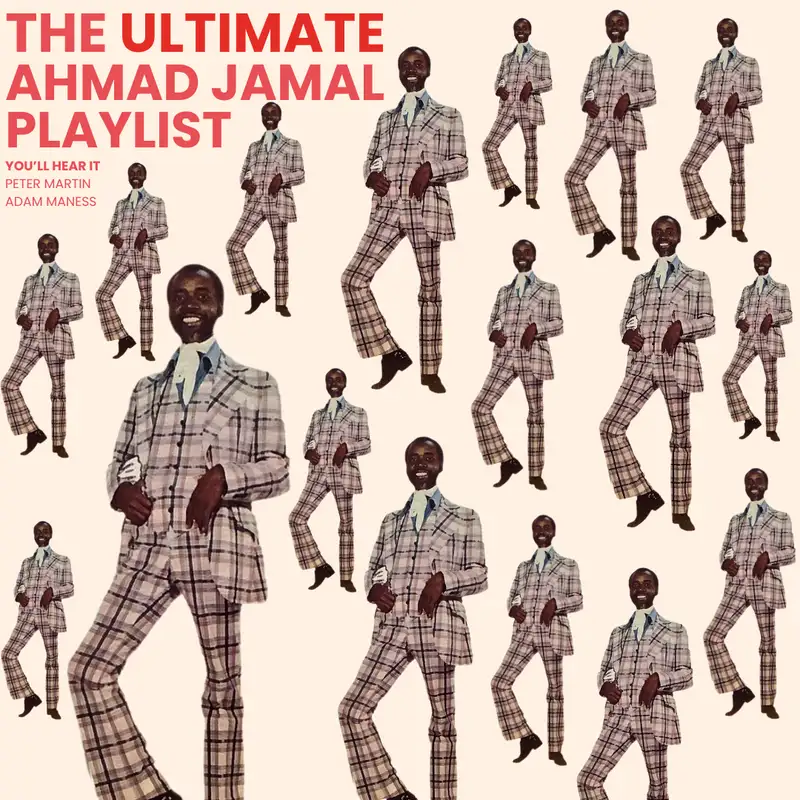
Ahmad Jamal, a master of taste, time and touch.
A hero to Miles Davis, Bill Evans, Nas and J Dilla.
This is the ultimate Ahmad Jamal playlist.
I'm Adam Maness.
And I'm Peter Martin.
And you're listening to the You'll Hear It podcast.
Music explored.
Explored, brought to you today by the You'll Hear It Players Club, Peter.
Yes.
This is a brand-new set of lessons that I began this season of the podcast, where
I'm going to do a selection of songs that we're going to do throughout the season, and I'm
going to teach you how to play them from a very basic level. So if you have been thinking, "I wish
I could dust off my instrument and learn how to play, I don't know, Led Zeppelin's 'The Ocean.'" Yeah.
Or Radiohead's "Weird Fishes," or Stevie Wonder's "Isn't She Lovely?" Well, that one I know
already. But yeah. Well, you do. But man, lock in. Plug in, because we're going to... Let's plug into
the Players Club. Plug into the Players Club. You can click the link in the description to learn more about the
Players Club. Go to... You'll Hear It Players. Yeah, go to you'llhearit.com. Sorry, had to throw that in there.
That's right. One more bit of housekeeping before we get going on this incredible lesson. While you're at
you'llhearit.com, leave us a voicemail, because we are going to do a mailbag episode coming up, and we want to
hear from you. Right. And you might be scared. You're like, "Oh, my voice is going to be on..." If you leave a SpeakPipe
or a message, your voice is going to be on the podcast. And you would be right to be scared.
It will be. But think about us. Our voices are all over this for an hour every week. So join the party. Join the party. Yes. Plug in. No,
you get a chance. Don't be nervous. You get a chance to submit it first. Although a lot of people think, "Oh, I'm just
talking and it's being recorded." You have a chance to approve it. Yeah. You can edit it, whatever, redo it. Yeah.
It's not about editing. Don't get excited, buddy. No, literally, plug it up. Plug in here. Plug in.
Today's an exciting day. Oh, my gosh, I'm so excited. I know you're about to say that, but it really is. We're talking about
not only a legend, a gentleman, a GOAT. A GOAT for sure. A steward of
jazz piano for multiple generations. An OG, but really one of the most influential
musicians we're ever going to talk about on this pod, in several different ways, beyond just what we're going to
celebrate, which is mostly his incredible pianism. Is that a word? I don't know. We say the
word. Do you know what I mean by it? Yes. So it becomes a word. Are you talking about the vegetable, the pea? The snow
pea? Pianism. Pianistic abilities, you know. We're talking about none other than Ahmad Jamal.
The great one. The great man, Ahmad Jamal. He is a hero to both of us. He's a
hero to most modern jazz musicians, and a lot of modern musicians, because of his
incredible sensibilities. One of the greatest masters of time, touch,
feel, melody, improvisation, voicings, taste. He ran an amazing band
for years. I love this stat here on our worksheet for this episode, Peter. He
was active playing and recording music from 1948 to 2020.
That's 72 years. That's longer than Queen Elizabeth's reign, in the 20th century.
That's astounding. That's right. Because he earned his. He wasn't born into it. No, he really did earn it.
And if you're not familiar with Ahmad Jamal, first of all, where have you been? Second of all,
I'm envious of you today, because you get to experience some of the great music of the 20th century for the first
time. Yeah, and there are actually probably a lot of people... Don't feel shameful if you're not familiar.
I think there are a lot of people who know the name. Yeah. Haven't really heard him. Well, actually, they have
heard him. And I think that's going to happen pretty quickly. But yeah, I think he's one of
those artists who has name recognition, but a lot of people haven't dug in. So like you say, envious
for sure. It's going to be a great time, because I think we have an incredible... What do we have, ten or eleven tracks here? We've got ten
tracks. Five each. Are we really naming this the ultimate Ahmad? Now I'm nervous. That was your idea,
buddy. The ultimate Ahmad Jamal playlist. When we have the pre-production meetings, I'm so excited, so cocky.
But then we get in here and I'm like, I want to do Mr. Jamal right. Well, this is truly a playlist, because
your first pick, Peter, is not anything on an album. Yes. This is from CBS Studios.
Legendary. Legendary studios. And this is from a television broadcast that brought together a lot of
famous jazz musicians. I remember watching it. Incredible. Yeah, I had the VHS. They used to show the
VHS in music school, in classes all the time. Lazy teachers. They've shown
footage. Ken Burns used some
footage of it for his jazz documentary. Lazy documentary. No, it's actually incredible. But there's just...
Because there's so
many. Yeah, Lester Young, Ben Webster. Legendary artists. Billie Holiday. Everybody was there.
Right, Billie Holiday. Right. Yeah. And it's beautifully filmed. Dare I say, for the technology they had for video and audio, and how it was
broadcast, it's incredible how good it is. It really holds up against a lot of
camera work today. And I don't know, it's good. Love it. We'll link to it. So of course, it's on YouTube. We'll
watch a little bit of it. So this is the
trio: Ahmad Jamal on piano, and some names we're going to hear pretty much the entire day. Israel Crosby on the bass, Vernel
Fournier on drums. And the title we got is "Excerpts from the Blues." Second part, Jazz from '61.
The Ahmad Jamal Trio. "Excerpts from the Blues," by Ahmad Jamal. All the
musicians
in the background. That's Jones right there. Okay, come on.
Just watch the
dynamics. That left hand, too. Tasty
AF.
The arrangements, par excellence. The arrangements make it. The arrangements are what
makes this trio so special.
He was thirty years old at this time.
Little... How do you like your
blues? Major?
Major seven? Why not? Man, look at that shot. If you're on audio,
make sure you check this out on YouTube. Vernel
Fournier there. Such a brush master. Oh, my God. Workshop technique.
Ben Webster. Yeah. For our listeners, they keep cutting to jazz legends. Webster with the cigarette hanging out of his mouth. Some hipster guy in the background. One of the most
orchestral pianists that
we've had. Space, too. So much space.
Okay.
We started out right, didn't we? Yeah. For your first pull. Oh, by the way, this is...
Is this a competitive situation? It's not competitive. It's not like the draft, because... No, because I've already won. It's not competitive. Boom.
Well, you picked five, and then I picked five. So I had to kind of deal with your five picks. Oh, I'm looking at this list. Somehow you managed. Oh, I'm doing okay. So it's not technically a draft. We're just kind of pulling our top five picks and trying to make the ultimate playlist, right? So I am coming at you. Okay. I'm going to come after you. That was a great pull.
Okay. And the only thing I could think of to counter would have been this.
"But Not for Me," live at the Pershing.
the soundofthe drums
Perfection, except for the tuning of the drums.
Even that, I'll take. Love that landing.
This is such an iconic arrangement and track. It's so simple.
Can I tell you why? And why Ahmad Jamal is the greatest?
Why?
He's never ten seconds away from the melody.
Yeah.
Whether he's playing the melody-
Right
... or during his solos, or even when-
Why?
... he's not playing anything. You can listen to a solo.
He's never ten seconds away from-
It's true. Might not be five seconds.
Yeah
... letting you know where the melody is. Such a lesson for any musician.
And when he commits to a melody, he commits.
He doesn't pull back.
And then that countermelody that
the bassline is.
See if we come out. Almost no comping in the left hand. Melody.
Oh right, quoting the melody.
Yeah.
Oh, I love these block chords here.
Come back.
Inevitably. Inevitably.
Oh.
Ho ho.
Yeah, the crash.
The bell.
Hey, do you miss the melody?
Because there it is.
There it is.
It rears its beautiful head.
Yep.
Oh.
Man, there's such a dramatic presence to, like...
From when he's playing to when he creates space. So.
Oh yeah.
Aw.
Oh, nice left-hand melody.
Dang. Ah.
Hey, do you miss the melody?
I think this is the most finely crafted
jazz piano trio playing ever.
100%. This is what we were saying on our Trio Showdown the other week.
Nat King Cole? Chick Corea?
I already planted my flag and said Ahmad Jamal trio.
Yeah, it is. Certainly for craft,
arrangement. Obviously.
Ending.
Ah. That was one of the simplest, most beautiful endings I can think of.
Aw, perfect. Okay.
You don't have to have an out chorus of the melody-
No
... if you're playing the melody the whole time. You know what I'm saying?
It's crazy that this is live at the Pershing, of course. 1958.
Yup.
Chicago, Illinois.
Yup.
What's really incredible about this is we always have a great opportunity with live
recordings. You hear people, like you're in the club. It's the '50s.
Yeah.
Chicago. Al Capone's coming in with the top hat. No, that's stereotyping, right?
But no, he hit the Green Mill a lot, though.
That's true.
We typically associate the greatest live recordings as being really free
spirited, extended solos. You don't know what's going to happen.
The crowd's roaring. And this crowd is very present. Like it's sort of chattery.
They're talking.
You can hear them talking, yeah.
Yeah. There's stuff going on. There's a concept. It's not like this silent thing.
But the way that they're playing, and look, we can talk about it, because I heard Ahmad
play numerous times, obviously, later on in his career, live.
But the way they're playing on this is like everything has been predetermined.
Yeah.
And I don't mean that in a stale way, but they're doing a live gig where people are
hyped up. You can feel the energy.
Yeah.
It's palpable.
Yeah.
But they're playing with a precision and craft that shouldn't work in a live
situation, because you'd be like, "Oh, that's boring." But it
wasn't written down. A lot of the stuff that Ahmad and the whole band did, there were
certain cues and triggers and things, doo da dee, that were always done.
But a lot of the stuff that sounds like, oh, that must've been composed because
it's so perfect, wasn't. That was actually improvised.
You can hear the different versions of the tunes.
But he had that combination between improv, planned, spontaneous arrangements and
cues that he would have. But how long is that thing? Like three...?
3:30.
3:30.
Yeah.
On a live trio.
Yeah.
In Chicago.
Yeah. They're not stretching.
No.
Yeah. He's not just blowing a bunch of lines.
There's so much music in that.
Like I keep saying, the melody's always so close.
Yeah.
And then the rhythm section of Israel Crosby and Vernel Fournier are cueing off-
Yeah
... of things that Ahmad's doing and creating these arrangements that are just
stunning.
Yeah.
And they are in such a great pocket.
What I think about when I think about this trio is quiet swagger.
They have this quiet confidence.
Quagger.
That sounds bad. But quag-
Squagger. Squaller.
That's better. No, but it is this confidence that they exude.
Oh, confidence.
You can hear it through the speakers.
Confidence and no cockiness, though.
No cockiness. There's very little ego going on.
I totally agree. When you feel that, it's a visceral feeling, the way they're all
playing, and then the way they play, it's such an ensemble.
Yeah.
But there's this restraint.
Yeah.
There's so much restraint.
Which takes confidence.
It takes confidence. And typically in live situations, it can be a little bit like,
hmm, did they really bring it? But damn, did they bring it.
Yeah.
And then when you look at the arc, I've listened to this track so many times.
I know.
And I think jazz pianists, this might be the most
revered sort of just trio crafted.
Yeah.
It's not like it's Ahmad's greatest solo or anything. It's certainly very good.
What we heard on the live thing, in a way, was more ripping and running kind of
Ahmad. But just as a trio craft-
No, it's perfect.
Yeah.
It is perfect.
It's like if you went to wherever Greek architecture and you want to see Ionian
pillars. Why are you looking at me like that?
Ionian. The Metrodome.
Oh, you didn't have those in high school? We had them, too. No, but some, like, columns.
Marble columns.
If you wanted to go see that and say, "Let's go to Athens."
Let's go.
This is the Ahmad Jamal Trio, it's like-
Boom. Let's go. Runaway. Hey everyone, taking a break real quick.
We throw around a lot of music theory terms here in the show.
If you're googling things like what is a triad?
Or-
Or Googling what is a triad? Exactly.
What is a Lydian chord?
How do you spell Lydian? How do you spell Lydian, bro? Sorry.
Good news. We have all the answers for you in the liner notes.
You'll find the Liner Notes Companion Guide with clear, simple explanations of the
concepts we explore in this episode in the episode description.
Download the liner notes for this episode for free today.
Okay.
So you're saying I won that round? I know this is not competitive.
Well, no, I don't think you did. I think we tied, I would say, so far.
All right. Well, your next cut, this is good.
So this is from the album called Portfolio of Ahmad Jamal.
Yeah.
And this is recorded live.
Live at the Spotlight. I think it's the same year. Recorded '58, released in 1959.
Same band. This is Old Devil Moon. This is incredible stuff. DC Spotlight Club.
Woo. Look how
simple
that is.
A little sophisticated swing.
They're always swinging.
A little swaggy swing.
Always swagging.
Swing schwag.
Quiet. Quagger.
Quagger.
Quiet swagger.
When we try to play like this, we're going to slide fire. Quiet.
Oh.
Oh, he gets obsessed with that E flat there.
Which, you think, oh, he's abandoned the melody. Hang on.
He's never more than a few bars away. Always around the corner.
Oh, space.
Fake. Man, their breaks-
... their breaks are so great because of the melody.
Yeah.
They're so great because of everything they do to lead up to it.
It was never just like a break. It's the drama of it. It's percolating.
Hmm
Ha!
And by Ahmad using space in the way that he does, using the melody in the way that
he does-
Yeah
... it's not a traditional, I solo, then the bass player solos-
No
... then we trade fours with the drummer every time.
Love it.
It's like there doesn't need to be that. You know what I mean?
Everybody's involved-
Yes
... the whole time. Group collective improvisation.
It really is. It's a template that... So back in the
day, we're talking '58? No, early '90, '91,
'92. I had a trio called the… I don't even know why I'm telling you.
Wait, we're doing the Ahmad Jamal-
Oh, are you playing?
The Ahmad Jamal playlist. Let me talk about my trio.
Yeah, I was going to say. Can I hear your version of "Old Devil Moon," please?
We used to play this arrangement.
Oh, really?
Yeah. Brian Blade on drums, Christopher Thomas on bass.
That's a hell of a band, man.
And we had a regular gig at a place called Charlie B's in the Warehouse District in
New Orleans, and the gig started at 1:00 AM.
See, I'm not about that lifestyle anymore, man.
It finished at 5:00 AM. It was an after-hours joint.
So you were a young man.
Yes.
Yeah.
But it was such a great time because Brian, Chris, and myself,
we were all obsessed. I'm sure you were at that age as well or whatever.
If you're a jazz pianist, all roads lead to Ahmad Jamal.
Yeah.
I think you could say the same about Herbie and McCoy or whatever but-
Yeah
... in a different way, I think, with Ahmad Jamal.
Yeah.
But we were so obsessed with this, and we had this gig of which oftentimes there
was nobody there. It was this big beautiful club, but it took a while.
So each week we would try to learn as many Ahmad Jamal trio arrangements, and this
is one of the ones we really liked. And sometimes some drunken
bros would come in there in New Orleans for a weekend and be like, "Play some Mardi
Gras Indian music. What are you doing, man?"
Yeah.
And we're up there, boom, boom, boo doom, do, do, do.
Yeah. Something like-
That's kind of my imitation of Ahmad Jamal-
... and you're probably dead arrogant with those cats too-
Yeah
... or the bros coming in.
Exactly. I got it.
You're just like, "Yeah, I'm not doing that for you." Yeah. That's amazing.
But yeah.
So that's a great pull. It's a great pull.
My next pull is from the album All of You, from 1962.
This is actually one of the first albums I ever bought on vinyl when I started
collecting vinyl.
Mm-hmm.
And I found this at The Record Exchange down in South City-
Yes
... which actually you and me and the great Christian McBride went to-
Oh, yeah
... several weeks ago. Almost got done there.
I almost lost Christian McBride in there.
I know.
He didn't want to leave.
Yeah. It's a cavernous record store.
Yeah.
And I bought this album, Ahmad Jamal Trio, All of You.
Yep. This is from the Live at the Alhambra, though, right?
It is, yes.
Because he did a lot of repackaging.
A lot of repackaging.
Repackaging.
And this is "Star Eyes," from that live gig, 1961, at the Alhambra.
Oh, yeah.
Hey. Mm.
Hm.
Love
that.
Little
A little military band vibe.
Oh, an Erroll Garner influence, perhaps?
Yeah, definitely. There's a lot of Erroll Garner here, isn't there?
Was Erroll Garner from Pittsburgh as well? Or am I making that up?
Yeah.
I think that's right.
Ah.
Yeah.
Is that clave I hear him playing on the hi-hat? Oh, Vernel.
That's that New Orleans sound. Oh.
Isn't that sick?
When he switches to the sticks.
Ah.
It's an unexpected use of that somehow.
It fits so well but-
But they're not going all the way into a New Orleans-
No, it's not like-
... vibe. But there's a lot of it. It's so incredible.
That's Vernel, right? He's bringing that at all times.
Yeah. Ding, ding, ding, ding, ding, ding. Wow.
Just amazing.
Yeah, you can't name that groove. You don't need to name it.
Woo. But we do have a track coming up next that we will be naming a groove.
Okay.
Actually, I haven't listened to that in a long time. Thank you for...
Oh, the Alhambra. Did you know that was Ahmad's cl- club?
Yeah.
He owned that club. Yep.
He owned a club. Yeah, that's right, in the late '50s or early '60s maybe.
Early '60s, yeah. Ahmad Jamal, famously from Pitt- Pittsburgh, punching above its
weight. We like to say the same thing with St.
Louis, kind of a Rust Belt, overlooked Midwestern city that has produced some great
musicians.
Pittsburgh's got heavy hitters. For sure. Okay. Now is where Peter takes the lead.
Cardwell School of Music in Pittsburgh. Oh, because of that?
Yeah.
That's where he went to school.
No, no. With your next pick.
Oh, okay.
Yeah. No. Ahmad started playing at three years old, apparently.
I know, I know.
Yeah. Going back far.
Musical family, all that good stuff. And I never knew this.
He was discovered by the famous, infamous Columbia executive John Hammond, who I
believe, am I going to speak out of turn here? You know what? I don't care.
Do it.
Because I'm not a journalist.
Go.
Didn't he discover Aretha Franklin as well, and some others?
You're looking like just total blank.
Could be yes, could be no, but you're not jumping on that bandwagon, are you?
I'm not, I'm not.
You're not jumping off it.
I'm not co-signing on it though. I don't know.
John Hammond was a fantastic exec for Columbia. Anyway.
Okay, but the next track that we have, I don't know how I was able to grab this.
Well, it was inevitable that one of us was going to do this.
This is definitely his most famous track. He played it all throughout.
When I got a chance to hear him, still in the 2010s, I guess. No, I never heard him
after the pandemic, but, and-
I think me too. It was around that time.
Yeah.
He was touring very late into his career.
Yeah. Yeah.
All the time.
He did tour like crazy. He did it when he wanted, and would just do really good
gigs.
He'd do clubs.
He'd do clubs.
Yeah. He was here at Jazz at Lincoln Center all the time.
He'd do Jazz at Lincoln Center. He'd do festivals in Europe.
Yeah.
The first time I met him, which was mid-'90s, I'll never forget, I was getting in a
van. It was a shuttle van at, I think it was the Nice Jazz Festival.
It's like you're going from the hotel over, and I'm getting in, and people move
around. Somebody said, "Oh, move to the back seat," so I could get in there, and I
was like, "Oh, my God, this is Ahmad Jamal," who's physically in the same vicinity-
Same
... that I am. I almost was like, "Ah!" I just wanted to crawl up and get in his
lap and be like, "Thank-"
Yeah.
But I said, "Oh, Mr. Jamal, it's so great to meet you." And he was, oh, my God.
What we're listening to here, this is exactly the way he was.
Yeah.
Did you ever get a chance to meet him?
I never talked to him. Never talked to him.
There was a certain amount of presence-
I think I shook his hand, but I never really spoke with him.
Yeah. Probably, I think, because of the level of playing, there's the
fear factor as pianists, whatever.
But he was so warm and just like, "Hey." And then it was like, "Oh, who are you
playing? Oh, I'll try to c..." I was like, "Oh, my God."
Yeah.
And this was during the period where I'm learning all these arrangements, and we're
playing them.
Cool. So cool.
It was like it was yesterday, I remember getting in that van.
Yes, this is his biggest hit. He played it forever.
"Poinciana," of course. And this is, I guess, the original recording?
It's not.
It's not.
He recorded it very early on.
I was testing you. You are correct.
Yeah. But this is by far the most famous version, the live from the Pershing,
right?
Yes.
And this is so iconic that literally the groove that's played here by Vernel
Fournier on the drums is now a standard groove, where you say, "Hey, give me a
'Poinciana' groove."
Yeah.
And every drummer knows exactly what you mean.
Even beyond jazz, kind of.
Yeah, of course. Yeah.
It's kind of like a thing. And it's rare that it would be named after a song that's
really from an arrangement. It's not even, I guess you could say give me that
Vernel Fournier groove, but even, this is about-
It's "Poinciana"
... how he plays it, but how the whole trio plays it, so.
Here we go, "Poinciana."
Oh. Oh. Check, check, ah, check,
check,
uh,
This is also a masterpiece, like, definitely.
You hear that four and? Is that low tom or is it a four and?
Yeah.
Or is that bass drum?
I believe it's a-
Sounds like a timpani too right there
... I believe it's a floor tom.
Yeah.
Oh, that's that New Orleans vibe now.
Wow. Whoo!
Two, three, four.
It's so... I mean, subtle, too, isn't it?
Doom, doom, doom. And the bass line, the way it interlaces.
And Ahmad just playing-
Straight
... so beautifully, sparsely-
Yeah
... straight down. There's not even syncopation.
Yeah.
He's just like…
Yeah, because everything's there. He knows he doesn't have to. Oh, exactly.
Exactly.
There's no anticipation.
Right. Because everything, they set up the whole thing. Oh, yeah.
Oh, wait till this bridge.
Yeah, everything's super straight.
And then let's,
let's...
Oh, wait till the last time we come back in. Little solo. Oh, no.
Yeah. We're building up right now, Peter, effectively to what's one of the greatest
moments in the history of jazz.
What happens in a few seconds.
Yeah.
Right there.
Oh, yeah.
But there's a connection with the groove before, right?
Ah.
Then, not far from the melody, huh?
Do, do, do you
believe in Santa Claus? Oh, man, that ride cymbal.
Splashy.
Uh.
Ba, ba, da, doo, doo, doo, doo, doo, doo, doo, doo, doo.
Like, I don't know how Vernel Fournier gets that snare drum, without snares, to
sound like that.
No, I know.
He's got those little pops. Those little rimshot pops.
Yep.
This is some of the small amount of soloing he does on this track.
Oh.
Back to melody.
And we're just hanging out here, too. Banger. All right. That's great. Hold on.
We've got to hear that moment one more time.
Okay.
I want to hear the moment one more time.
It's a break. I mean, it's such a great break.
And the build.
One of the greatest rimshots, that happens right before.
Boom. And this part is very... It's still got the groove, but it's very kind of
square the way Ahmad was playing before that went... Let's listen another time.
Da-dum, da-dum, dum. Oh. Dum, oh.
So right here.
You like that part? Magical. It's funny.
It is magical.
It is.
It really is magical. All right. My next pick-
And again, a live recording, which is-
Yeah
... just insane.
Because everything we've done has been live.
Everything's been live. Or on live on television.
Well, this f- next one is the first one that's not live, and it's also the first
one that doesn't have Israel Crosby or Vernell Fournier.
Yep. Which is interesting.
This is from the 1970 album "The Awakening"-
Yes
... on the Impulse record label.
Heavily sampled. Heavily sampled.
Heavily sampled. Yeah. This is "I Love Music." This features Jamil Nasser on the
bass and Frank Gant on the drums.
Mm.
And "I Love Music," sampled by Nas-
Nas, yep
..."The World Is Yours," famously. But the whole track is pretty killing.
Killing. I love this record.
It's really this...
Hear Ahmad for, like, five minutes run through these changes like
this.
Hmm. Woo. Mm.
1970. Great year.
So he's kind of a different player at this point.
Yeah. He's on Impulse now.
Yeah. The sound is different. His approach is slightly different.
I mean, he's maturing, and he's exploring things more.
And this, I heard him many times live, this is really-
Yeah
...this is the way he was playing live.
I agree. I agree. When I heard him live, he sounded more like this than he did-
Yeah
... on the live version.
No, he was always moving.
Yeah.
He was always moving forward.
All right. Next up. You got it.
Okay. Ooh, I got another banger, but we're going back in time back to 1958.
This is "It Could Happen To You" from the Live At The Spotlight again. Oh, okay.
This is so good.
We've got to start this.
That's so good.
This is another-
Go on. Bring it
... this is another one of those, like, do we slap our way in? Do we play it?
But this is just, hey, this is just like, they ease their way directly into the
swing.
Ah, there we are. Party's on. It's like you walk into the party. "Hey, I'm here."
Okay.
Hi-hat.
Huh.
Hey. Boom, boom, boom,
boom.
Like getting slapped in the face.
Yeah.
And no pickups on those, just straight ba-doom, doom, doom.
Do you like the melody? Yeah. Brian Blade, very influenced by Vernel Fournier.
Watch his brushwork.
There just aren't too many bands that sound like this.
Yeah. Their two-feel is very unique, because it's like dun, dun-dun, go, go-go.
Yeah.
It's got a little bit of a lop.
There's a lilt.
Lilt, lop, lilt.
A walt.
A laut.
A lauf.
A lauf.
Oh.
Woo!.
And because of the way Vernel Fournier... He's not like just... He's like...
It's not like...
It's not that str- straight kind of swinging.
Oh.
Da, ka, ta, ka, tum. And no pickups on this. I love that.
It's not like, pa-dop, pa, pa-dop, none of that. It's just dun.
And the resonance of Israel Crosby. Ba-dum.
Hey. Yeah.
Whoo!
There's so much joy. There's so much playfulness in all of these recordings today.
Any of this stuff to turn down is sacrilege.
Alright, can we talk about the elephant in the room, please?
Okay.
No, literally-
Woo!
... there's an elephant sitting right over there.
One of us was going to make a dad joke. You beat me to it. All right, what do you got?
Influence on Miles Davis.
Yeah. Sure.
Which I guess isn't a huge elephant to talk about.
Yeah, Miles talked about it openly.
Yeah. Oh, yeah. Well, he spoke about it in his book.
It's on record, yeah.
Okay, yeah. The thing, what I'm noticing here, there's very direct ways in terms of
repertoire and approaches and even some of the arrangements on the Miles at
Carnegie Hall, I believe it was, and some of the mini big band stuff, that he
really took the trio versions-
Mm-hmm
... or at least the approaches that the Ahmad Jamal Trio had. And he talked about this,
Miles Davis, and used that for these arrangements as a template, as a model for a
lot of that stuff. But what I'm hearing on this, and I never really thought about
it like this, I think Ahmad had a huge influence on Miles in terms of how Miles
played melodies.
I couldn't agree more.
Okay.
Yeah.
Yes, you could. Come on, people agree.
I agree so much with that.
Let's go next level.
No, you're absolutely right.
Because solo-wise, it's not like Miles was derivative, but it was more
like you could just feel this resonance of how
Ahmad Jamal used space.
Yeah.
Honored the melody on these great standards, but also was fine to let it go, almost
to where the listener's imagination is going.
Yep.
And then to come back in and as you said, never more than 10 seconds away from the
melody. That's all Miles, and the space-
Well-
... and elegance-
...but Peter, your theory here holds up with evidence because when you listen to
young Miles playing with Bird-
Yeah
... he's got some of his Miles sensibilities.
Yeah.
He's not Dizzy Gillespie. He's not trying to be this superhero trumpet player
playing all this flash. But he still had-
Ah, he was. There were moments that he was.
But he was doing more of it than he would do after Ahmad Jamal's influence on him.
So you can hear him playing less and less and less.
Yeah.
And he talked about Jamal's influence on him so much so that... I don't know if you
remember, we did that episode on the four Prestige records, the "Relaxin'," "Workin',"
"Cookin'," "Steamin'."
Yeah.
And the pianist on those albums was-
Red Garland. Yep
... Red Garland, and Miles told Red specifically, "Do that Ahmad Jamal thing-"
Right.
"... way up high on the piano."
Right.
"Play less, try to sound like that." He wanted that sound, and you can hear it in
Miles' own playing, and you can hear it in the direction the bands went, especially
around this time. And obviously, Miles went his own direction even more eventually
away from this, but.
Yeah, he was definitely trying. It was a competitive landscape for trumpet players
in the bebop era, right at the beginning, when he came to New York, when Miles did.
Obviously, Dizzy Gillespie was the towering giant, but then you have Fats Navarro,
Clifford Brown. These were players that maybe fit into that classic bebop
trumpet player mold better than Miles in a way.
Because Miles hadn't found... He had a sound, though.
You hear his sound on that, but he didn't have the dexterity.
He was really good, for sure. Maybe Ahmad kind of unlocked...
Because we always think of Miles, the tastemaker, the original, the OG
influenced by nobody, influences everybody else. That was later, right?
Yeah.
It almost feels like Ahmad gave him license to be like, "Okay, I'm not going to
imitate trumpet players. And maybe there's a little bit because I can't, because I'm
taking the greatest ones that ever lived in the bebop era, who happened to be around.
But I'm going to pick something that's a little bit off the grid, in terms of it's a
different instrument, but there's a resonance to that approach that's deep inside
of me. So let me try some of that piano stuff over here." And it worked, or
sometimes.
Good. That's a great take, Peter, and I think you're spot on.
I really think you're right, and I think the evidence backs you up. Okay.
My next pull here. This is interesting.
I don't know if you know this existed, but do you know that there's a Live at the
Pershing volume two?
I do, and I don't know it that well.
It's so good!
Yeah.
It's from the same dates.
From the same dates, right?
Same band, same style of arrangement. Yeah. So this is "Cherokee."
And this was recorded the same day as, the same weekend as, the Live at the Pershing,
but released three years later. This is "Cherokee."
Yes. I do know this very well.
This is half-time 3/4, I think.
Yeah.
Whoo!.
Uh.
Israel Crosby doing heavy lifting here.
Wow.
Man. Ahmad Jamal's not playing. Oh, my God.
And that's the thing. If it's not so clearly delineated like, "This is my solo,
this is your solo"-
Right
..."you can come and go as you please."
Yes. That was their thing.
So great. Let's bring it back.
Boom!
Oh yeah, I remember this now.
Aw.
Hear the drummer swinging.
Really one of the only times you hear this type
of thing. What a brush master.
Ah, damn.
Now I'm remembering what an influence he had on Blade.
Oh yes, you can hear it.
Greg Hutchinson too.
Brush stuff.
That's a good one, man.
It's incredible.
There's a funny part again. Sorry. Sorry. No, please.
Again, these little arrangements, these little cues.
Dang
Man, that'd be a run-on sentence in lesser hands.
Good thing he peaced out for 90 seconds.
You built up the street cred to do that throughout the whole thing.
Oh, he loves that rhythm.
Check it out.
"I like that." You hear a guy in the corner just say, "I like that."
Give me another.
That's so funny.
That's so good. I listened to that way back in the day. We actually played that
arrangement
with the Chris McBride Trio many times. He likes doing that one. Man, I made a note here: Israel
Crosby. Out of sight, out of mind kind of situation.
When you look at the late '50s, even from the mid-'50s, all the way through the '60s,
the bass player who dominates piano trios, quintets,
the great Prestige, Blue Note and Impulse
records... There are a bunch of great bass players, but Paul Chambers, yes, of the young bass players, is the one that comes
to mind. He was so great, and really dominated. But I've got to put
Israel Crosby up there. Maybe not in the volume of recordings,
and he was very heavily playing with Ahmad
Jamal. But in terms of technique, swing and sound...
Is that a controversial hot take?
I don't think it's controversial. He sounds great in that band.
He's older than everybody, too. He's ten years older than Ahmad Jamal, and he feels so
solid back there. There's nothing Ahmad could do to throw him,
or that Vernel Fournier could do to knock him off that beat. It's just so
big. What's your next pick?
"Willow Weep for Me." "Willow Weep for Me," from the Alhambra 1961 live album.
Ease your way in.
You get some of that Oscar Peterson, native influence, right?
Hmm.
And the way he stretches, pulls, pushes the melody.
And then his blues chops. We don't think about that as his go-to, but it's so
good. We need it.
Chops.
. Ah!
Man, so many of these live recordings. And we didn't cherry-pick, but I just want to
stress that on all these records, I could have...
This is a hard set list to make, because you take five classic songs-
Yeah, it's very hard and very easy at the same time. But the precision. It's very rare
on great live recordings that everything's perfect. You know what I mean?
Yeah. Even with Oscar Peterson or something.
Because he's very exposed. This is a
lot of playing for him, in a way. One of those things: brushes. So that you can hear
every detail. If he hits any cacks, you're going to hear it. Exactly. Very precision-
oriented. All right. That was a great pull. Do you want the last pick, though?
We've got our last track? I'm sad. Petey sad. Yes, Petey sad. Petey, you're doing baby talk.
I'm actually going to call an audible. Okay. As we were listening to these tracks from Live at
the Pershing, yeah, I had something picked from earlier in his career. Yep. And I'm kind
of realizing, I didn't want to do too much from Live at the Pershing, but then I was
like, yeah, but I cannot do an ultimate playlist without including this. Uh-oh. Oh,
my
God. This is S-tier.
Not for counting, but-
"What's New." This is the last track on that iconic album.
There are some moments in here that are my favorite moments in music. Yes. And have been
more influential on me than anything else, maybe, that I've ever heard.
Man, this is such a unique, templatable version. A way of playing a ballad.
Huh
Everything: the chord changes, the sort of walking down field, then this.
Wow
That has a ballad groove.
Ooh
It feels like one of the Wu-Tang about to jump in, you know.
Nobody was playing like this then. Not even in a piano trio. He
influenced the Ray Brown Trio later on. He incorporated a lot of these
things really well, in the '90s, up until he was no longer with us.
Phenomenal. Staggeringly good. Thank you, Ahmad Jamal, for the incredible music,
the amazing career, the wonderful light and energy you gave off. Every time I saw him live, I left feeling
elevated, light on my feet. Let's do some categories, Peter. Desert island tracks,
what have you got? I've got "But Not for Me," which for me was a close call between "Poinciana" and "But Not
for Me." There's something about that...
Yeah, it always gets me up off my seat, gets me moving. Well, we're good, because I've got "Poinciana." Perfect. You've got me
covered. Normally I'd be like, I'm not going to go with that, but I'm like, "Man."
Apex moment. Speaking of "Poinciana," that snap,
right before the pff, boom, boom, doo doo doo. When Vernel goes to the ride for the first
time? Just the snap before that. Oh, gotcha. That one moment.
It doesn't matter if it was the first time I heard it. I thought I couldn't walk.
I lost feeling in my legs and knees, and I still feel that way every time I hear it. It still causes
immense stank face and joy. I'm torn. I put down, from
the live video from '60, the excerpt from the blues, when they go into the swing.
Such a deep thing. I'm also thinking about "Old Devil Moon," the way it ends. True.
Slick
endings, easy to learn. Ahmad played a lot of
stuff. Not all of it. He played some stuff where you're like, "Oh, my God, I could never play that." But most of it, compared to an Oscar
Peterson, or a Herbie Hancock, or a Chick Corea, or a McCoy Tyner, is accessible.
There's space, there's clarity. Now, to do it well, like him, is hard,
because it's stylized, and there are bigger-picture things that are part of it, beyond the notes. He's making
things seem easier than they are. There's a certain amount of connection with Bill Evans, and I wonder how much
Bill Evans... He certainly was influenced by Ahmad. Anyway,
the way that ends. We didn't get to the end, but everybody go and listen to the way it ends.
It's another one of his cute tag endings, with a little bit of variation.
Such a lift. He had that ability because of everything that came before it. It's not, okay, now we're
done, bam, next tune. You're elevated, and you end on this high.
So I'm going to go with that. Snob-O-Meter. Two. Seven. Opposite ends.
You think it's snobby? I think the ultimate Ahmad Jamal playlist we've put together is snobby, yeah.
Why? I think it's very listenable music that I could put on for...
I'm sorry, does the Snob-O-Meter measure listenability? It measures how snobby it is, how accessible it is.
Would a general audience like it? And I think if you put on "But Not for Me," or any of these
tracks, someone who doesn't know anything about jazz, with no context, would still be like, "Wow, that feels great."
So it's accessibility, is what you're changing it into. Changing it? No, I take it to be, okay, you're at a party.
Hey, Rob. You always come up with these elaborate scenarios.
No, it's snobbiness. How do you measure snob? You get a guy with a corduroy jacket with a strap on it. So you come up
to him. Oh, you don't come up with elaborate scenarios? A guy named Rob, with two B's. Robb.
He reads the Robb Report. It's short for Robbie, which is short for Robert, which added a B.
And I kept the extra B. So you say, "Hey, Robb, how are you? What have you been listening to lately?"
And he has a pipe, but it's not lit, it's just kind of there.
"Well, I've been listening to your ultimate Ahmad Jamal playlist recently." Would you be
like, "Snob, snob"? I'd be like, "Nerd." But I don't know if I'd be
like, "Snob." Okay, anyway. Seven. I feel like the
Snob-O-Meter is only working if we're at completely polar opposites. That's how it's always worked. I feel like Ahmad,
in general, does have a little bit of snob. Totally accessible, I agree. But Bill Evans, I think, most of his stuff
is a two, because people know him, people like him. People do know and like Ahmad,
but they haven't heard him quite as much. Can we spend a couple of minutes on the name? Because you and I have been saying it
differently this whole time. I think it's Ahmad Jamal. I believe it's Ahmad. Because I used to say
Ahmad all the time.
Someone corrected me. Okay, agree to agree. Is this better than KOB?
By "is this," we mean this ultimate Ahmad Jamal playlist. Yes. No, he didn't. What? Yes, he did.
Maybe. So I'm close. For me, I like this. It's
apples and oranges. We're cherry-picking. If we were to do the ultimate Miles Davis playlist versus this, that would be a real argument. I think this might be that. We should do a draft at some point. Well, this was awesome, man. We very rarely get into KOB territory, tying or exceeding, so that's exciting. This is the apex for me. This is pinnacle. This is as good as art can get. We've been to the mountaintop. Yeah. Cool. Well, this was fun, man. Until the next time. You'll Hear It.